



About this worksheet
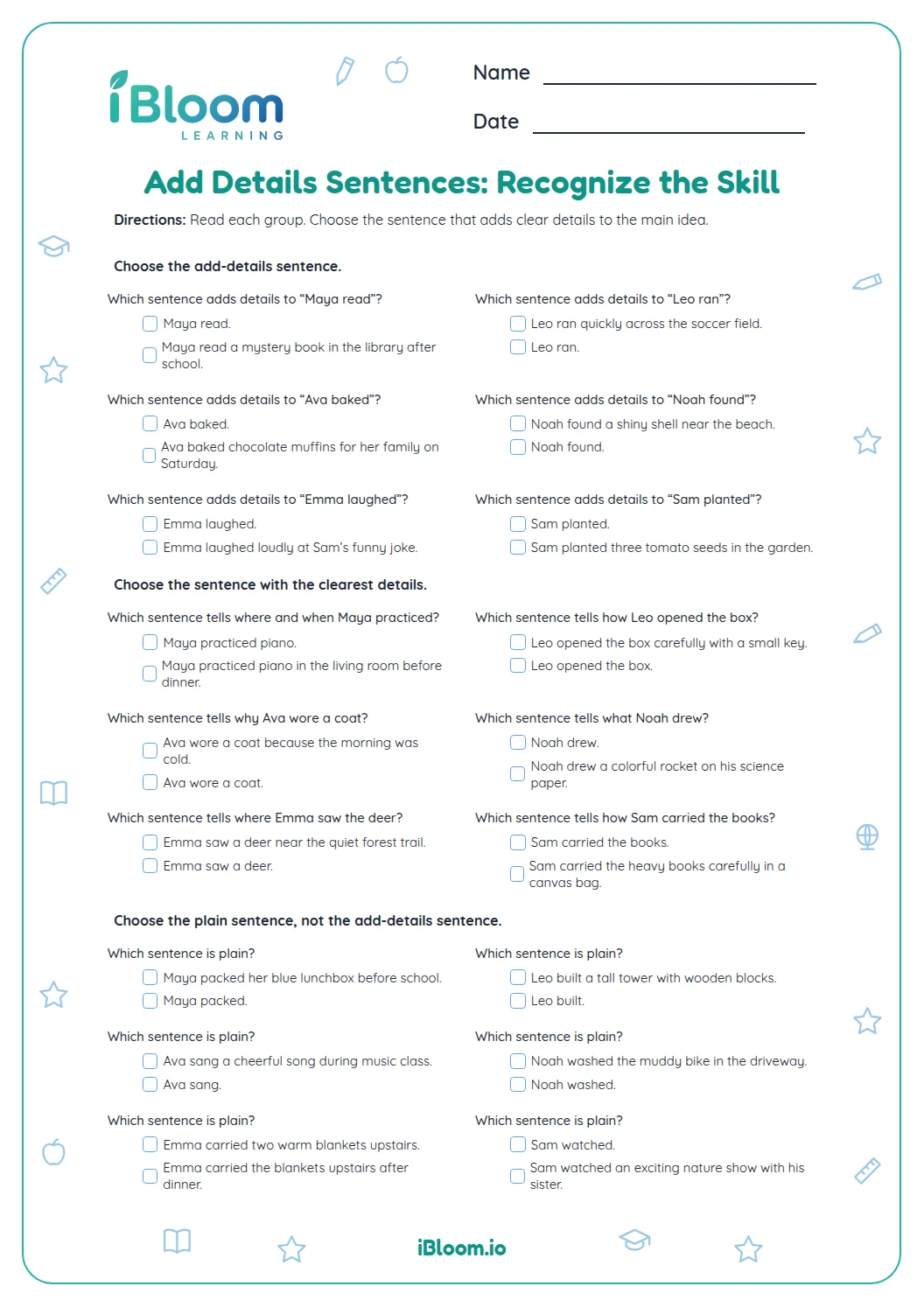
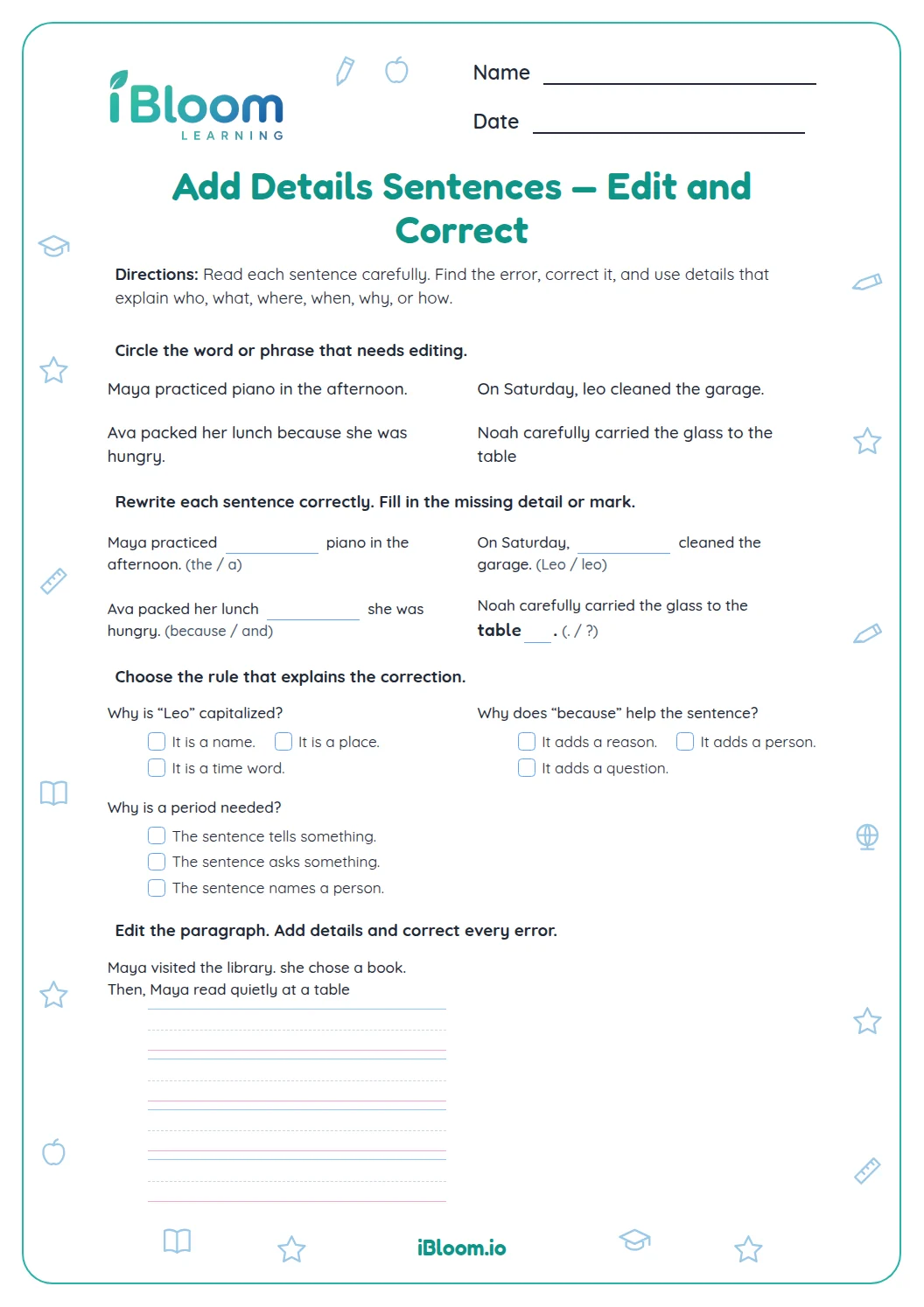
This free Grade 5 printable gives writers 14 ways to make sentences clearer and more vivid. Early prompts add where or when; later prompts use sensory clues, precise details, and short descriptions while preserving the original meaning. The answer key offers sample responses for open-ended writing. The page practices CCSS L.5.3.a by expanding sentences for meaning, reader interest, and style.
Aligned to L.5.3.a
What kinds of details do students add?
The first prompts add a place or time; later items ask for sensory details, precise description, and a short scene. The final writing keeps a clear subject and action while giving the reader a stronger picture.
The answer key accompanies the worksheet; written responses are checked against the requested detail or word.
- 1The puppy ran. Add where it ran.
- 2Sample: The puppy ran across the yard.
How can a student work through the page?
Read the sentence before adding anything. Identify the requested detail, such as where, when, or what a character hears. Then complete each remaining part in order.
How can families check the answers?
Use the key after the child finishes. For open-ended sentence writing, accept a different response when it follows the prompt and keeps the sentence clear.
How to use this worksheet
- 1Read the sentence before adding anything.
- 2Identify the requested detail, such as where, when, or what a character hears.
- 3Add a phrase that answers that request.
- 4Reread the whole sentence to check that its meaning still makes sense.
- 5Compare with the sample key; accept another detail that fits the prompt.
Common mistakes and quick fixes
The mistake
Adding a detail that changes the event
The fix
Keep the original action and add information around it.
The mistake
Choosing a detail that does not answer the prompt
The fix
For a where prompt, name a place; for a when prompt, name a time.
The mistake
Stacking unrelated adjectives
The fix
Choose a detail that helps the reader picture the exact moment.
Common Core alignment
This worksheet practices the listed Common Core skill through its questions.
A detail should sharpen a reader’s picture while keeping the sentence’s meaning.
On this sheet: The first prompts add a place or time; later items ask for sensory details, precise description, and a short scene. The final writing keeps a clear subject and action while giving the reader a stronge
Show the official wordingHide the official wording
Expand, combine, and reduce sentences for meaning, reader/listener interest, and style.
What to practice next
Make more practice
Further reading
Questions parents and teachers ask
What does adding details mean?
The worksheet has 14 questions in four parts. Students add where and when details, select useful revisions, and write short descriptions. The key includes sample answers for open-ended prompts. This printable gives families a focused way to review the skill together.
How many questions are included?
The prompts are written for Grade 5. Students move from adding a phrase to writing short descriptions, using details that make meaning clearer and more interesting for a reader. This printable gives families a focused way to review the skill together.
What grade is this sentence worksheet for?
No. The key gives one model for open-ended writing. Another response is appropriate when it follows the prompt, adds a relevant detail, and keeps the original event or idea intact. This printable gives families a focused way to review the skill together.
Does the answer have to match the sample exactly?
Ask what a reader still needs to picture: where or when something happened, what it looked or sounded like, or how it moved. Have the child reread the sentence with the detail. This printable gives families a focused way to review the skill together.
How can I help a child add a useful detail?
Ask what a reader still needs to picture: where or when something happened, what it looked or sounded like, or how it moved. Have the child reread the sentence with the new detail to check that it remains clear. This printable gives families a focused way to review the skill together.