



About this worksheet
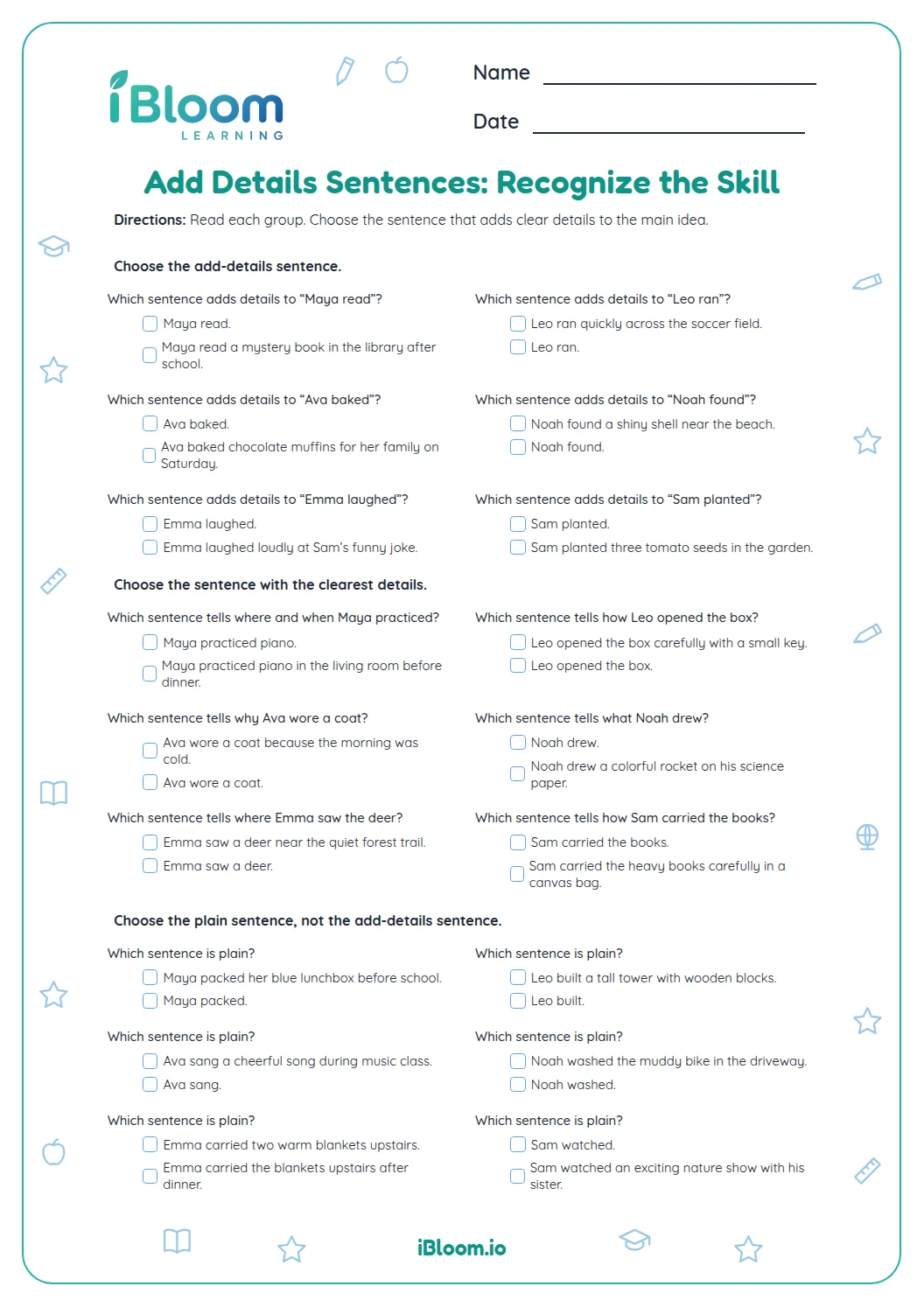
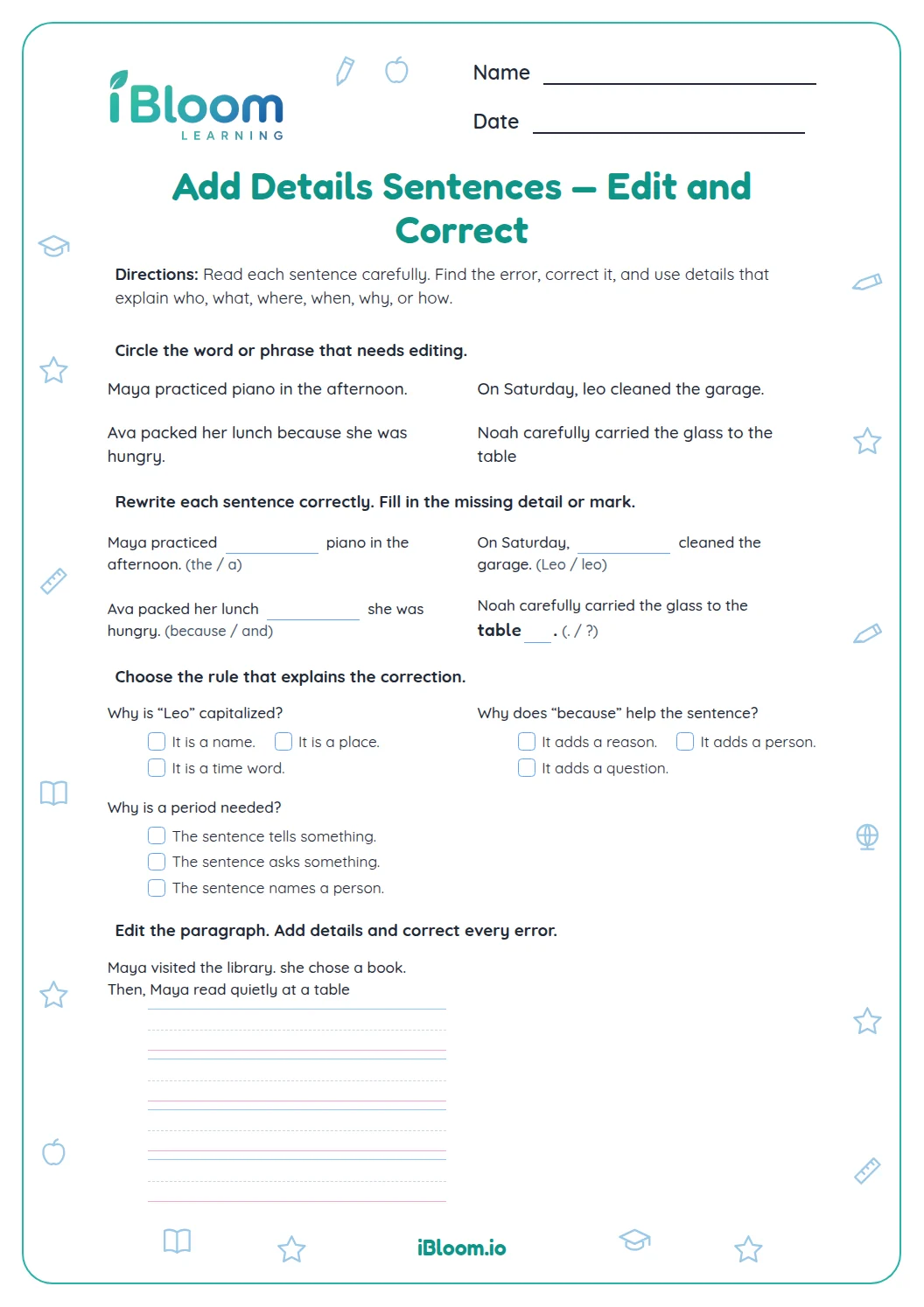
This Grade 5 worksheet practices adding specific details to sentences. In Part A, students choose words or phrases that tell where, when, or how, or describe a noun. Part B asks them to choose precise revisions, including adjective and adverb forms and a concise sentence combination. The 14 multiple-choice questions focus on sentence clarity and standard English usage; a separate answer key is included.
Aligned to L.5.1
What kinds of details do students choose?
Part A asks students to identify details of place and time, choose an adverb that explains how an action happens, and select an adjective that describes a noun. Each question gives a sentence or a short base idea.
- Questions 1–7: choose a useful detail or the correct word form
- Questions 8–14: revise for clarity, precision, and concision
- Answer key lists the correct choice for every item
How can a detail make a sentence clearer?
A where detail answers where an action happens; a when detail answers when. Adjectives describe nouns, while adverbs often describe actions. Read the whole sentence to decide which kind of word it needs.
- 1Kai packed his lunch ___.
- 2“Carefully” tells how Kai packed, so the adverb form completes the sentence.
How can students check a revision?
After choosing an answer, reread the full sentence with the choice in place. Ask whether it answers the prompt and whether it adds information without repeating an idea. For a combined sentence, look for a shorter, grammatical version that preserves the intended meaning.
A simple way to work through the page
- 1Read the base sentence and the exact detail the prompt requests.
- 2Decide whether the missing idea describes place, time, manner, or a noun.
- 3Compare both choices in the complete sentence.
- 4For revisions, check that the added information fits and does not repeat.
- 5Use the answer key to revisit choices that do not fit the prompt.
Common sentence-detail slips
The mistake
Choosing “careful” after an action verb.
The fix
Ask how the action happened; an adverb such as “carefully” answers that question.
The mistake
Picking a when detail when the prompt asks where.
The fix
Match the detail to the question word before comparing choices.
The mistake
Keeping a longer revision that repeats an idea.
The fix
Choose wording that adds the requested information clearly and concisely.
Common Core alignment
The questions practice standard English grammar and usage as students choose adjective and adverb forms and revise sentences.
Choose grammatical word forms and revise sentences for standard English usage.
On this sheet: Students choose correct adjective and adverb forms and grammatical revisions.
Show the official wordingHide the official wording
Demonstrate command of the conventions of standard English grammar and usage when writing or speaking.
What to practice next
Make more practice
Further reading
Questions parents and teachers ask
What does this worksheet cover?
It covers where and when details, adverbs that tell how, adjectives that describe nouns, and sentence revisions. Students choose among two options in each of the 14 questions. The key shows the intended answer for every item. Ask the student to point to the matching question or passage detail as they explain the choice.
How can I explain adjectives and adverbs?
An adjective describes a noun, such as a colorful poster. An adverb can describe an action, such as packing carefully. Ask what word the detail describes, then choose the form that fits that job in the sentence. Ask the student to point to the matching question or passage detail as they explain the choice.
Is there space for written answers?
The worksheet uses multiple-choice questions, so students mark a choice rather than write a new sentence. They can still explain aloud why the detail fits, especially when two choices describe different aspects of the same action. Ask the student to point to the matching question or passage detail as they explain the choice.
How should students use the answer key?
Have students complete a section before checking it. For a missed answer, reread the prompt and sentence together, identify the requested detail, and compare the choices in context. That makes the correction about sentence meaning and grammar, not guessing. Ask the student to point to the matching question or passage detail as they explain the choice.
What should students practice next?
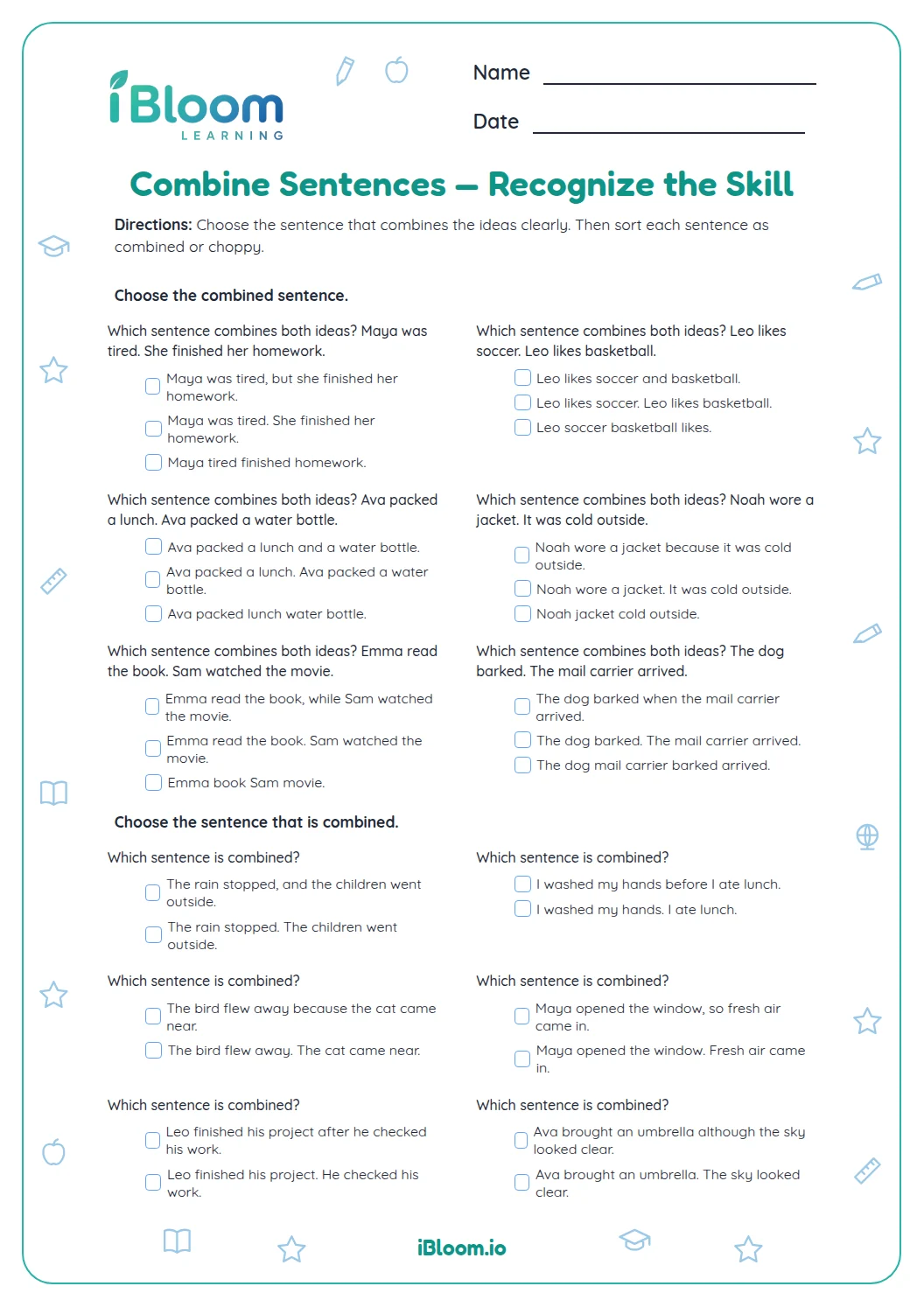
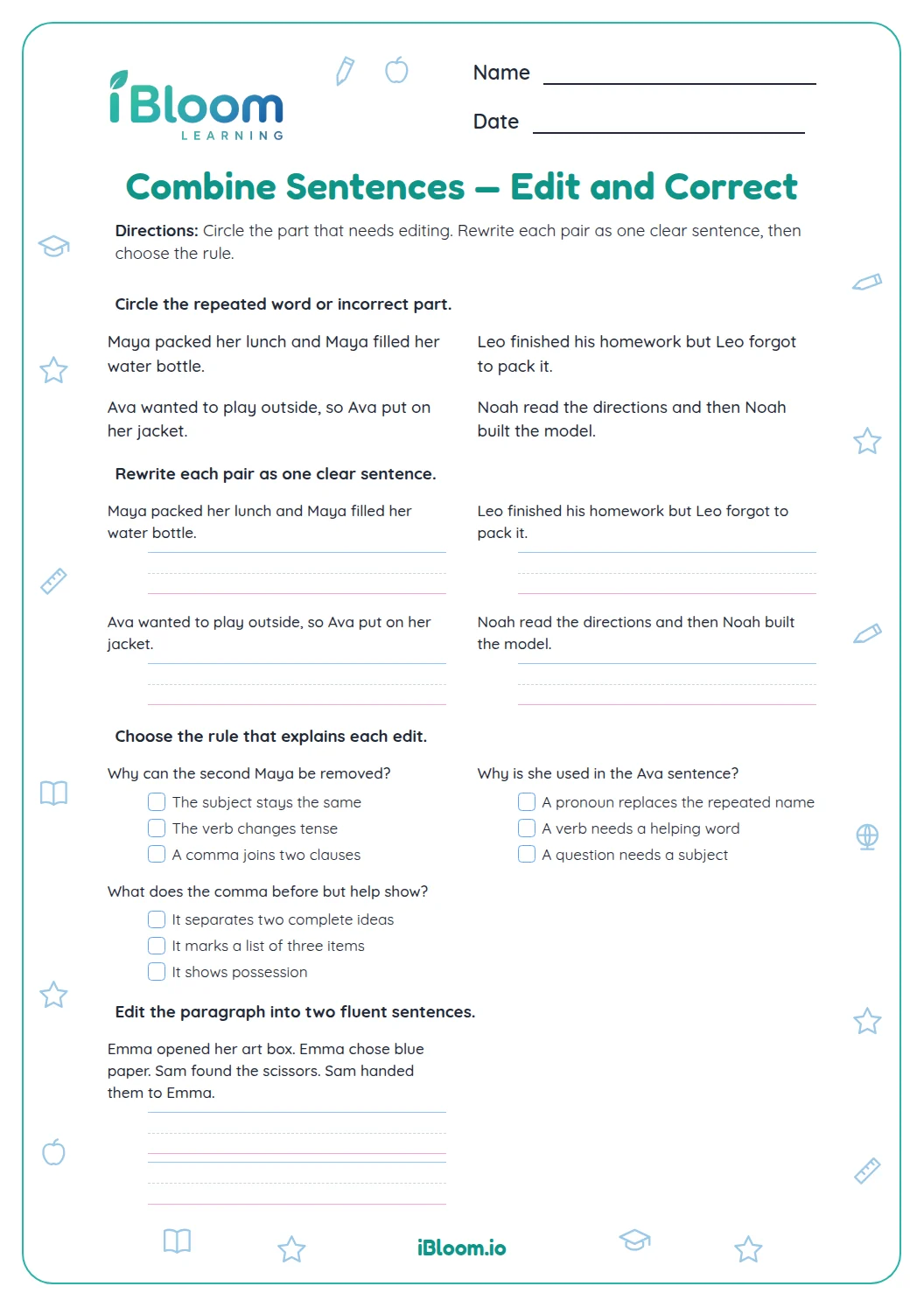
Try combining sentences or writing sentences with sensory details next. Those related skills give students a chance to apply the precise details and concise revisions they recognized on this page. Ask the student to point to the matching question or passage detail as they explain the choice.