


About this worksheet
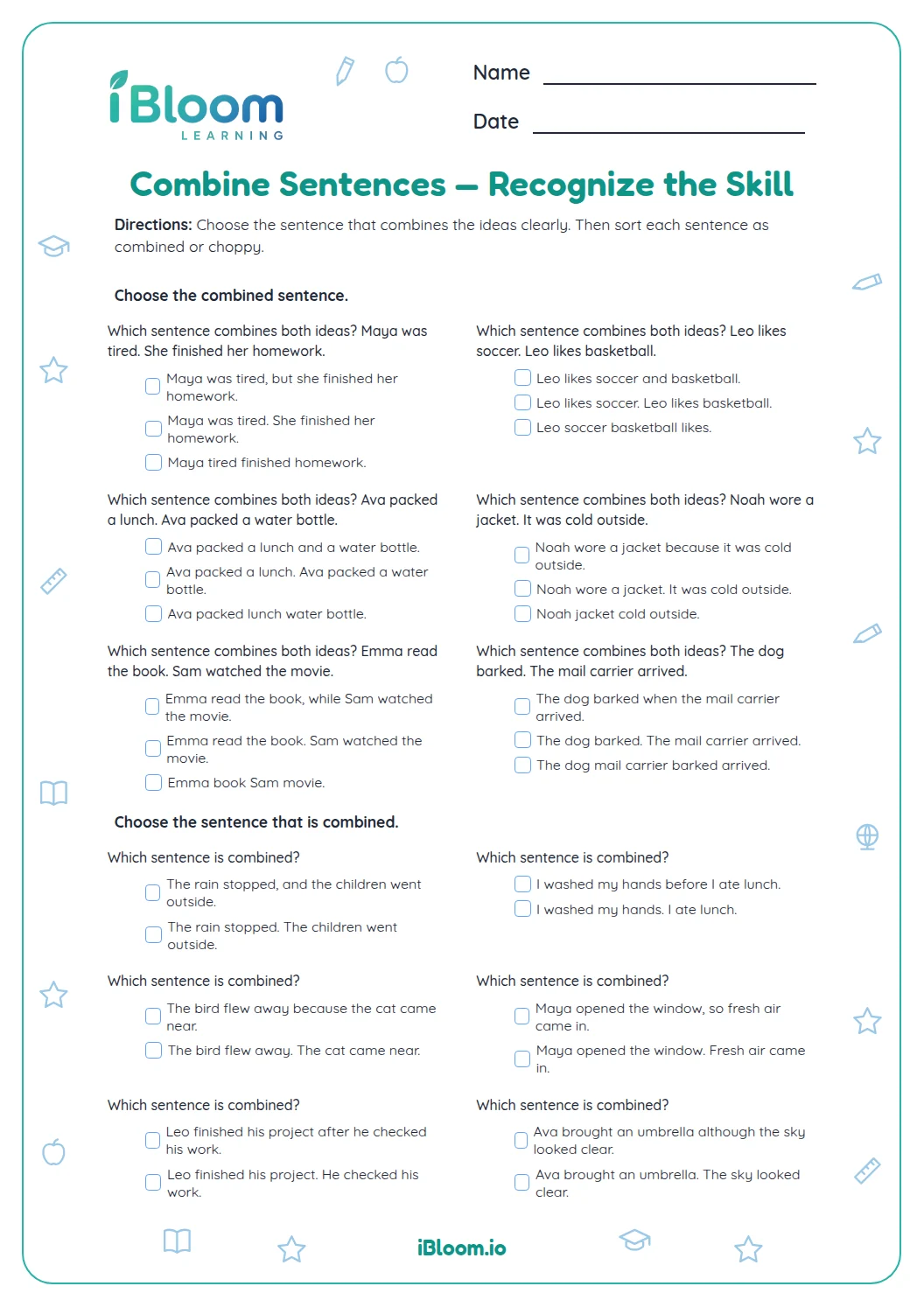
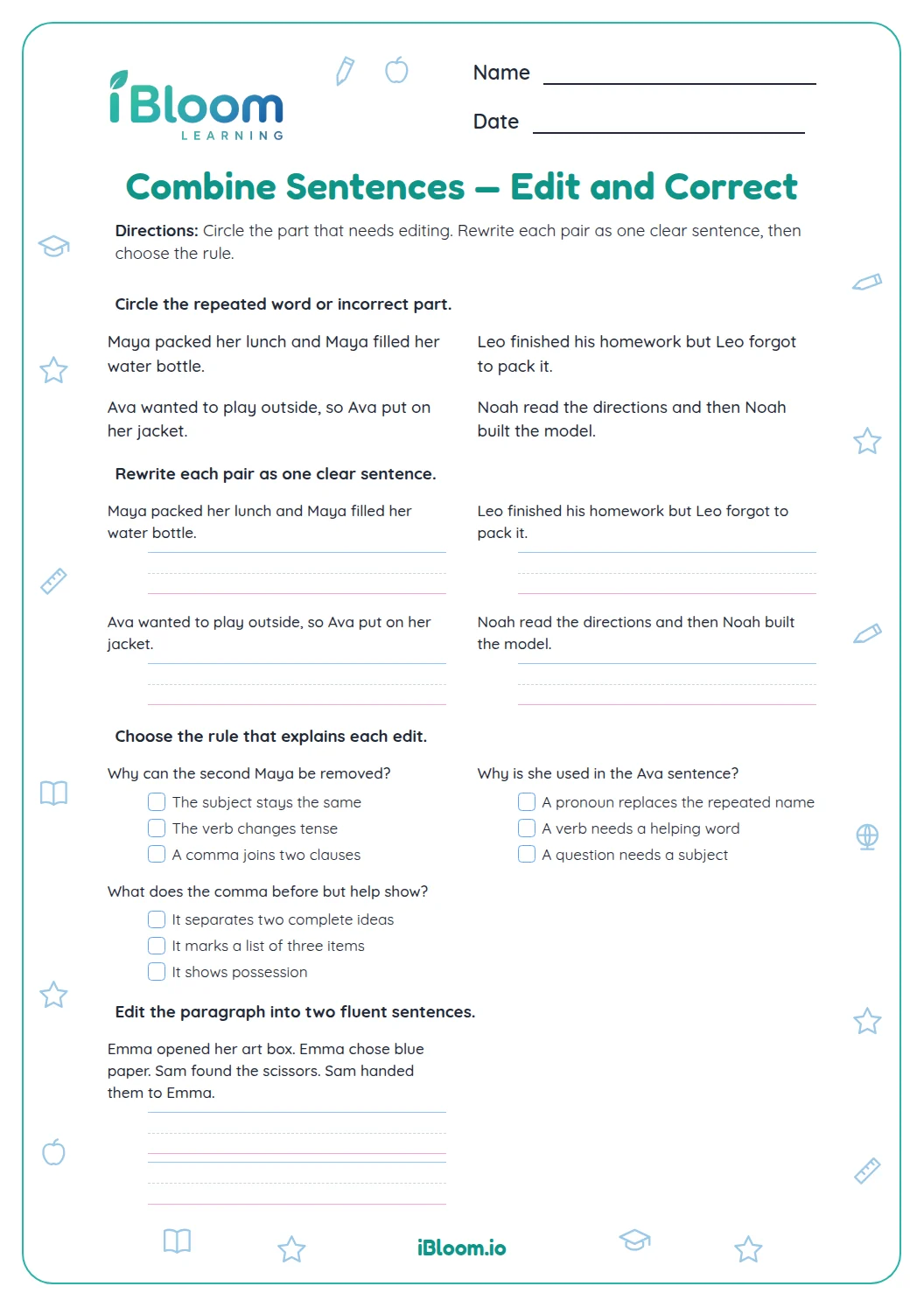
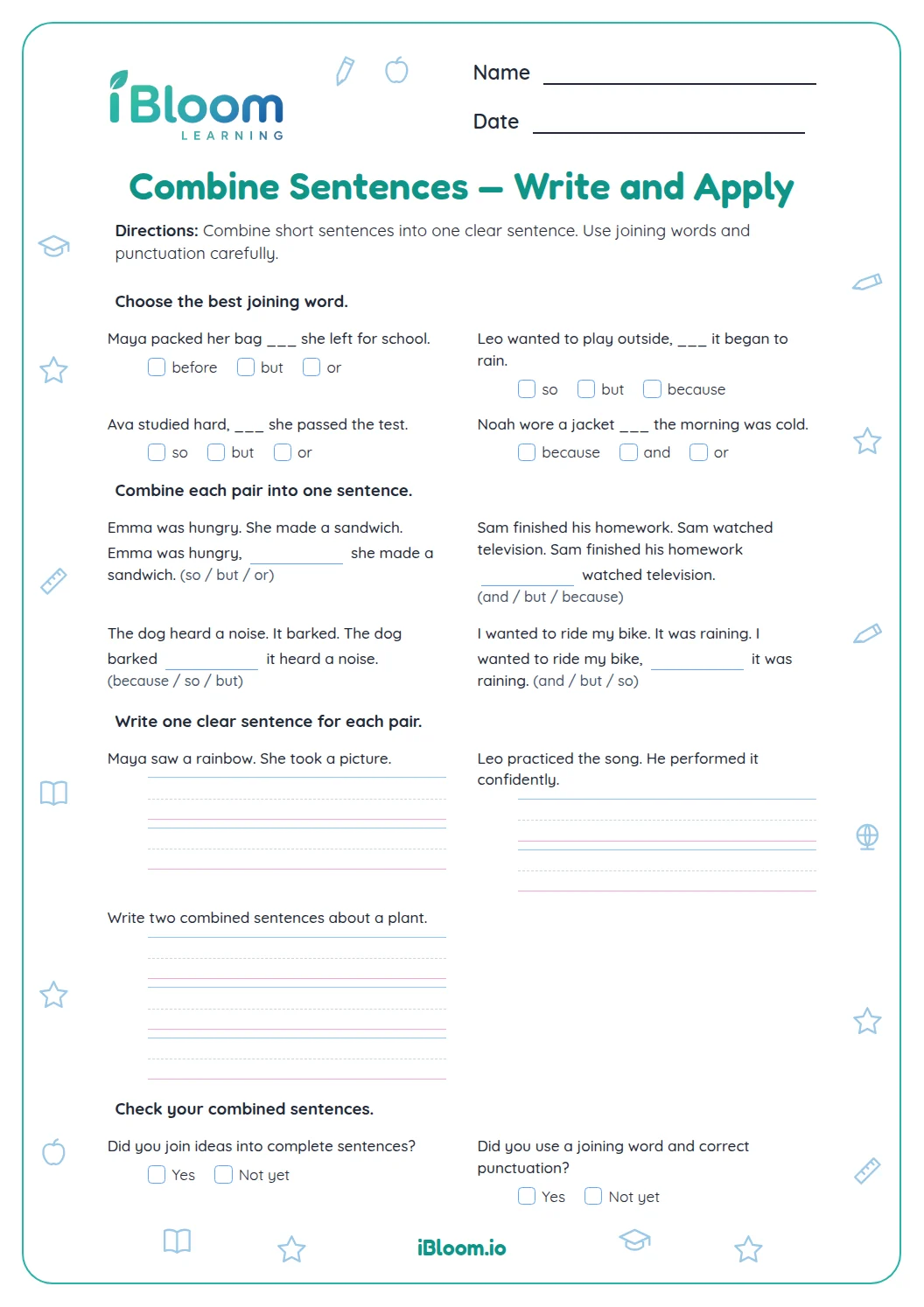
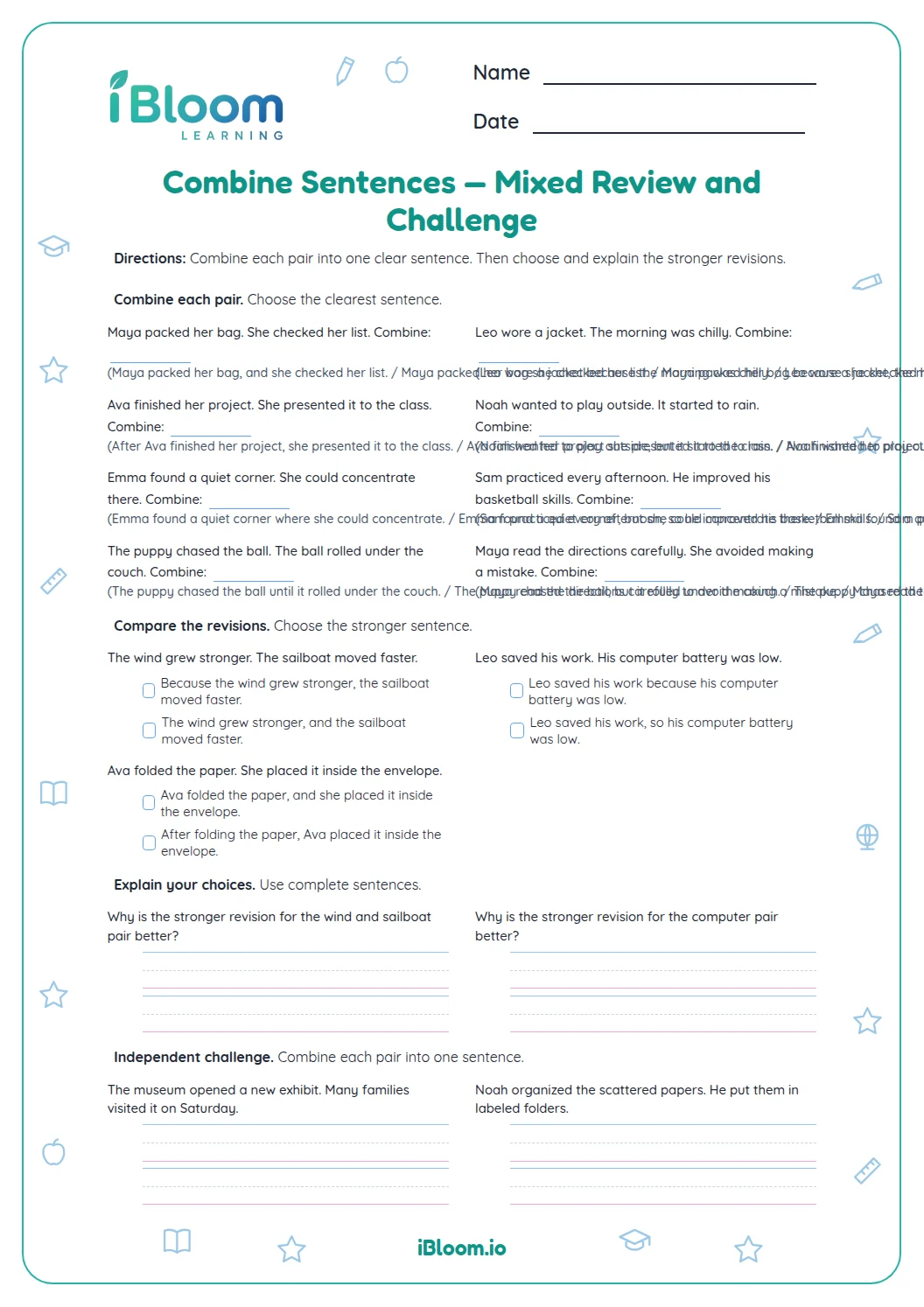
This Grade 5 printable guides learners through combining related ideas into clear sentences. Fourteen prompts provide a sentence stem and a conjunction blank; children choose the joining word that connects the ideas and punctuate the result. A final prompt asks for an original combined sentence. The answer key provides the conjunctions and a sample sentence. The work connects to Common Core L.5.1.a.
Aligned to L.5.1.a
What relationship does the joining word show?
Part A joins two clauses or complete ideas. Choose a conjunction that shows how the ideas connect, then reread the sentence.
- 1The trail was muddy, so we walked slowly.
- 2So shows the result of the muddy trail.
Where does punctuation belong?
When a sentence begins with a dependent clause, use a comma before the main clause. Read the full sentence aloud to check that the ideas flow together.
How can I combine ideas independently?
The last part gives more room to make a choice. Select a conjunction that accurately connects the two ideas, then check capitalization and punctuation.
How can I use this worksheet?
- 1Read both statements and identify how they relate.
- 2Use the conjunction named in the prompt.
- 3Keep all important meaning from both ideas.
- 4Add a comma when a dependent clause comes first.
- 5Reread the sentence for sense, capitalization, and end punctuation.
What should I check as I work?
The mistake
Choosing a conjunction that changes the meaning
The fix
Check whether the word shows time, reason, result, or choice as intended. Replace it if the connection does not fit.
The mistake
Leaving out part of an idea
The fix
Compare the combined sentence with both original statements. Make sure each important detail remains.
The mistake
Forgetting a comma after an opening clause
The fix
Find the dependent clause at the start and place a comma before the main clause.
Common Core alignment
The practice focuses on joining related ideas with conjunctions and clear punctuation.
Use coordinating and subordinating conjunctions to connect ideas.
On this sheet: Students use conjunctions to connect ideas and make combined sentences.
Show the official wordingHide the official wording
Explain the function of conjunctions, prepositions, and interjections in general and their function in particular sentences.
What to practice next
Make more practice
Further reading
Questions parents and teachers ask
What does sentence combining practice?
A conjunction connects words, phrases, or clauses and shows how ideas relate. In Question 1, “so” connects the muddy trail with the choice to walk slowly. The worksheet practices conjunctions such as and, or, because, when, before, after, and so.
How many questions are included?
There are 15 questions: 14 guided items that ask children to join related clauses and one prompt for an original combined sentence. The separate key lists a conjunction for each guided item and gives a sample sentence for the open prompt.
Does every answer have to match the key exactly?
Each guided item is written so one listed conjunction best connects the clauses in context. The final open response allows different choices; the key gives one example, and a clear, grammatical sentence is acceptable when it joins related ideas. The guided blanks have a single best answer.
When does a combined sentence need a comma?
Each guided item is written so one listed conjunction best connects the clauses in context. The final open response allows different choices; the key gives one example, and a clear, grammatical sentence is acceptable when it joins related ideas.
How can a child decide which joining word fits?
Yes. The key provides an answer for each of the 14 guided combinations and a sample for the final writing prompt. Other complete sentences are acceptable for that prompt when the conjunction clearly connects two related ideas. The answer key is separate from the student pages.
Is an answer key included?
Yes. The key provides an answer for each of the 14 guided combinations and a sample for the final writing prompt. Other complete sentences are acceptable for that prompt when the conjunction clearly connects two related ideas. Families can review answers after practice.