



About this worksheet
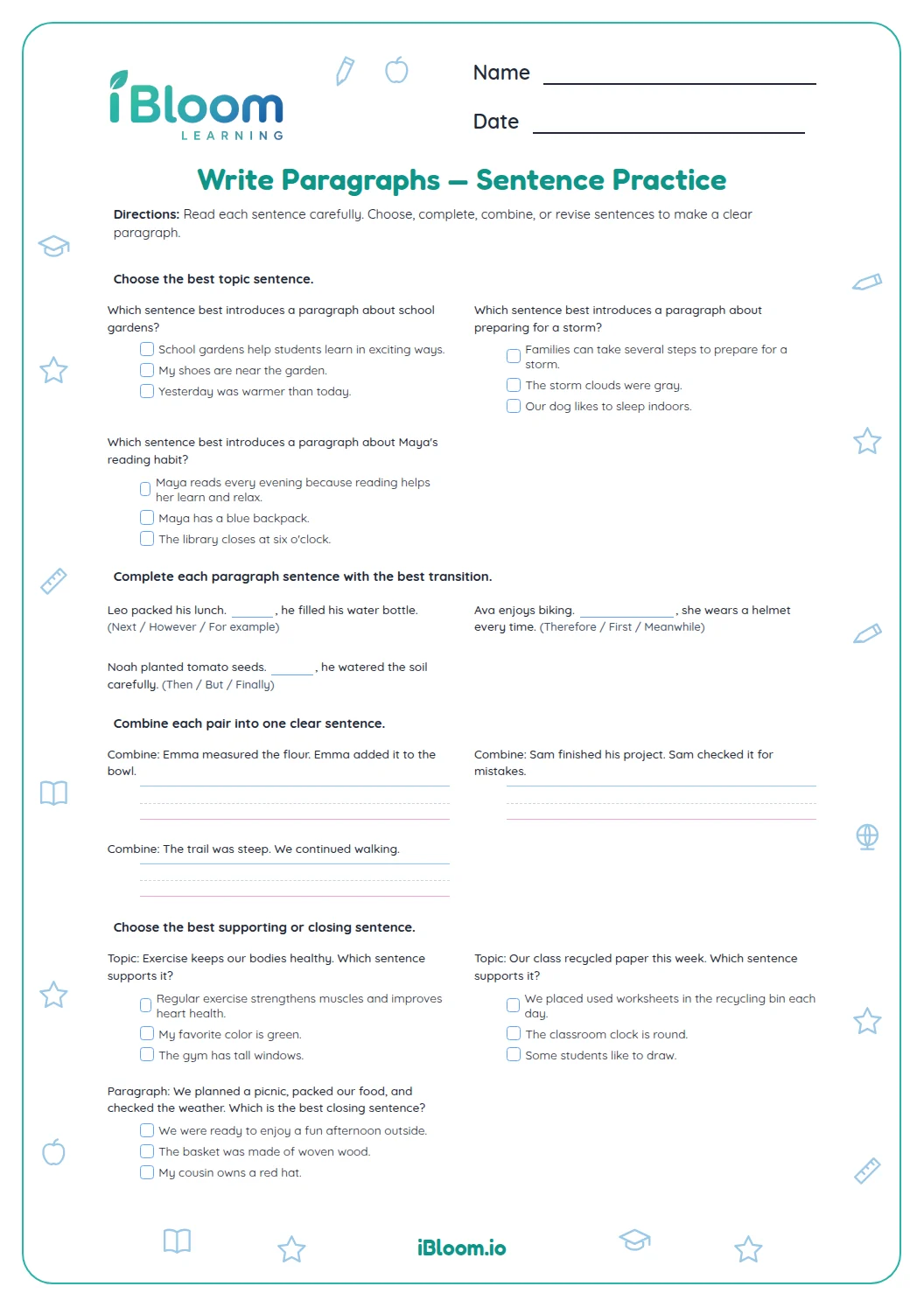
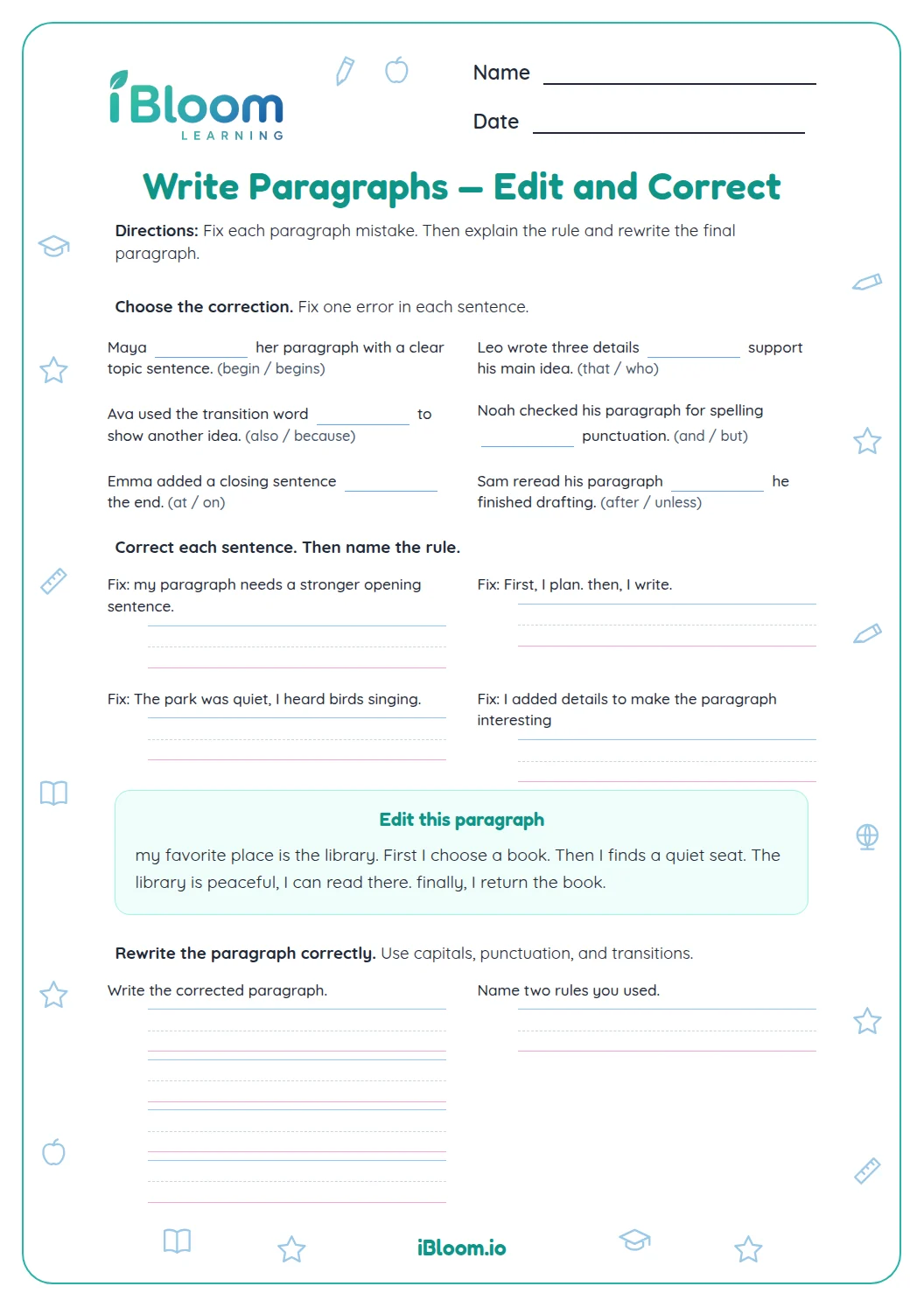
This free Grade 5 writing worksheet guides students through building a focused paragraph about a class garden. In 14 questions, they choose relevant details, complete a short writing guide, and finish sentences that add evidence, explain ideas, or conclude a paragraph. The sequence moves from recognizing what fits to composing a sentence of their own. It practices developing a topic with facts and concrete details, aligned with Common Core W.5.2.b. A separate key includes sample completions.
Aligned to W.5.2.b
How can you tell whether a detail belongs?
A supporting detail explains or illustrates the paragraph’s main point. In a garden paragraph, measurements, planting steps, and shared jobs fit; an unrelated lunch or school-door fact does not.
Question 2 asks for evidence of teamwork. “Students take turns watering and pulling weeds” directly shows shared work.
- 1Main idea: The garden needs teamwork.
- 2Supporting detail: Students take turns watering and pulling weeds.
What job does each sentence do?
A topic sentence names the paragraph’s point. Supporting details develop it with facts or examples. A concluding sentence brings the point together. Transitions such as “Next” help readers follow the order.
Transitions such as “Next” help readers follow a sequence of steps. Read the surrounding sentences to choose a word that matches the relationship.
How can a writer complete a paragraph?
Read the sentence before the blank and ask what the paragraph needs next: evidence, an explanation, or a conclusion. Then complete the sentence so it connects to the same topic.
For question 13, “We took turns, so every bed received water” completes the sentence with a detail that fits the garden paragraph. Other clear words or phrases can fit when they complete the sentence and make sense.
How to use this worksheet
- 1Read the prompt and identify the paragraph’s main point.
- 2Choose a detail only if it supports that point.
- 3Use transitions to show sequence or connection.
- 4For a sentence completion, write only the word or phrase needed in the blank.
- 5Reread the paragraph to check focus and flow.
Common mistakes and quick fixes
The mistake
Adding an interesting detail that does not support the topic.
The fix
Ask whether the sentence helps explain the paragraph’s main point.
The mistake
Repeating the topic sentence as the conclusion.
The fix
Restate the idea in fresh words and briefly sum up what the details showed.
The mistake
Writing a detail without explaining why it matters.
The fix
After evidence, add a sentence that connects the fact back to the paragraph’s point.
Common Core alignment
Students build focused paragraphs with topic sentences, relevant details, and conclusions.
Develop a topic with relevant facts, details, and examples.
On this sheet: Questions ask students to select and write relevant supporting details for a paragraph.
Show the official wordingHide the official wording
Develop the topic with facts, definitions, concrete details, quotations, or other information and examples related to the topic.
What to practice next
Make more practice
Further reading
Questions parents and teachers ask
What skills does this guided completion page cover?
Students choose relevant sentences, identify paragraph parts, complete a writing guide, and finish sentence frames that add details or explain evidence. The questions use a class garden topic, which lets students focus on how the paragraph works instead of switching subjects.
Are there right answers for the writing questions?
The key gives sample completions, but students can write different words or phrases where the prompt allows them. A response should complete the sentence, stay on the garden topic, and connect clearly to the paragraph’s point. For instance, several phrases could finish the sentence about what students learned.
What is a supporting detail?
A supporting detail gives a fact, example, or concrete piece of information that develops the paragraph’s point. “We measured each stem every Friday” supports a paragraph about observing plant growth because it names a specific action. The detail should help a reader picture or verify what happened.
How is a topic sentence different from a conclusion?
A topic sentence introduces the main point of the paragraph. A conclusion brings that point together after the supporting details. The worksheet asks students to practice both jobs in the context of a class garden project. Readers can use the final sentence to understand why the details mattered.
How many items are on the worksheet?
There are 14 questions in two parts: three multiple-choice items and eleven sentence completions. The answer key lists expected words or phrases, and sensible completions that fit the sentence can also be correct. Adults can accept another response when it completes the sentence clearly and stays on topic.