




About this worksheet
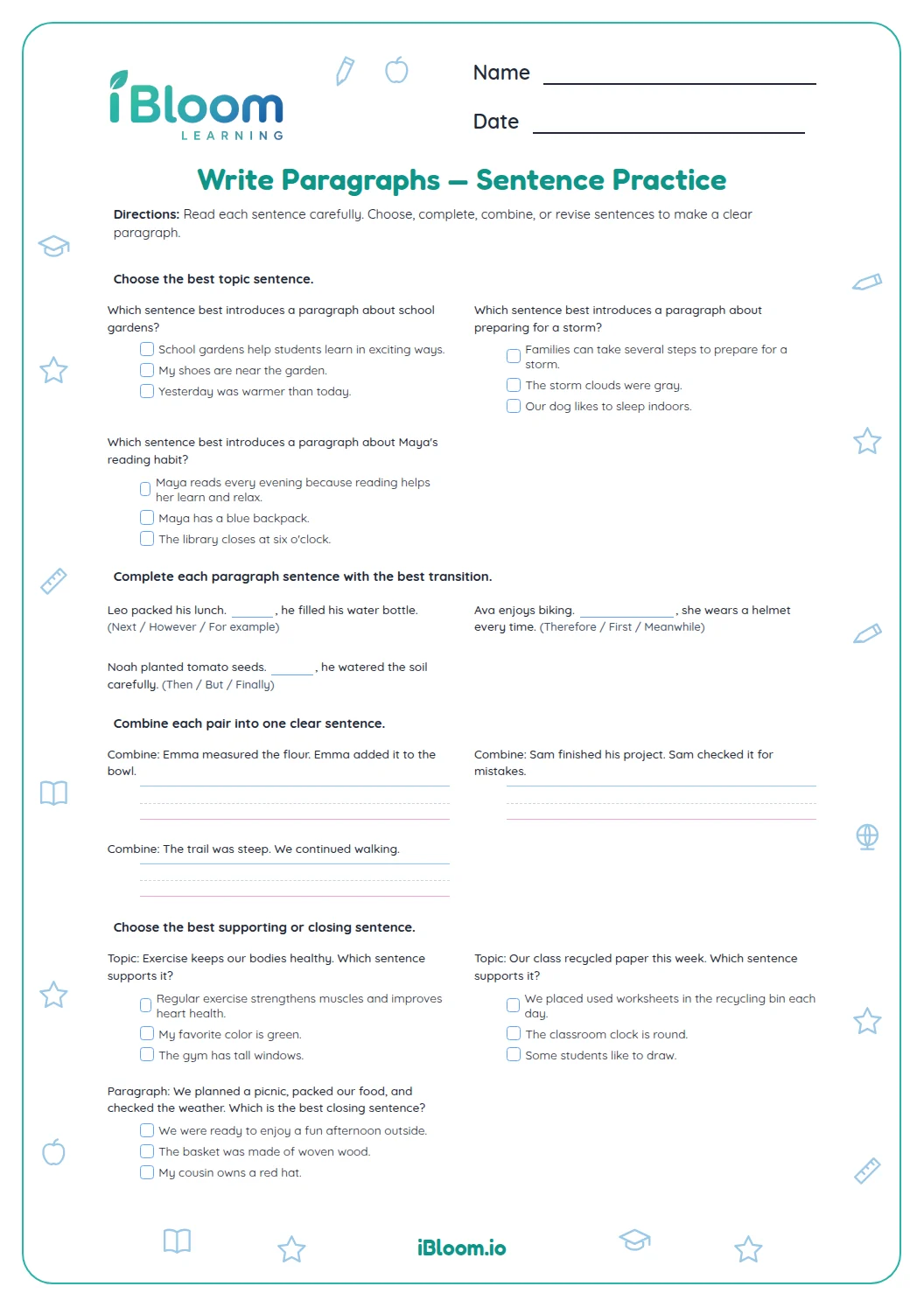
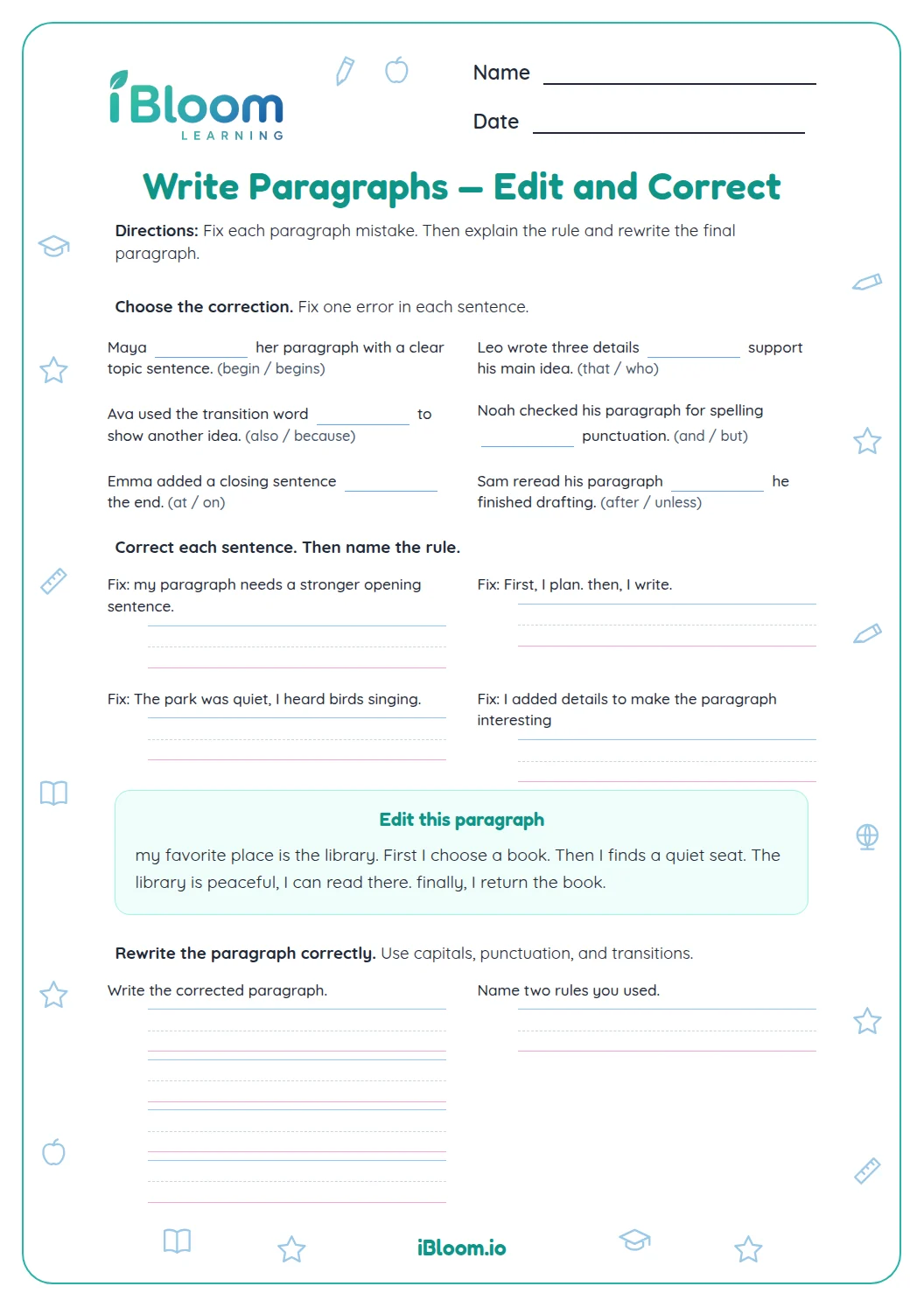
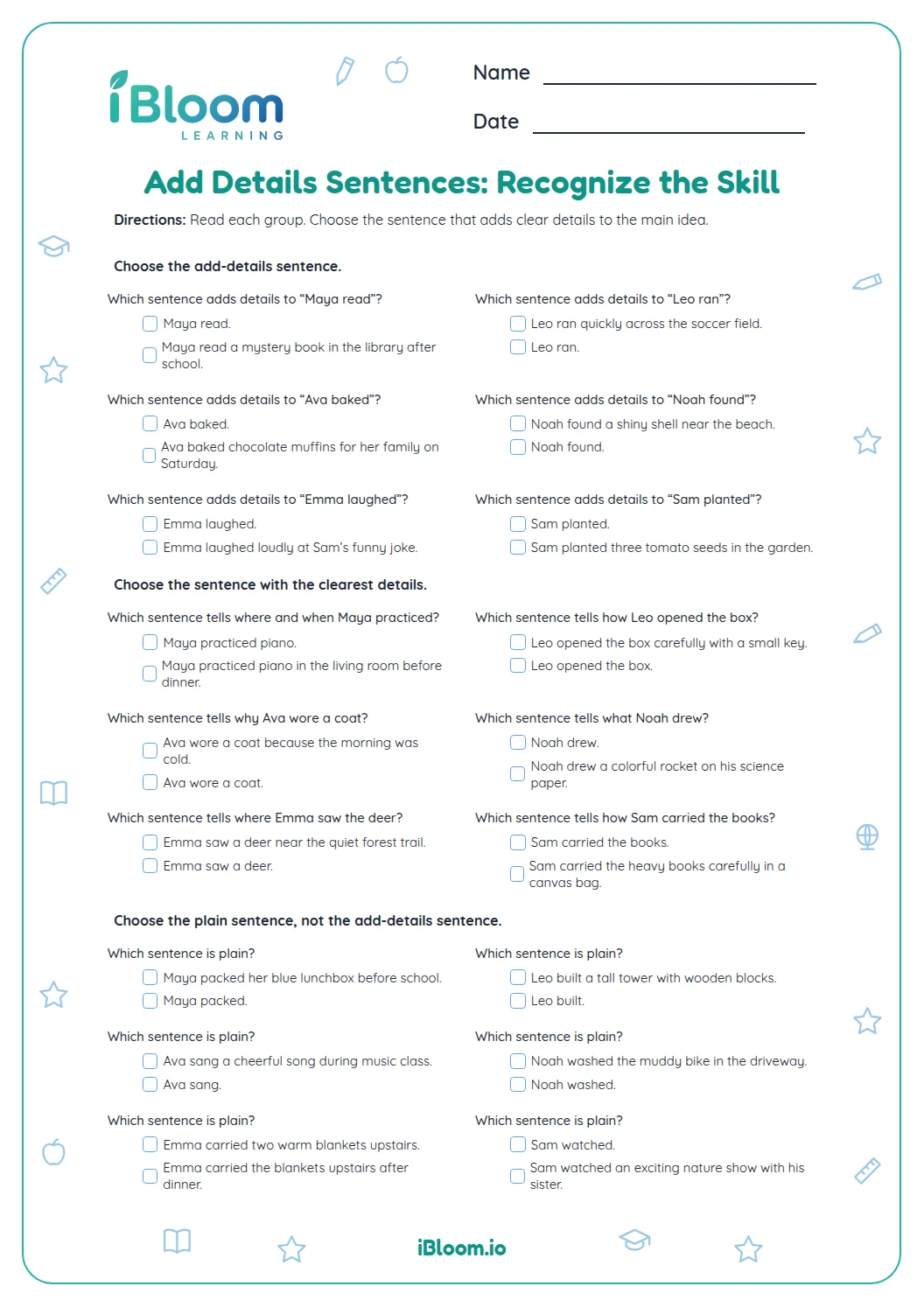
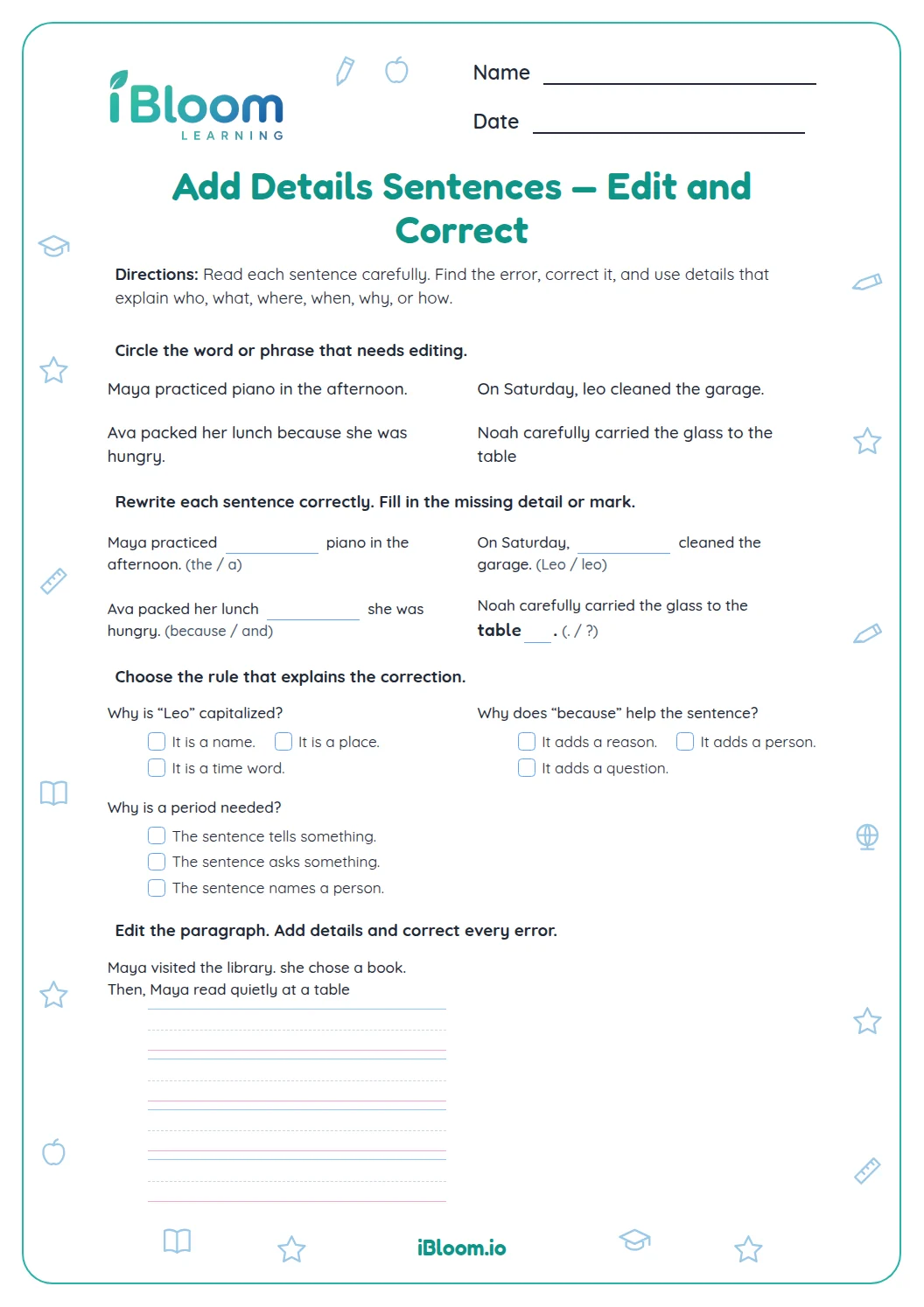
This free printable Grade 5 worksheet helps students recognize how sentences work together in a paragraph. Fourteen questions move from identifying topic sentences, supporting details, and conclusions to selecting relevant information and putting ideas in order. Students then write topic sentences and short paragraphs of their own. The practice supports Common Core W.5.2.a by connecting a clear focus with logically grouped information. A separate answer key gives fixed answers for the recognition tasks and sample responses for the writing tasks.
Aligned to W.5.2.a
What job does each sentence do?
A topic sentence states the paragraph’s focus. Supporting details explain that focus with specific information. A conclusion brings the ideas to a close. Questions 1–4 label those jobs in sentences about finding library books.
Part A uses T for topic sentence, D for supporting detail, and C for conclusion. Ask what each sentence contributes: an overall idea, one example, or a wrap-up.
How do students choose a supporting detail?
Compare each choice with the whole topic, not just a single familiar word. A sentence about watering dry soil explains regular garden care. The time lunch starts does not explain how a garden is cared for.
- 1Question 5 topic: Caring for a class garden.
- 2Choice: We water dry soil.
- 3Watering is a specific example of garden care, so this detail belongs.
How does recognition lead to writing?
Part C asks students to arrange seed-planting steps and sentences about a reading corner. The seed task uses time words; the reading-corner task moves from a general idea to a detail and a conclusion.
In Part D, students supply topic sentences for details, then write three connected sentences about keeping a desk tidy and caring for a class plant. Keep the focus on the connection between ideas while checking that each sentence is complete.
How to use this worksheet
- 1Read the three sentence-job labels aloud and explain each in a few words.
- 2For questions 1–4, ask what each library sentence adds to the paragraph.
- 3In Part B, have students explain why their chosen detail supports the topic.
- 4Read each Part C sequence aloud in the chosen order.
- 5Use the key to check recognition answers, then review each paragraph for focus and order.
Mistakes to check and ways to help
The mistake
Choosing a detail just because it mentions school.
The fix
Match the detail to the specific topic, such as saving paper, rather than the broader setting.
The mistake
Placing a conclusion before the details it sums up.
The fix
Read the sequence aloud and ask what “these choices” refers to.
The mistake
Writing three unrelated sentences for question 12.
The fix
Name one desk-tidying idea, add a concrete action, and finish by explaining the result.
Common Core alignment
Recognize a clear topic and organize related sentences into a focused paragraph.
On this sheet: Students identify topic sentences, select related details, order sentences, and write a focused paragraph.
Show the official wordingHide the official wording
Introduce a topic clearly, provide a general observation and focus, and group related information logically; include formatting (e.g., headings), illustrations, and multimedia when useful to aiding comprehension.
What to practice next
Make more practice
Further reading
Questions parents and teachers ask
Does my child write a whole paragraph?
Yes. Question 12 asks students to write a three-sentence paragraph about keeping a desk tidy. Questions 13 and 14 add a topic sentence and another short paragraph about caring for a class plant. The key gives sample responses; students can use different wording if the focus and order are clear.
Are topic sentences always the first sentence?
A topic sentence can appear in different positions, but this worksheet uses clear general statements to make their purpose visible. Students identify the overall idea in the library example and place a general statement first in the reading-corner sequence before adding a supporting detail.
How should I check the writing answers?
Check the meaning and organization rather than requiring the exact words on the key. Question 11 needs a general statement that covers both paper-organizing details. Question 12 needs three complete, connected sentences about a tidy desk. The key labels its writing responses as samples.
What makes the ordering questions different?
Question 9 organizes a process, while question 10 organizes an explanation. First, next, and finally signal the planting sequence. In the reading-corner example, the broad idea comes first, a specific storage detail follows, and the sentence about “these choices” closes the paragraph logically.
What should I do if every detail seems related?
Return to the exact topic and ask what each detail explains. For the garden question, watering dry soil describes care, while lunch time and backpack color do not. Have your child explain that connection aloud before selecting an answer or adding a new detail.