


About this worksheet
This Grade 5 worksheet gives 14 short fill-in questions on simple, compound, and complex sentences. Students classify structures, complete clauses, and add conjunctions or punctuation to connect ideas. The answer key gives a target word or mark for each item. It practices Common Core L.5.1a.
Aligned to L.5.1a
What does the worksheet cover?
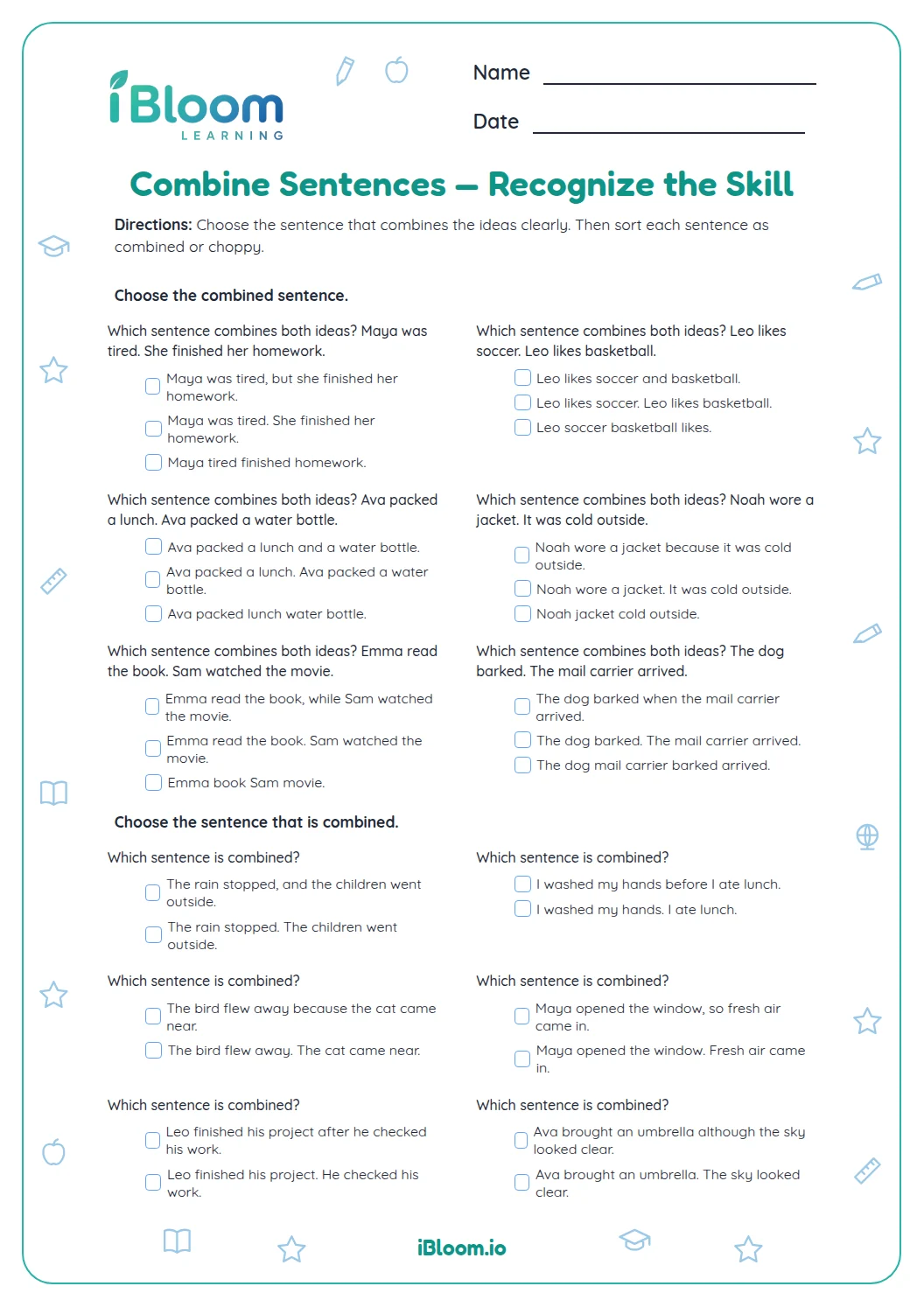
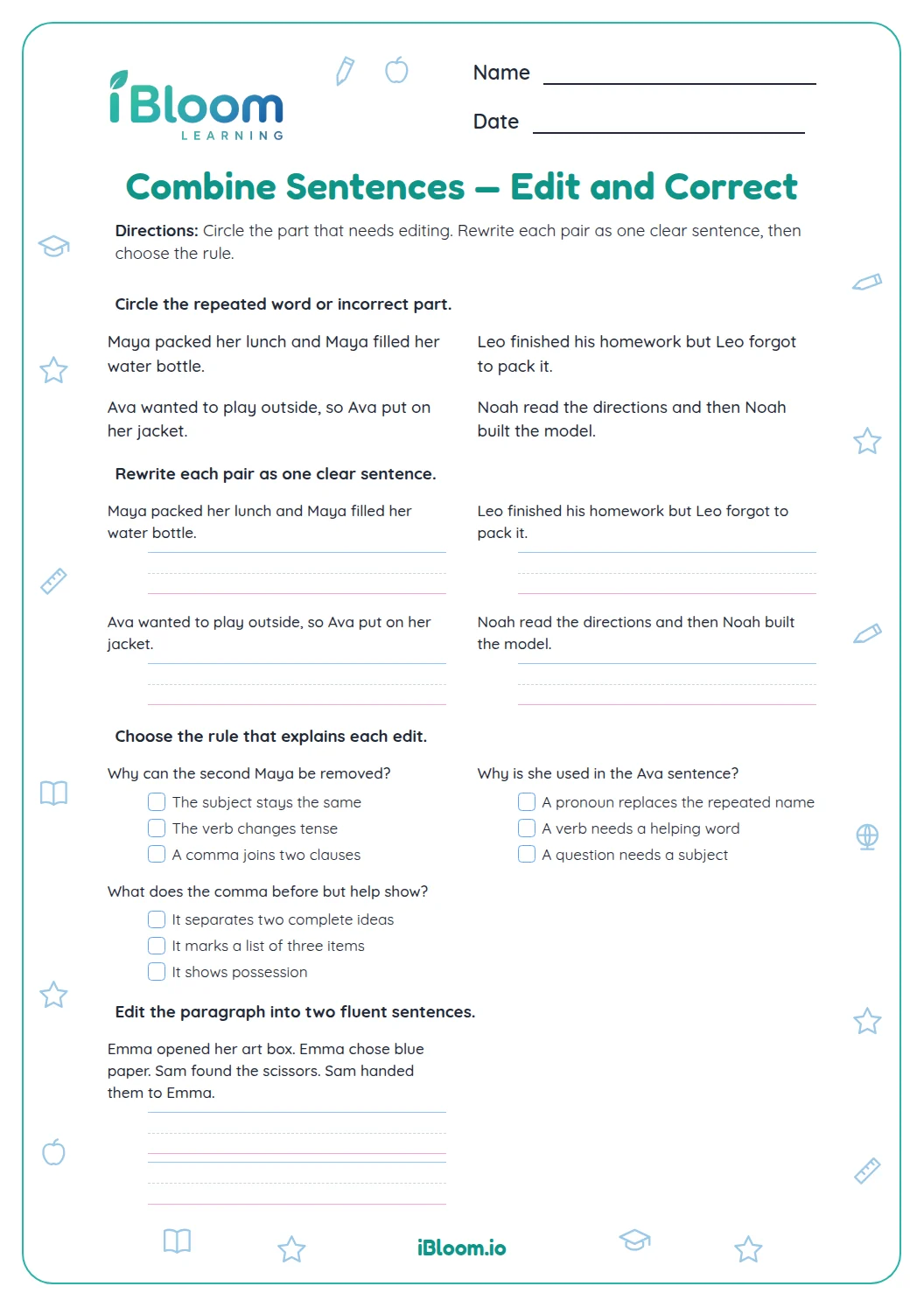
The first part classifies sentence structures. The second completes clauses and adds conjunctions or punctuation. Each item uses a short blank so students can focus on how clauses work.
- Part A: classify simple, compound, and complex sentences
- Part B: complete and connect clauses
How can students identify each structure?
A simple sentence has one independent clause. A compound sentence joins independent clauses; a complex sentence includes an independent clause and a dependent clause. Find the subject and verb in each clause before naming the structure.
- 1When the rain stopped, the sun came out.
- 2This is complex: “When the rain stopped” depends on the main clause.
How should students check the punctuation?
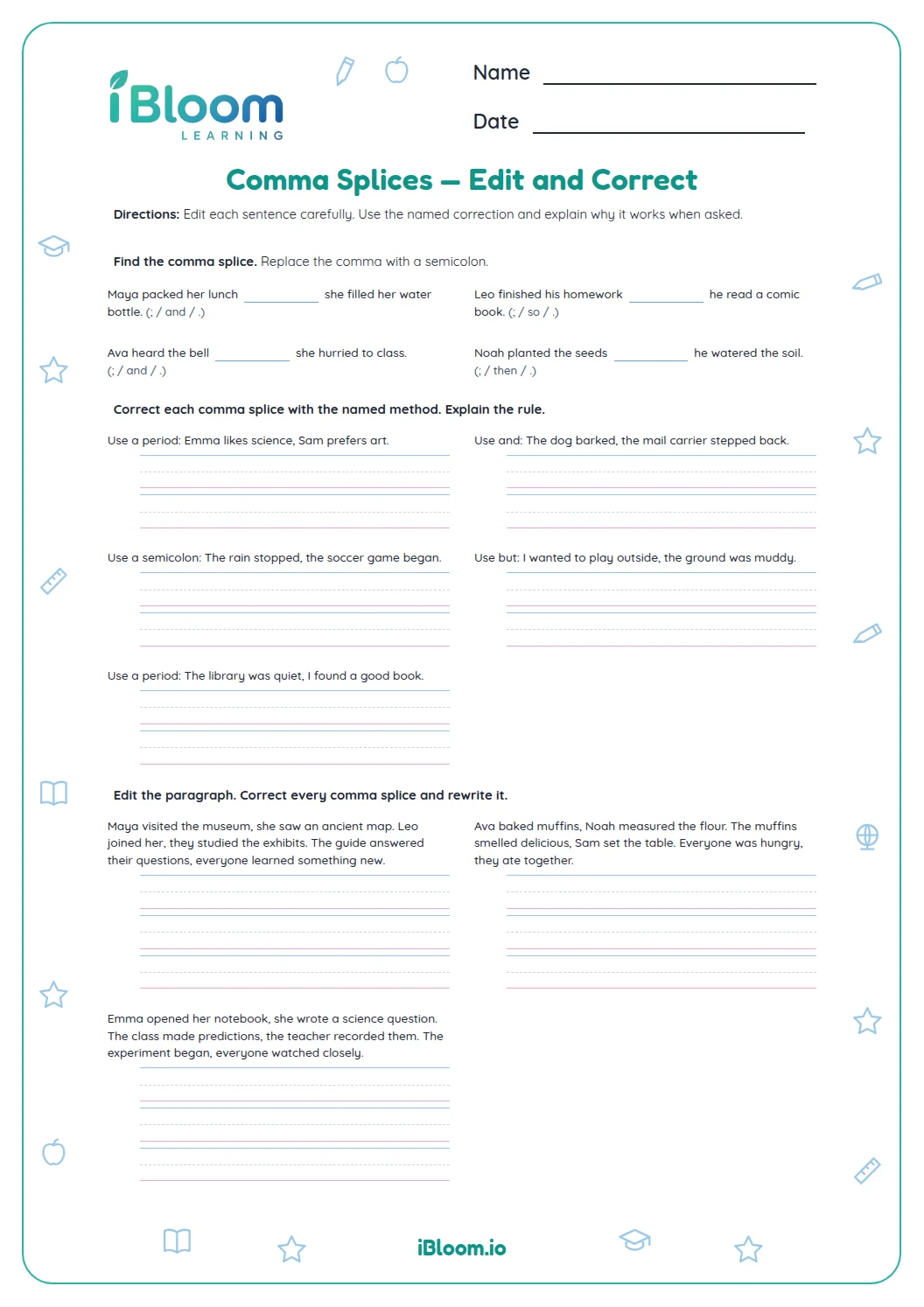
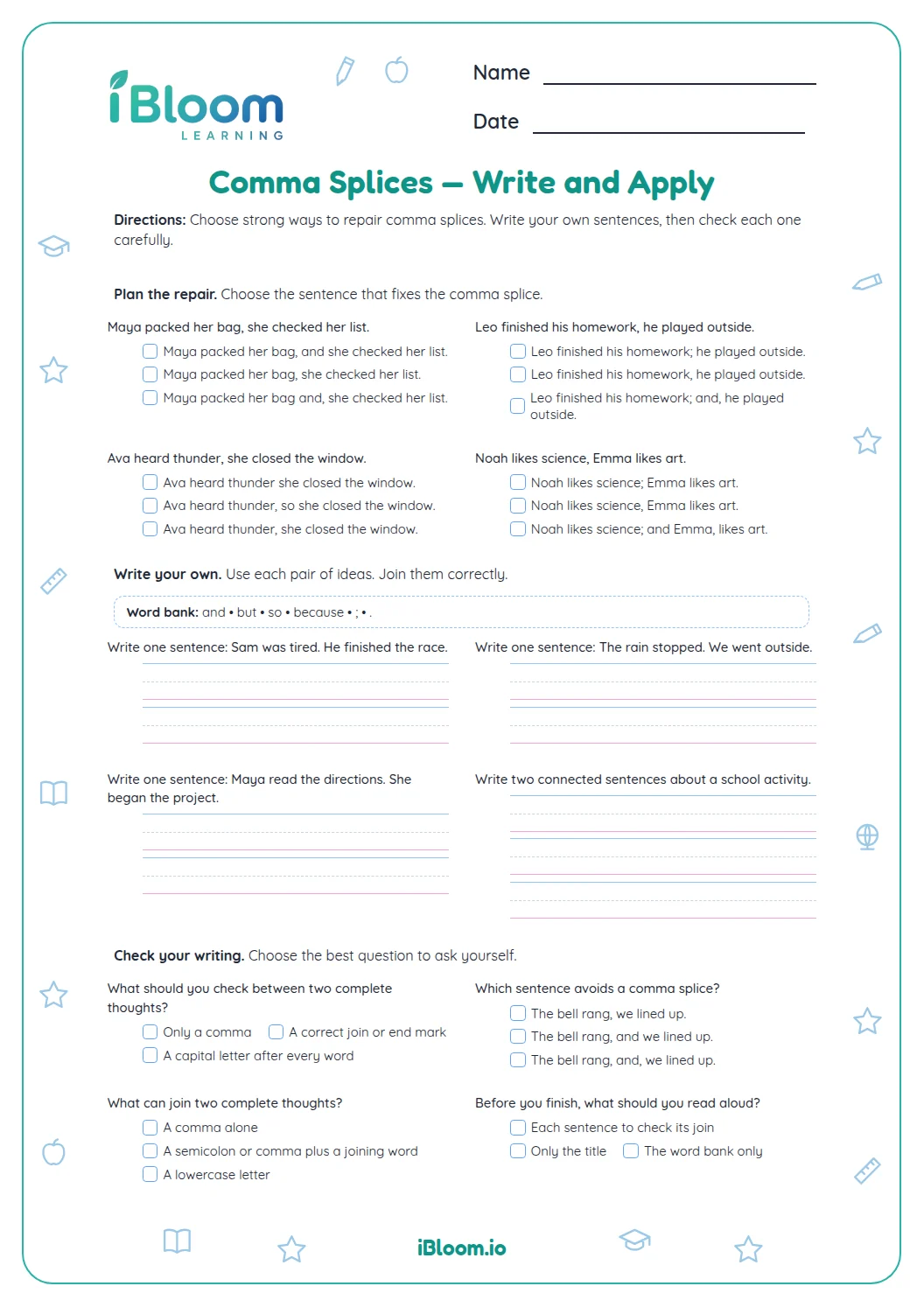
When two independent clauses are joined with and or but, place a comma before the conjunction. A dependent clause beginning with because or after must connect to a complete thought. Read the full sentence to check its meaning.
What does the answer key show?
The key gives the expected structure label, conjunction, or punctuation mark for all 14 items. Students can compare the completed sentence with the key and reread it to confirm that the clauses form a complete thought.
Check sentence structure
- 1Find the subject and verb in each clause.
- 2Decide which clauses can stand alone.
- 3Name the structure: simple, compound, or complex.
- 4Add a conjunction or punctuation mark that connects the ideas.
- 5Reread the finished sentence, then check the key.
Common sentence errors
The mistake
Joining two independent clauses with only a comma.
The fix
Add a coordinating conjunction after the comma or separate the clauses with a period.
The mistake
Leaving a because or when clause by itself.
The fix
Attach it to an independent clause so the reader knows the complete thought.
Common Core alignment
This worksheet practices Grade 5 conventions for joining clauses and punctuating sentences.
Explain the function of conjunctions, prepositions and interjections in general and in particular sentences.
On this sheet: Students use conjunctions to join independent clauses and connect dependent clauses while editing and revising.
Show the official wordingHide the official wording
Explain the function of conjunctions, prepositions, and interjections in general and their function in particular sentences.
What to practice next
Make more practice
Further reading
Questions parents and teachers ask
How can students tell a compound sentence from a complex one?
A compound sentence joins two independent clauses, often with a comma and a coordinating conjunction such as and or but. A complex sentence has an independent clause and a dependent clause, often introduced by because, when, or although. The worksheet practices both patterns.
What does this worksheet ask students to edit?
Students classify five sentence patterns, complete clauses, and fill in conjunctions or punctuation marks. Each item is short enough to focus attention on the sentence structure. The answer key lists the intended word or mark for all 14 questions.
When does a sentence need a comma before and?
Use a comma before and when it joins two independent clauses. For example, “The bell rang, and we lined up” has a complete thought on each side. The worksheet includes a blank for the needed conjunction in a similar sentence.
What is a dependent clause?
A dependent clause has a subject and verb but does not express a complete thought on its own. Words such as because, when, and although often begin one. Connect it to an independent clause, then reread the sentence to check that the idea is complete.
How can students check their answers?
Identify the clauses first, then decide how they connect. Check the answer key for the expected structure, conjunction, or punctuation mark. If the finished sentence sounds incomplete, look for a dependent clause that needs an independent clause to complete its thought.