



About this worksheet
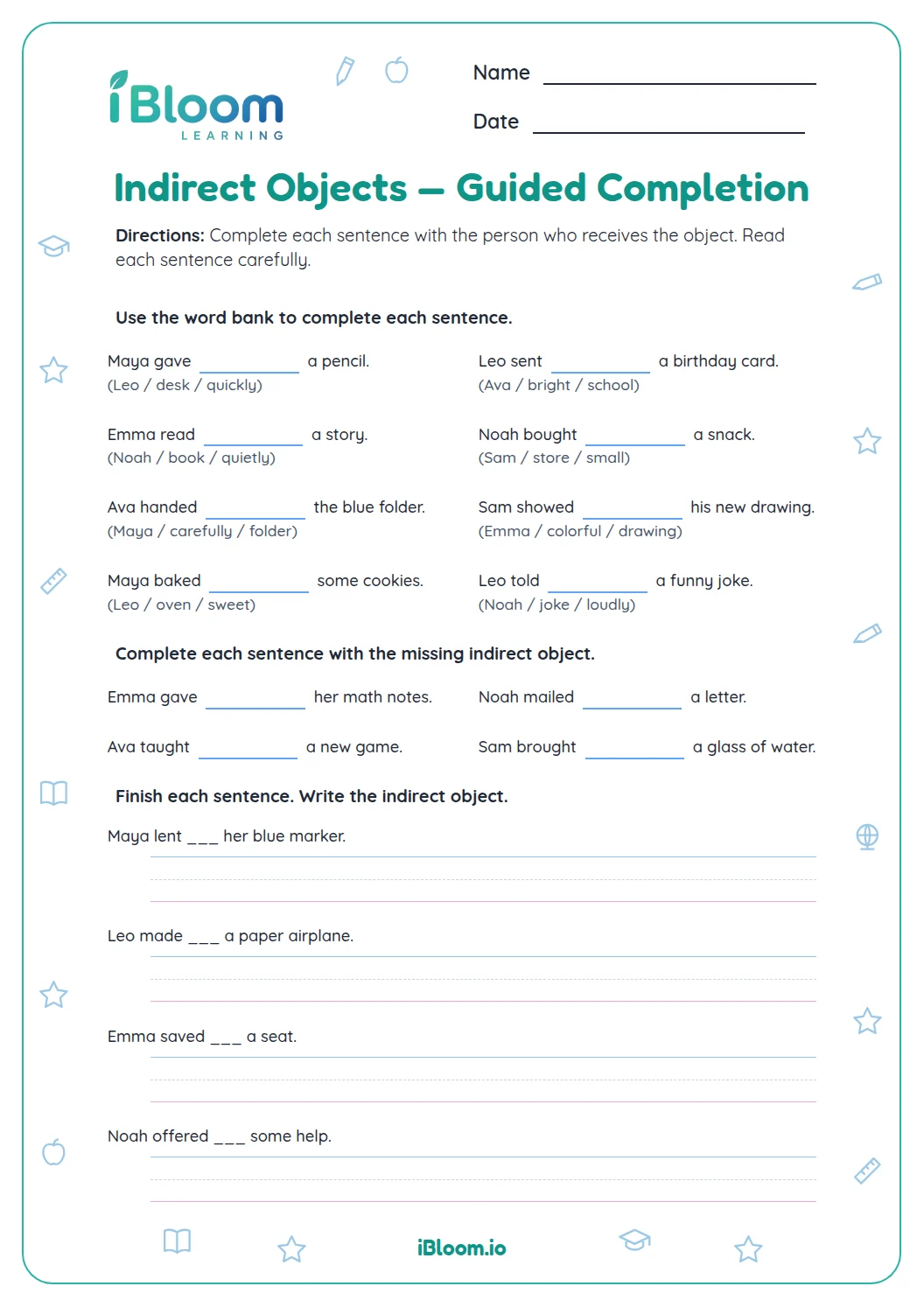
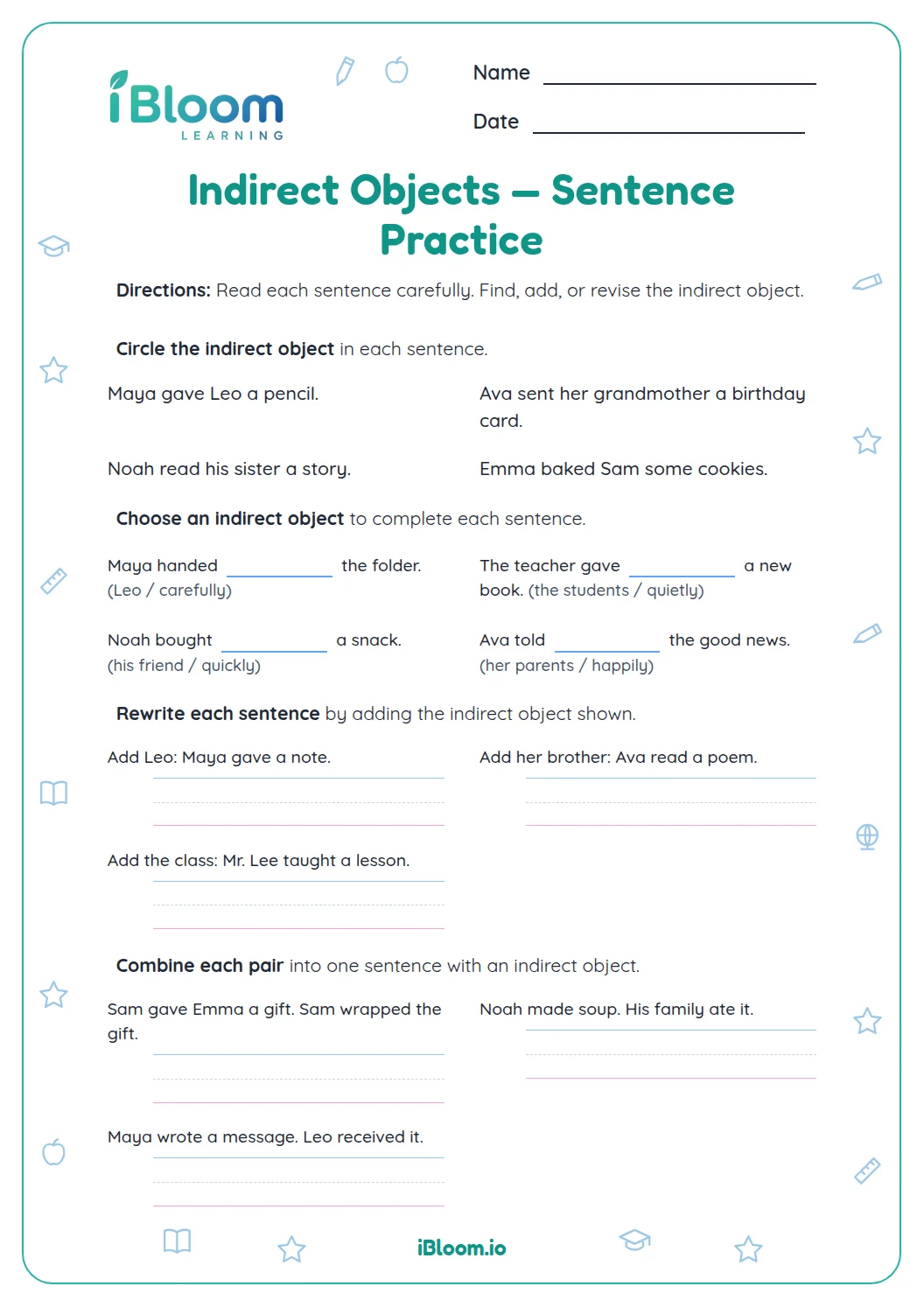
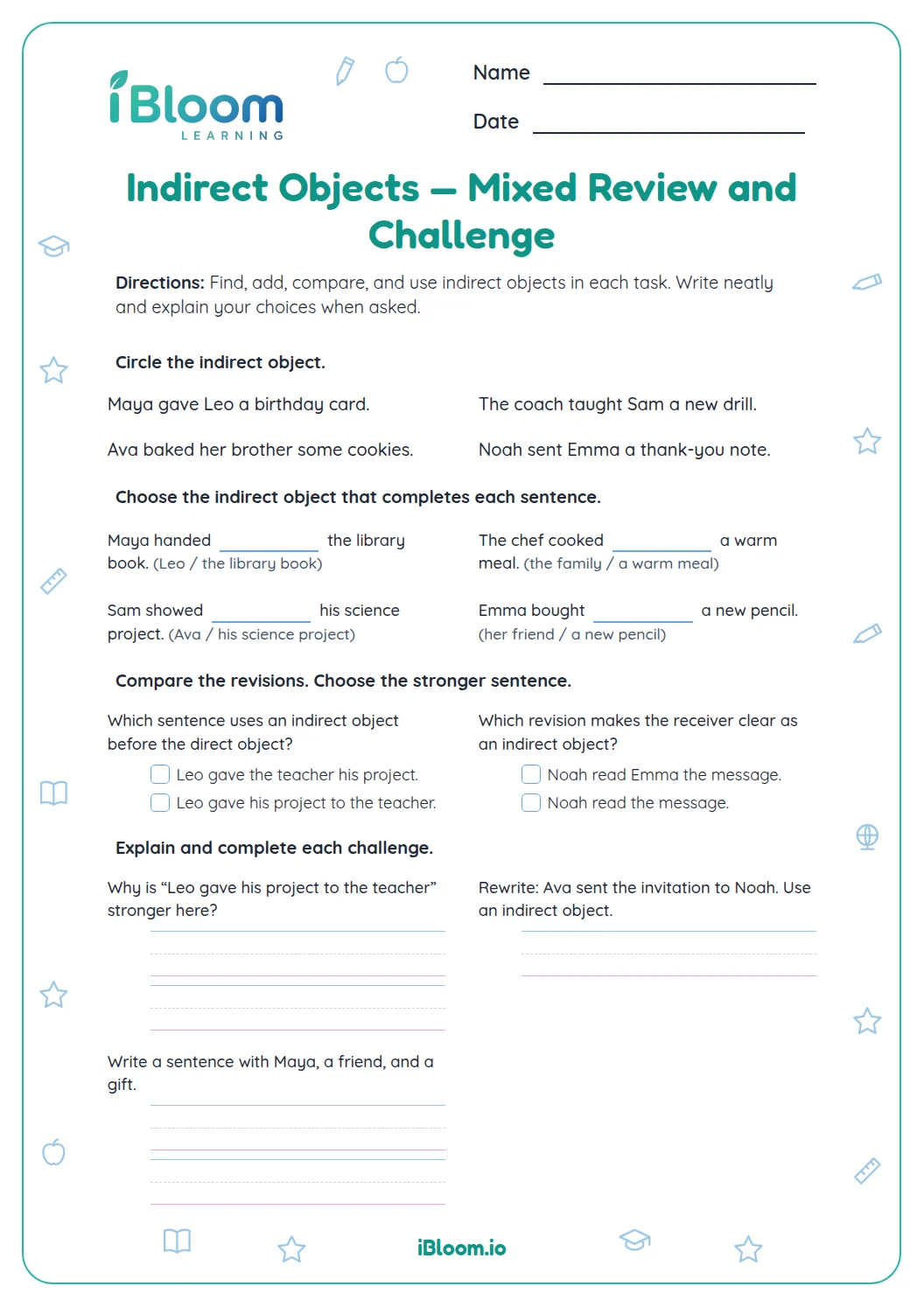
This Grade 5 grammar worksheet has 16 sentences for identifying and using indirect objects. Children find the receiver in complete sentences, then supply a receiver to finish five new sentences. The separate answer key gives sample responses for open-ended items. The work practices CCSS L.5.1: standard English grammar and usage in writing and speaking.
Aligned to L.5.1
What does an indirect object do?
An indirect object tells who receives the direct object. In “The coach handed Maya a medal,” the medal is handed, and Maya receives it.
Questions 1–11 ask children to identify the receiver in complete sentences. In the final part, children supply a receiver to complete each sentence.
- 1The coach handed Maya a medal.
- 2What was handed? a medal
- 3Who received it? Maya
How do you add an indirect object?
First find the action and the thing acted on. Then ask who receives that thing. “The teacher gave ___ a new folder” can become “The teacher gave my classmate a new folder.”
How can I check the receiver?
For Question 14, “The team offered ___ cold water,” cold water is the thing offered. Ask who received it; “the players” is a suitable indirect object. Then read the full sentence to make sure it is complete.
How can I check the receiver?
For Question 14, “The team offered ___ cold water,” cold water is the thing offered. Ask who received it; “the players” is a suitable indirect object. Then read the full sentence to make sure it is complete.
How can I use this worksheet?
- 1Read the whole sentence first.
- 2Ask what was given, told, sent or shown.
- 3Ask who received it; that person or group is the indirect object.
- 4For Part C, choose a receiver that makes a complete, sensible sentence.
- 5Reread and check that your sentence has a subject and verb.
Common mistakes and quick fixes
The mistake
Marking the thing received as the indirect object.
The fix
Ask “what?” for the direct object, then “to whom?” or “for whom?” to find the receiver.
The mistake
Choosing a person named in the sentence who receives nothing.
The fix
Connect the receiver to the verb and the thing being given, sent or shown.
The mistake
Writing a fragment in the completion section.
The fix
Read the completed sentence aloud and check for a subject and verb.
Common Core alignment
This worksheet practices the standard below through its questions.
Use standard grammar when identifying and writing sentences with indirect objects.
On this sheet: The practice asks children to identify and use indirect objects in complete sentences.
Show the official wordingHide the official wording
Demonstrate command of the conventions of standard English grammar and usage when writing or speaking.
What to practice next
Make more practice
Further reading
Questions parents and teachers ask
What is an indirect object?
An indirect object names who receives the direct object. In “The coach handed Maya a medal,” the medal is what was handed and Maya is the receiver. Questions 1–11 ask children to identify that receiver in a complete sentence.
How can I find the indirect object?
First ask what was given, sent, shown, or told. Then ask who received it. In “The baker gave each child a cookie,” the cookie is the direct object and “each child” is the indirect object. The questions use this receiver relationship.
Can an indirect object have more than one word?
Yes. A receiver can be a phrase such as “my cousin,” “each child,” or “our group.” Include the complete phrase when answering, rather than selecting just one word from it. Several receiver answers on this worksheet use more than one word.
What do children do in the final part?
Part C has five sentence completions. Children add a receiver to each blank, then read the full sentence to check that it makes sense. The answer key gives sample completions because many receivers can fit. A different receiver is fine when it makes a complete, sensible sentence.
Is an answer key included?
Yes. The two-page answer key gives the receiver for each identification question and sample completions for the open blanks. Since Part C allows different sensible receivers, compare the sentence meaning with the example instead of requiring identical wording.