




About this worksheet
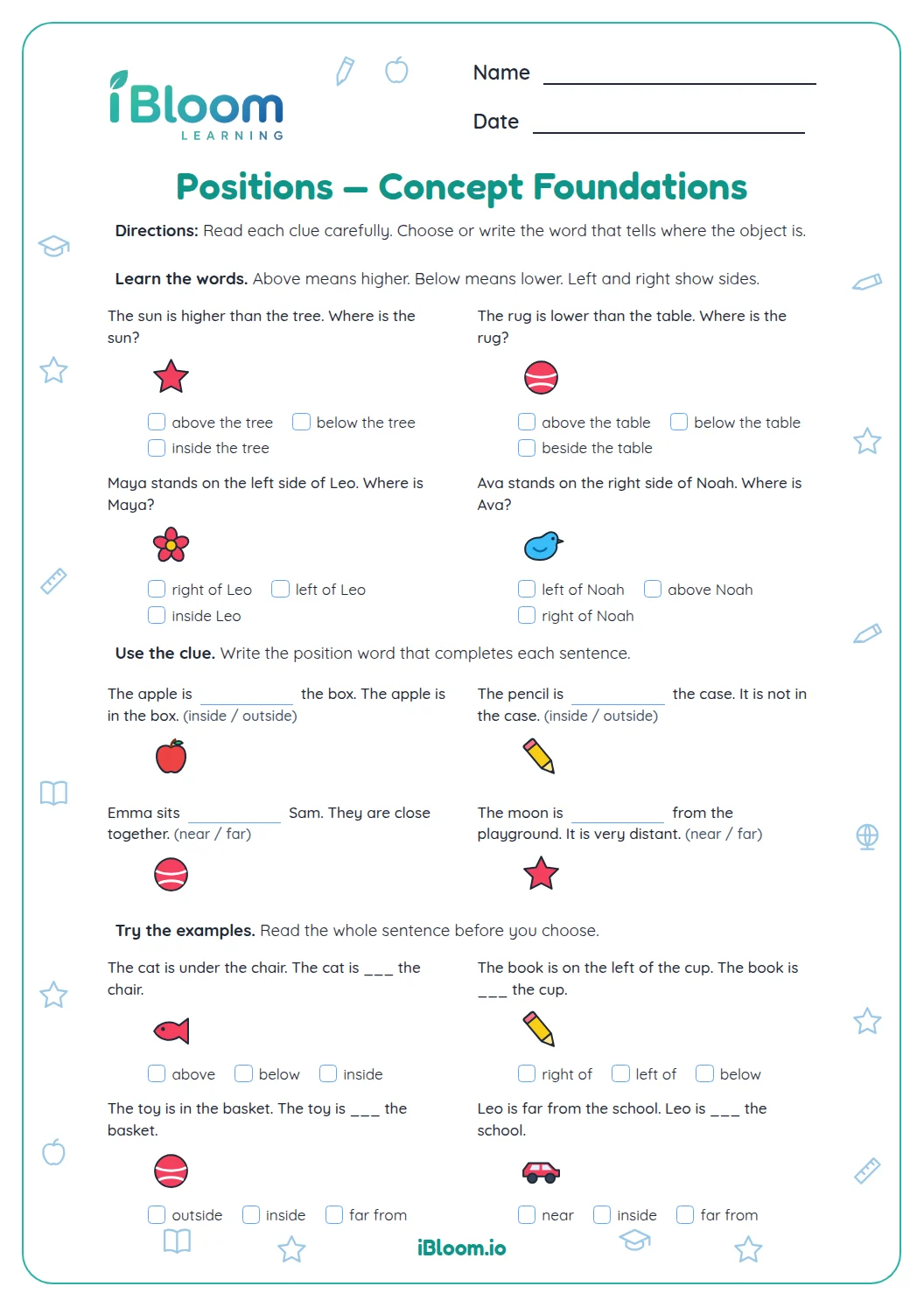
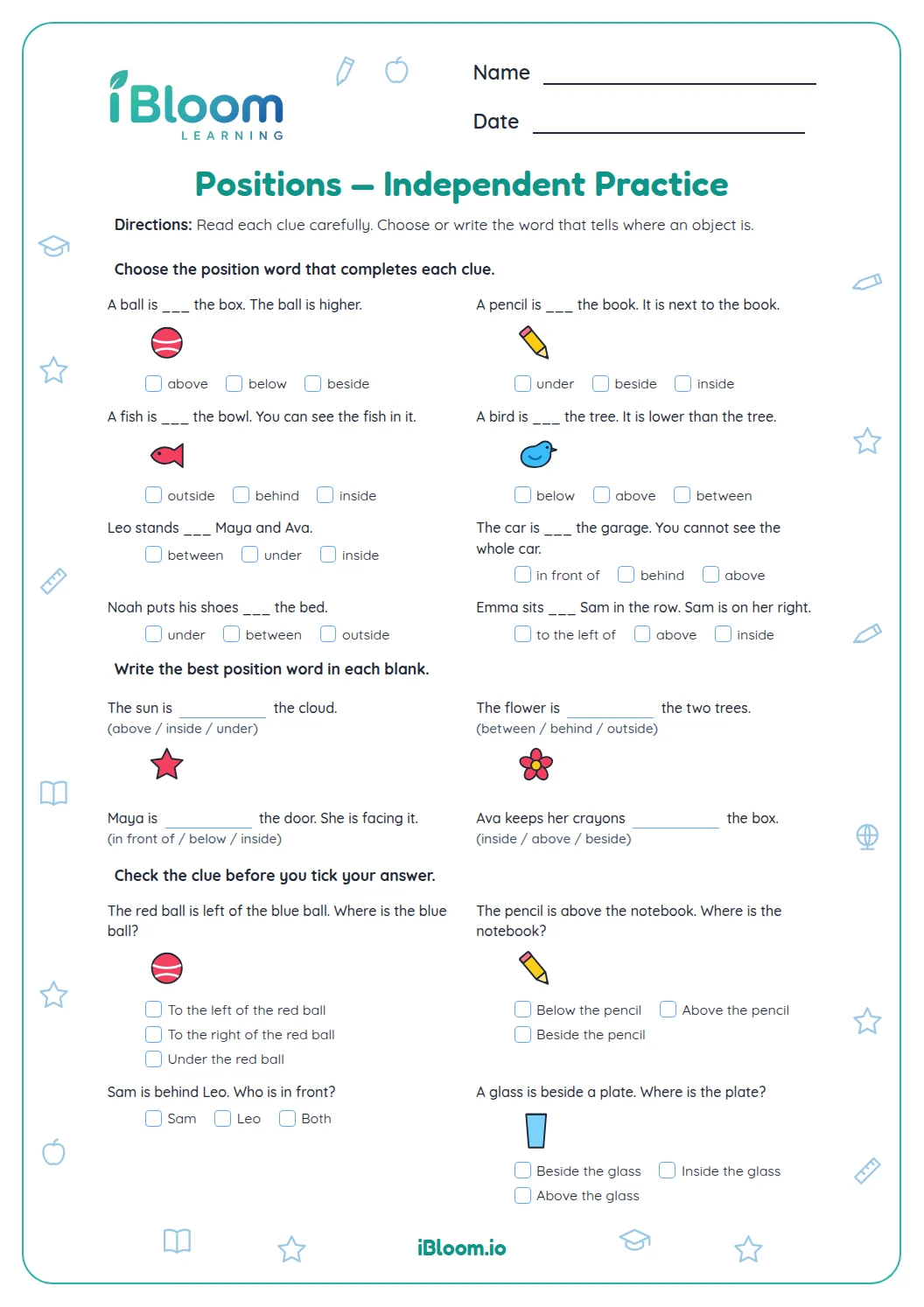
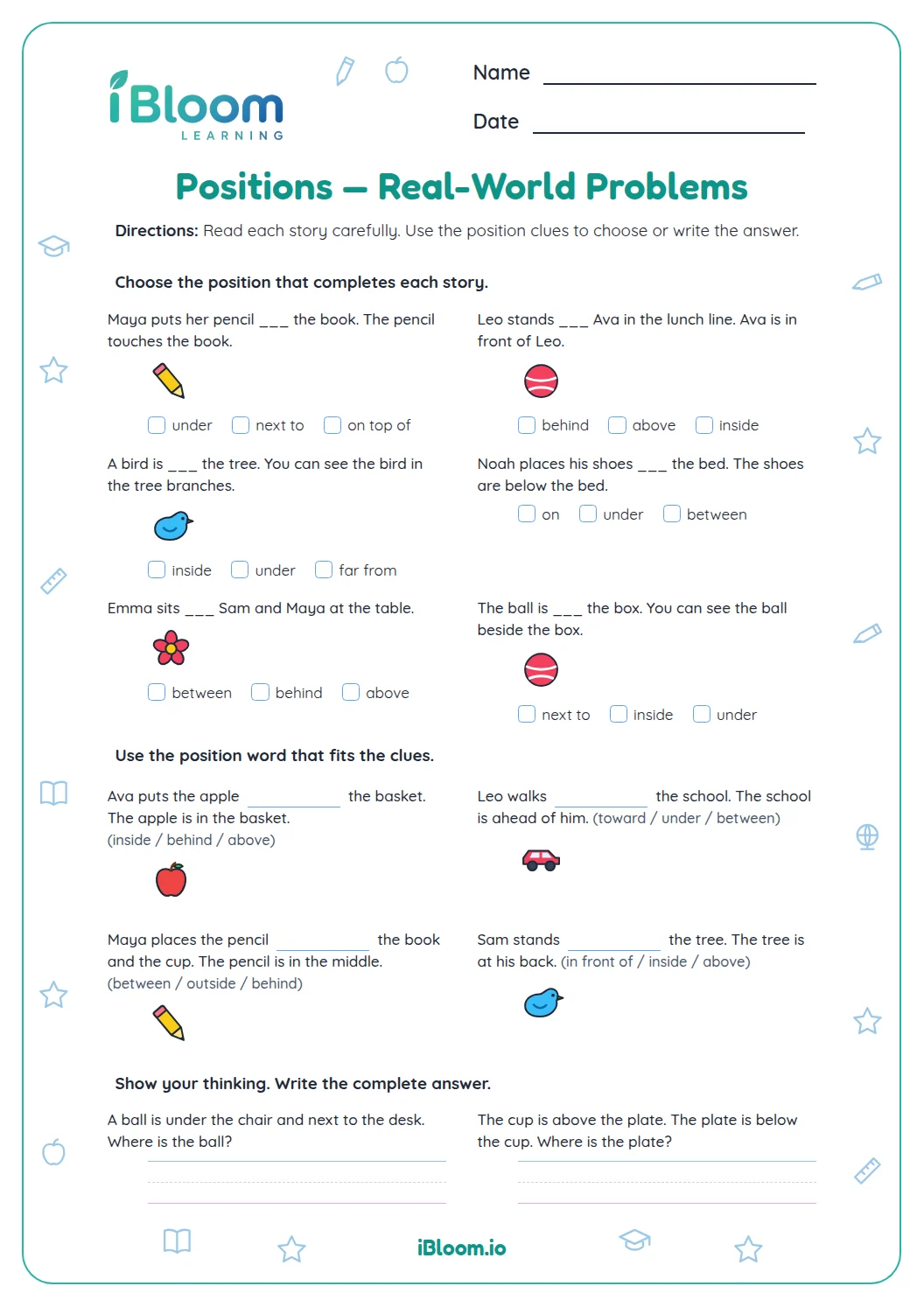
This Grade 1 geometry printable gives children 16 visual questions about relative position. Picture rows practice between, immediately left of, and immediately right of; simple point grids show above, below, and beside. The rows provide clear left-to-right examples, and the answer key identifies the matching item or position word. The position language connects to CCSS K.G.A.1.
Aligned to K.G.A.1
How do position words describe a scene?
Part A uses picture rows read from left to right. In apple, ball, cat, the ball is between the apple and the cat. For left and right questions, “immediately” means the next item in the row.
- 1apple — ball — cat
- 2The ball is between the apple and the cat.
Which position words appear?
Part B uses a small grid to compare two labeled points. Find A first, then locate B: a point higher on the grid is above, a lower point is below, and one on the same row is beside.
- 1A is at (2, 1); B is at (2, 4).
- 2B is above A.
How can a child check a position word?
For a grid question, find point A first, then compare point B with it. The grid shows whether B is higher, lower, or beside A.
How to use this worksheet
- 1Read the entire scene.
- 2Name the object used as the reference.
- 3Picture or act out where the other object is.
- 4Choose the position word that matches.
- 5Use the answer key to check the vocabulary.
Common mistakes and quick fixes
The mistake
Reversing the two objects.
The fix
Say the sentence again and point to the reference object first.
The mistake
Confusing beside with above or below.
The fix
Ask whether the objects are next to each other or one is higher/lower.
The mistake
Mixing up in front of and behind.
The fix
Imagine looking toward the reference object, then identify what is closer or hidden.
Common Core alignment
This worksheet practices the letter and number skills named in the standard below.
Describe where objects are using words such as above, beside, and behind.
On this sheet: Each prompt asks children to interpret a relative position in a short concrete situation.
Show the official wordingHide the official wording
Describe objects in the environment using names of shapes, and describe the relative positions of these objects using terms such as above, below, beside, in front of, behind, and next to.
What to practice next
Make more practice
Further reading
Questions parents and teachers ask
What is a reference object?
There are 16 visual position questions. Twelve picture rows use between, left, and right. Four small point grids ask whether point B is above, below, or beside point A. The answer key gives the matching position or item for each drawing.
Are left and right included?
The picture rows practice between, left, and right. The point grids practice above, below, and beside. Children read the pictures or locate labeled points, then choose the word that describes one object’s position compared with another. Read the full clue once more to confirm which object or point is the reference.
Can children act out the scenes?
Yes. Children can read each picture row from left to right, or point to A and B on a grid. For a grid question, compare the height and side-to-side location of B with A before choosing above, below, or beside.
Why are these described as short scenes?
The page uses picture rows and labeled point grids because those are the template’s available visual models for relative position. The drawings directly show between, left, right, above, below, and beside relationships for children to describe. Read the full clue once more to confirm which object or point is the reference.
What standard is listed?
The page lists K.G.A.1, which asks children to describe relative positions of objects using words such as above, below, beside, in front of, behind, and next to. This page practices relative position through picture rows and the words between, left, and right.