




About this worksheet
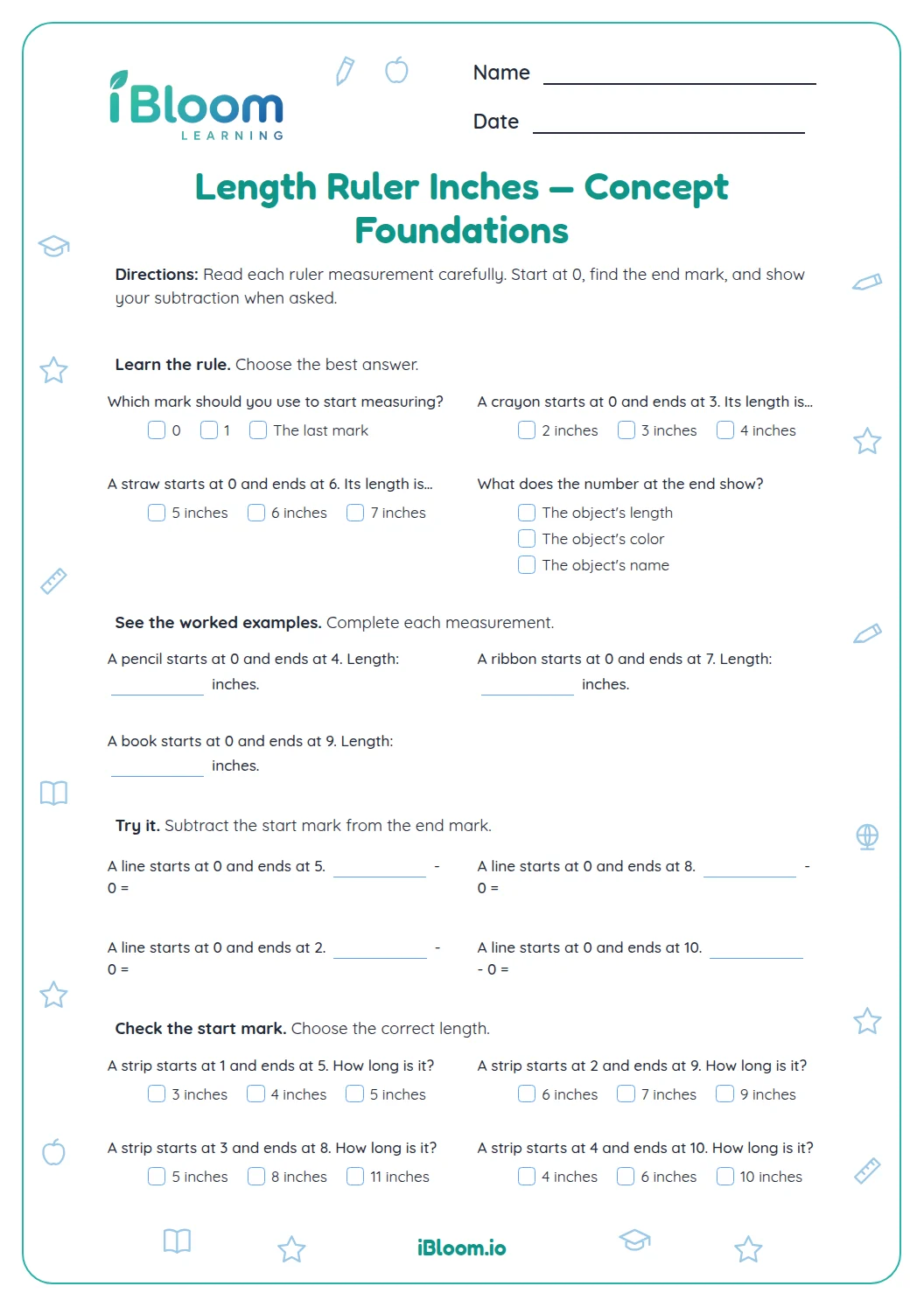
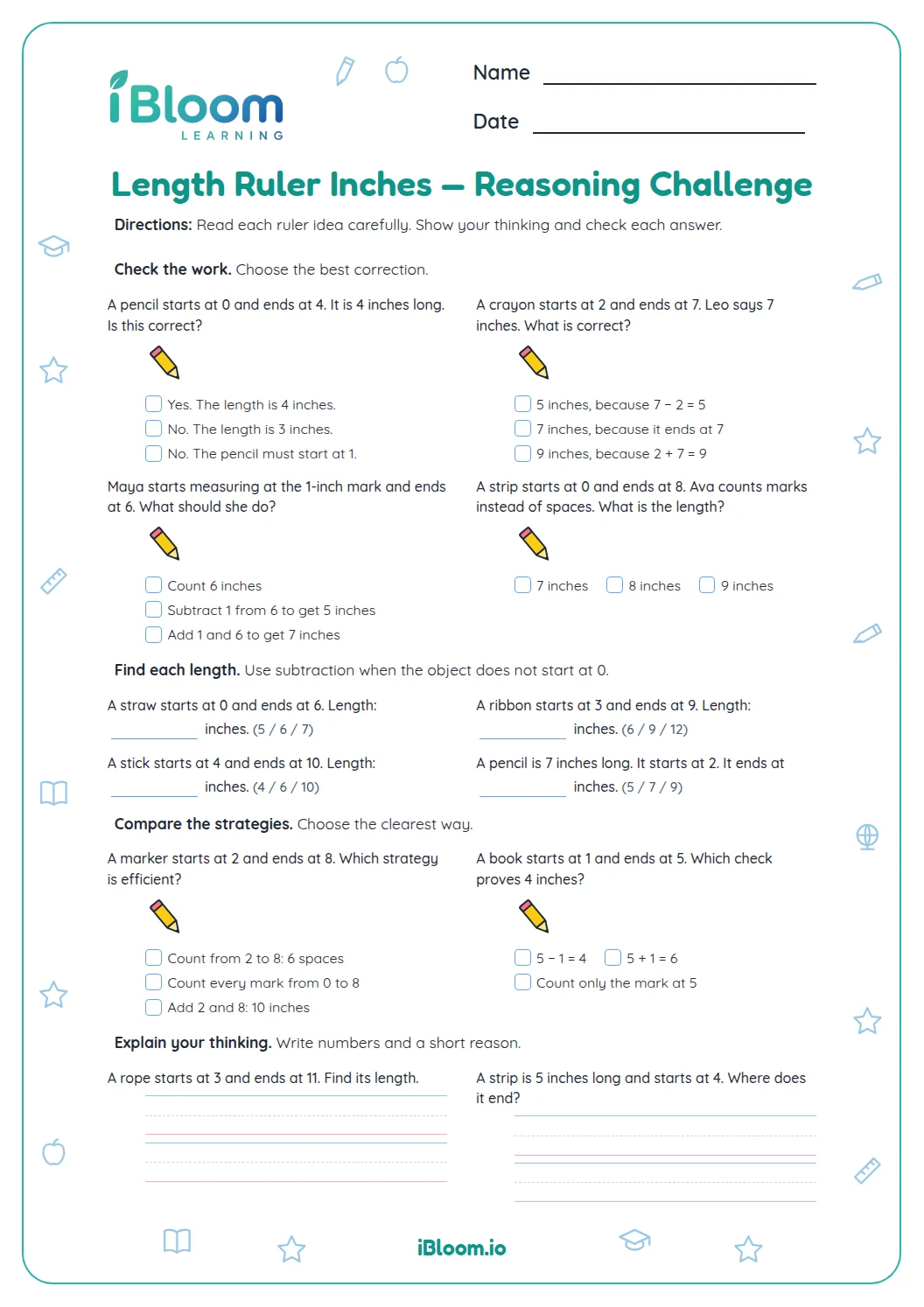
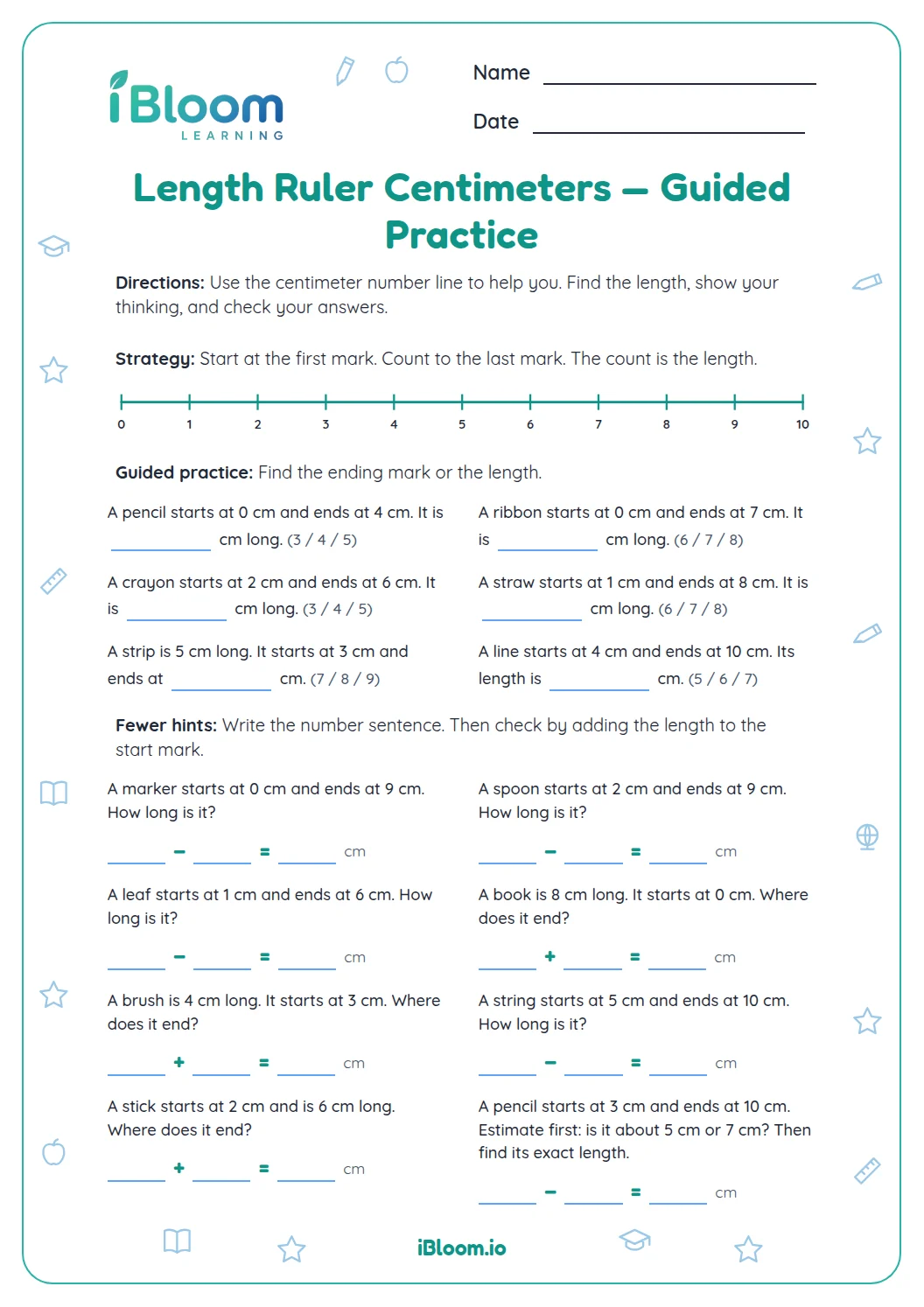
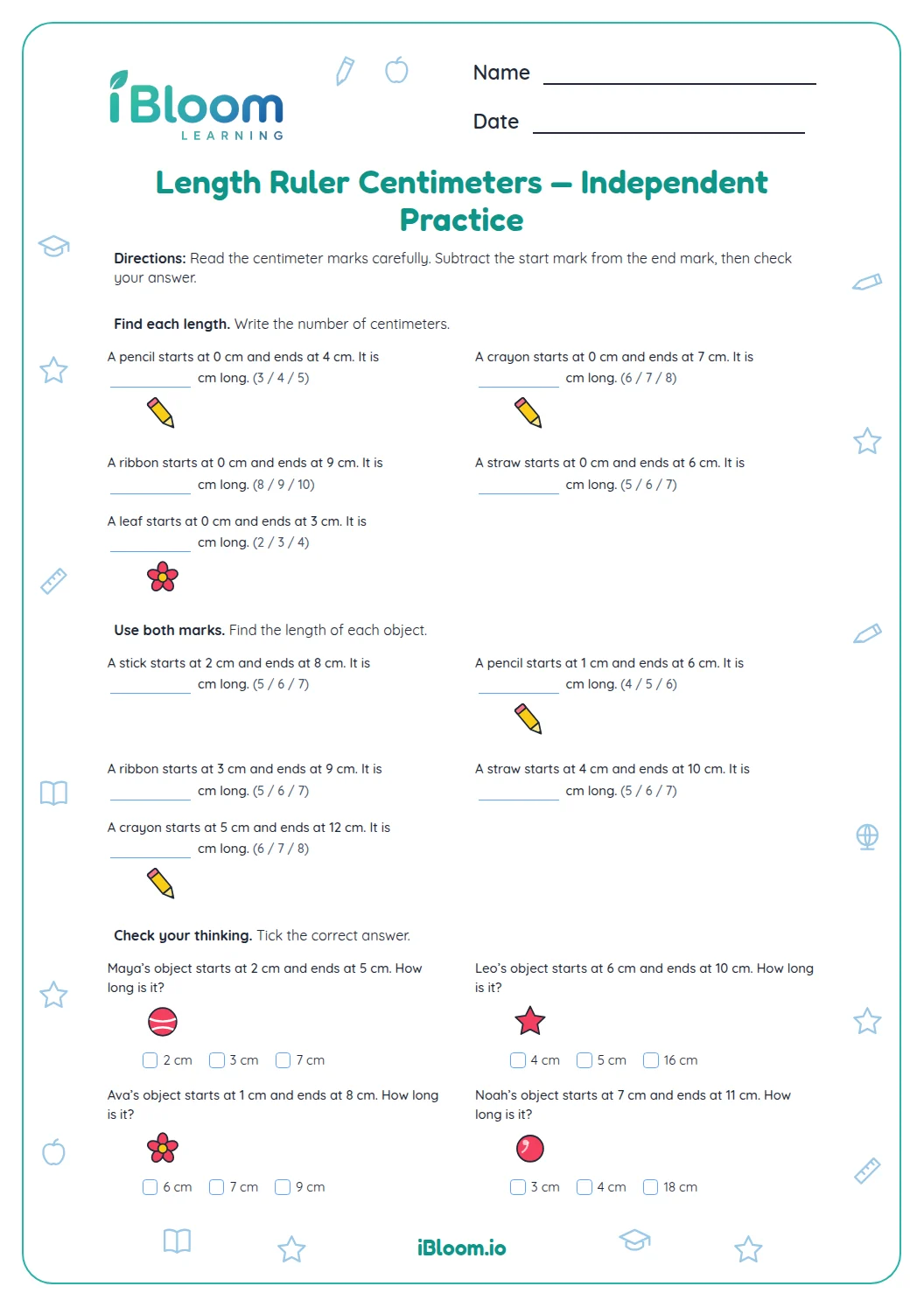
This free printable Grade 1 worksheet connects inch-ruler readings with 14 everyday measurement problems. In Part A, children read four bars that start at zero. Part B gives the starting and ending ruler marks for five objects; three start beyond zero, so children subtract to find the length. Part C has five stories about joining, cutting, and comparing lengths. The sheet practices ruler measurement in CCSS 2.MD.A.1 and addition and subtraction word problems in CCSS 1.OA.A.1. A separate answer key gives all 14 lengths in inches.
Aligned to 2.MD.A.1 and 1.OA.A.1
Where should children start reading the ruler?
Start at the zero mark under the left end of each bar. An inch is the space from one numbered mark to the next, so the space from 0 to 1 is the first inch. The zero mark is a starting point, not an extra inch.
Every bar ends on a numbered mark. Children can follow those whole-inch intervals without counting the shorter marks between them.
- 1The tape bar begins at 0 and ends at 3.
- 2The spaces are 0 to 1, 1 to 2, and 2 to 3.
- 3The tape is 3 inches long.
What if the object starts beyond zero?
Part B gives the ruler marks in words. The endpoint gives the length directly when an object starts at zero. When it starts farther along the ruler, subtract its starting mark from its ending mark.
For question 7, the crayon runs from 2 to 6. Count four spaces: 2 to 3, 3 to 4, 4 to 5, and 5 to 6. The subtraction 6 − 2 = 4 records that count.
When should children add or subtract lengths?
Part C asks children to use lengths in short stories. Joining strips makes a longer strip, so add. Cutting a piece off leaves a shorter piece, so subtract.
Comparison stories require attention to longer and shorter. A card that is 2 inches longer than a 6-inch bookmark measures 8 inches. Ribbon that is 3 inches shorter than 9 inches measures 6 inches.
Do children need a separate ruler?
Children read the four rulers drawn in Part A and use the measurements stated in Parts B and C. Each colored bar represents the supply named in its question. Use the labeled scale on each illustration; its physical size can change with printer settings.
For an optional follow-up, use a real inch ruler to measure a strip of paper. Line up one end with zero and compare that action with the bars on the worksheet.
How to use this worksheet
- 1Point to zero and count one inch from 0 to 1 on the first drawing.
- 2Read the four bar lengths in Part A and write the numbers of inches.
- 3For Part B, subtract each starting mark from its ending mark.
- 4For Part C, decide whether each story adds length or takes length away.
- 5Check the answers and ask your child to explain one nonzero-start measurement.
Mistakes to notice and fix
The mistake
Counting zero as the first inch and getting one extra inch.
The fix
Count spaces between numbered marks, beginning with 0 to 1.
The mistake
Reading the last number on the ruler instead of the end of the bar.
The fix
Move a finger down from the bar’s right edge to its matching mark.
The mistake
Using 6 as the crayon’s length when it starts at 2 and ends at 6.
The fix
Count the spaces from 2 to 6 or subtract 6 − 2. The crayon is 4 inches long.
Common Core alignment
Read pictured inch rulers and determine lengths from starting and ending marks.
On this sheet: Children use ruler drawings to determine the lengths of bars representing everyday materials.
Show the official wordingHide the official wording
Measure the length of an object by selecting and using appropriate tools such as rulers, yardsticks, meter sticks, and measuring tapes.
Add and subtract lengths within 20 in joining, taking-away, and comparing stories.
On this sheet: Five length stories ask children to add or subtract to find a new length, a remaining length, or a total.
Show the official wordingHide the official wording
Use addition and subtraction within 20 to solve word problems involving situations of adding to, taking from, putting together, taking apart, and comparing, with unknowns in all positions, e.g., by using objects, drawings, and equations with a symbol for the unknown number to represent the problem.
What to practice next
Make more practice
Further reading
Questions parents and teachers ask
Are the ruler drawings printed at actual inch size?
Read the labeled scale on each drawing to answer the questions. The bars and rulers are illustrations, and their physical size can change with printer settings. Children use the zero mark and numbered endpoints on the sheet; they do not need to place a separate ruler on the paper.
What do the colored bars represent?
Each colored bar represents the supply named in its question: tape, a label, a paper strip, or ribbon. Its left end lines up with zero, and its right end marks its length. Children read these four measurements before working with starting and ending marks stated in words.
Does my child need to read the small ruler marks?
All four pictured bars end on whole-inch numbers, so children can read their lengths from the numbered marks. First trace the spaces from zero to the endpoint. In Part B, the starting and ending marks are given as whole numbers, and children find the number of inch spaces between them.
Why is the crayon 4 inches long if it ends at 6?
The crayon starts at 2, so the spaces before 2 are not part of its length. Count from 2 to 3, then 3 to 4, 4 to 5, and 5 to 6. Those four inch spaces give a length of 4 inches, recorded as 6 − 2 = 4.
Can I read the word problems aloud?
Yes, reading the situations aloud lets your child focus on the measurements and the operation. In Part B, emphasize the starting and ending marks. In Part C, ask whether the length grows or shrinks. The key gives all 14 answers so you can check each measurement together.