






About this worksheet
This Grade 2 worksheet uses four illustrated centimeter rulers and ten compact number sentences about length. Learners read each ruler from zero, then use addition or subtraction to find a length or difference. The separate answer key supports review; ruler reading aligns with CCSS 2.MD.A.1.
Aligned to 2.MD.A.1
Where does the measurement begin?
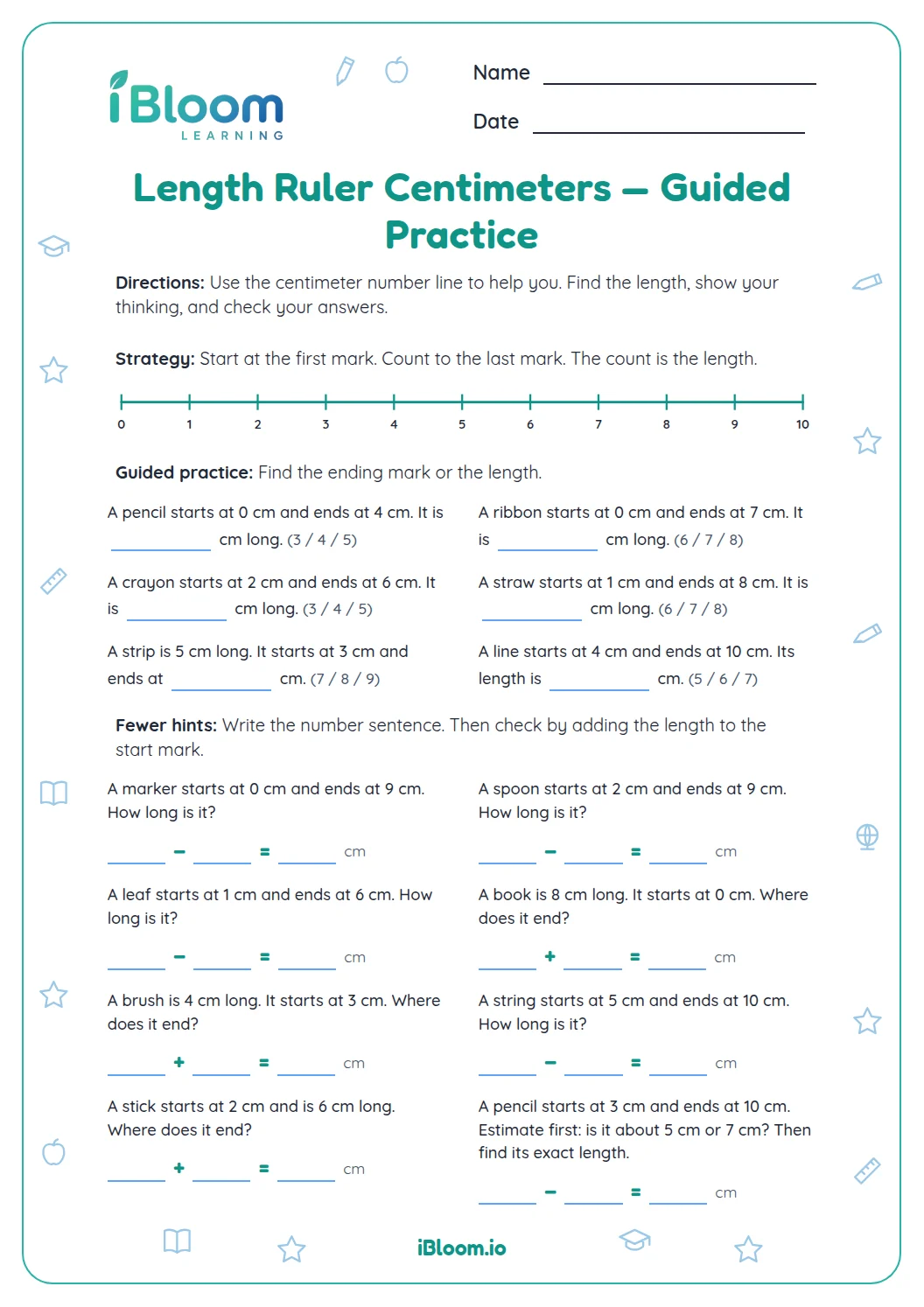
Start at zero and read the centimeter mark at the object’s far end. For example, the pencil in question 1 reaches 3 cm, so its length is 3 cm.
How can a model show a missing length?
A number bond connects a whole length to its parts. In question 5, the whole is 7 cm and one part is 4 cm, so the missing part is 3 cm.
How do you compare two lengths?
Compare the measurements, then subtract the shorter from the longer to find how much longer it is.
How to work through this page
- 1Find the zero mark before reading.
- 2Read the far endpoint in centimeters.
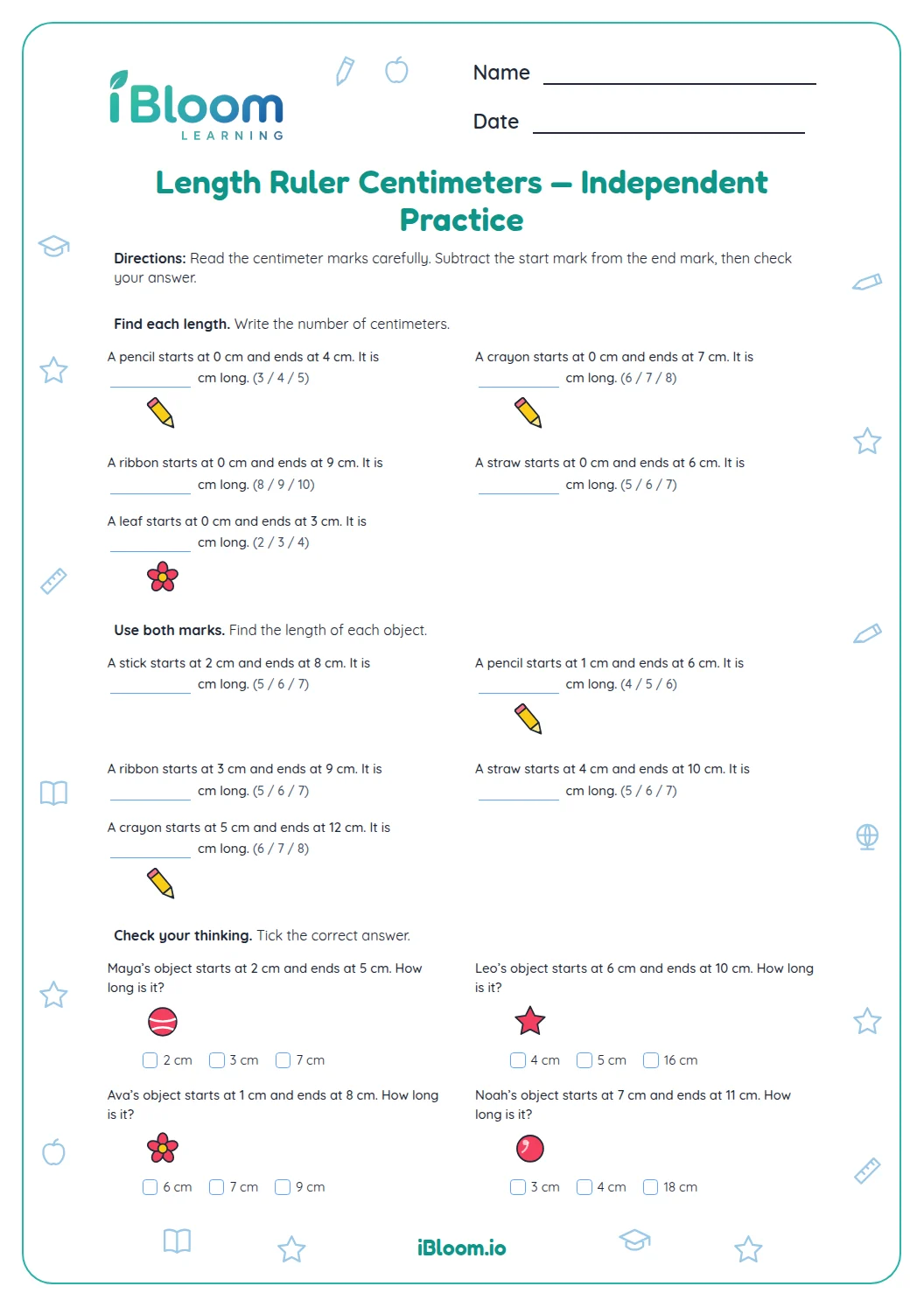
- 3For a missing part, subtract the known part from the whole.
- 4For “how much longer,” subtract the shorter length.
Check these details
The mistake
Counting the zero mark as one centimeter.
The fix
Count the spaces from zero to the endpoint.
The mistake
Giving only a number.
The fix
Write cm when the answer is a length.
The mistake
Subtracting the longer length from the shorter.
The fix
Start with the greater measurement.
Common Core alignment
Measure an object by using a ruler and reading its endpoint.
On this sheet:
Show the official wordingHide the official wording
Measure the length of an object by selecting and using appropriate tools such as rulers, yardsticks, meter sticks, and measuring tapes.
What to practice next
Make more practice
Further reading
Questions parents and teachers ask
How do I read the ruler drawings?
Place your eyes at zero, then follow the object to its far endpoint. The endpoint number is the length in centimeters. For instance, question 1 ends at 3, so the pencil is 3 cm long. The drawings use whole-centimeter marks.
Why does the measurement start at zero?
The zero mark is where the object begins, so the length is the distance from zero to the endpoint. Counting the spaces gives the measurement. If an object starts at 1 and ends at 6, its length is 5 cm, not 6 cm.
How do number bonds help with length?
A number bond shows how a total length is made from two parts. If the whole is 7 cm and one part is 4 cm, subtract 4 from 7 to find the other part. Questions 5 and 6 use this relationship to find missing lengths.
What does “how much longer” ask?
It asks for the difference between two lengths. Subtract the shorter measurement from the longer one. In question 11, the red strip is 7 cm and the blue strip is 3 cm, so the red strip is 4 cm longer.
How many questions and pages are included?
There are 14 questions on two worksheet pages, followed by a two-page answer key. The practice starts with four centimeter-ruler readings and continues with ten compact number sentences about length. Students can write each answer with its unit when the prompt asks, then check with the key.