






About this worksheet
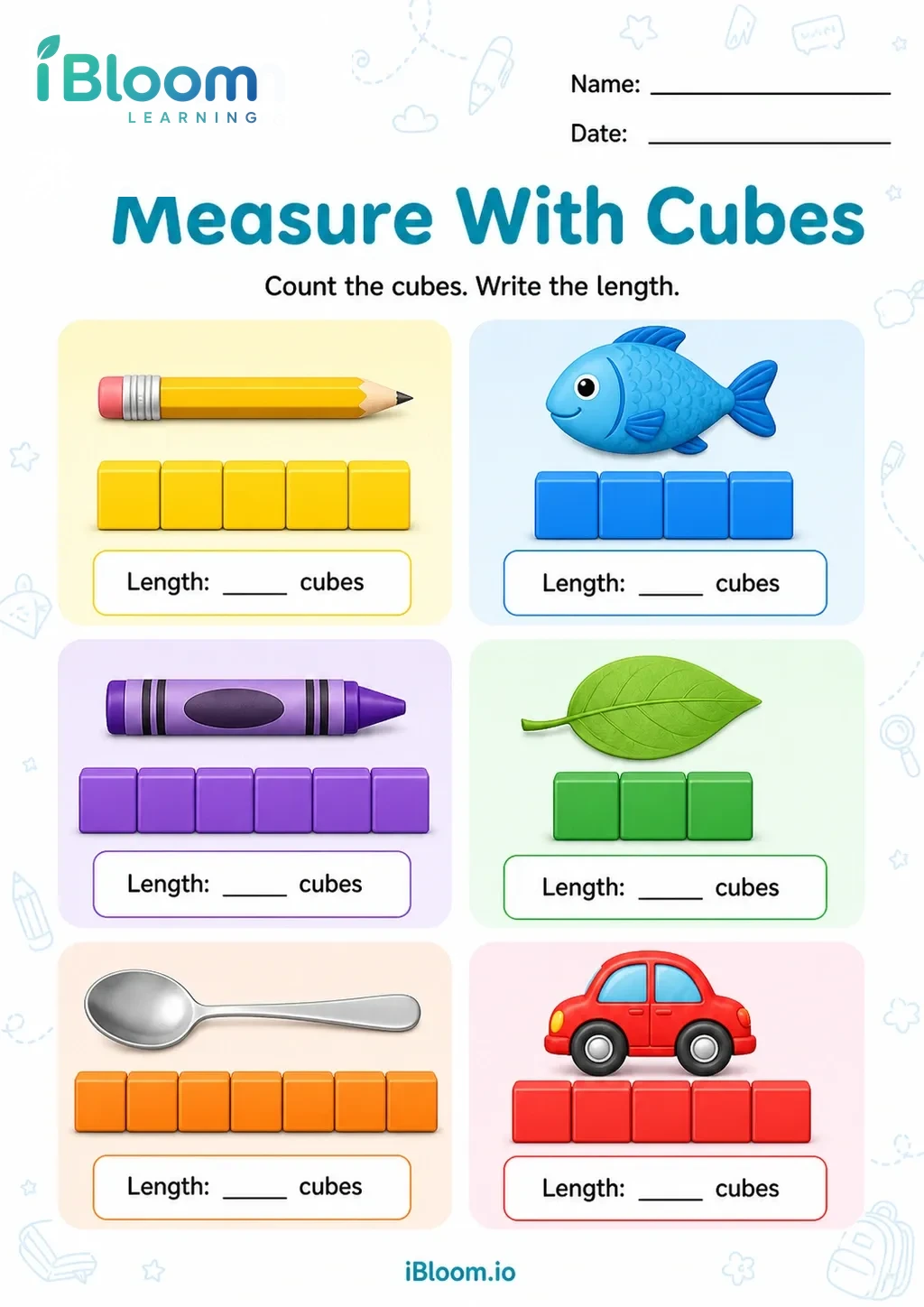
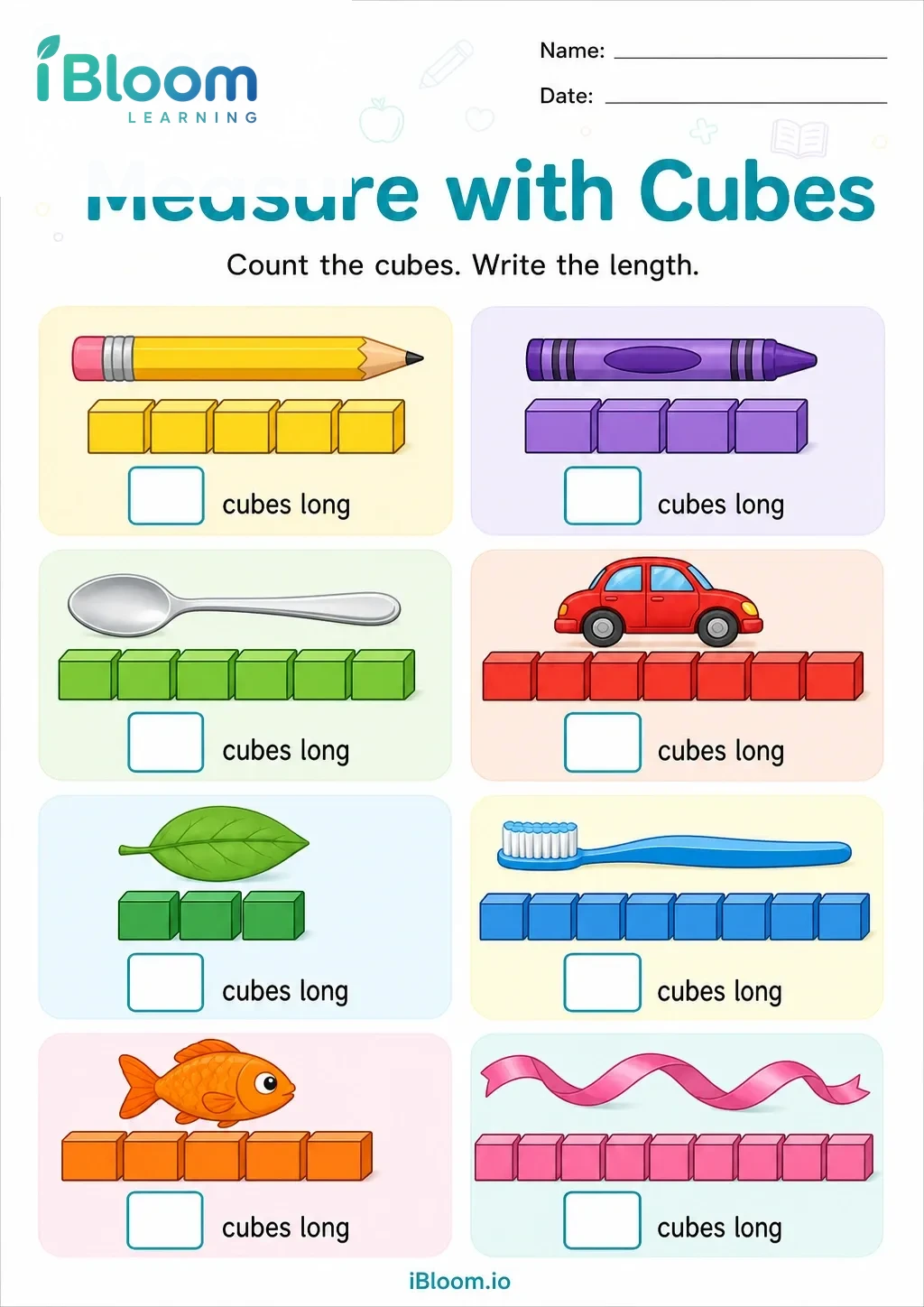
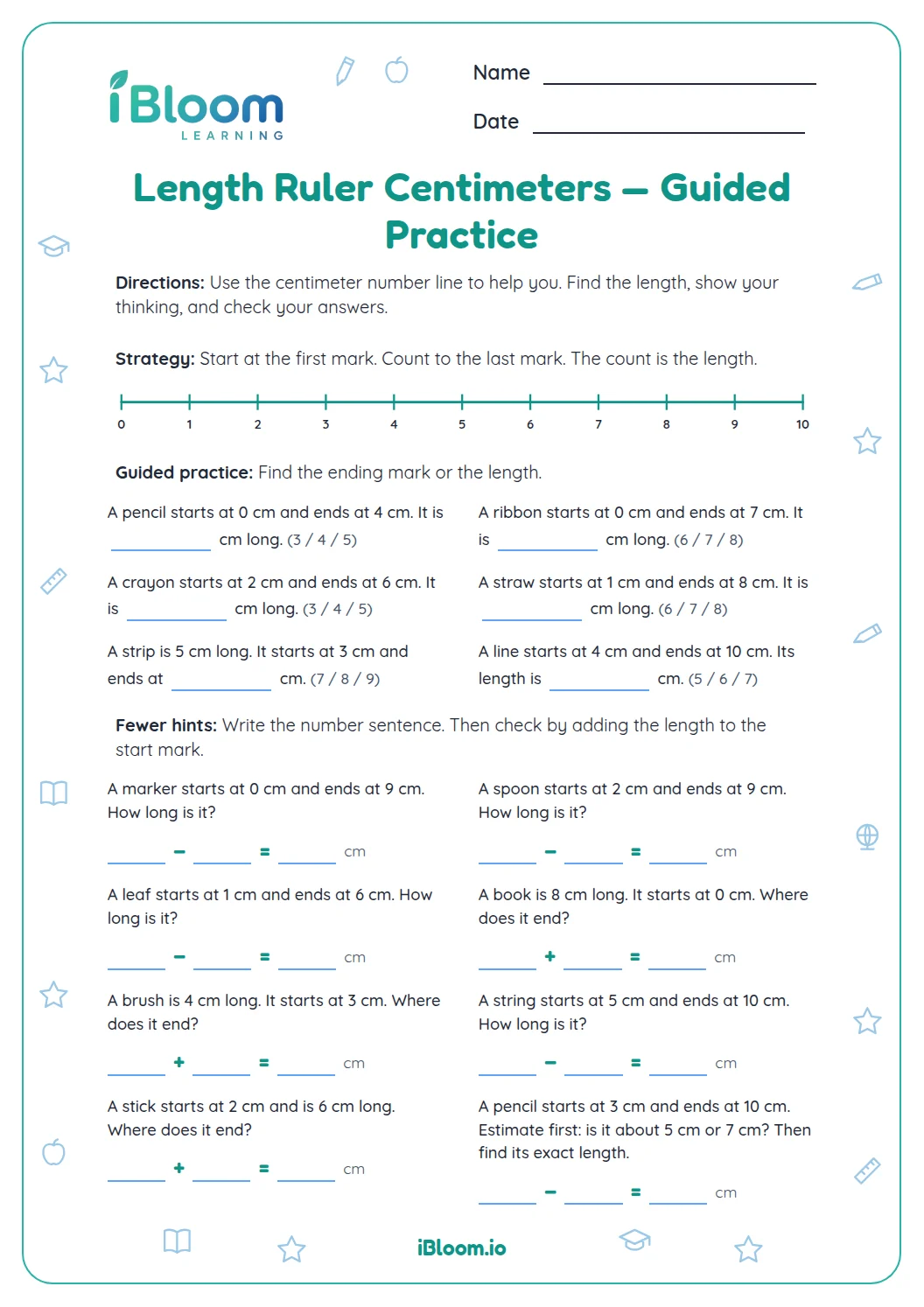
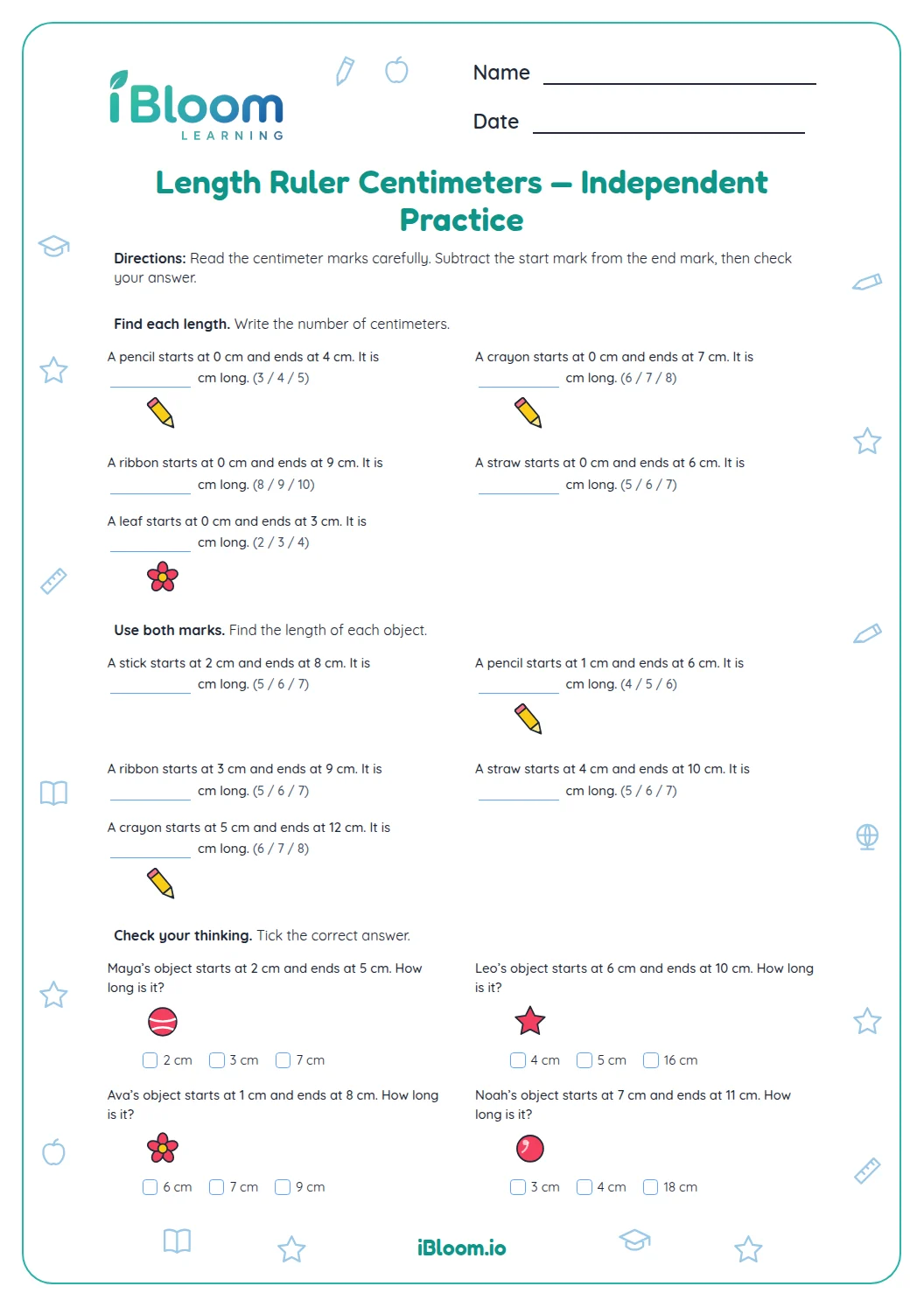
This free printable worksheet gives Grade 1 children guided practice with centimeters. Each part opens with a short hint, and the questions move from counting centimeter cubes, to comparing and joining lengths, to deciding whether an answer makes sense for a real object. It practices Common Core 1.MD.A.2, where a length is the number of same-size units laid end to end, with 1.OA.A.1 for the short word problems within 20. Every length is a whole number of centimeters, and a two-page answer key follows the sheet.
Aligned to 1.MD.A.2 and 1.OA.A.1
What does 1 centimeter mean to a first grader?
A centimeter is a small unit of length, about the width of a pinky fingernail. For first graders the useful idea is that length is a count. A centimeter cube is exactly 1 cm long, so six cubes in a row make a line 6 cm long.
A ruler works the same way. Its marks show centimeters one after another, so an object that starts at 0 and ends at the 9 mark is 9 cm long. Children who have counted cubes understand why the number at the end tells the length.
- 1Mia lines up 6 centimeter cubes end to end.
- 2Touch each cube and count: 1, 2, 3, 4, 5, 6.
- 3The last number you say is the length.
- 4Answer: 6 cm
How do children compare and join lengths?
Children use the same thinking as in other first grade word problems: which is longer, how much longer, and how long are they together. In question 5, a crayon is 9 cm and a marker is 14 cm. The marker is longer because 14 is more than 9.
Questions 9 and 10 use the numbers. Putting an 8 cm string and a 5 cm string end to end gives 8 + 5 = 13 cm. A 15 cm pencil is 15 − 3 = 12 cm longer than a 3 cm paper clip. A quick drawing of two bars helps children see whether to add or take away.
Why ask whether an answer makes sense?
A child who only computes can write 90 cm for a crayon without noticing. Questions 6 to 8 give children a few anchor lengths to check against: a pinky fingernail is about 1 cm wide, a paper clip is about 3 cm long, and a new crayon is about 9 cm long.
With those anchors in mind, children can tell that 3 cm is too short for a math book.
What is on this worksheet?
Ten questions in three parts, each with a hint under its heading. The questions are written out and there is no ruler picture, so keep a real centimeter ruler and some cubes or small objects at hand. Children can lay cubes in a row to check Part A.
- Part A, Count the cubes: three fill-in questions on counting cubes, adding more and cutting some off (questions 1 to 3)
- Part B, Compare and check: reading a length from 0 on a ruler, longer or shorter, and sensible lengths for real objects (questions 4 to 8)
- Part C, Solve: joining two lengths and finding how much longer one is, with working space (questions 9 and 10)
- A matching two-page answer key
How to use this worksheet at home or in class
- 1Gather 10 centimeter cubes, or cut a paper strip into 1 cm pieces. Line up six and count them together.
- 2Read the hint under the Part A heading aloud and do question 1 with the cubes.
- 3Let your child finish Part A. For question 4, hold a real ruler and point to the 0 before counting.
- 4Before Part C, ask for a quick drawing of two bars so your child can see whether to add or take away.
- 5Read questions 6 to 8 aloud. Then test them: hold a crayon next to a ruler and see whether it is about 9 cm.
- 6Check with the answer key and talk through any miss with the cubes or the ruler.
Common mistakes and quick fixes
The mistake
Counting the marks on a ruler instead of the spaces between them. In question 4, a child counts 0 to 9 as ten marks and answers 10 cm.
The fix
Say "zero" at the start of the object, then count the jumps: 1, 2, 3, up to 9. The last jump you say is the length.
The mistake
Adding when the question asks how much longer. In question 10, a child writes 15 + 3 = 18 cm.
The fix
Ask, "Is the answer a total or a difference?" Draw two bars side by side. The part of the long bar that sticks out is how much longer it is.
The mistake
Choosing a length that cannot be right, such as 90 cm for a crayon in question 6.
The fix
Compare with something known. A crayon fits in a child's hand, and 90 cm is longer than a child's arm.
Common Core alignment
Most US states use the Common Core standards or a close state version. This sheet practices Grade 1 measurement with length units and short word problems about length.
Say how long something is by counting same-size units, like centimeter cubes, laid end to end.
On this sheet: Main standard: Part A treats a centimeter cube as the length unit and counts how many span a line.
Show the official wordingHide the official wording
Express the length of an object as a whole number of length units, by laying multiple copies of a shorter object (the length unit) end to end; understand that the length measurement of an object is the number of same-size length units that span it with no gaps or overlaps.
Add and subtract within 20 to solve short word problems about lengths.
On this sheet: Questions 2, 3, 9 and 10 are one-step word problems about length, all within 20.
Show the official wordingHide the official wording
Use addition and subtraction within 20 to solve word problems involving situations of adding to, taking from, putting together, taking apart, and comparing, with unknowns in all positions, e.g., by using objects, drawings, and equations with a symbol for the unknown number to represent the problem.
What to practice next
Make more practice
Further reading
Questions parents and teachers ask
What does a first grader need to know about centimeters?
They need to know that a centimeter is a small unit of length and that a length is a count of equal units. A cube that is 1 cm long, lined up six times, makes 6 cm. Most children do not need to remember conversions or other metric units yet.
How does this sheet build the idea of a length unit?
Grade 1 children measure by laying same-size units end to end and counting them (1.MD.A.2). On this sheet each unit is a centimeter cube, so a 6 cm line is six cubes in a row with no gaps or overlaps. Lining up real cubes at home makes the idea concrete.
Why is there no ruler picture on the worksheet?
The sheet is made of written questions, so it says where an object starts and ends instead of showing a ruler. That keeps the numbers exact, but it means children still need a real ruler. Hold one next to question 4 and let your child point to the 0.
What are the answers to the compare and solve questions?
The marker is longer in question 5, the two strings together are 13 cm in question 9, and the pencil is 12 cm longer than the paper clip in question 10. In the fill-ins, 7 cm of ribbon is left in question 3. The answer key lists all ten answers in order.
How can I make this worksheet more hands-on?
Use centimeter cubes, or cut paper into 1 cm squares, and build each length from the questions. Lay out 8 cubes and 5 cubes end to end for question 9 and count the line. Then measure a real crayon and a paper clip against a ruler.
How long does it take, and is there an answer key?
Most first graders finish in about 15 minutes, a little longer if you build the lengths with cubes. Yes. The two-page answer key comes after the worksheet, so you can print only the worksheet for your child and keep the key for yourself.