






About this worksheet
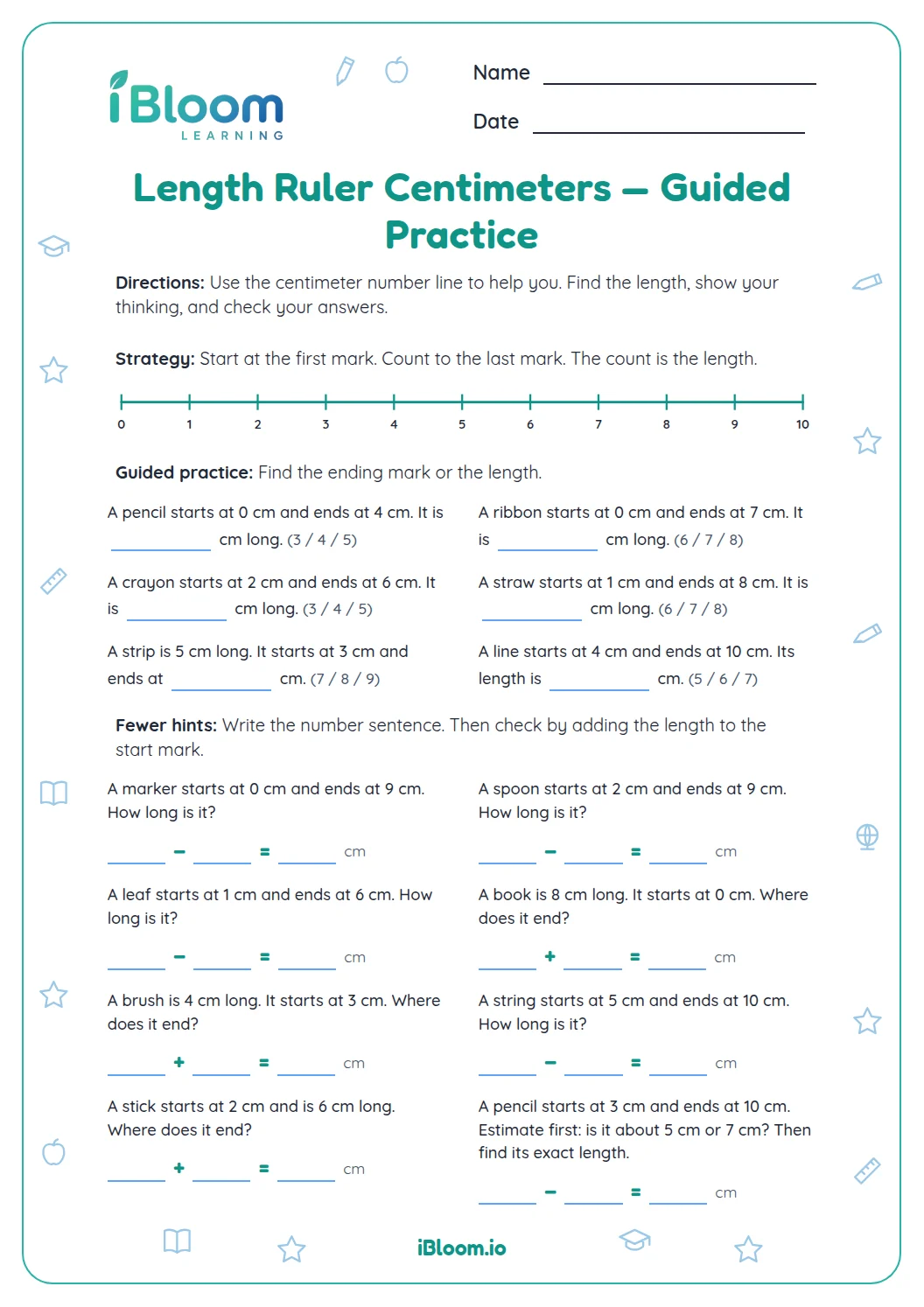
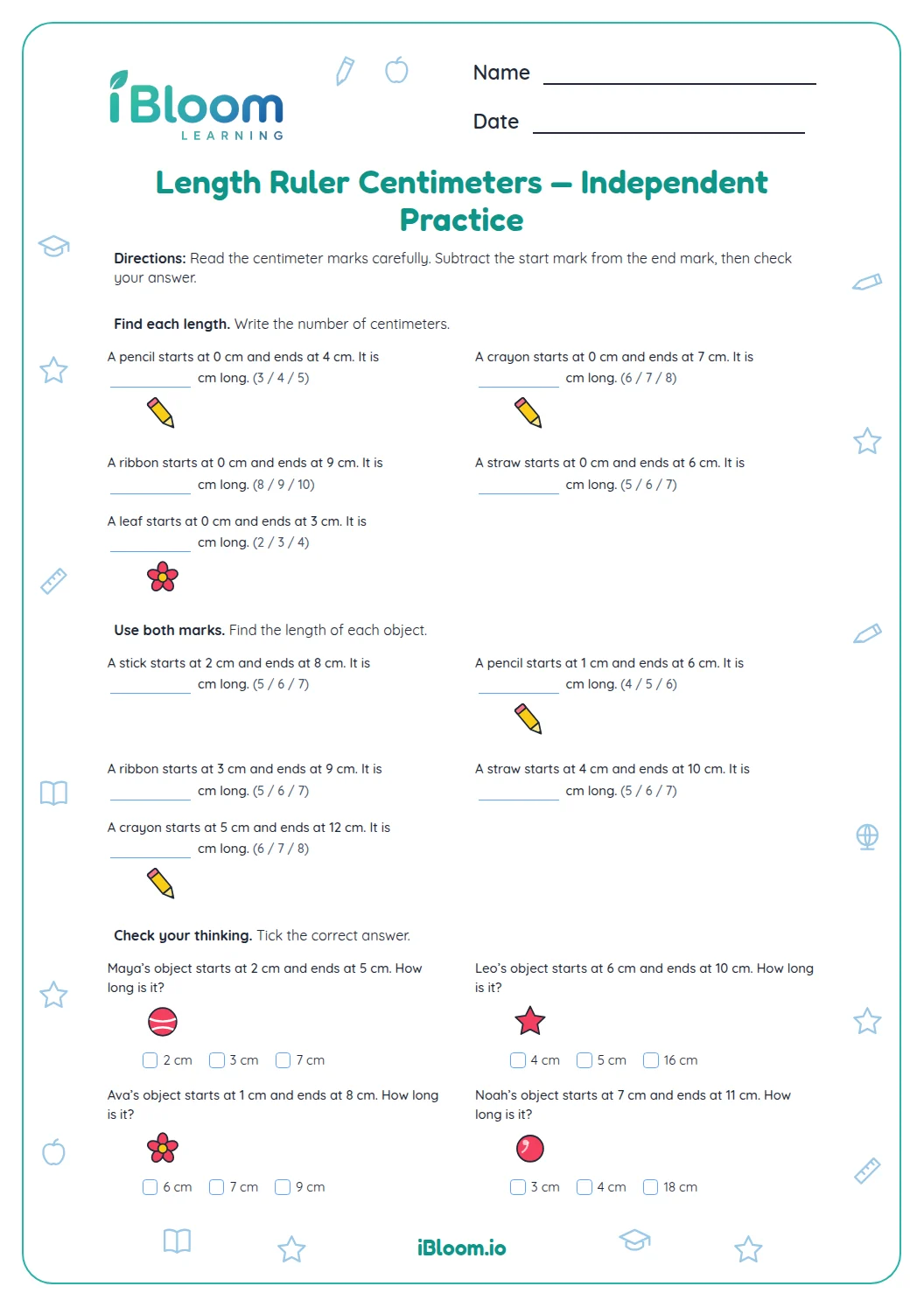
This Grade 1 worksheet has 15 short stories about lengths in centimeters. Students use addition and subtraction to combine lengths, find differences, or work out a missing part. The problems keep answers within 20 and ask children to include cm. A separate answer key gives the results.
Aligned to CCSS 1.OA.A.1
What is the key idea for this skill?
When lengths join, add them; when one length is removed or compared, subtract. Keep centimeters in the answer.
- 11) A crayon is 8 cm long. What does 8 cm tell?
How can you check your answer?
Use the numbers and action in each story to choose addition or subtraction.
- 16) 6 cm + 5 cm = 11 cm.
What should you look for as you work?
A “how much longer” question asks for the difference, found by subtracting the shorter length from the longer one.
- 111) 12 cm − 8 cm = 4 cm.
How to use this worksheet
- 1Read the story and identify each length.
- 2Decide whether lengths join, separate, or compare.
- 3Write an equation that matches the action.
- 4Solve and include cm in the answer.
- 5Check that the answer fits the story.
Common mistakes and quick fixes
The mistake
Adding when the story asks for a difference.
The fix
Subtract the shorter length from the longer one.
The mistake
Leaving cm off the answer.
The fix
Write the unit after each length result.
The mistake
Subtracting from the smaller amount in a comparison.
The fix
Start with the longer length and subtract the shorter.
Common Core alignment
This worksheet practices CCSS 1.OA.A.1 through its questions and examples.
Solve addition and subtraction stories about joining, taking apart, and comparing lengths.
On this sheet: Students solve length stories with addition or subtraction and name the unit in each answer.
Show the official wordingHide the official wording
Use addition and subtraction within 20 to solve word problems involving situations of adding to, taking from, putting together, taking apart, and comparing, with unknowns in all positions, e.g., by using objects, drawings, and equations with a symbol for the unknown number to represent the problem.
What to practice next
Make more practice
Further reading
Questions parents and teachers ask
What does cm mean?
Cm is the abbreviation for centimeters, a metric unit of length. The stories give lengths in centimeters and ask students to combine, compare, or separate those lengths. Children should include cm in the answer so the number names a measurement.
Does a student need a ruler?
No ruler is needed for these story problems because the measurements are given in the text. Students use the supplied centimeter lengths to write an equation and find a total, difference, or missing length. The examples use the same skill throughout.
What kinds of problems are included?
The 15 questions include unit recognition, joining lengths, finding a remaining piece, comparing lengths, and finding a missing part. Every measurement answer is within 20 centimeters, and the equation space supports showing the operation. The examples use the same skill throughout.
How can a child solve a “how much longer” question?
Find the difference between the two lengths by subtracting the shorter from the longer. For example, a 12 cm string is 4 cm longer than an 8 cm string because 12 − 8 = 4 cm. The examples use the same skill throughout.
What comes with the printable?
The printable includes a worksheet and a separate answer key. The key lists the expected response for each item, including centimeter units on length results. Students can compare their equations as well as their final answers. The examples use the same skill throughout.