






About this worksheet
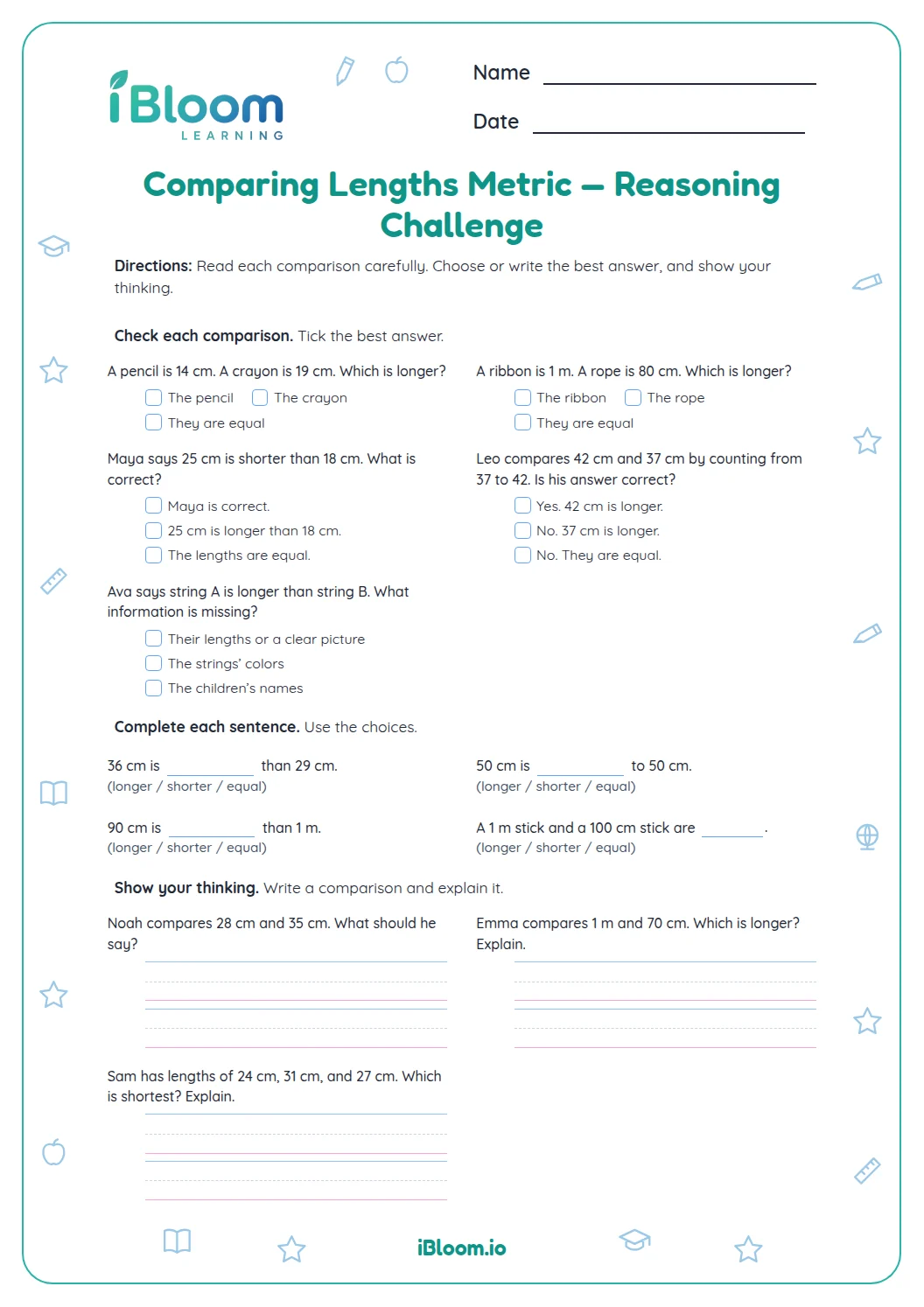
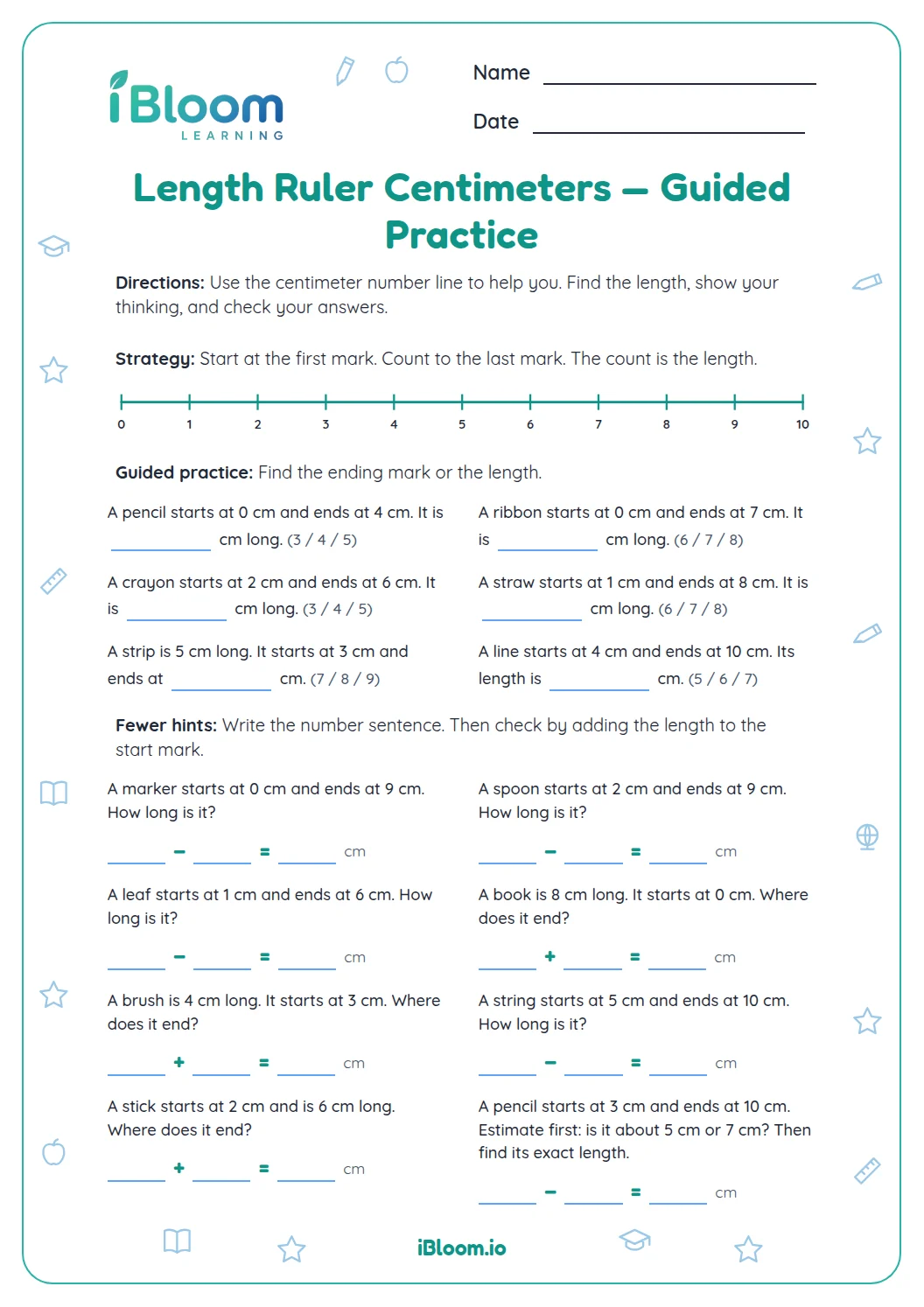
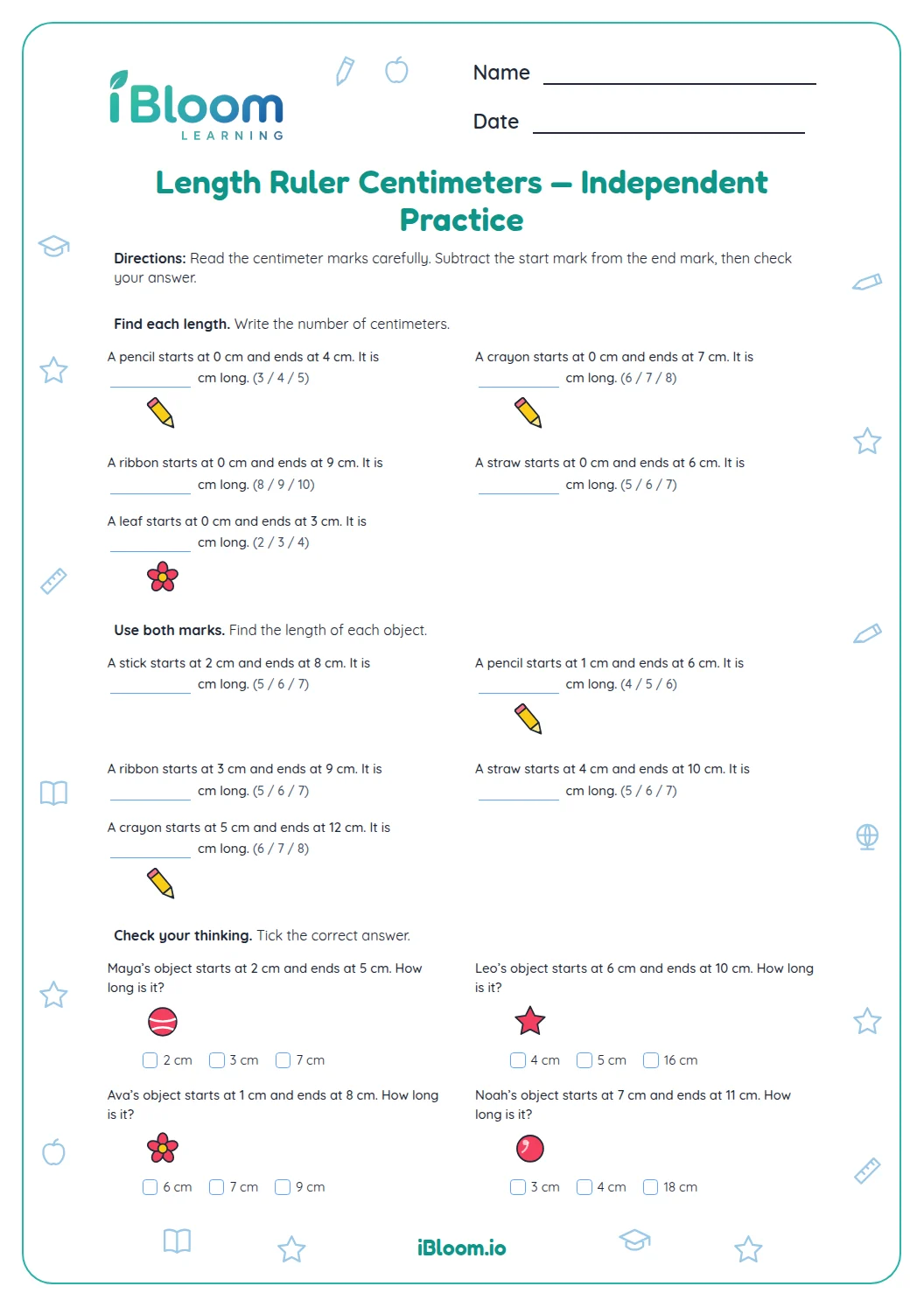
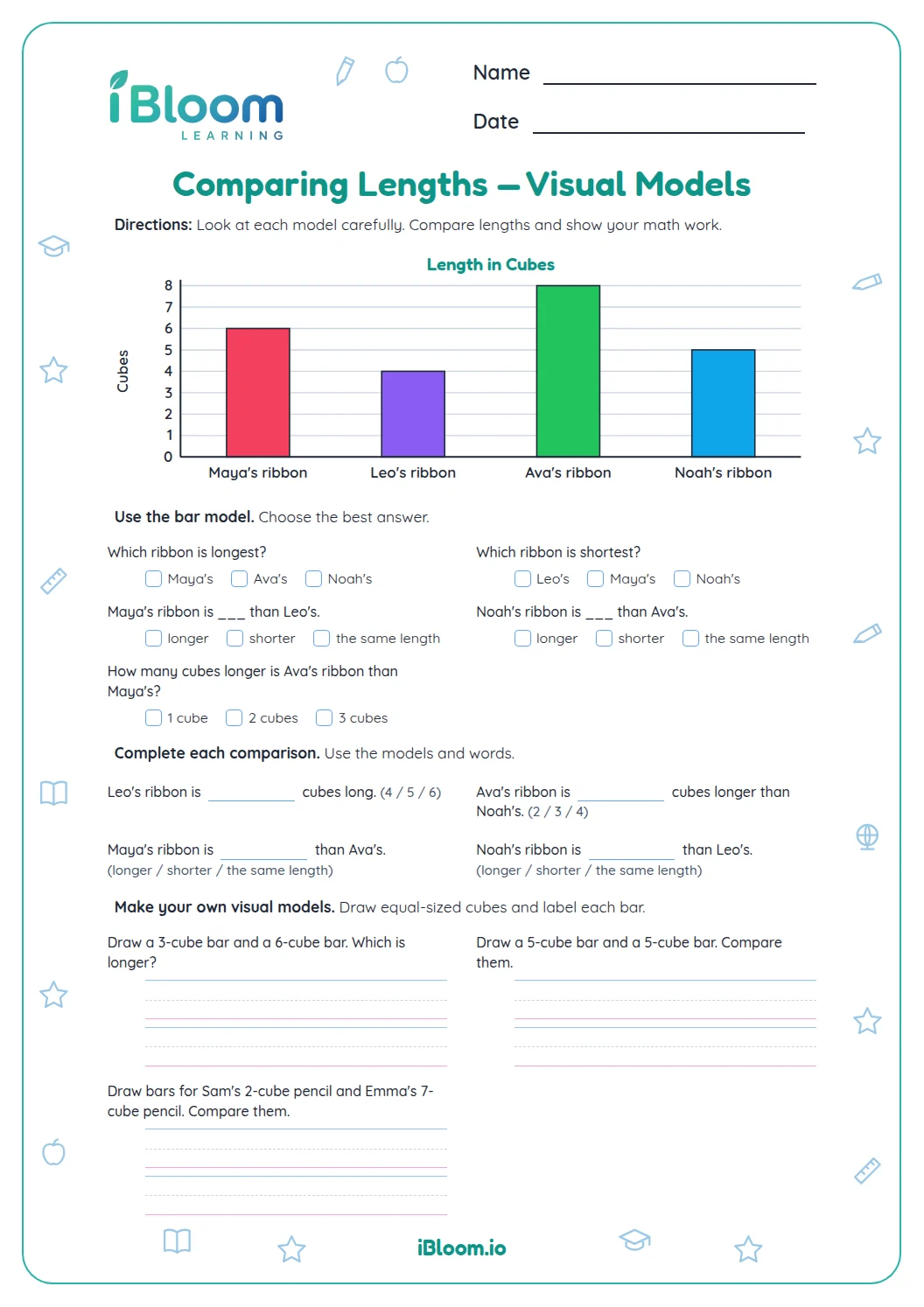
This Grade 1 measurement worksheet gives children 14 comparisons of lengths in centimeters. Two ruler drawings model measured objects; other questions ask children to compare pairs, order three named objects, or compare two objects through a shared third object. A separate answer key supports checking each response. It aligns with Common Core 1.MD.A.1.
Aligned to 1.MD.A.1
How do you order lengths from shortest to longest?
Compare the centimeter counts. The smaller number is the shorter length, and the larger number is the longer length. For three objects, list all three from smallest measure to largest.
Question 1 gives a 6 cm leaf and a 9 cm twig. The leaf is 3 cm shorter than the twig.
- 1Leaf: 6 cm; Twig: 9 cm
- 29 − 6 = 3
- 3The leaf is 3 cm shorter than the twig.
How can a third object help compare two lengths?
A shared object can help compare two lengths indirectly. If a ruler is longer than a pencil and the pencil is longer than a crayon, the ruler is longer than the crayon.
Question 3 compares a 7 cm marker and a 10 cm brush, with a 14 cm book as the reference. The brush is longer than the marker.
Why keep the centimeter unit with each length?
The number tells how many centimeters long an object is. Saying “10” alone does not name the unit; “10 cm” makes the measurement clear. The measured lengths on this page use centimeters.
All the centimeter measures use centimeters, so the lengths can be compared directly.
How to use this worksheet
- 1Read the name and centimeter measure for each object.
- 2For an ordering question, sort the measures from smallest to largest.
- 3For a pair, compare the two measures and use the third object as a reference.
- 4Write the object name or the full shortest-to-longest order.
- 5Check that each object appears exactly once in an ordering answer.
Common slips and helpful fixes
The mistake
Comparing objects by their names or imagined size.
The fix
Use the stated centimeter length or the comparison clues.
The mistake
Reversing shortest-to-longest order.
The fix
Start with the smallest centimeter measure.
The mistake
Reversing a comparison chain.
The fix
Follow each “longer than” clue in order through the shared object.
Common Core alignment
These activities practice the stated Common Core skill through the worksheet questions.
Order three lengths and compare two lengths through a third.
On this sheet: Children order centimeter lengths and compare pairs using a common reference.
Show the official wordingHide the official wording
Order three objects by length; compare the lengths of two objects indirectly by using a third object.
What to practice next
Make more practice
Further reading
Questions parents and teachers ask
How do you order lengths from shortest to longest?
Compare the centimeter measures and list the objects from the smallest measure to the largest. One ordering item gives a 5 cm leaf, a 7 cm stem, and a 9 cm twig; the order is leaf, stem, twig. Check that each object name appears once.
How can a third object help compare two lengths?
If one object is longer than a second object, and that second object is longer than a third, you can compare the first and third through the shared middle object. Two questions use this chain, so no direct measurement of the pair is needed.
Why are the lengths in centimeters?
Every measured length on this sheet uses centimeters, so the values can be compared in the same unit. Children can also connect the ruler drawings to a real centimeter ruler. Keep the unit with a measurement when writing a difference, such as 3 cm.
Do children need a physical ruler?
No physical ruler is needed to answer these questions: the first two include centimeter ruler drawings, and the other items provide lengths or comparison clues. A classroom ruler can be useful afterward for measuring familiar objects and connecting the printed values to real lengths.
How many questions and pages are included?
There are 14 length-comparison questions across two worksheet pages, plus a separate two-page answer key. Students read ruler models, compare pairs, order three named objects, and use a shared object to make an indirect comparison. The page mixes visual and written practice.