






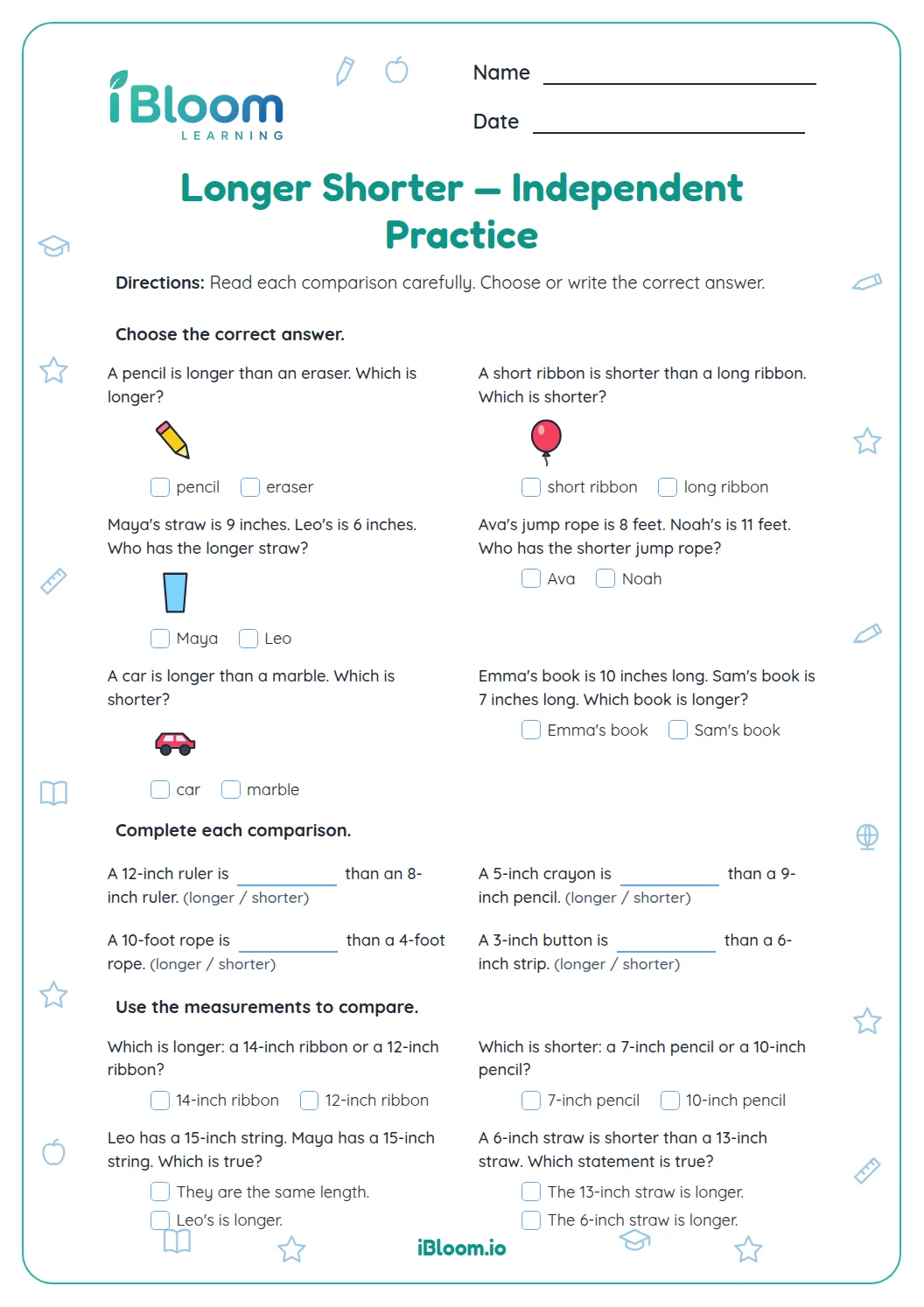
About this worksheet
This Grade 1 worksheet practices CCSS 1.MD.A.2 by expressing length in equal units with no gaps or overlaps. It pairs centimeter ruler drawings with direct length questions. Students begin at zero, count the spaces to an endpoint, compare two lengths, and consider what changes when measuring begins at a later mark. The ruler pictures and answer key support a careful first look at measurement.
Aligned to 1.MD.A.2
Read the ruler?
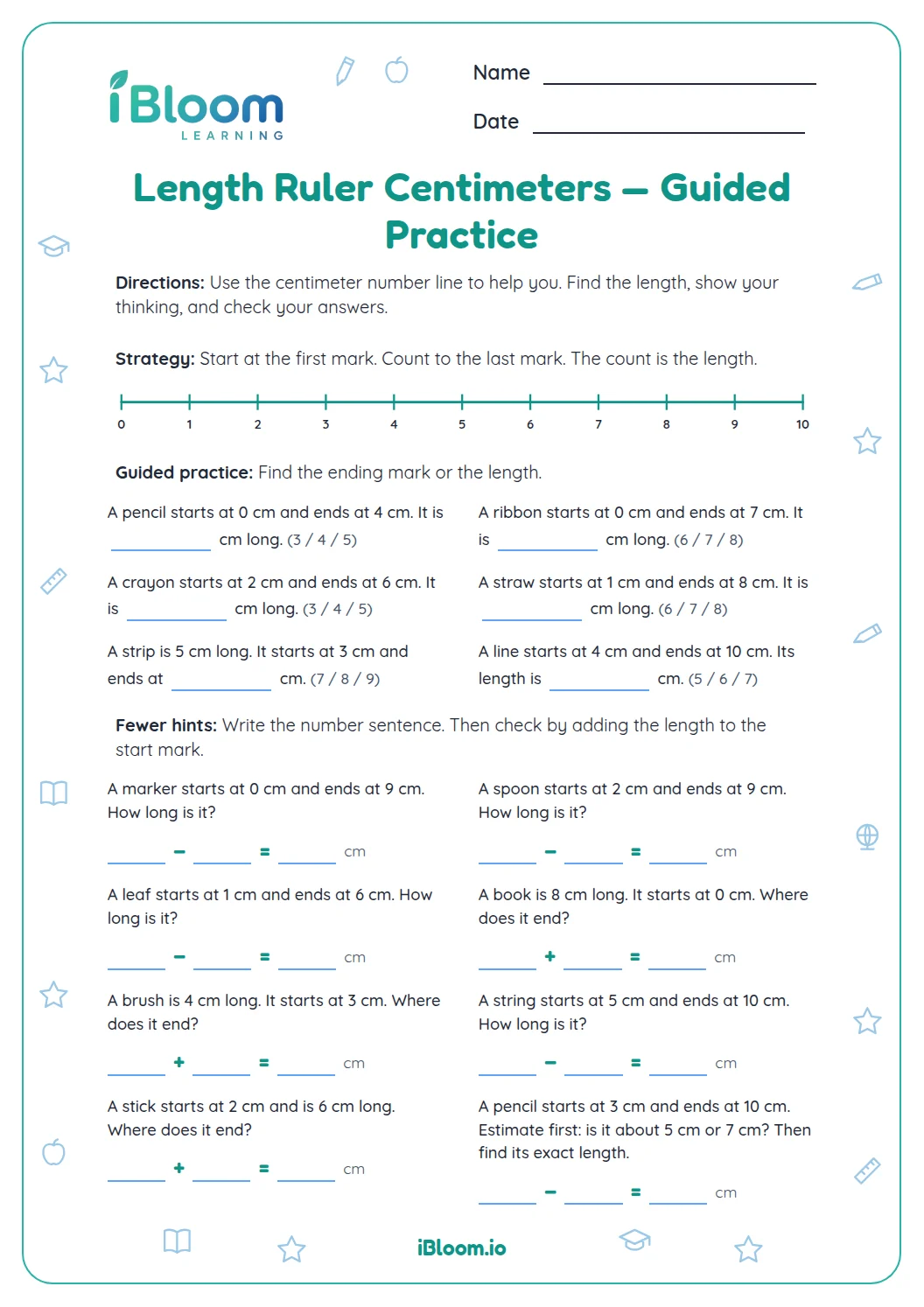
Point to zero first. Count each centimeter space until you reach the object’s end.
- 1How long is the pencil?
- 2Answer: 4 cm
Use and compare lengths?
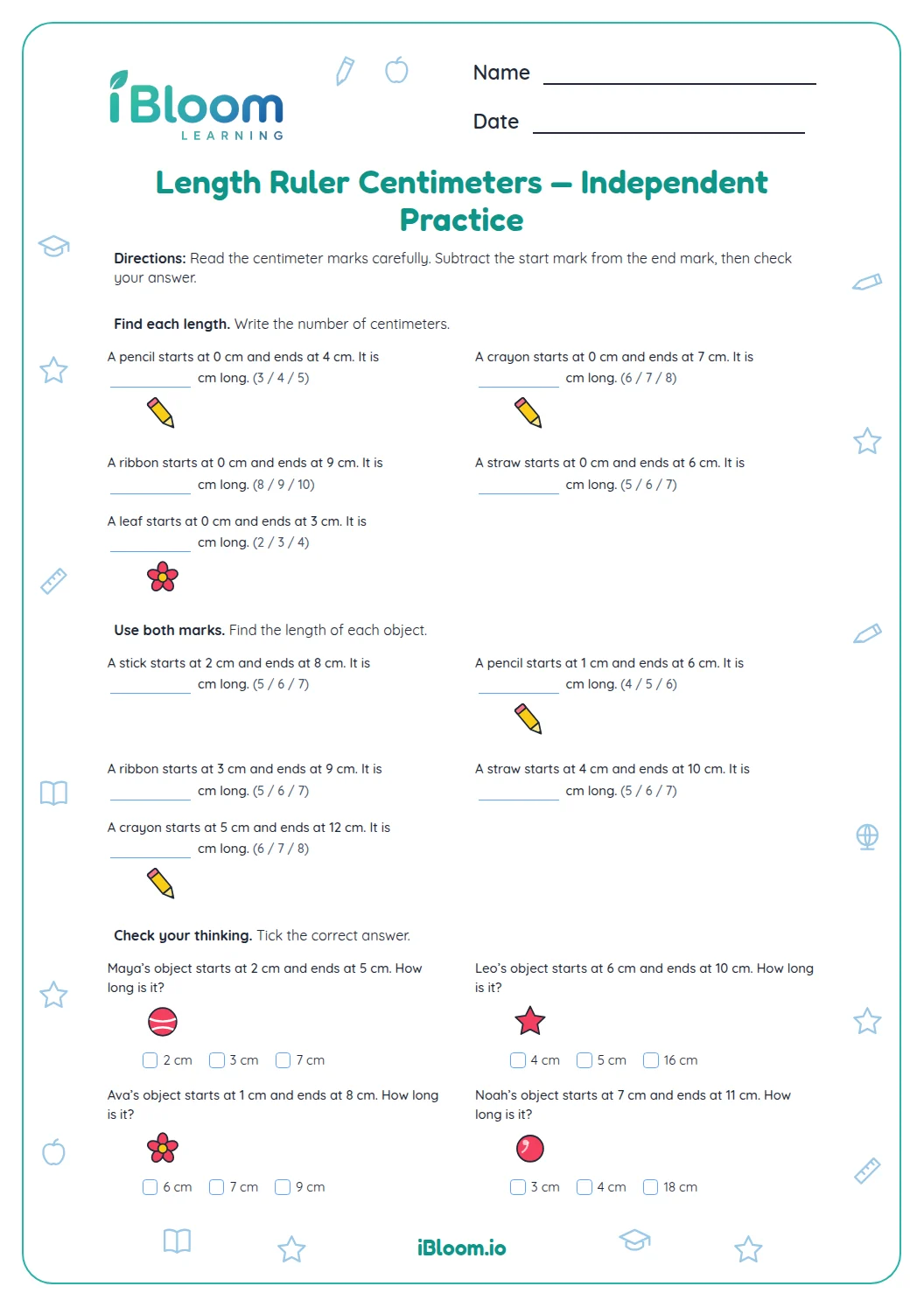
Use and compare lengths uses the same strategy in a new way: reading centimeter rulers from zero and comparing lengths.
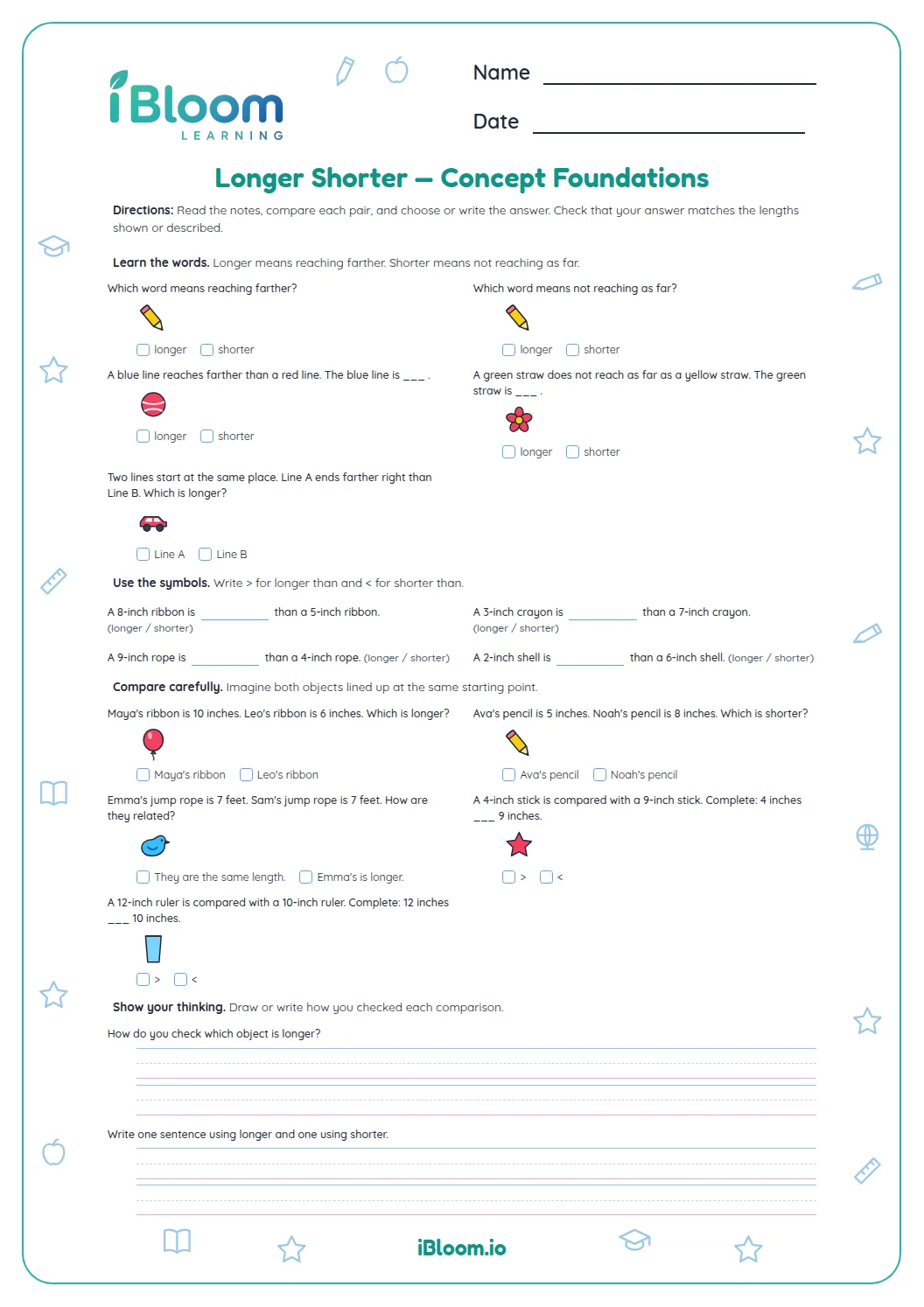
- 1Which is shorter: 2 cm or 3 cm?
- 2Answer: 2 cm
Check the starting mark?
Finish by applying reading centimeter rulers from zero and comparing lengths and checking each result against the question.
- 1A book is 3 cm long. A block is 3 cm long. Are they different lengths?
- 2Answer: They are the same length
How to use this worksheet
- 1Read the direction for read the ruler.
- 2Work through each item and write one answer for each question.
- 3Use the model or number pattern to check the result.
- 4Finish the last part, then use the answer key to review.
Common mistakes and quick fixes
The mistake
Ignoring the key step in reading centimeter rulers from zero and comparing lengths.
The fix
Point to zero first. Count each centimeter space until you reach the object’s end.
The mistake
Writing a result without its requested unit or form.
The fix
Reread the question and include the unit or comparison symbol it asks for.
The mistake
Checking only the final number.
The fix
Repeat the count, measurement, or addition step and compare it with the model.
Common Core alignment
This worksheet practices measuring length in equal units, beginning at zero.
Measure objects by iterating equal-length units from zero.
On this sheet: Students read equal centimeter spaces from zero and compare measured lengths.
Show the official wordingHide the official wording
Express the length of an object as a whole number of length units, by laying multiple copies of a shorter object (the length unit) end to end; understand that the length measurement of an object is the number of same-size length units that span it with no gaps or overlaps.
What to practice next
Make more practice
Further reading
Questions parents and teachers ask
What does this worksheet practice?
This sheet gives students 14 questions on reading centimeter rulers from zero and comparing lengths. The separate answer key matches each question and includes the correct result. Start with the first part together if the model or vocabulary is new, then let the student finish the remaining items before checking.
Why should measuring start at zero?
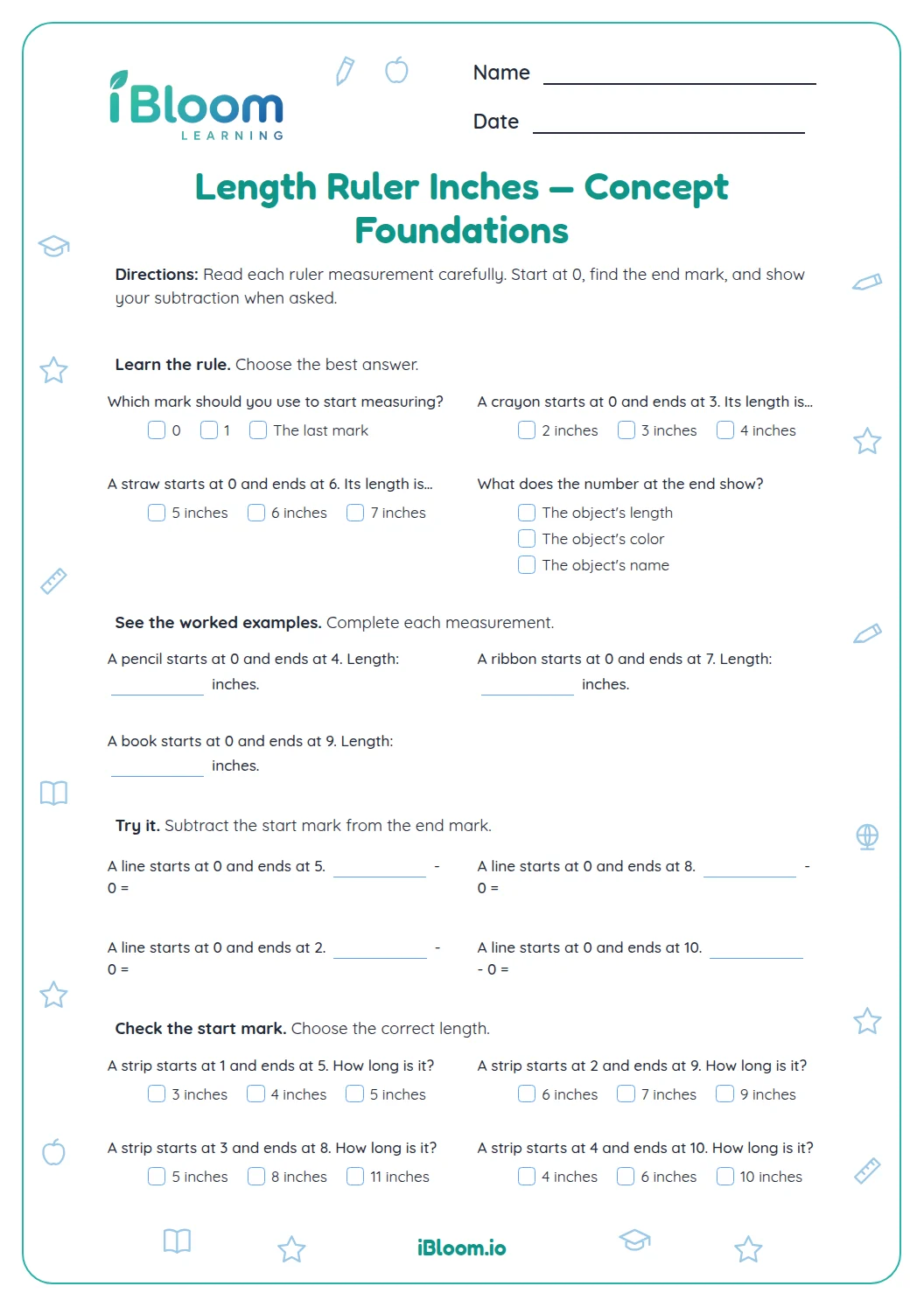
Starting at zero makes the number of spaces match the object’s length. If an object begins at 1 cm and ends at 6 cm, its length is 5 cm because the distance is 6 minus 1. The endpoint alone is not the length when the start is elsewhere.
What does each centimeter mark represent?
The marks divide the ruler into equal one-centimeter spaces. A length is the number of those spaces that span the object, with no gaps or overlaps. Students can touch or point to each interval as they count from the object’s starting point.
How can I use the answer key?
Have the student finish one part before opening the answer key. Compare each response with the matching question and revisit any difference by naming the step that led to the answer. The key is a check; the student can still explain a correct method in their own words.
Can this be used at home or in class?
This printable works for a short classroom practice session or at home. A teacher can assign one part at a time, while a family can review the model and then check the work with the included key. The questions use the same skill throughout so students can focus on the strategy.