


About this worksheet
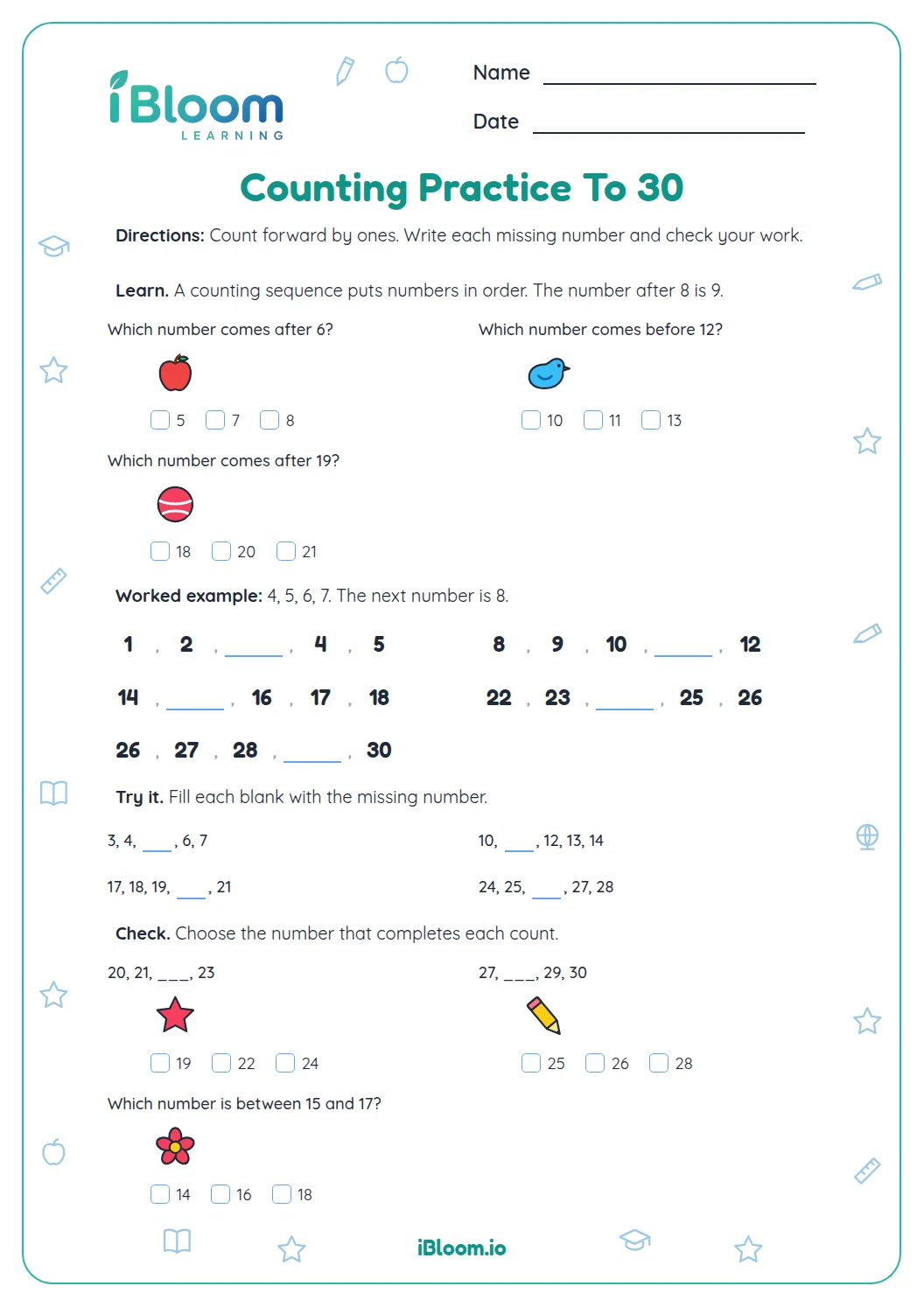
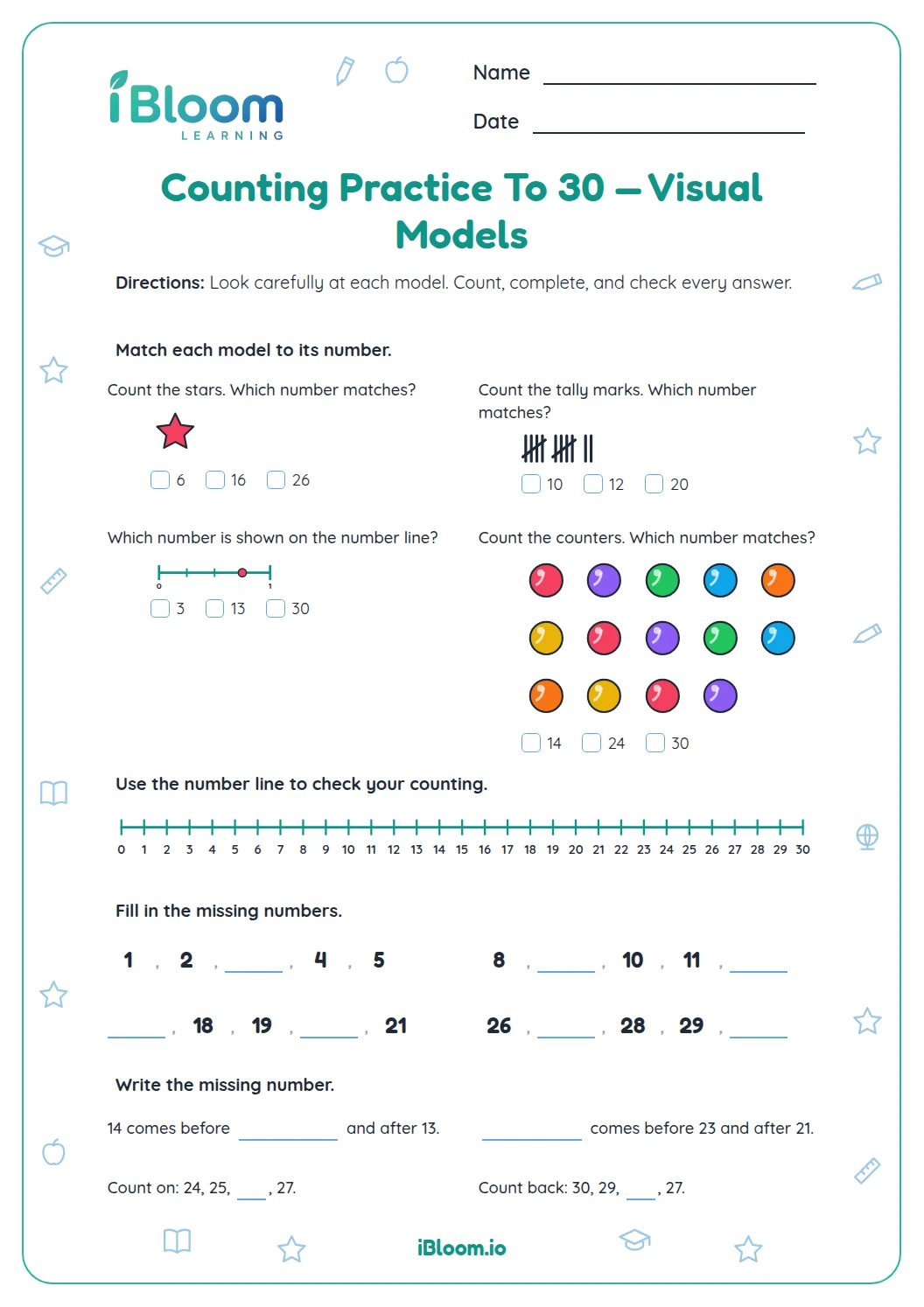
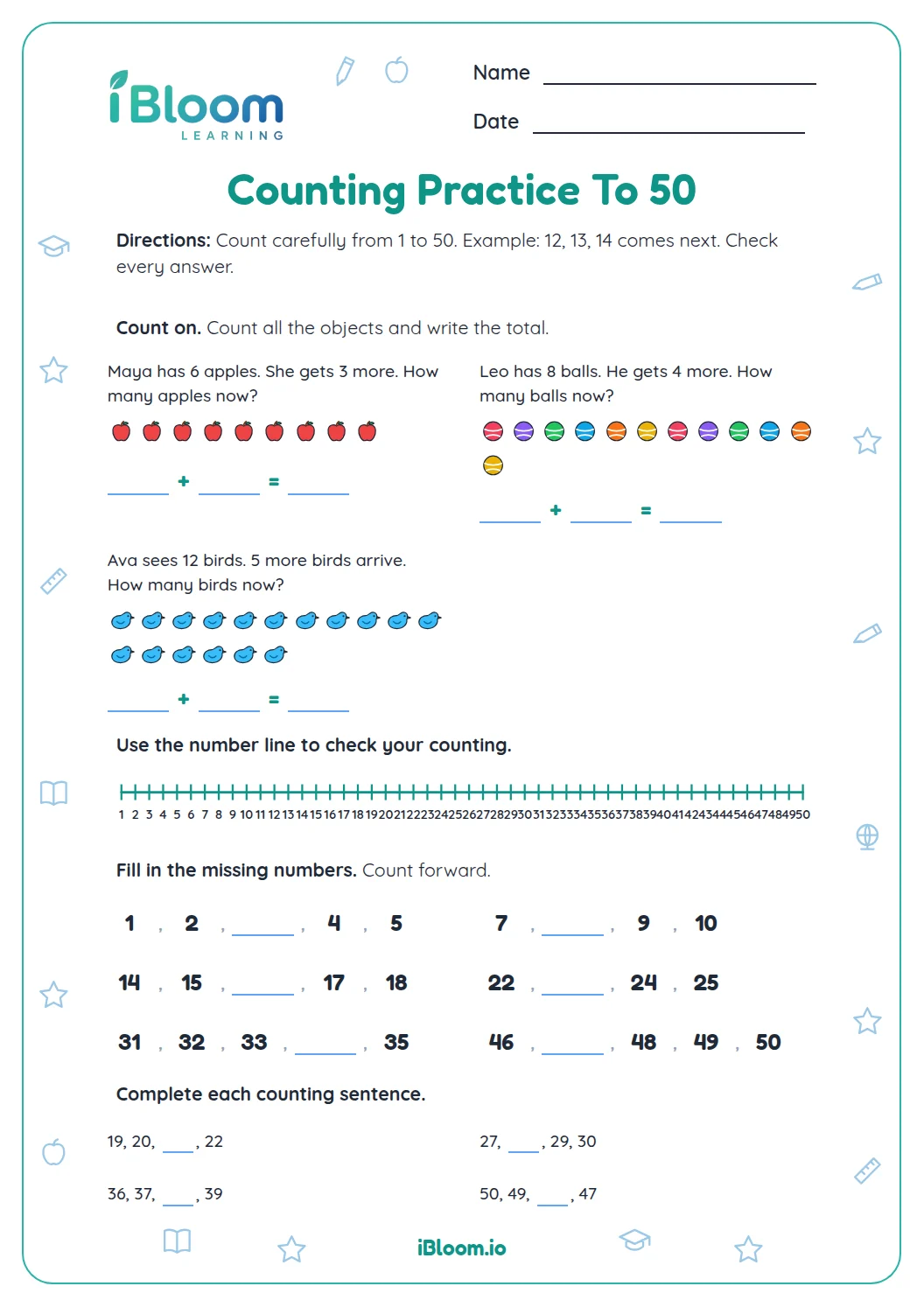
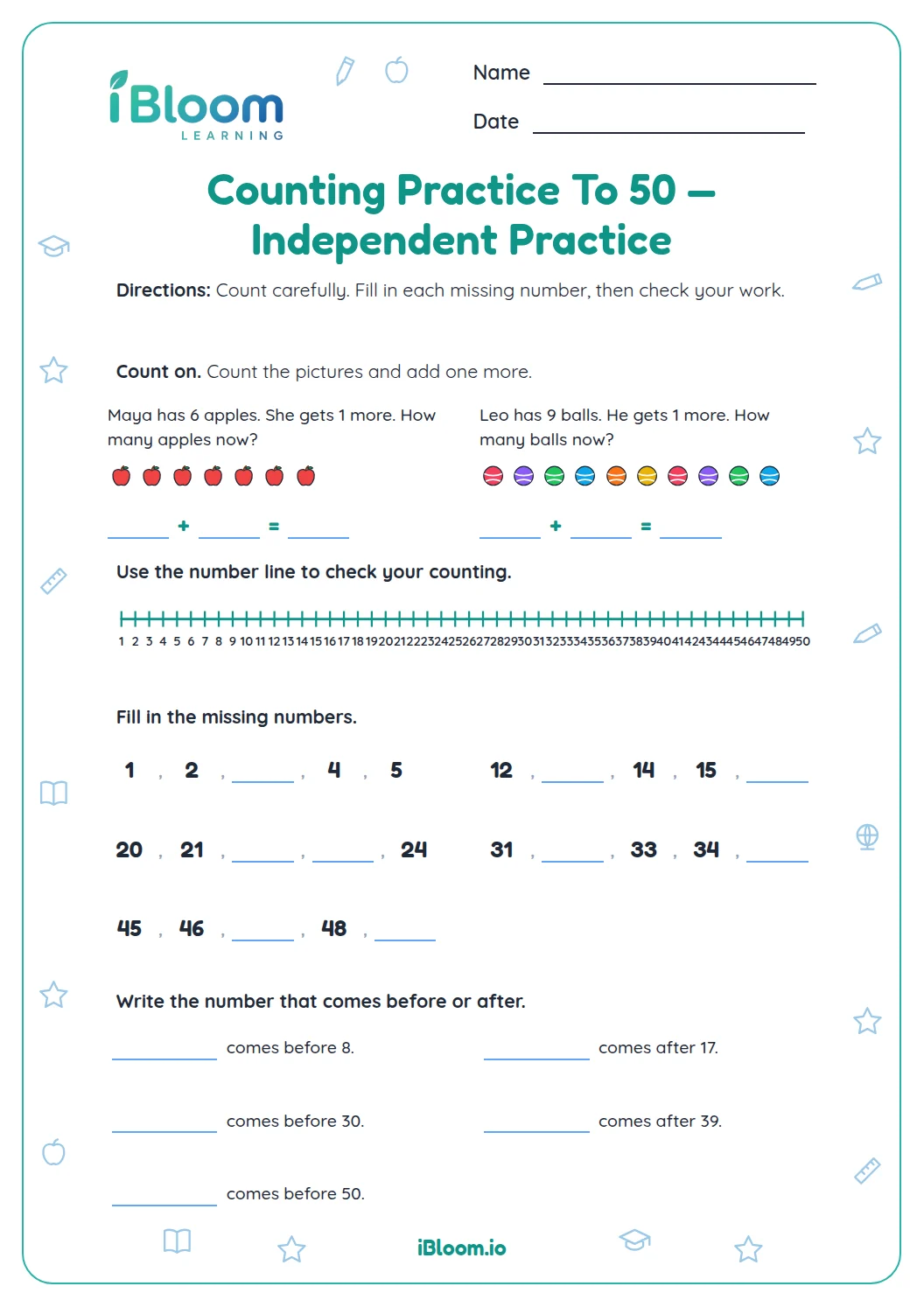
This Grade 1 number-chart worksheet gives students 14 ways to practice counting through 30. Two ten-frame pictures show counters to count, six quick checks ask children to continue or complete a sequence, and six missing-number items cover the ranges 1–10, 11–20, and 21–30. It supports CCSS 1.NBT.A.1 with reading and writing numerals in order through 30. A separate answer key makes checking each sequence simple.
Aligned to 1.NBT.A.1
How do the counter models support counting?
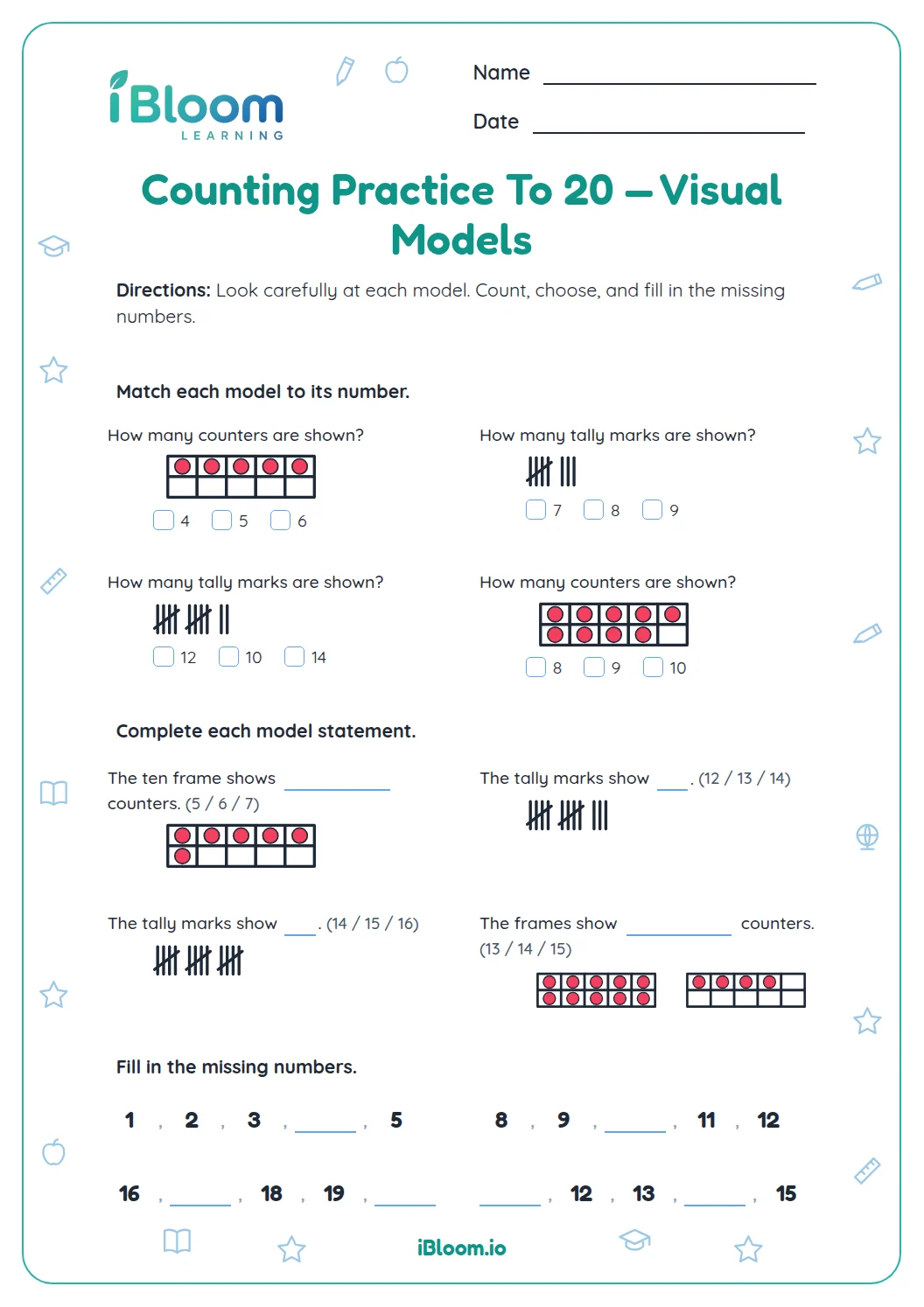
Part A starts with ten-frame pictures. Students count each counter once, keeping track as they move across the frame. The two models show 6 and 13 counters, connecting a written numeral with a group of objects.
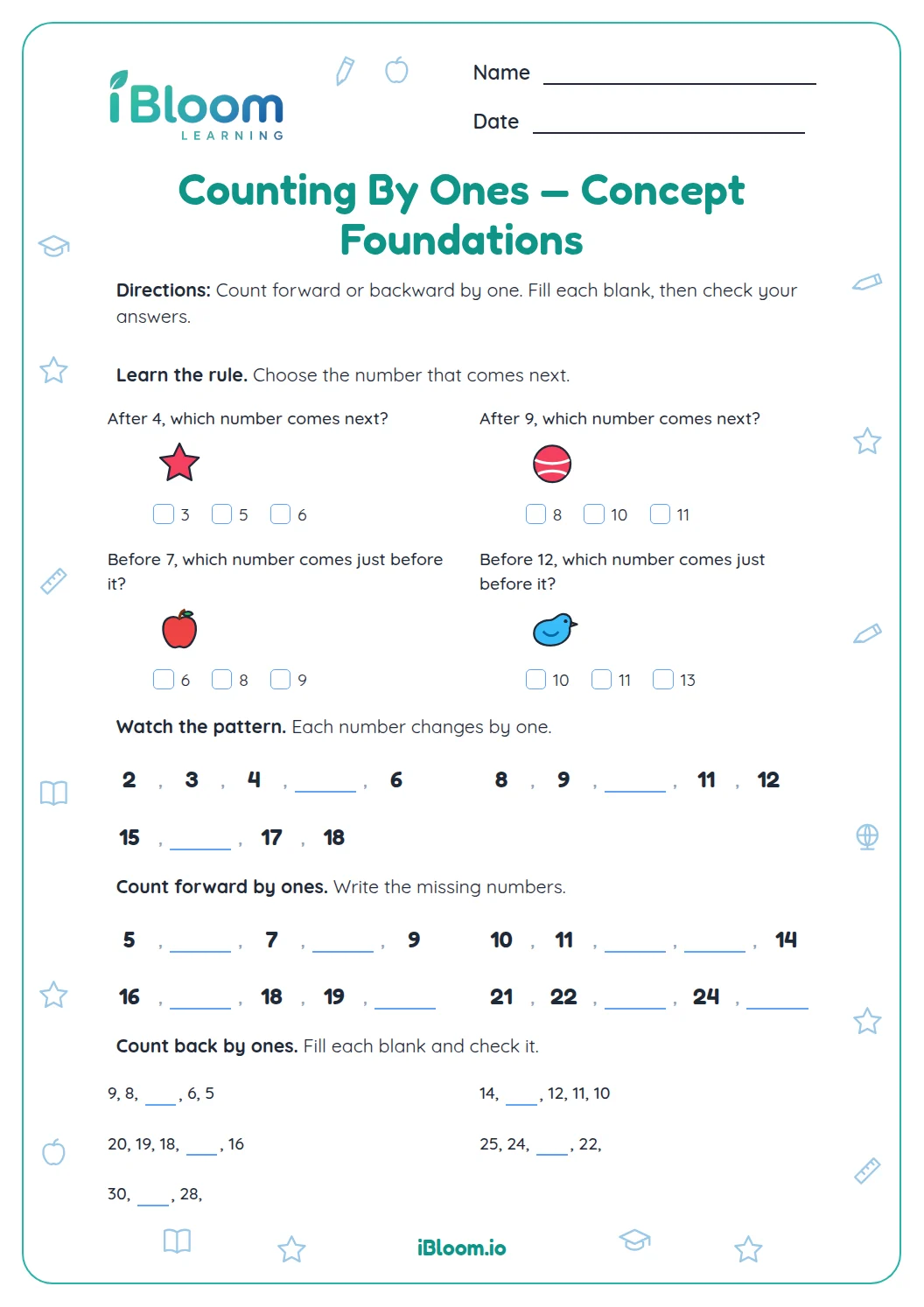
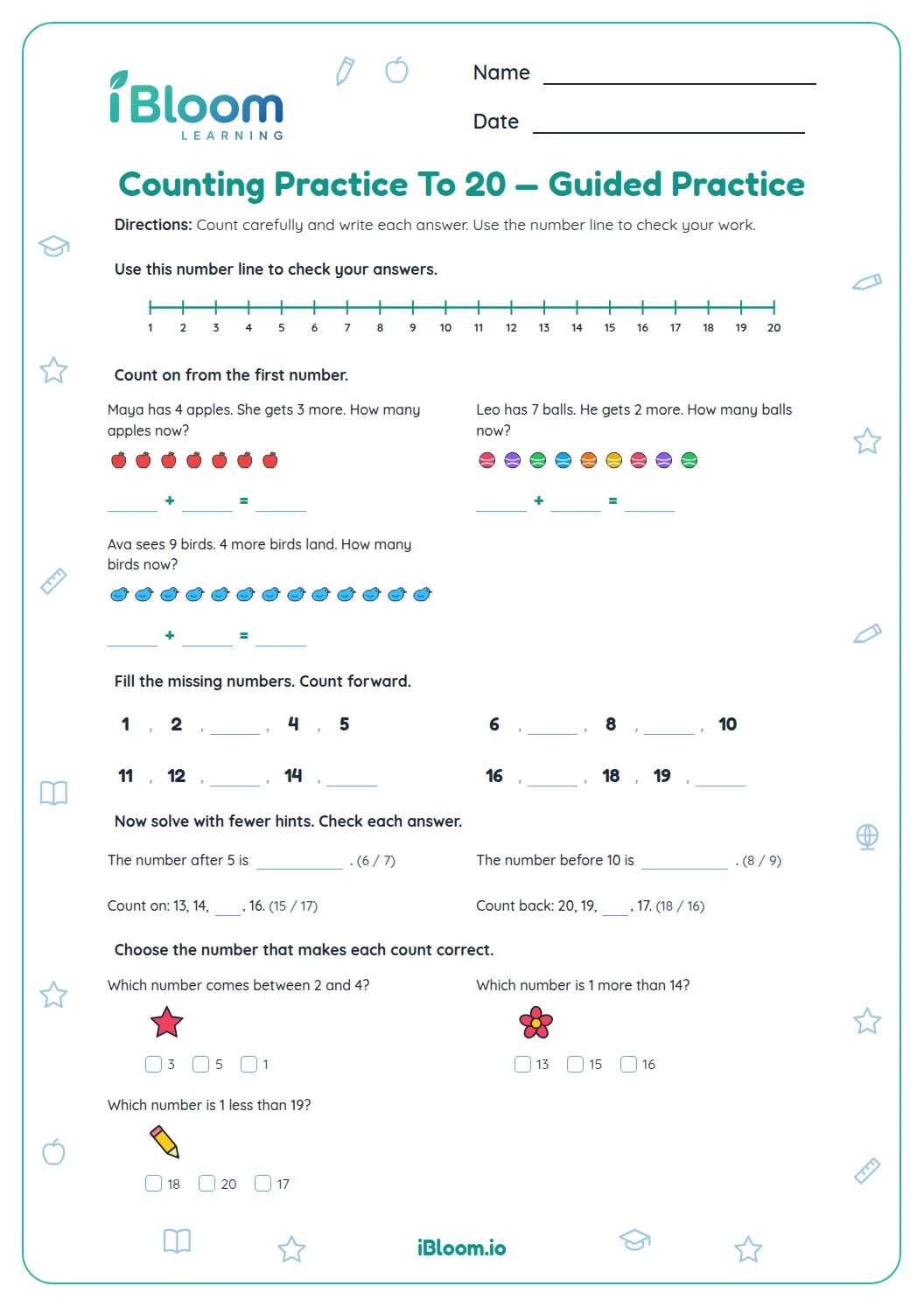
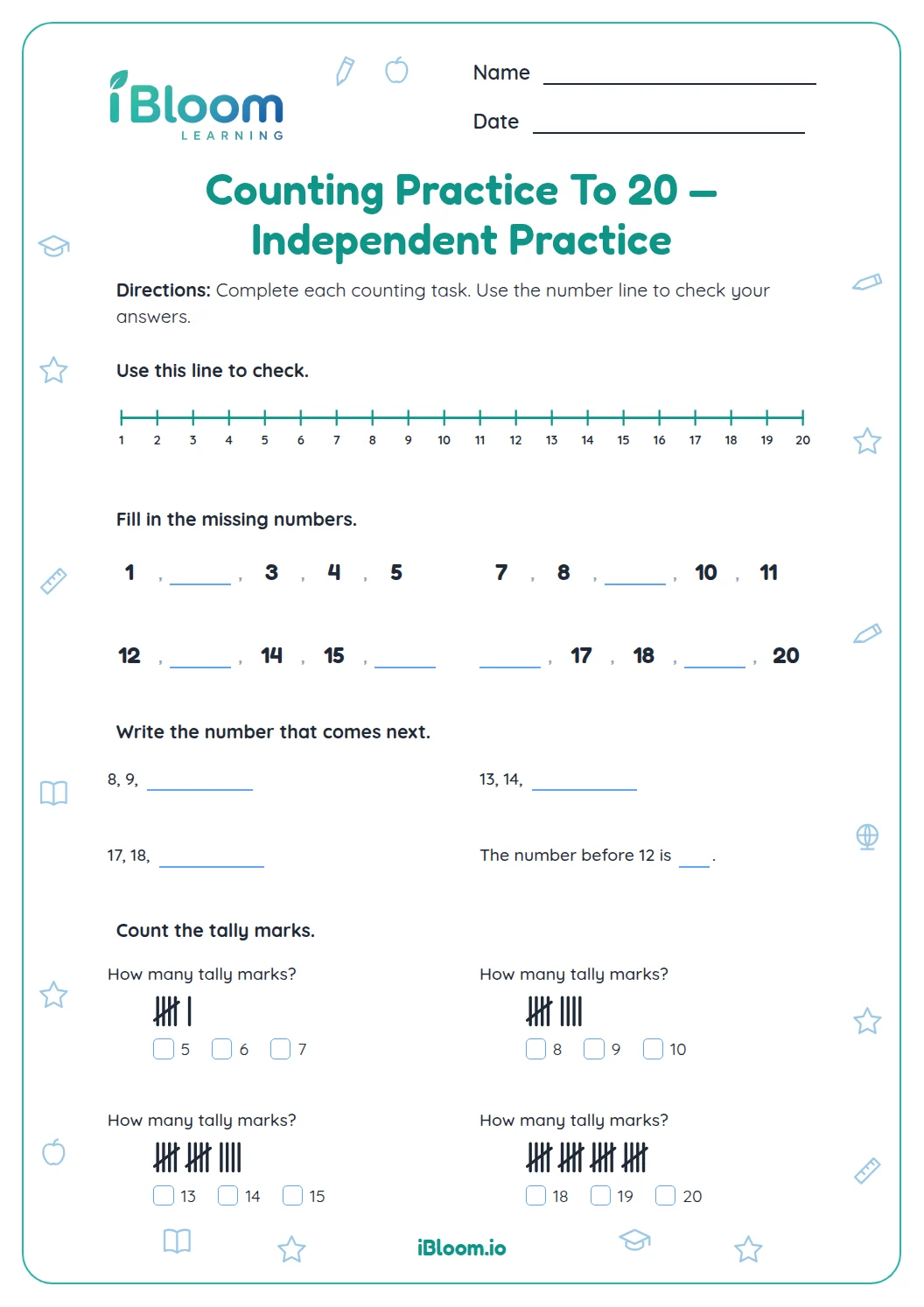
The next items use number order directly. Children name what comes after 9, fill in a missing term, or find the number before 18.
- Count each counter once
- Continue forward by one
- Notice the number immediately before or after
How can students complete a number sequence?
Question 13 gives 21, 22, ___, 24, 25. Count forward from 22: 23 comes next, followed by 24 and 25. The missing number belongs between its neighbors.
- 121, 22, ___, 24, 25
- 2Count on one number after 22.
- 322, 23, 24, 25
- 4Write 23 in the blank.
How does the page cover all numbers through 30?
The missing-number sequences are grouped into three ranges: 1–10, 11–20, and 21–30. That lets children practice each part of the counting order and see the transition from one decade to the next.
If a child skips a number, have them restart just before the gap and say each number aloud until the sequence is complete.
How to practice counting to 30
- 1Count each ten-frame counter once, left to right.
- 2Read the sequence before filling a blank.
- 3Start at the last number before the gap.
- 4Count forward one at a time to find what is missing.
- 5Check the neighboring numbers to make sure the order is correct.
Common counting-order mistakes
The mistake
Skipping a number when counting from 18 to 20.
The fix
Say the sequence aloud: 18, 19, 20. The missing number is 19.
The mistake
Writing the number after the blank instead of in it.
The fix
Count from the number just before the blank, then stop at the empty space.
The mistake
Counting one counter twice in a ten-frame.
The fix
Move across each row in one direction and touch each counter only once.
Curriculum alignment
Count, read, and write numbers through 30 in order.
On this sheet: Students count, read, and write numerals through 30 and fill gaps in ordered sequences.
Show the official wordingHide the official wording
Count to 120, starting at any number less than 120. In this range, read and write numerals and represent a number of objects with a written numeral.
What to practice next
Make more practice
Further reading
Questions parents and teachers ask
What number range does the worksheet cover?
The sheet practices counting in order through 30. Its missing-number sequences include numbers in the ranges 1–10, 11–20, and 21–30, with extra checks for numbers before or after a given number. Students fill each blank by counting on one at a time.
How many practice questions are included?
There are 14 questions: two ten-frame counting models, six quick counting checks, and six missing-number sequences. The items move through the full range to 30, and the answer key shows the number that belongs in each blank. Children can finish them in order or pause between parts.
How do ten-frames help with counting?
A ten-frame organizes counters into rows, making it easier to count each object once. This page shows groups of 6 and 13. After counting the picture, the student writes the matching numeral in the answer space. It also makes a group of ten easy to recognize.
What should I do if my child skips a number?
Start the sequence again just before the blank and say each number aloud together. In 21, 22, ___, 24, 25, counting one step after 22 gives 23. Then reread the sequence to check that it moves by ones. This gives the child a way to check the pattern.
Is this worksheet suitable for independent practice?
Yes. The questions use short directions and familiar number sequences, so a Grade 1 student can try them independently. An adult may read the prompt aloud or point to each counter in the ten-frame if the child needs support getting started.