



About this worksheet
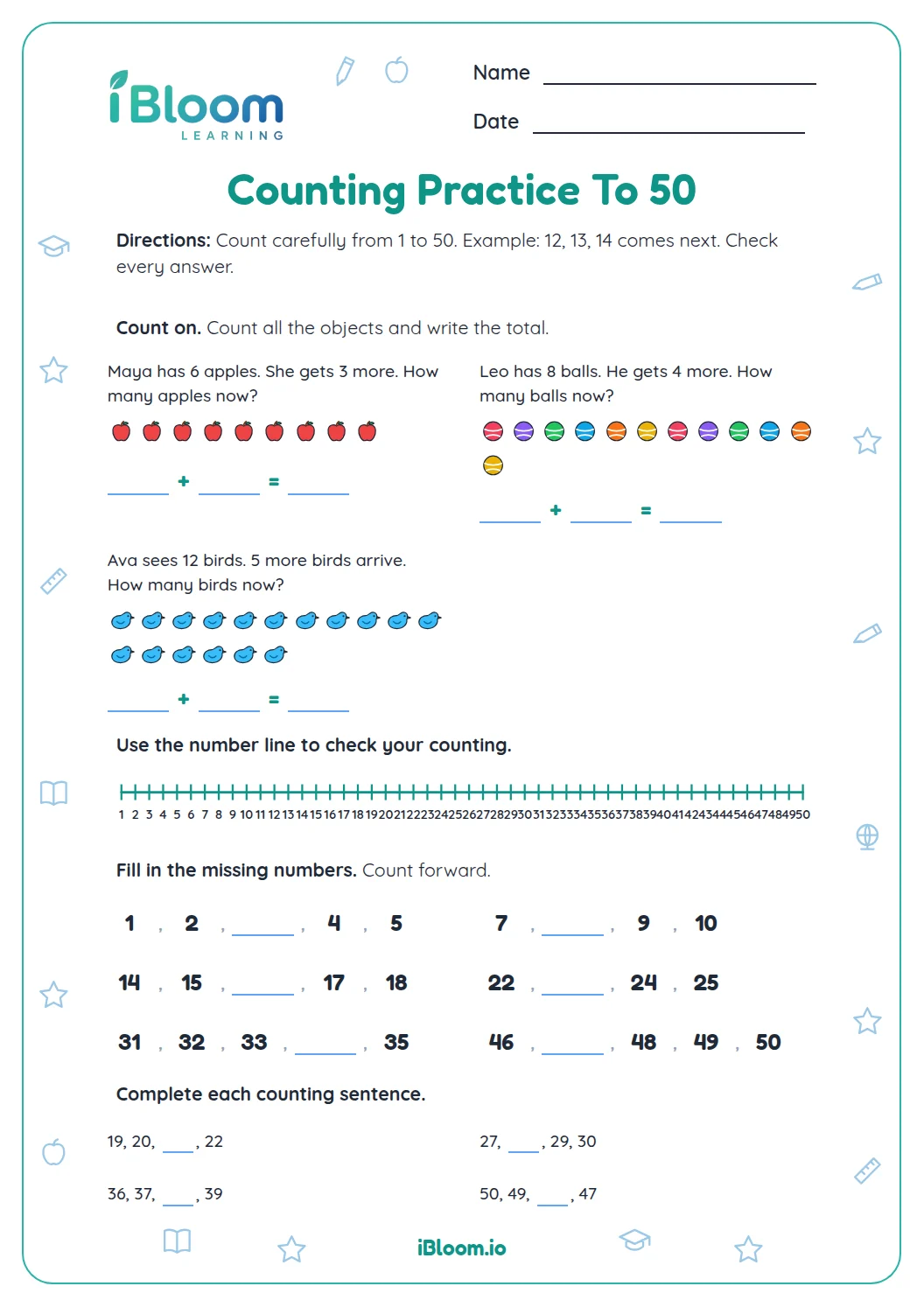
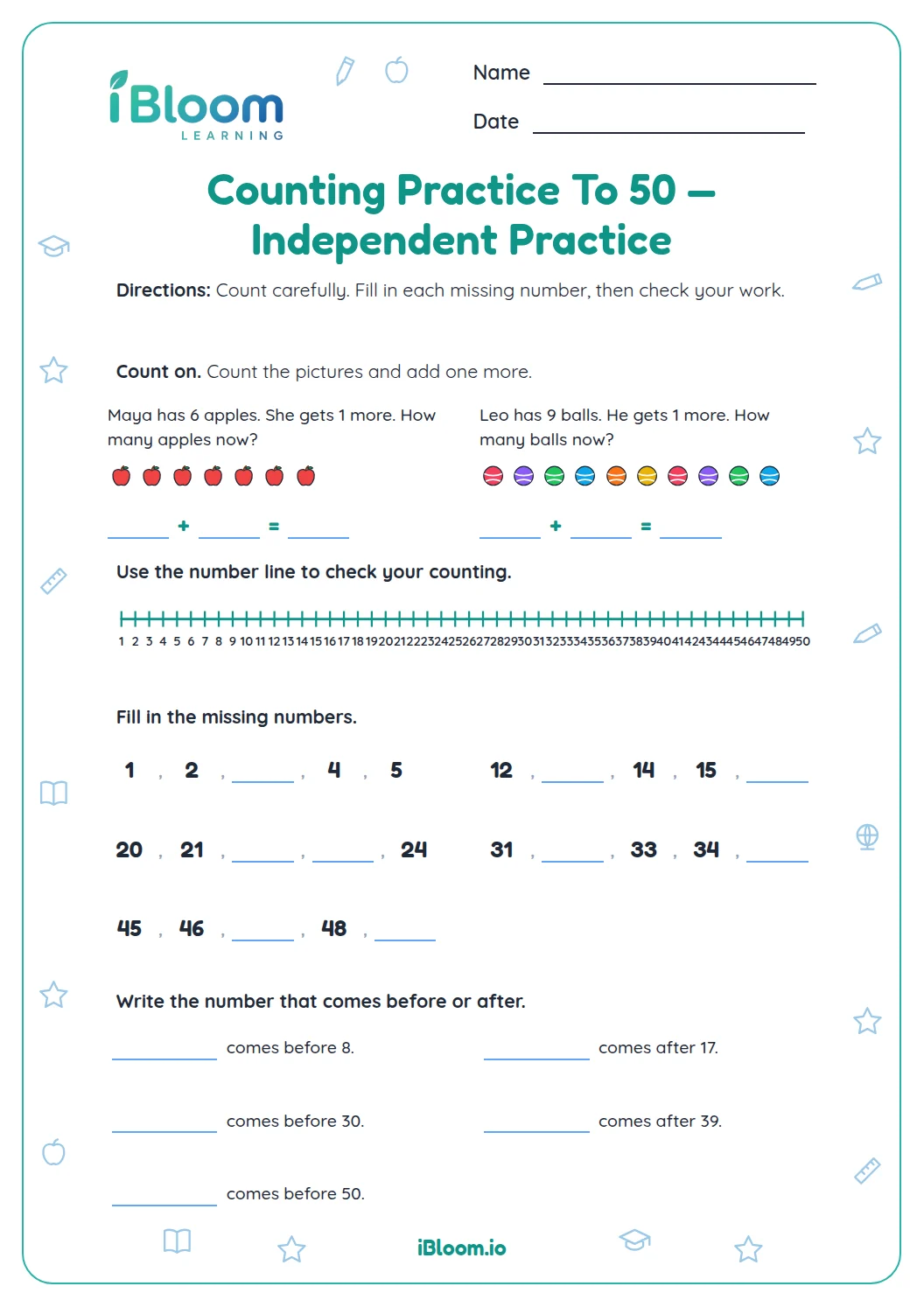
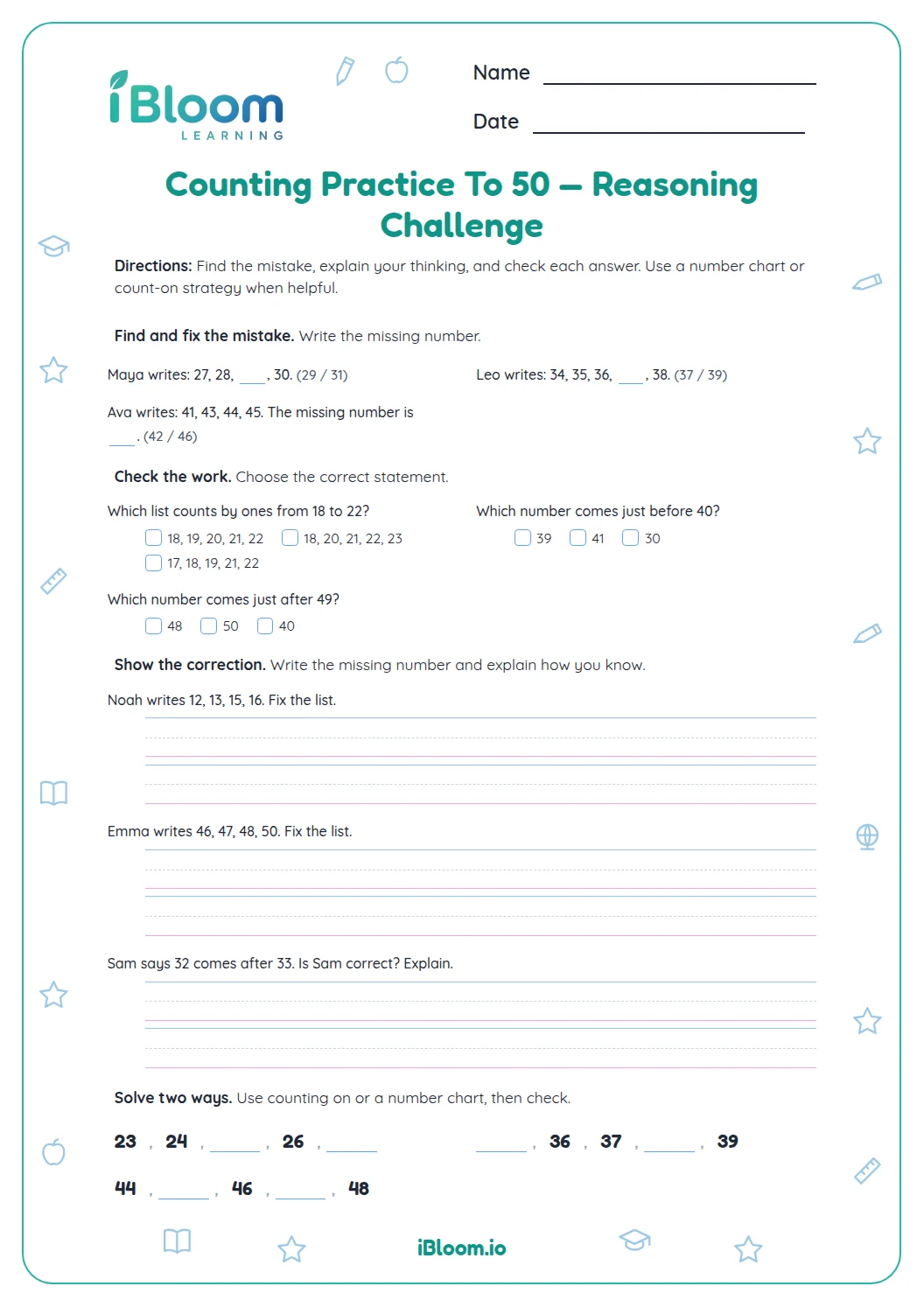
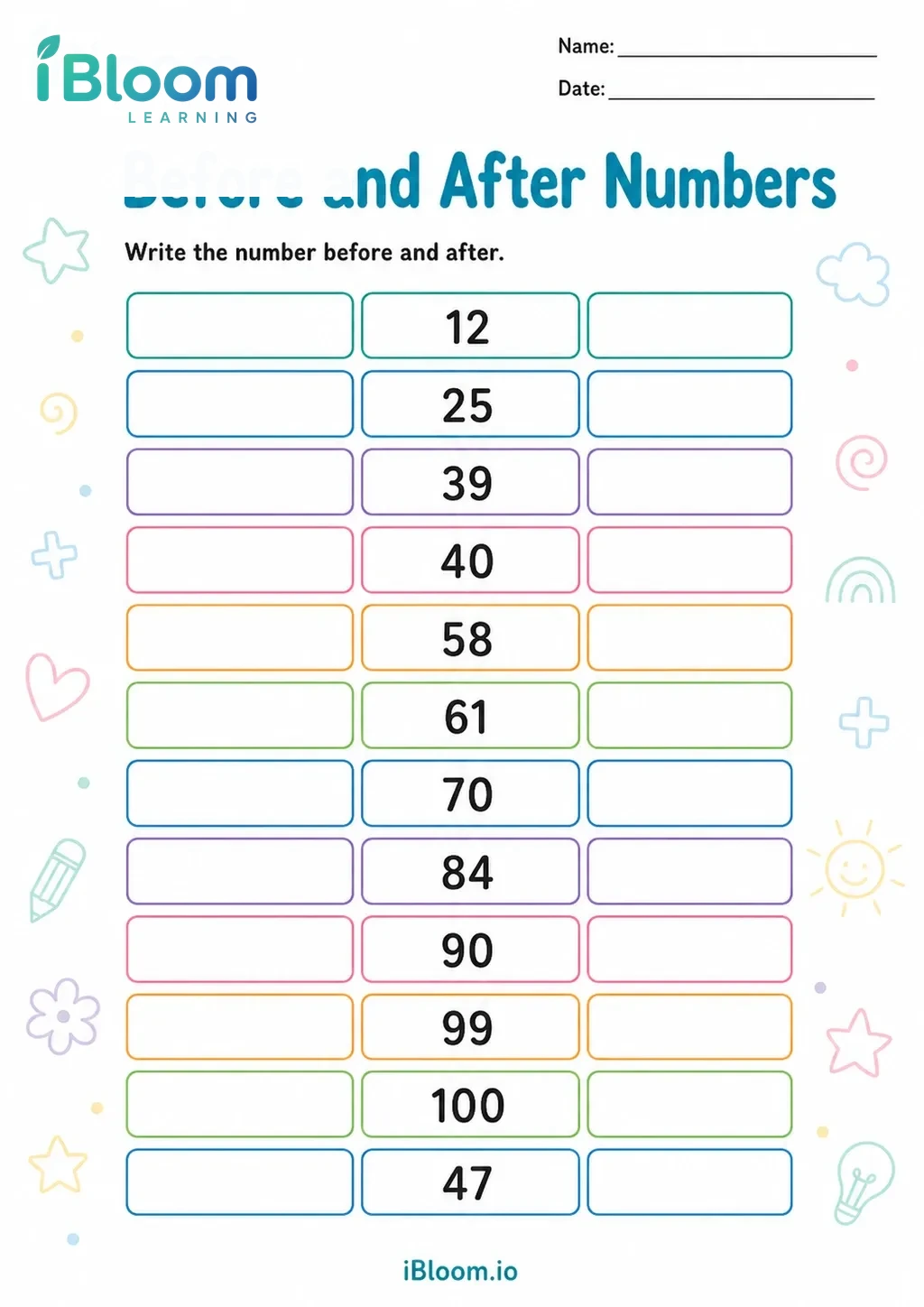
This Grade 1 printable builds counting fluency with numerals through 50. Students continue sequences, find numbers before, after, or between given neighbors, and work across decade changes such as 39 to 40. Two number-line questions provide a visual way to count; the separate answer key lists each missing numeral or sequence.
Aligned to 1.NBT.A.1
How do counting sequences work?
The number names follow a fixed order, and each next number is one more. Start at the number you know and say the count forward until reaching the blank. This works even when the sequence begins in the middle rather than at one.
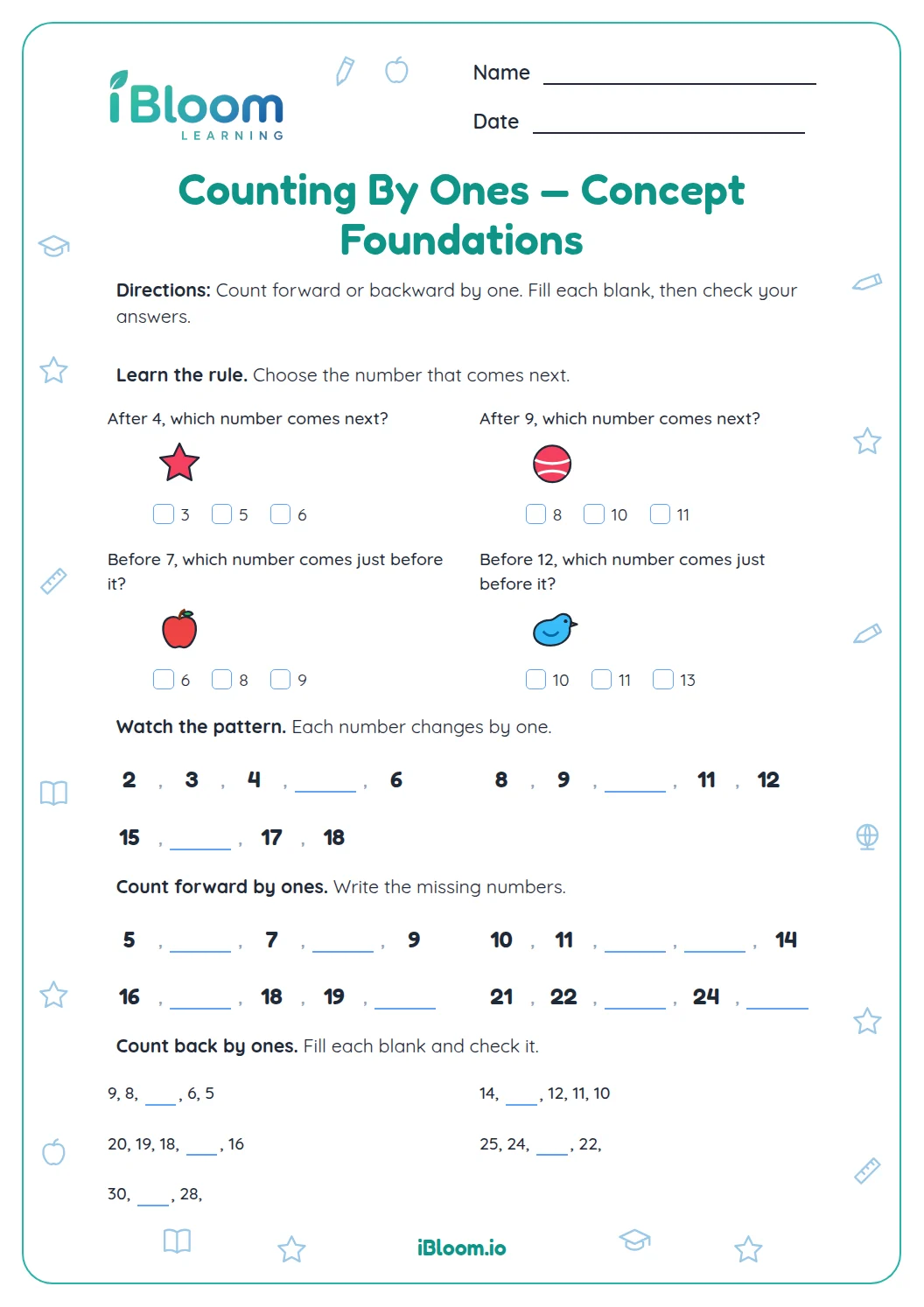
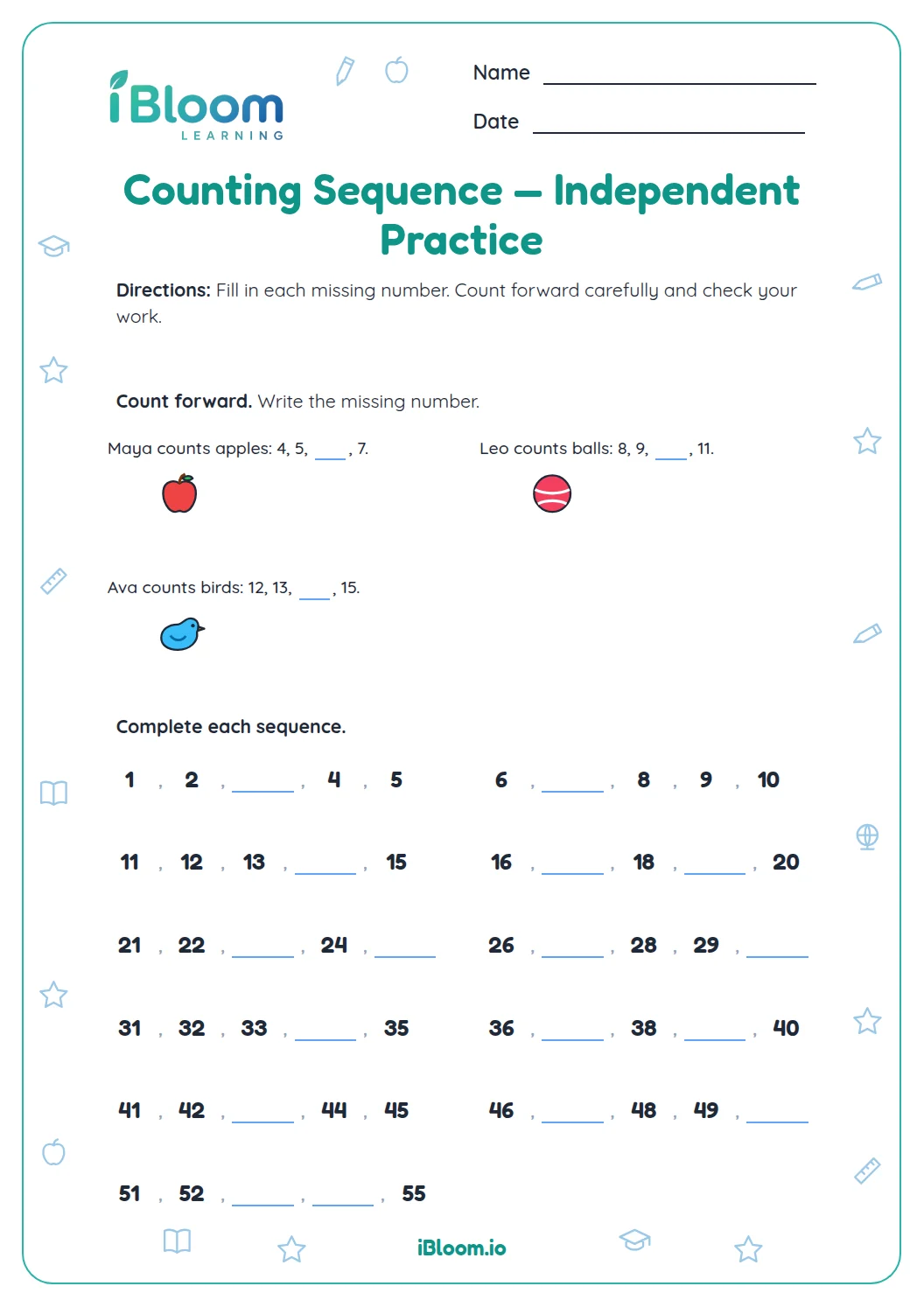
- 1In q1, count on from 16: 17, then 18, then 19.
What changes when a count reaches a new ten?
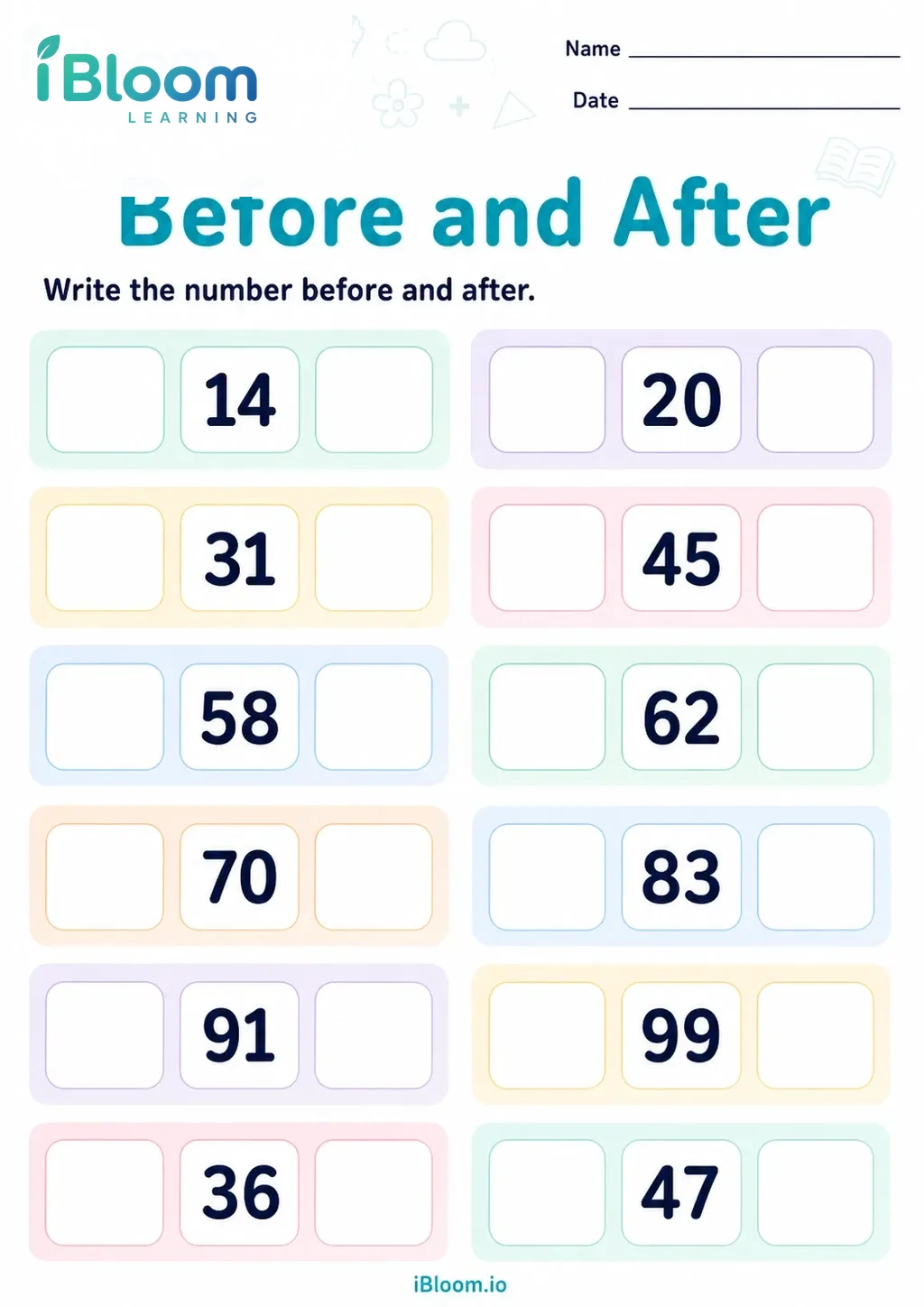
The number before 31 is 30 because 30 comes immediately before 31. In question 14, the count goes 32, 33, 34, 35, 36, 37.
- 1In q8, the number just before 31 is 30.
How can neighboring numbers check an answer?
A missing number should be one more than its left neighbor and one less than its right neighbor. In 24, blank, 26, the only number that fits both relationships is 25.
- 1In q15, count from 40 along the number line to point A: 47.
How to use this worksheet
- 1Find the first number you recognize.
- 2Say the counting sequence forward one number at a time.
- 3Watch for a change from one ten to the next.
- 4Write the numeral that fits the blank.
- 5Read the completed sequence to check it.
Common mistakes and quick fixes
The mistake
Skipping a number while counting aloud.
The fix
Touch or point once for each number name.
The mistake
Changing the tens digit too early or too late.
The fix
Say the full sequence through 19, 20, 21 and similar transitions.
The mistake
Writing a neighbor instead of the missing middle number.
The fix
Check that the answer comes one after the left number and before the right.
Common Core alignment
These standards describe the reading, language, or math work practiced on this page.
Read, write, and continue numerals in the counting sequence.
On this sheet: Students read and write numbers while continuing sequences through 50.
Show the official wordingHide the official wording
Count to 120, starting at any number less than 120. In this range, read and write numerals and represent a number of objects with a written numeral.
What to practice next
Make more practice
Further reading
Questions parents and teachers ask
What does this counting worksheet cover?
The worksheet has 16 questions about counting through 50. Children fill gaps in sequences, name a number before, after, or between neighbors, complete two short counts, and read two number lines. Every answer is a numeral from 1 to 50.
How can a child find a missing number?
Start with the number just before the blank and say the count aloud, one number at a time. For example, after 16 comes 17 and then 18. The numbers around the blank help confirm that the sequence increases by one each step.
Why practice across decade changes?
There are 16 questions in four parts. Learners fill six sequence gaps, find six neighboring numbers, complete two short counts, and read two number lines. The numbers stay within 50, including counts that cross a decade such as 39 to 40.
How does the number line help?
The number line in the final section runs from 40 to 50, with point A placed at one of its numbers. Students count the equal steps to identify the point. Other questions ask them to continue written sequences and use nearby numerals as clues.
How many questions and pages are included?
There are 16 questions in four parts: six sequence completions, six before-and-after or between items, two pattern questions, and two number-line questions. The printable uses two worksheet pages, followed by a separate two-page key with all answers. Students can count aloud along each line before checking.