



About this worksheet
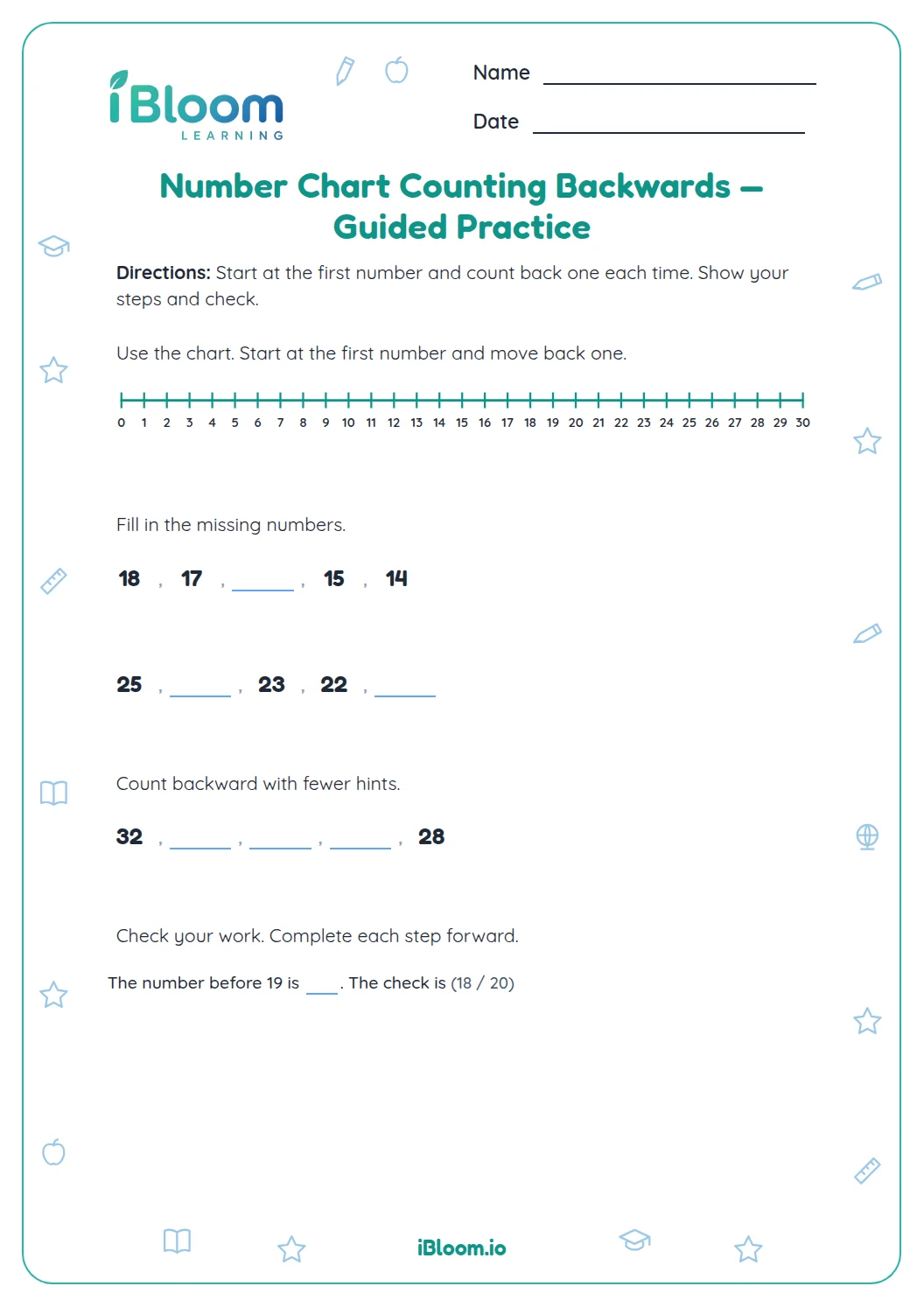
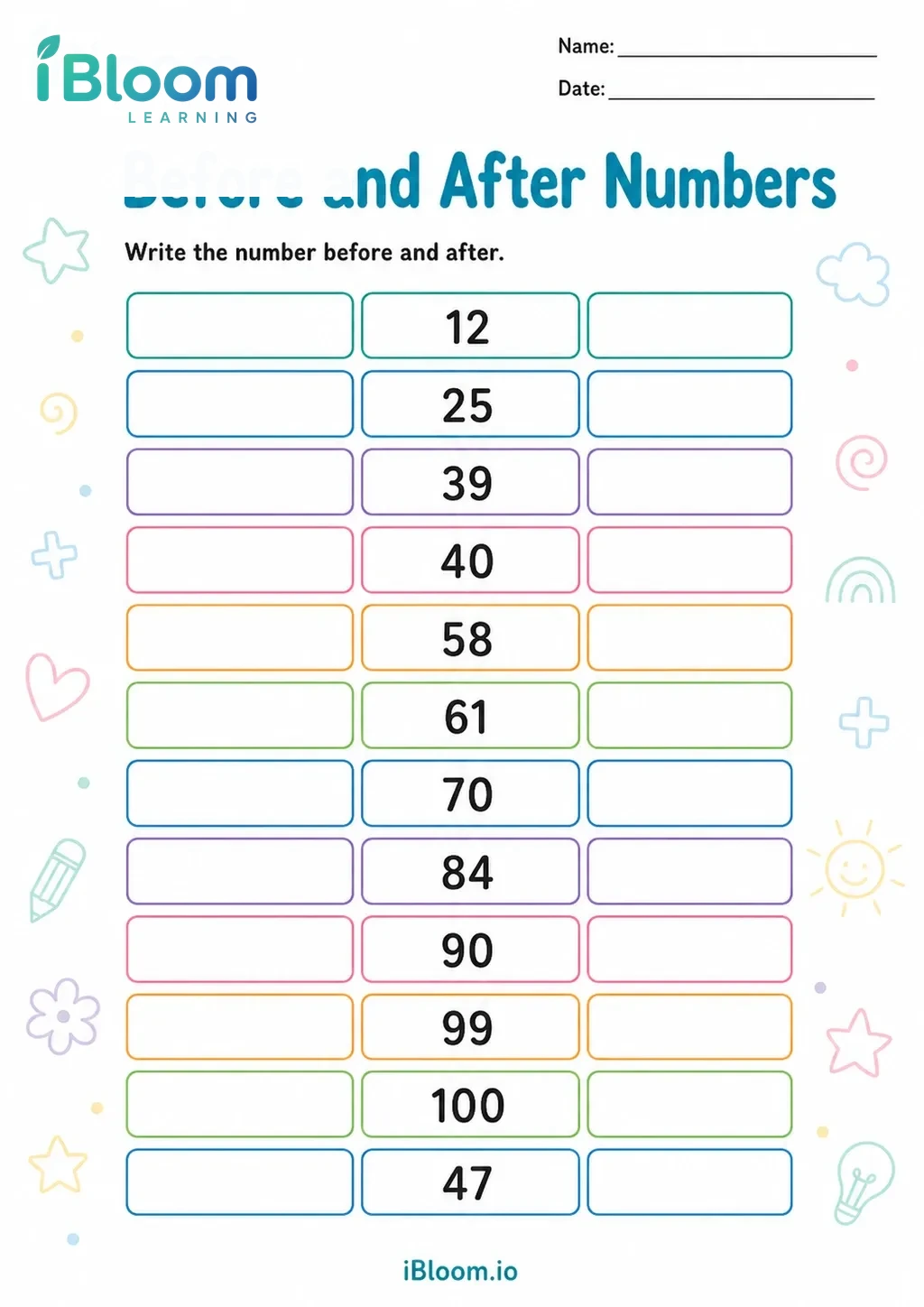
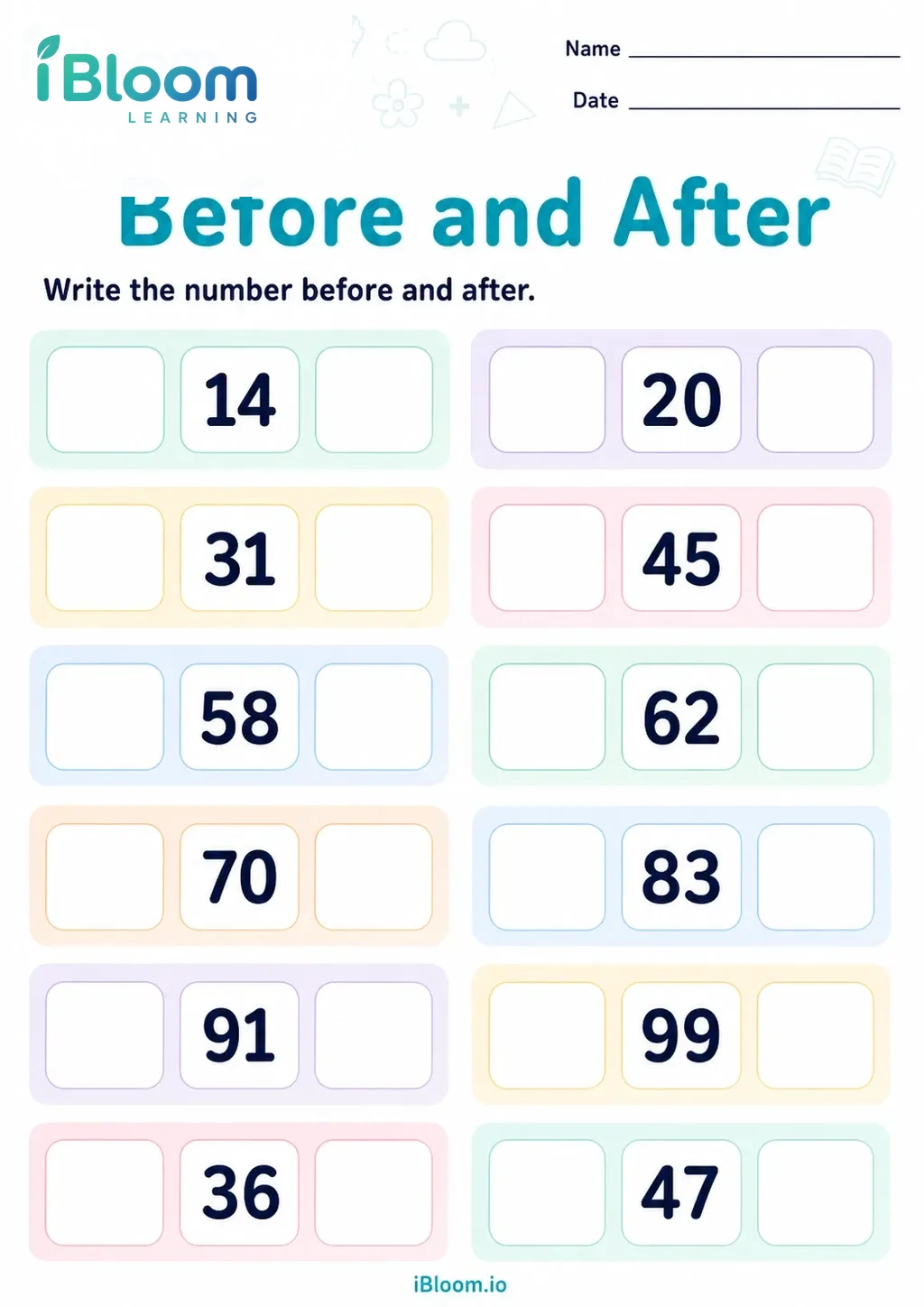
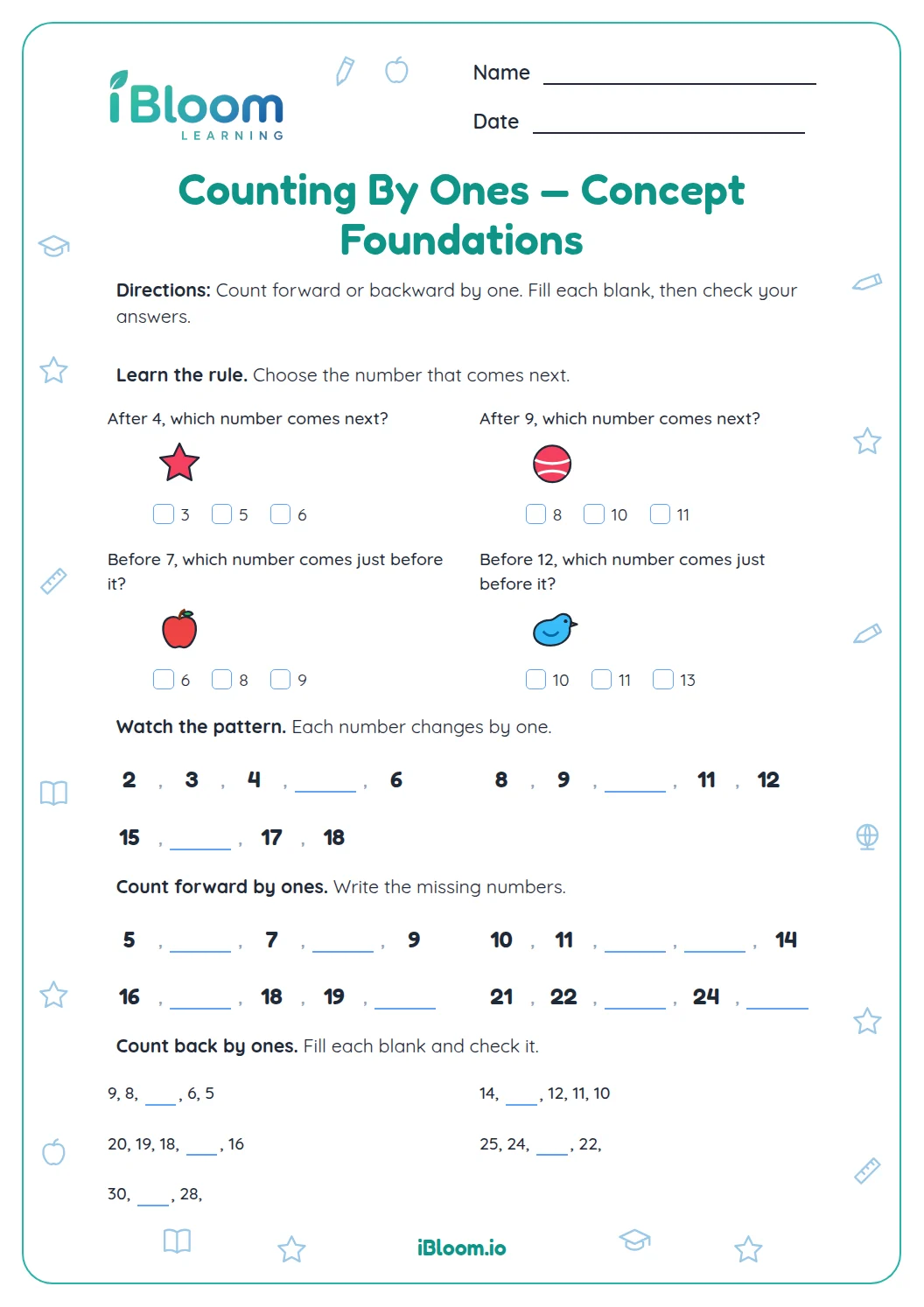
This Grade 1 printable practices counting backward by ones within 20. Students complete six number sequences and use marked number lines to follow 12 backward jumps or choose a matching count. The number-line models show each starting point, and a separate answer key lists the missing numbers and correct choices.
Aligned to 1.NBT.A.1
What does counting backward look like?
When counting backward by ones, each next number is one less: 18, 17, 16, 15. Use the numbers around a blank to identify the missing count.
How does a number line show a backward count?
Find the marked starting number, then move one tick left for every step named. The landing number is the answer.
- 1Start at 16 and count backward 3: 15, 14, 13.
- 2The landing number is 13.
How can a number line help check a count?
Point to the start, count the requested ticks to the left, and say the number where you stop. The worksheet shows the starting point on each number-line question.
How can a child check a missing number?
Read the full sequence from its first number, saying one less each time. On a number line, count the ticks rather than the spaces between the ticks.
How to use this worksheet
- 1Find the starting number.
- 2Say the next number that is one less.
- 3On a number line, move one tick left per count.
- 4Stop after the number of jumps named.
- 5Read the full sequence again to check.
Common mistakes and quick fixes
The mistake
Counting up instead of down.
The fix
Say the numbers in reverse order, one less each time.
The mistake
Counting spaces instead of number-line ticks.
The fix
Point to each tick as you make one backward step.
The mistake
Making too many jumps.
The fix
Keep track of each jump named in the question.
Common Core alignment
This practice uses counting sequences and backward counts within 20.
Count backward from a given number within the counting sequence.
On this sheet: Students continue backward sequences from a stated number and follow backward steps on number lines.
Show the official wordingHide the official wording
Count to 120, starting at any number less than 120. In this range, read and write numerals and represent a number of objects with a written numeral.
What to practice next
Make more practice
Further reading
Questions parents and teachers ask
How many backward-count questions are included?
There are 18 questions in three parts: six missing-number sequences, six number-line jumps, and six number-line choices. Every item asks students to use a count that moves backward by ones from a stated number. This gives families a simple way to review each step together at home.
What number range does the practice use?
The sequences and number lines use numbers from 0 through 20. Students begin at a stated number and move backward by one for each step, keeping the count within this familiar range. This gives families a simple way to review each step together at home.
What is marked on the number lines?
Each number-line question includes a number line with labeled ticks. Students use the starting number in the prompt, count one tick to the left for every backward step, then identify where the count ends. The number line helps children keep track of the direction and each step.
Does the answer key show the number-line landings?
Yes. The separate key lists the missing number or correct choice for every item, including the landing number after each named set of jumps. Compare the result with the sequence or jump count to check it. This gives families a simple way to review each step together at home.
How can an adult help a child use the models?
Invite the child to point to the starting number and move left one tick at a time. Saying each number aloud can help keep the number of jumps matched to the question and the landing number. This gives families a simple way to review each step together at home.