



About this worksheet
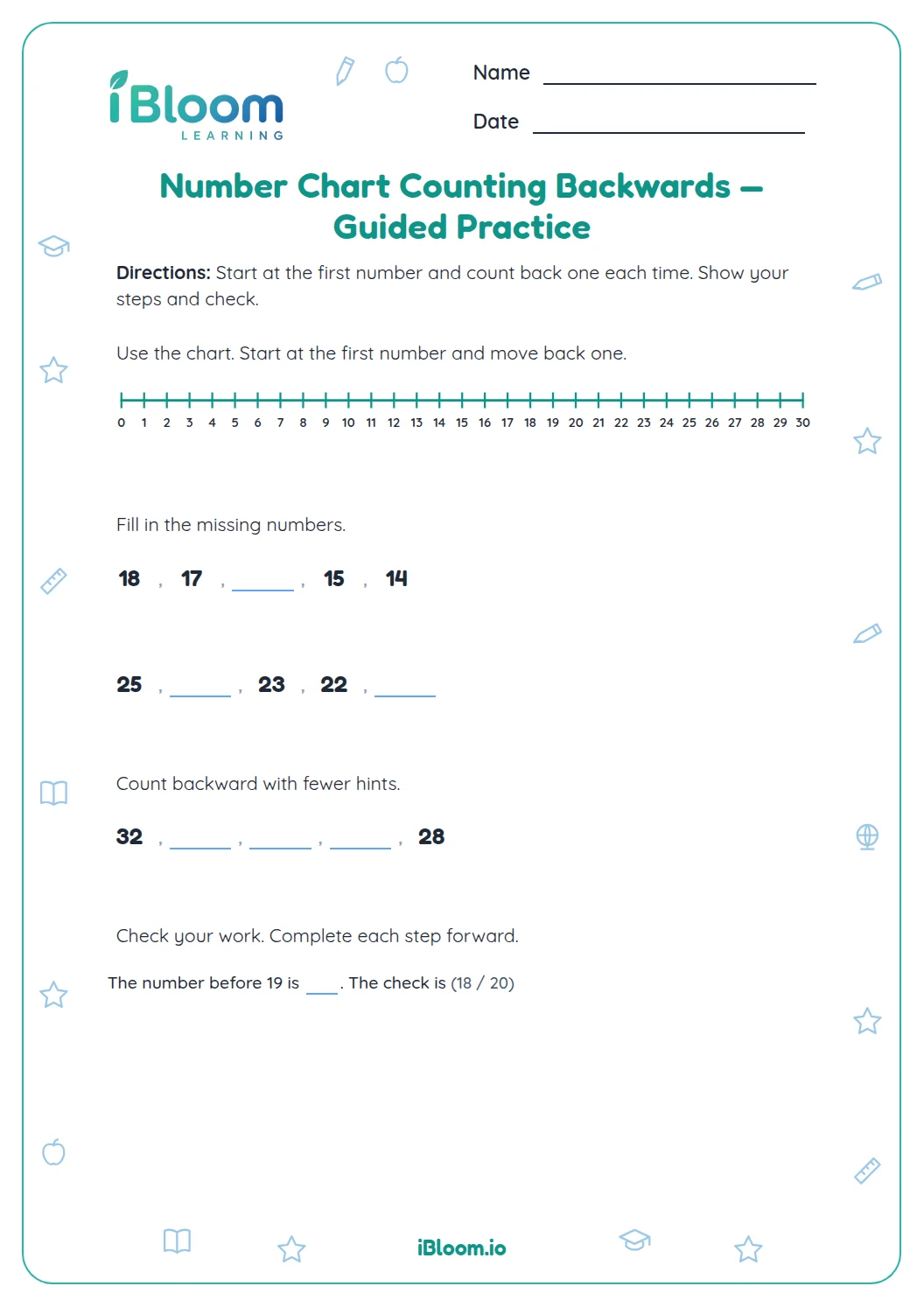
This Grade 1 printable practices counting backward by ones from numbers within 120, including crossing from one decade to the previous decade. Children solve 16 questions in three parts: count the steps, find a missing difference, and name a number a set number of steps before the start. It connects number-chart movement to subtraction and aligns with CCSS 1.NBT.A.1. The answer key is provided on its own page.
Aligned to 1.NBT.A.1
How do you count backward one step at a time?
Each move to the previous whole number is one step. Start counting after the number you begin on.
In question 1, start at 38 and stop at 35: 37, 36, 35. The three moves are the steps.
- 138 → 37 → 36 → 35
- 2Three moves means 3 steps back.
What changes when the count crosses a decade?
At a decade boundary, the count continues without a pause: after 40 comes 39, and after 30 comes 29.
For 51 to 43, count 50, 49, 48, 47, 46, 45, 44, 43: eight steps.
How to use this worksheet
- 1Point to each step on a number chart or number line.
- 2Circle the start and target numbers before counting.
- 3Count aloud backward by ones, including the decade change.
- 4Write the number of steps or fill in the missing difference.
- 5Check by counting forward from the target to the start.
Common mistakes and quick fixes
The mistake
Skipping the number just before the start.
The fix
The first step from 38 is 37; 38 is where you begin, not a step.
The mistake
Saying 40, 39, 38 when counting back from 40.
The fix
The number immediately before 40 is 39.
The mistake
Counting the endpoints as steps.
The fix
Count the jumps between numbers, not the numbers you land on.
Common Core alignment
This worksheet practices the standard below through focused printable practice.
Count from a given number within 120 and read and write the numerals reached.
On this sheet:
Show the official wordingHide the official wording
Count to 120, starting at any number less than 120. In this range, read and write numerals and represent a number of objects with a written numeral.
What to practice next
Make more practice
Further reading
Questions parents and teachers ask
What does counting backward by ones mean?
Start at the given number and say the number immediately before it, then continue one number at a time. For example, counting back from 43 to 38 takes five steps: 42, 41, 40, 39, and 38. The starting number is not counted as a step.
How do children cross a decade when counting backward?
After 40 comes 39, and after 30 comes 29. Keep the sequence moving by one each time; the tens digit changes at the boundary. Children can check a backward count by counting forward from the target to the start and confirming the same number of steps.
How many questions are on the worksheet?
There are 16 questions in three parts. Children count the steps between numbers, complete missing-number equations, and find a number a stated number of steps before a starting point. The last questions include larger jumps and decade changes.
Is an answer key included?
Yes. The separate answer key gives the answer to all 16 questions. Children can use it after finishing the worksheet to check both the number reached and the number of steps. If an answer differs, count forward to see where the sequence changed.