



About this worksheet
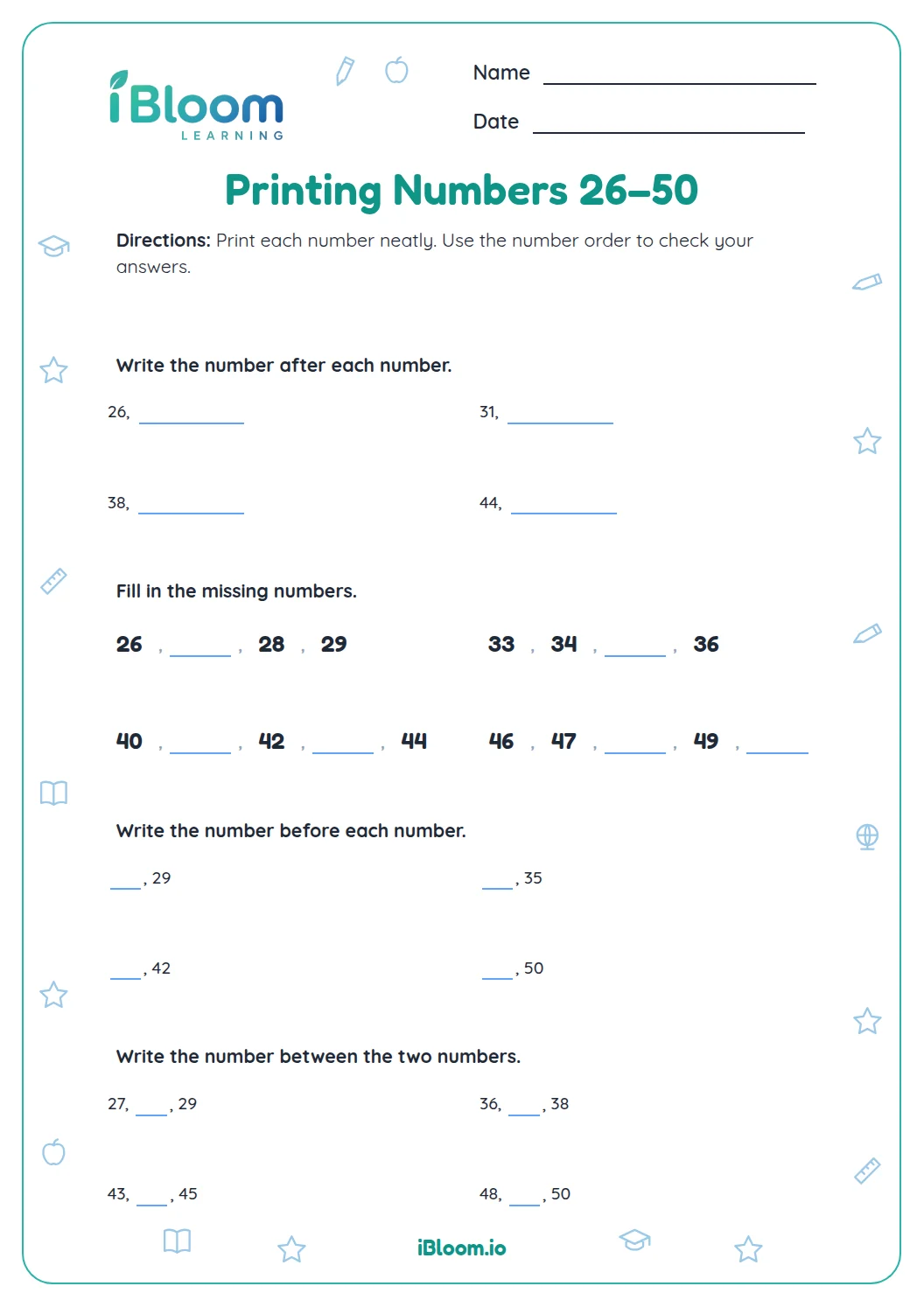
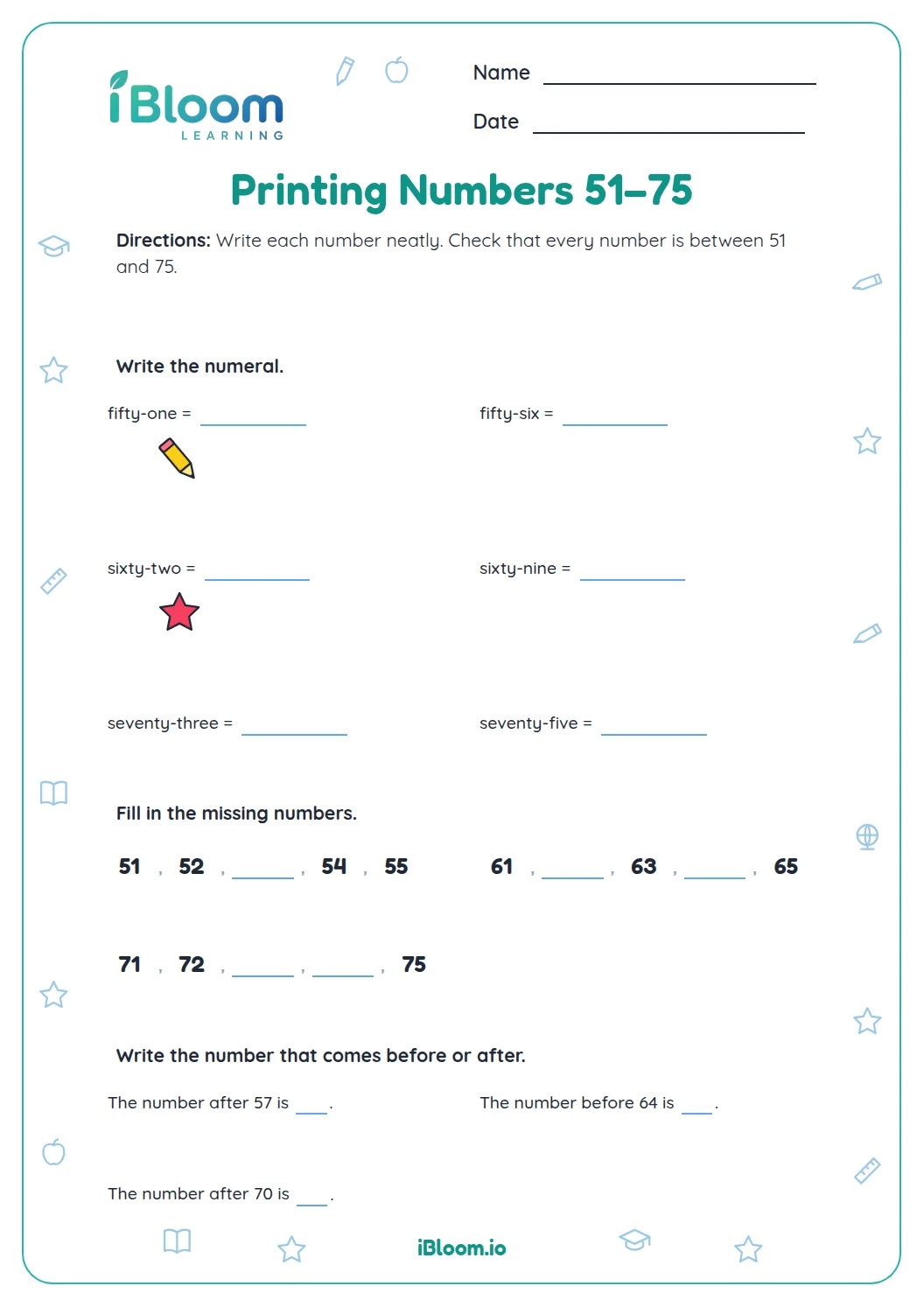
This Grade 1 printable practices writing numerals from 26 through 50 in several familiar ways. Children write four numerals from number names, complete six count-by-one sequences, solve four addition or subtraction stories, and choose a matching numeral. It practices CCSS 1.NBT.A.1 and includes a separate answer key.
Aligned to 1.NBT.A.1
How do number names become numerals?
Listen for the tens word and the ones word. “Twenty-eight” means 2 tens and 8 ones, so write 28. Questions 1–4 give one number name at a time, and the final choice question checks that a child can match the name to the correct numeral.
- 1twenty-eight
- 22 tens and 8 ones
- 328
How can counting fill a number gap?
Say the numbers in order and notice what comes just before and after the blank. In question 5, 30, 31, 32, 33 counts by ones, so 32 belongs in the gap. The six short sequences continue through 50.
What addition and subtraction stories are included?
Four short situations ask children to record an equation and a numeral answer. Question 11 starts with 26 beads and adds 4, giving 30. Other stories add 6 or 3, or subtract 8 from 50.
- Part A: four number-name clues
- Part B: six count-by-one gaps
- Part C: four addition or subtraction stories
- Part D: one multiple-choice numeral check; separate answer key
How to use this worksheet at home or in class
- 1Read the number name and say its tens and ones.
- 2Count by ones from the number before a gap.
- 3For each story, decide whether the amount increases or decreases.
- 4Write an equation and the resulting numeral for each story.
- 5Read the final number name again before choosing its numeral.
Common mistakes and quick fixes
The mistake
Reversing the digits in twenty-eight.
The fix
Say “2 tens and 8 ones,” then write 2 before 8.
The mistake
Skipping a count number when filling a sequence.
The fix
Start one number before the blank and count aloud one at a time.
The mistake
Adding when a story says an amount was sold or taken away.
The fix
Notice whether the story says more were added or some were removed.
Common Core alignment
This worksheet practices the standard below through its printed questions.
Count, read, and write whole numbers through 120 using numerals.
On this sheet: Children read number names and write the corresponding numerals throughout 26–50.
Show the official wordingHide the official wording
Count to 120, starting at any number less than 120. In this range, read and write numerals and represent a number of objects with a written numeral.
What to practice next
Make more practice
Further reading
Questions parents and teachers ask
Does the worksheet include every number from 26 to 50?
Yes. The number names, sequence examples, story amounts, and answer choices use numbers throughout 26–50, including every numeral in that range. Children practice writing a numeral, filling a count-by-one gap, solving an operation story, and matching a number name to its numeral.
What kinds of questions are included?
There are 15 questions: four number-name clues, six missing-number sequences, four addition or subtraction stories, and one multiple-choice numeral check. The mix follows the old sheet’s practice style while keeping the same 26–50 number range and providing a separate key.
How can a child complete the sequence questions?
Begin with the number just before the blank and count forward by ones. In 30, 31, ___, 33, the missing number is 32. The six sequences move through the number range in small steps, giving practice reading and writing numerals in order.
What operation should a child use in each story?
Look for whether the amount grows or gets smaller. Emma starts with 26 beads and gets 4 more, so add to find 30. The balloon story says the shop sells 8 from 50, so subtract to find 42. Each story has space for an equation and answer.
What does the answer key include?
The separate key shows each missing numeral, sequence answer, and story total, along with the correct numeral choice. For a story, children can compare both the equation and final number. A parent or teacher can ask them to explain whether the amount increased or decreased.