




About this worksheet
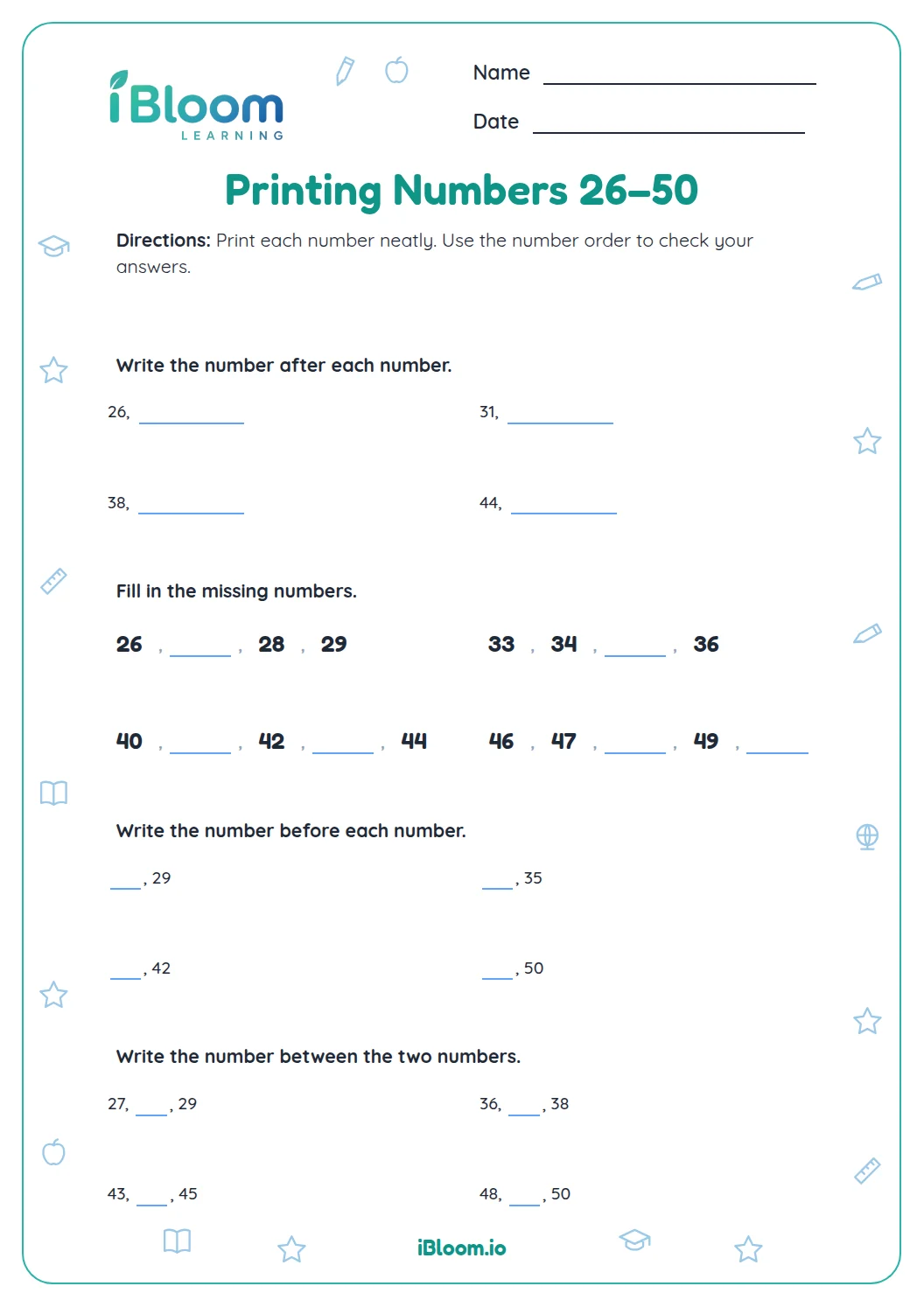
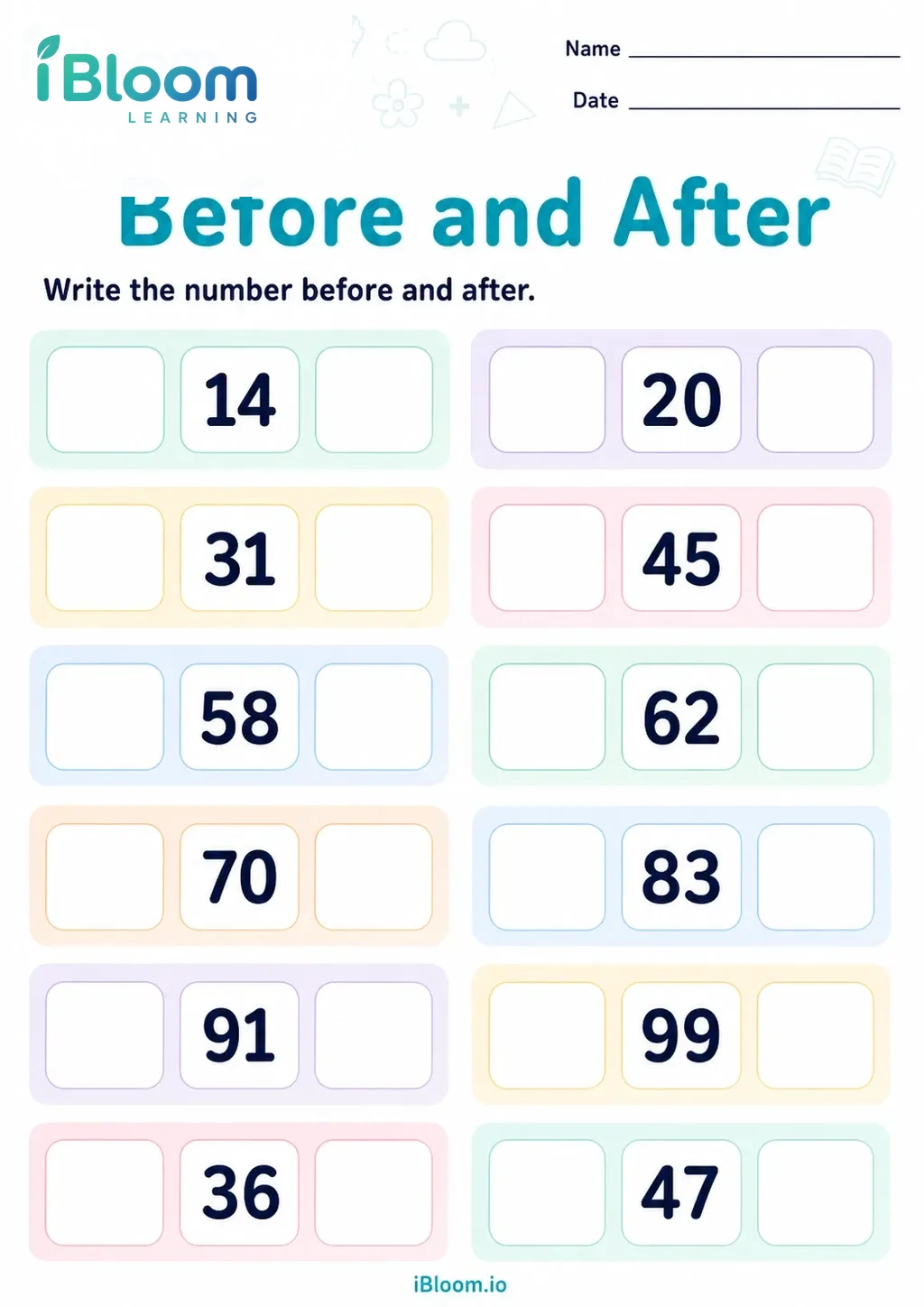
This free Grade 1 worksheet gives children a writing prompt for every numeral from 26 through 50. Students practice the full sequence, paying attention to two-digit numerals and the change from one ten to the next. There are 14 prompts across worksheet pages, followed by an answer key. The activity supports reading and writing numerals in the counting range described by CCSS 1.NBT.A.1, while keeping the task focused on clear numeral formation.
Aligned to 1.NBT.A.1
How can a child write two-digit numbers clearly?
Say the number, then write its tens digit and ones digit in that order. For example, 34 has 3 tens and 4 ones. The prompts move in counting order, so children can also notice how the ones digit changes before the next ten.
- 1Question 9 asks for 34.
- 2Say “thirty-four.”
- 3Write 3 first and 4 second: 34.
What changes when the numbers cross a new ten?
At the end of a decade, the ones digit returns to zero and the tens digit increases by one: 29 is followed by 30, and 39 is followed by 40. Say the pair aloud and check that both digits match the number name.
How can counting order help with numeral practice?
Count forward from 26 while writing each numeral. If a numeral looks uncertain, check the number just before and after it. That sequence check helps distinguish numbers such as 36 and 37 and keeps the full range from being skipped.
More Grade 1 number-chart practice at home or in class
- 1Point to the prompt and say the number aloud.
- 2Write the tens digit first and the ones digit second.
- 3Count forward one number at a time as you work down the page.
- 4At 29 and 39, say the next ten before writing it.
- 5Compare all 25 numerals with the answer key and correct any reversed digits.
Common mistakes and quick fixes
The mistake
Writing the ones digit before the tens digit.
The fix
Say the number and write the tens digit first, as in 42.
The mistake
Skipping from 29 to 31 or from 39 to 41.
The fix
Pause at the decade change: 29, 30 and 39, 40.
The mistake
Reversing digits in numbers such as 36 and 63.
The fix
Say the number name, then check tens and ones in the same order.
Curriculum alignment
Read and write numerals throughout the counting sequence practiced here.
On this sheet: The worksheet directly practices this skill in its questions.
Show the official wordingHide the official wording
Count to 120, starting at any number less than 120. In this range, read and write numerals and represent a number of objects with a written numeral.
What to practice next
Make more practice
Further reading
Questions parents and teachers ask
Which numerals are included?
The worksheet practices every numeral from 26 through 50, inclusive. Paired prompts ask children to write adjacent numbers, and the final question checks the greatest numeral in the range. There is one writing prompt for each number in the full range.
How many writing prompts are there?
There are 14 prompts that cover every number from 26 through 50. Most ask children to write two numerals on one line, and the final prompt asks for the greatest numeral in the range. A blank line follows each printed number. Each question names a numeral for the child to write.
How can I help with the change from 29 to 30?
Count the last number in the twenties, 29, and then say 30 as the first number in the thirties. The same idea works for 39 and 40. The worksheet gives the numbers in order so children can notice these transitions. The numerals are printed in counting order to support sequence checking.
Is this a number-word worksheet?
No. Children write numerals such as 26 and 47. Saying each number name aloud is a helpful support, but the answer line is for the digits. Saying the number name can help the child select the tens and ones digits.
What should I check in the answer key?
Check that both digits appear in the right order and that the numeral matches its prompt. Pay extra attention to decade changes and pairs that can be reversed, such as 36 and 63. The key lists all 25 numerals in order for quick checking.
How long does the practice take?
About 15 minutes is a reasonable starting point for all 25 numerals. Children can complete one part at a time and compare each set with the key before continuing. Children can take a short pause at each transition between tens.