
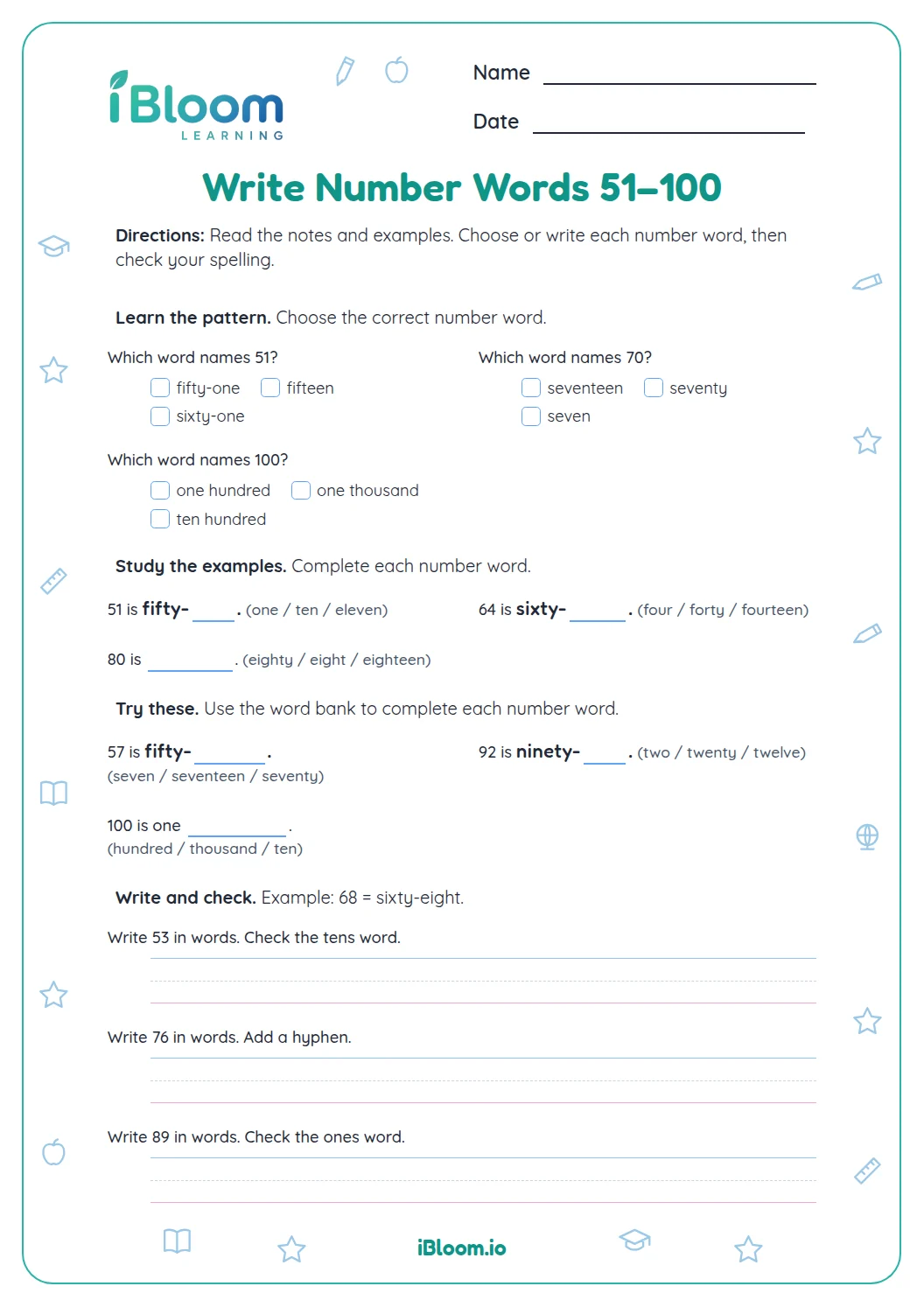
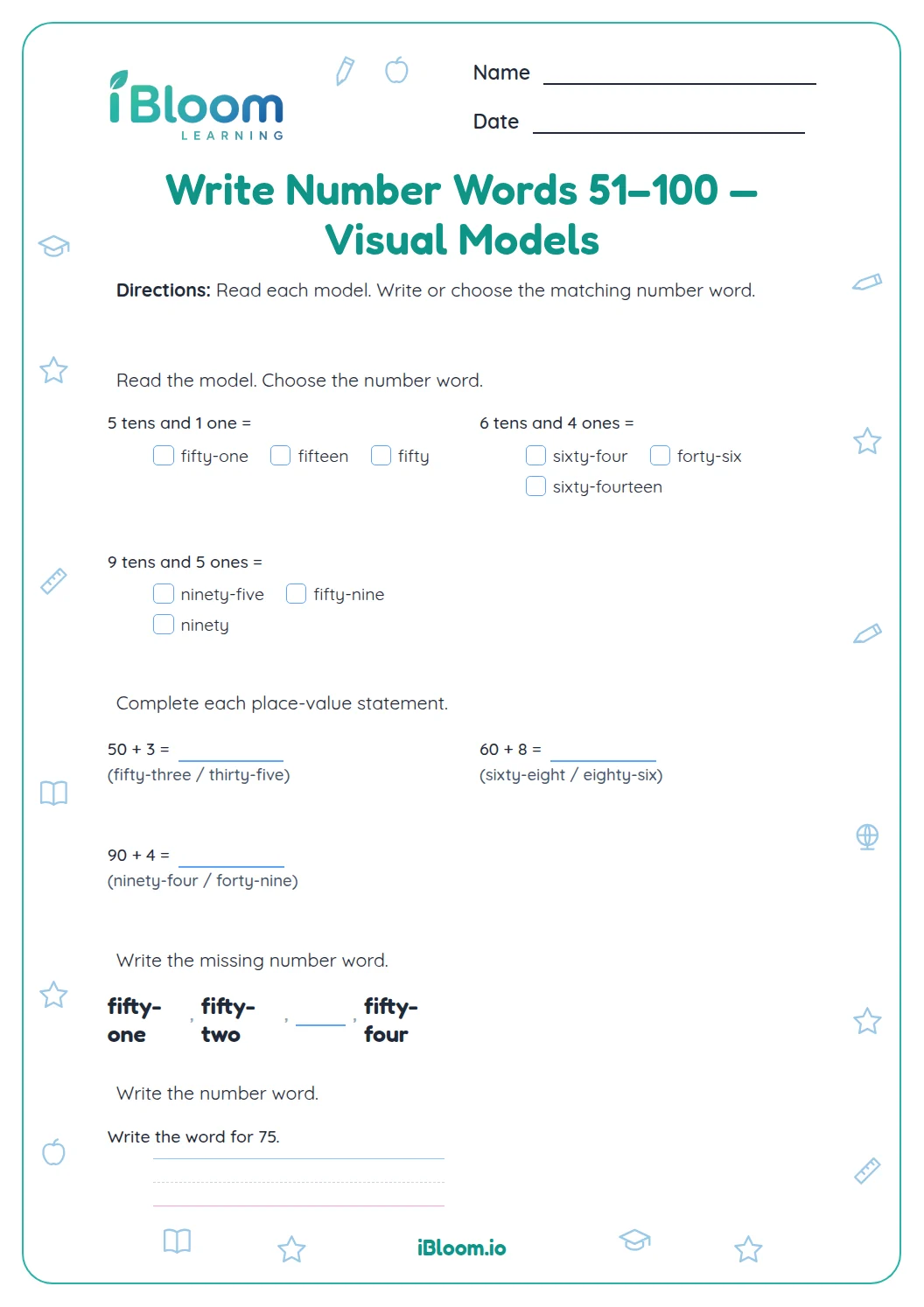
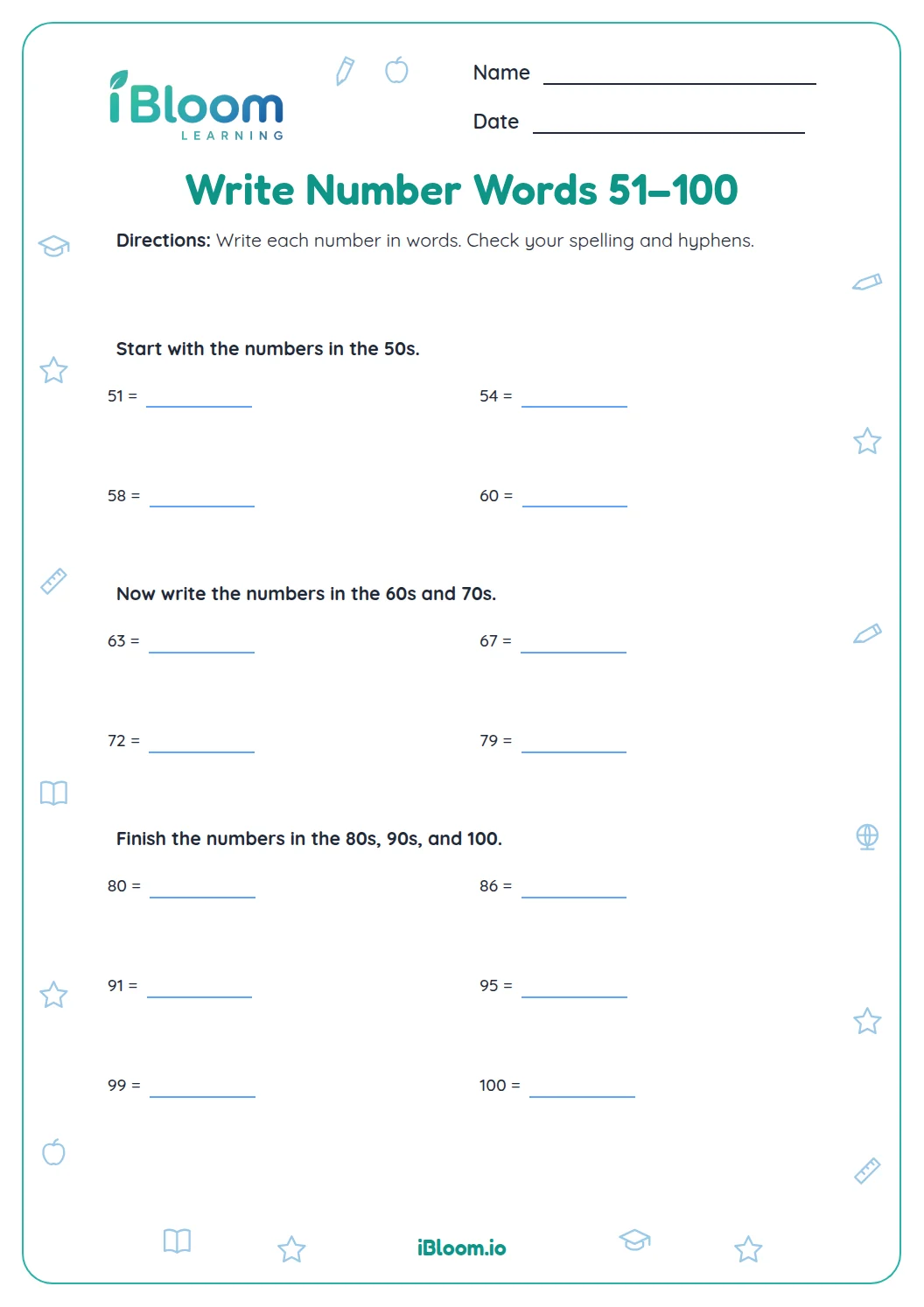
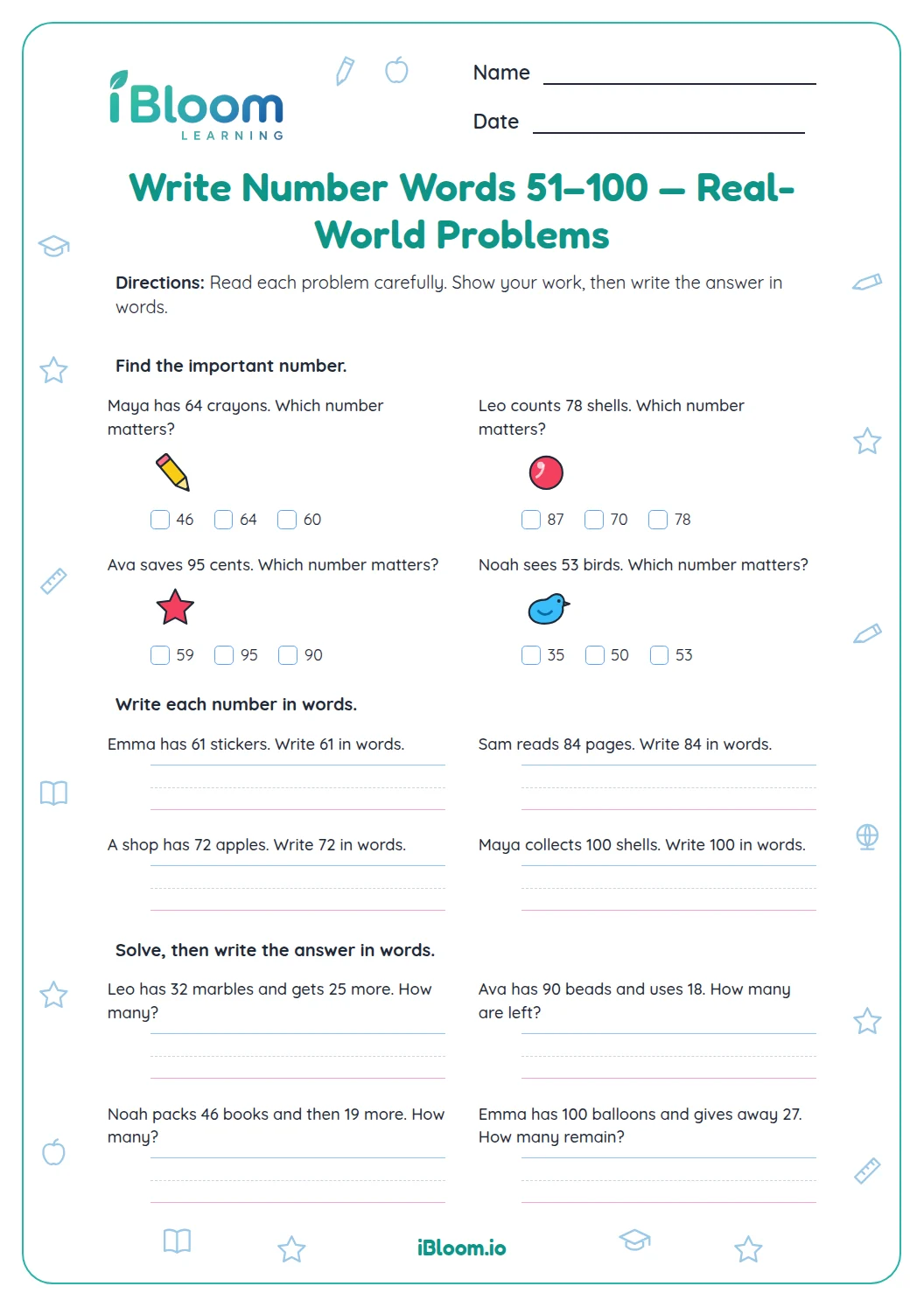



About this worksheet
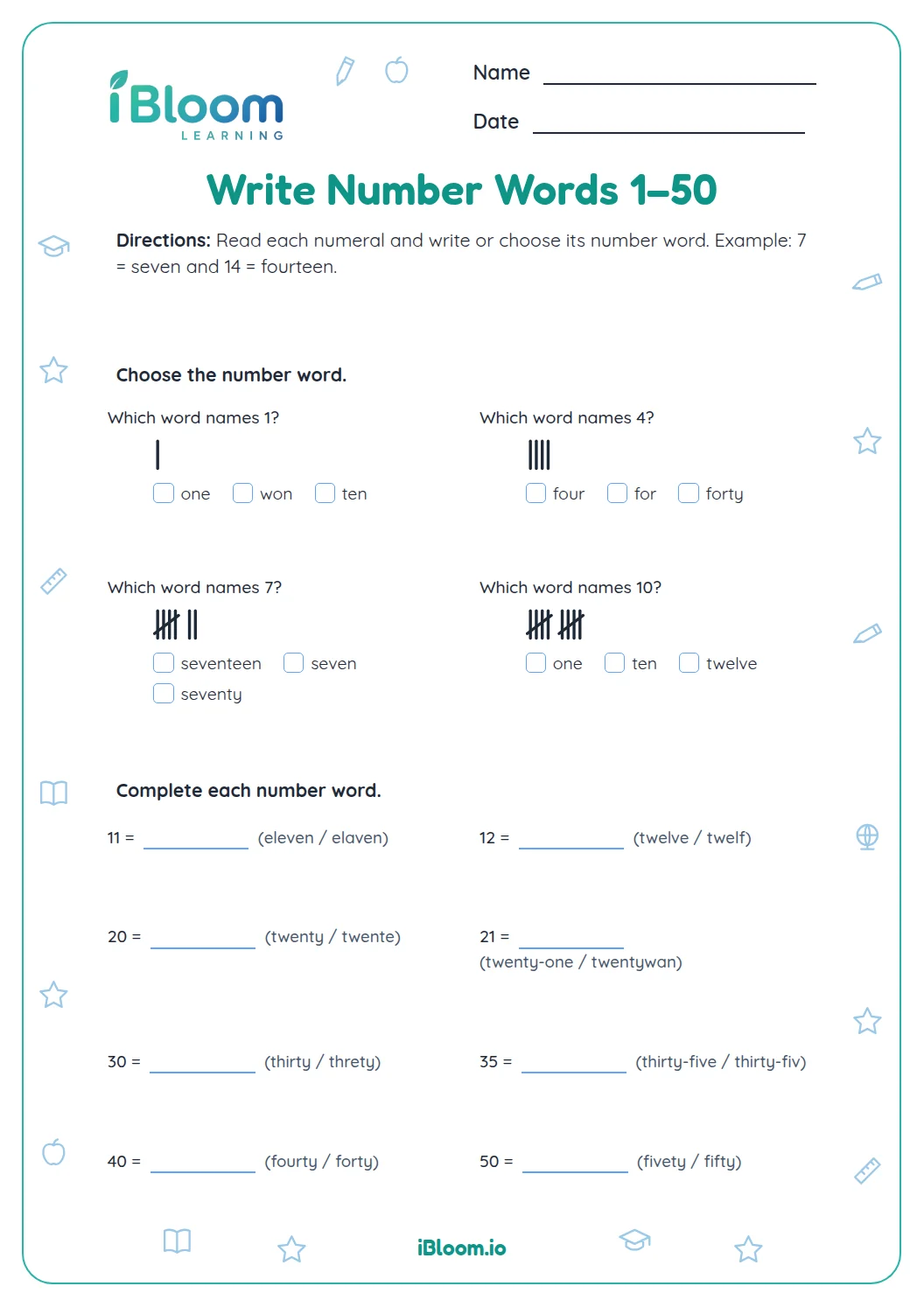
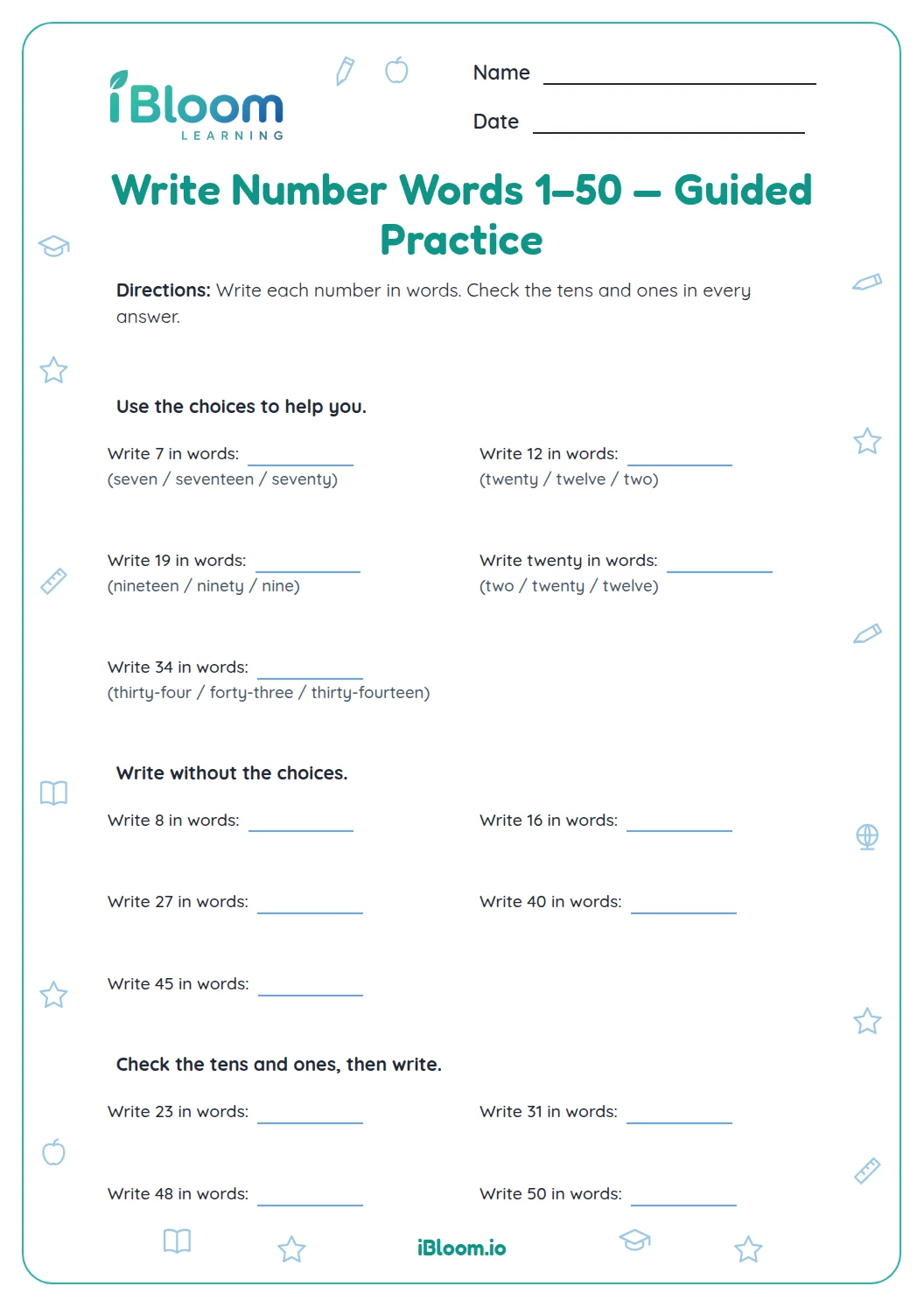
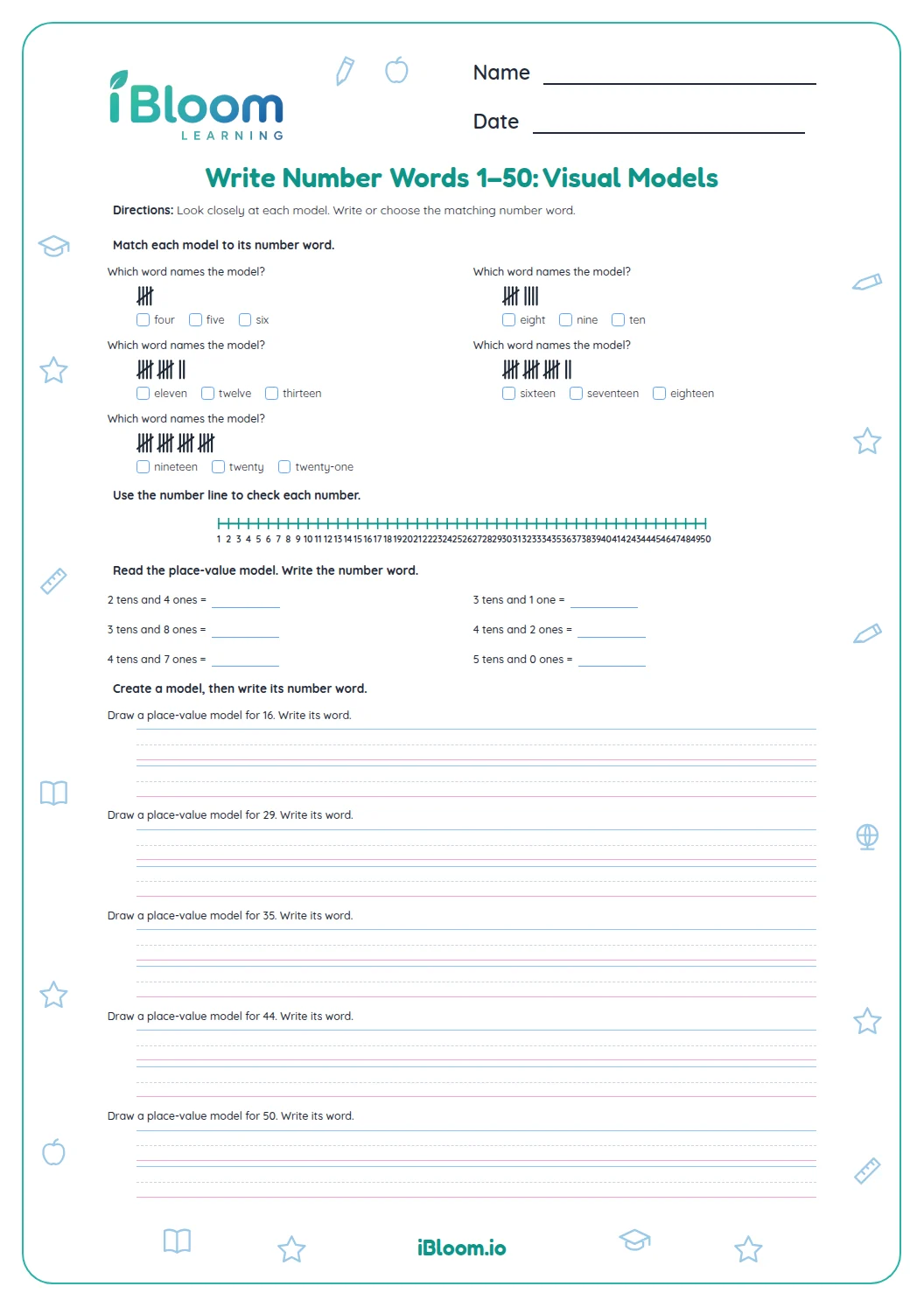
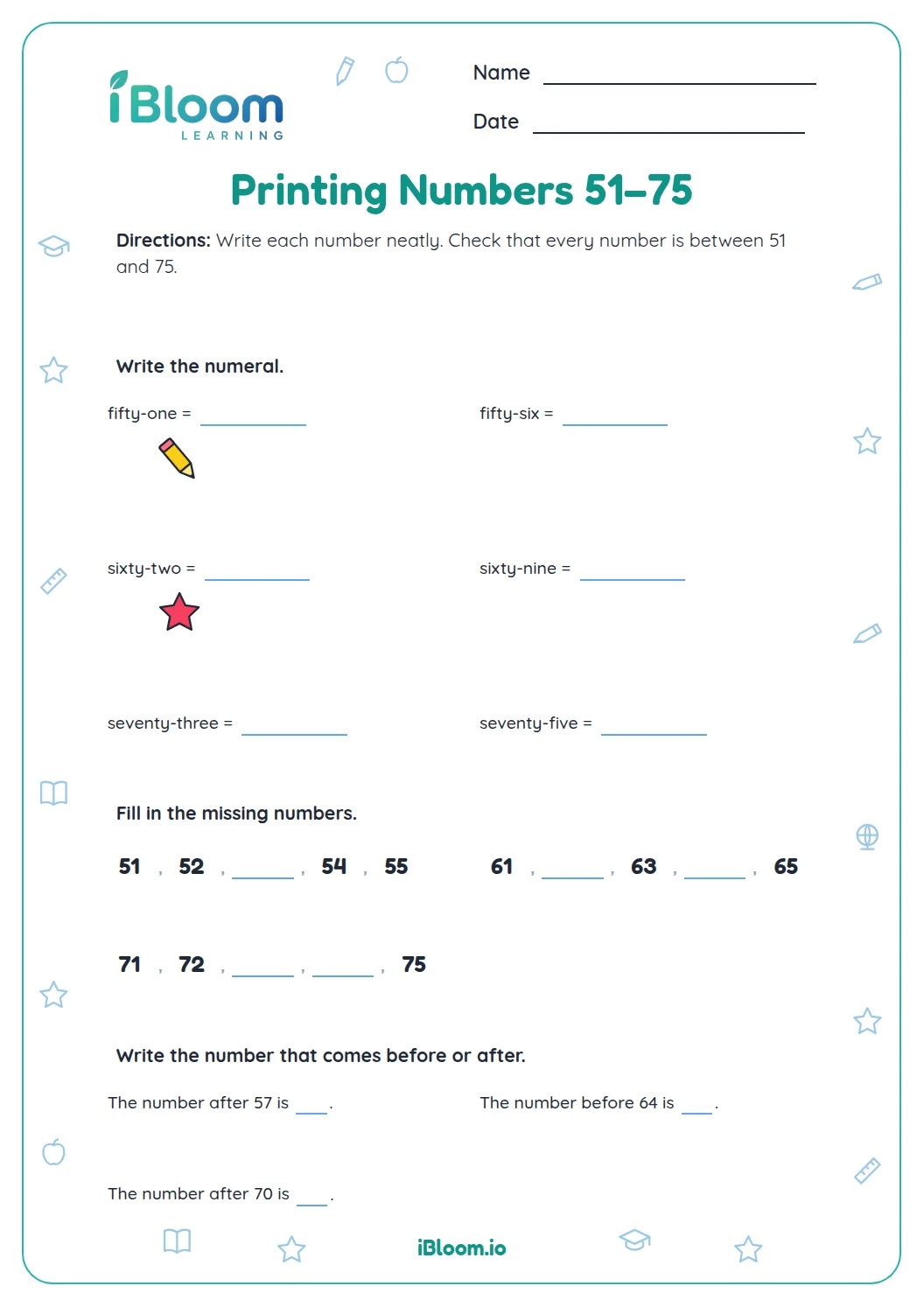
This free printable worksheet helps Grade 1 children read and write the number words from 51 to 100. It is guided practice: it begins with the numeral, then reverses to the word, then connects each word to its tens and ones, and ends with a quick check. In Part A, children write six numbers in words, such as 85 as eighty-five. In Part B, they read six number words and write the numerals. Part C connects the word to tens and ones, and Part D asks them to pick the right word from three choices. It supports Common Core 1.NBT.A.1 and 1.NBT.B.2. The answer key is on separate pages.
Aligned to 1.NBT.A.1 and 1.NBT.B.2
What is on this worksheet?
Twenty-two questions in four parts. The numbers are spread across the whole range from 51 to 100, so children see every tens word: fifty, sixty, seventy, eighty and ninety, plus one hundred.
The sheet works in both directions. Children turn numerals into words, and words back into numerals, which is what makes the spelling meaningful instead of just copied.
- Part A, questions 1 to 6: write the number word for a numeral, from 52 to 100
- Part B, questions 7 to 12: read a number word and write the numeral
- Part C, questions 13 to 16: finish a tens-and-ones sentence like seventy-three = 70 + ___
- Part D, questions 17 to 22: pick the word that names a number from three choices
- Answer key on separate pages
How do you build a number word from 51 to 99?
Every number from 51 to 99 follows one pattern: the tens word, a hyphen, and the ones word. After the tens words are learned, a child only needs the one-to-nine words they already know from counting.
The tens words are the tricky part, because they do not match the digit names exactly. Five tens is fifty, not fivety, and eight tens is eighty, with a single t. Children have to learn fifty, sixty, seventy, eighty and ninety as five new words.
- 185 = ___
- 28 tens is eighty, and 5 ones is five
- 3Write: eighty-five
How does Part C connect number words to tens and ones?
Part C shows that the word and the place value tell the same story. In seventy-three = 70 + ___, seventy is the tens part, and children find the ones part from the second word. This is the idea in Grade 1 place value: the two digits of a two-digit number stand for tens and ones.
It also gives a quick way to check spelling mistakes. If a child writes seventy-three but the number they meant has a 5 in the ones place, the mismatch shows up.
- 1eighty-seven = 80 + ___
- 2eighty is the 80, and seven is the ones part
- 3Write: 7
Why do children mix up words like ninety and nineteen?
Part D uses sound-alike choices on purpose. Ninety and nineteen start with the same sound, and so do sixty-seven and sixteen. The difference is the ending: -ty means tens, and -teen means 10 plus another number.
A good habit is to look at the tens digit first. In 90 the tens digit is 9, so the word is ninety: 9 tens and no ones. Nineteen is 19, with a 1 in the tens place. If the tens digit is not 1, the word cannot end in -teen.
How to use this worksheet at home or in class
- 1Practice the five tens words aloud first: fifty, sixty, seventy, eighty, ninety. Clap each syllable.
- 2In Part A, ask your child to say the tens, then the ones, before writing the word, for example "eighty... five."
- 3In Part B, have your child underline the tens word and circle the ones word before they write the numeral.
- 4In Part C, say the tens-and-ones check out loud: "eighty-seven is 80 and how many more?"
- 5In Part D, ask your child to say each choice out loud before filling in a bubble. Read the digits of the number first.
- 6Check with the answer key, and ask your child to re-write any word that was spelled wrongly, copying the key letter by letter.
Common mistakes and quick fixes
The mistake
Writing "fiftytwo" with no hyphen, or "fifty two" with a space, for 52 in question 1.
The fix
Show the hyphen as a small bridge that joins the tens and the ones. Point to question 1: fifty-two, with a bridge between fifty and two.
The mistake
Mixing up -ty and -teen, such as choosing nineteen for 90 in question 18.
The fix
Ask how many tens are in the number. A -ty word names whole tens (ninety is 9 tens). A -teen word names 1 ten and some ones. Look at the digits to check.
The mistake
Misspelling the tens words, such as "fifty" written as "fivty", or "eighty" as "eigthy", or "ninety" as "ninty".
The fix
Keep the five tens words on a card beside the sheet and have your child copy them, then cover them and write them again from memory.
Common Core alignment
This sheet practices the two Grade 1 standards below: writing numerals and understanding two-digit numbers as tens and ones.
Read and write numerals; here, write the numeral for a number word from 51 to 100.
On this sheet: Part B asks children to write the numerals for 58, 66, 71, 89, 90 and 99.
Show the official wordingHide the official wording
Count to 120, starting at any number less than 120. In this range, read and write numerals and represent a number of objects with a written numeral.
Understand that a two-digit number is made of tens and ones, as in eighty-seven = 80 + 7.
On this sheet: Part C connects each number word to its tens and ones, such as eighty-seven = 80 + 7.
Show the official wordingHide the official wording
Understand that the two digits of a two-digit number represent amounts of tens and ones.
What to practice next
Make more practice
Further reading
Questions parents and teachers ask
How does writing number words help with place value?
Each number word from 51 to 100 names its tens and then its ones, so eighty-seven is 8 tens and 7 ones. Moving between the word, the numeral and the tens and ones links all three forms. Part B practices writing numerals (1.NBT.A.1), and Part C makes the tens and ones explicit (1.NBT.B.2).
Why does the sheet use a hyphen in seventy-seven?
A hyphen joins two number words into one number, as in seventy-seven. Numbers from 21 to 99 that are not whole tens are written this way in standard English. Children see it in ten of the twelve Part A and Part B answers (ninety and one hundred have none), and it is the most common thing to forget.
Why does the sheet start with the numeral and not the word?
Children usually know the numeral before the word, so Part A starts from what they know and builds the word from the tens and ones. Part B then turns the direction around, which shows whether they can really read the word. Together, the two parts check understanding, not memory.
Is the 51 to 100 range too much for one sheet?
It is a lot of different words, but the pattern repeats: five tens words, plus the ones words children already know. The sheet gives them 22 questions that touch each tens word at least twice, and the guided parts give hints before the final check in Part D.
What if my child can write the number but not spell the word?
This is common. Keep a card with the five tens words, fifty to ninety, and the ones words one to nine, and let your child copy from it for the first sheet. Then cover the card and try again. Spelling grows with repeated writing, so it is fine to repeat the sheet.
How do I check Part C of the worksheet?
Each Part C answer is a single digit, the ones part of the word. In seventy-three = 70 + ___, the answer is 3, because the second half of the word says three. If your child is unsure, ask them to say the number word again and listen for the ones word at the end.