


About this worksheet
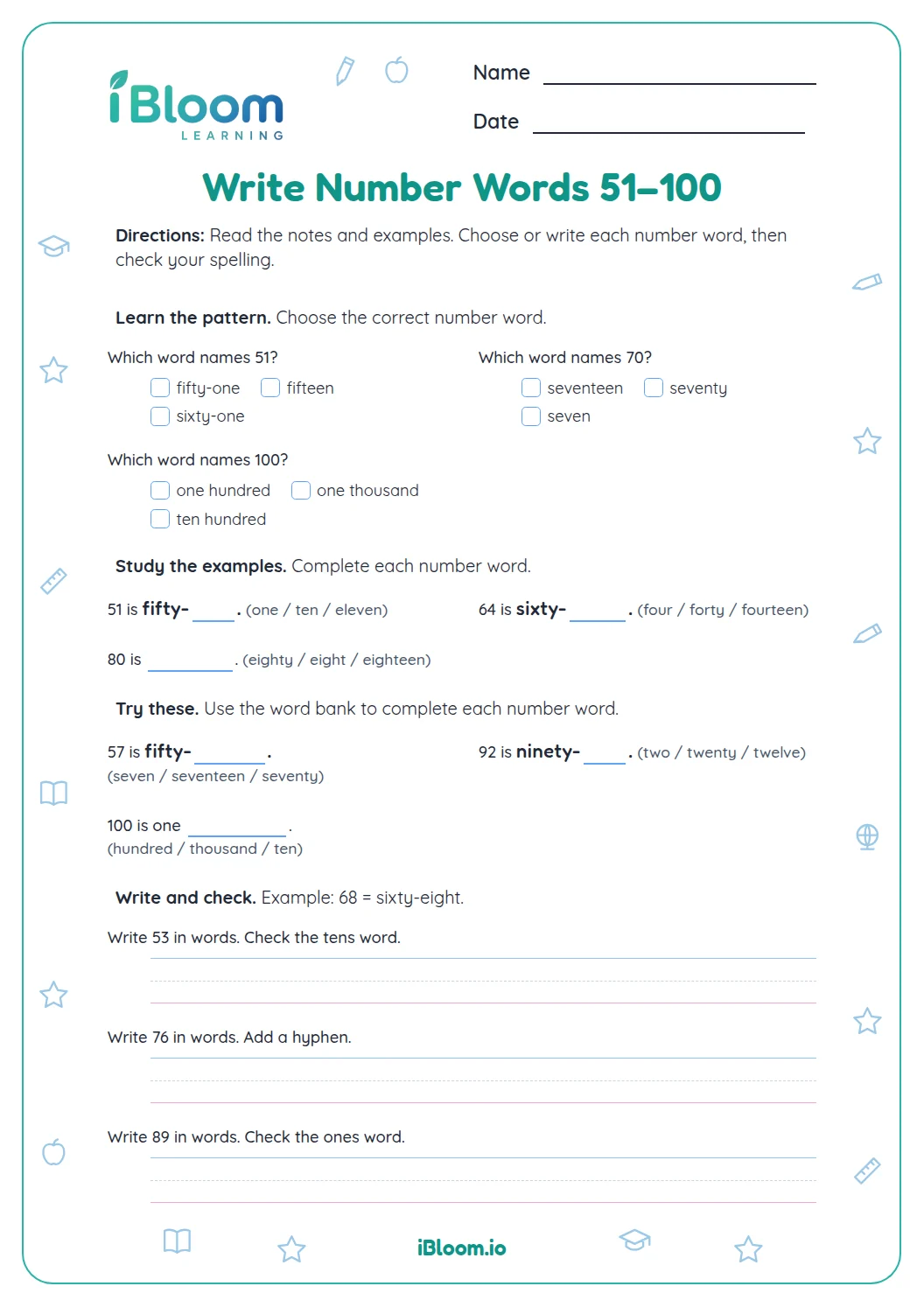
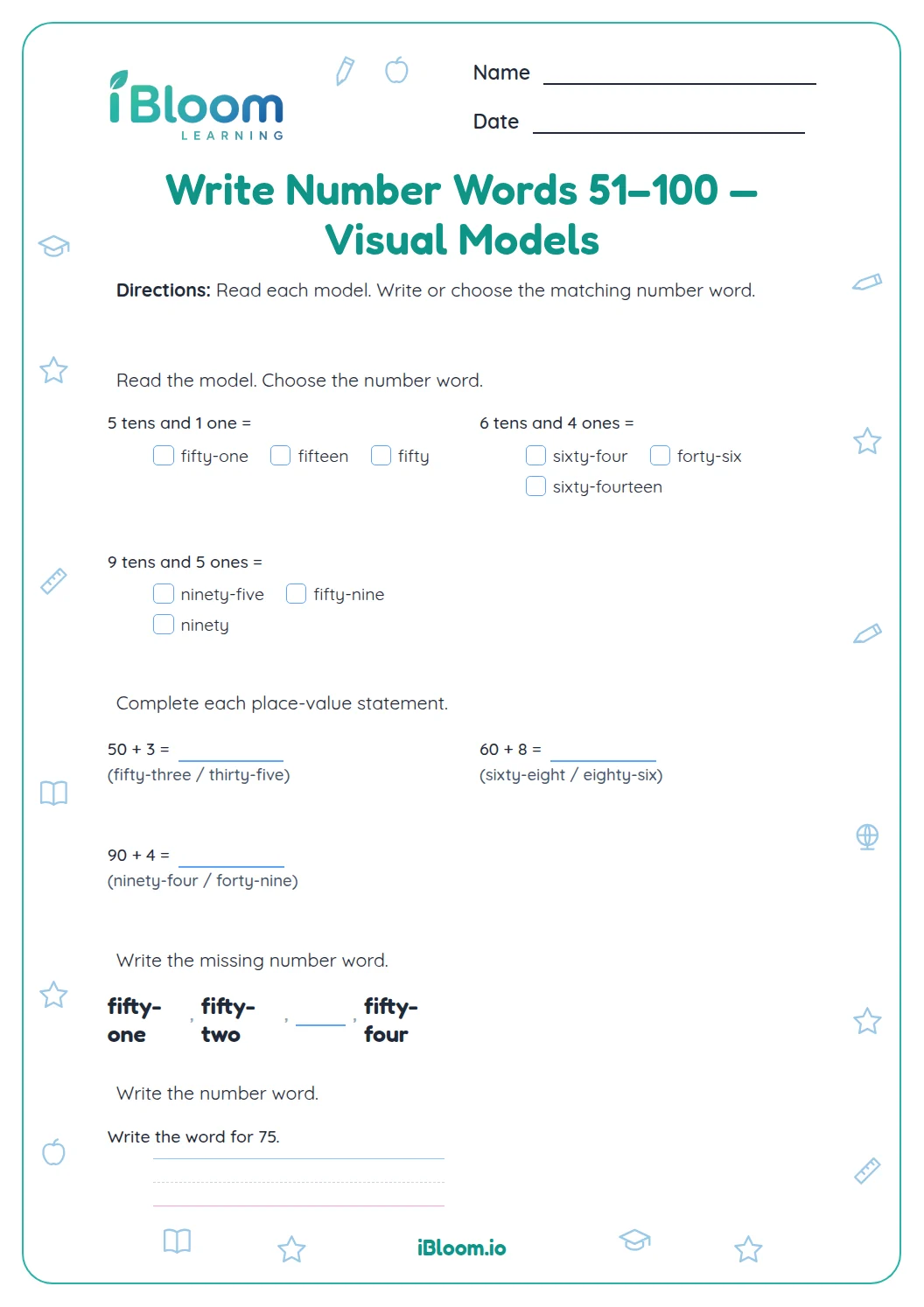
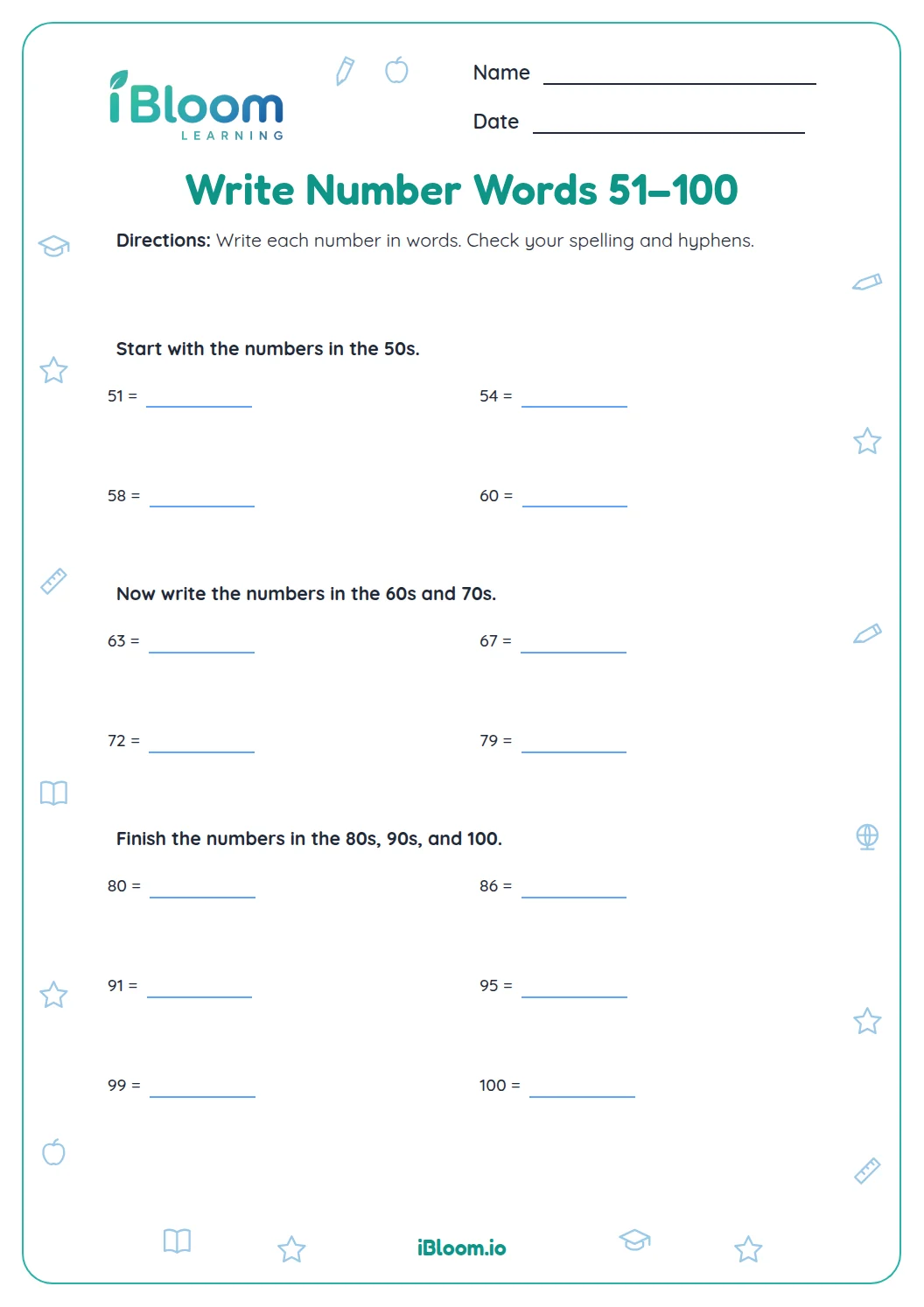
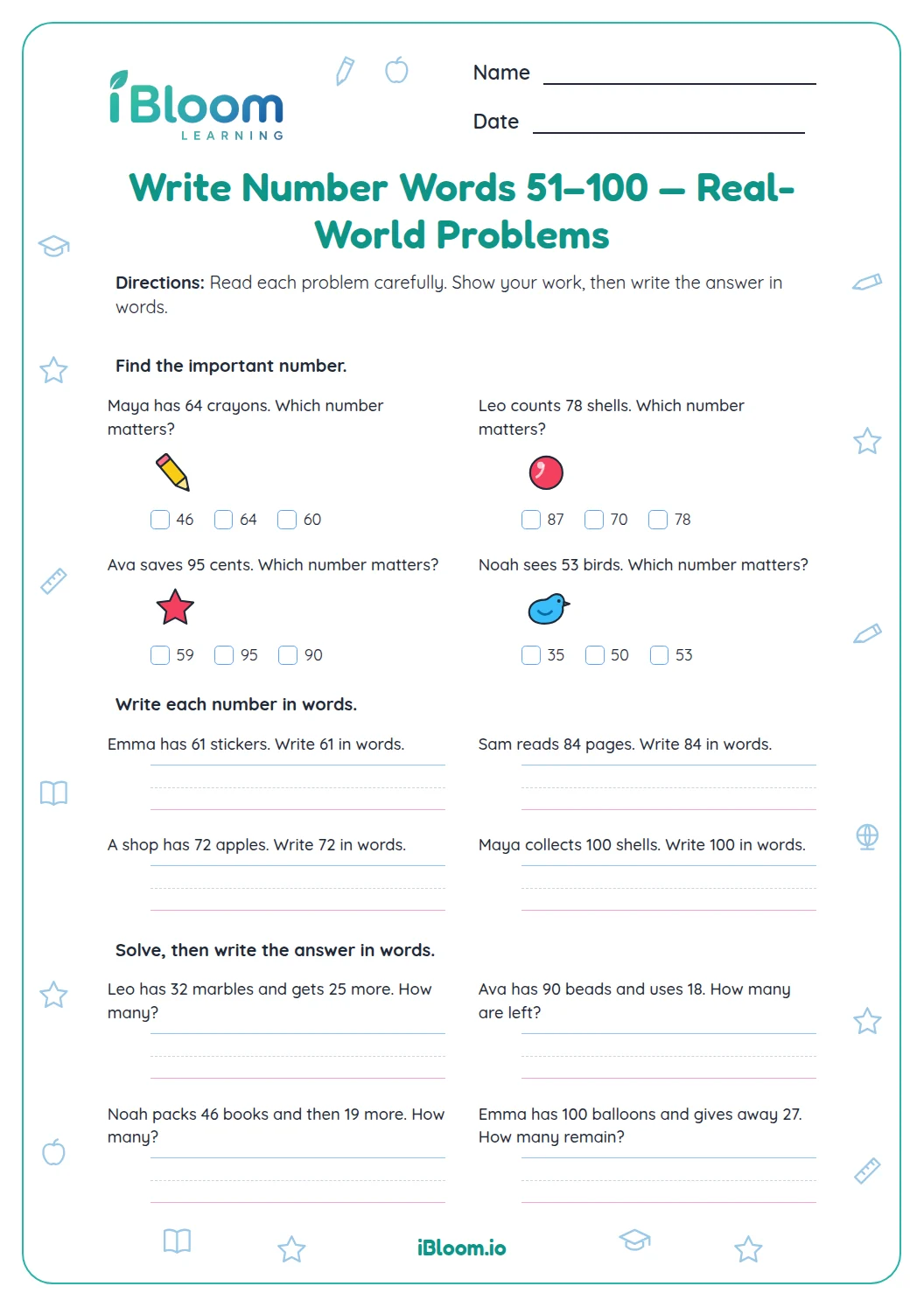
This Grade 1 worksheet practices writing number names for 51 through 100. Children write number words, match numerals and names, complete missing forms, and use tens-and-ones clues to identify a number. It connects to CCSS 1.NBT.A.1 and 1.NBT.B.2; the separate answer key lists each expected numeral or number name.
Aligned to CCSS.MATH.CONTENT.1.NBT.A.1 and CCSS.MATH.CONTENT.1.NBT.B.2
How do children write numbers in words?
Write the tens word first, followed by the ones word when needed. The worksheet includes forms such as fifty-eight and one hundred.
How do numerals and number names match?
The multiple-choice items ask children to pair a numeral with its word form. In question 5, seventy-four matches 74; the digits keep the tens and ones in the right places.
How can tens and ones identify a number?
A clue such as 9 tens and 4 ones describes 94, or ninety-four. Use the tens clue first, then add the ones word.
A number-word routine
- 1Read the numeral or clue carefully.
- 2Say the tens word.
- 3Add the ones word when the number is not a multiple of ten.
- 4Hyphenate the tens-and-ones name.
- 5Check that the written name matches the numeral.
Number name checks
The mistake
Reversing the tens and ones in a number such as 74.
The fix
Read the tens digit first: 7 tens, then 4 ones.
The mistake
Writing “fourty” for 40.
The fix
Remember the standard spelling is forty.
The mistake
Forgetting the hyphen in seventy-six.
The fix
Join the tens and ones words with a hyphen.
Common Core alignment
The number-name and place-value questions connect to these Grade 1 standards.
Read and write numerals in the 51–100 range.
On this sheet: The questions ask learners to practice this standard.
Show the official wordingHide the official wording
Count to 120, starting at any number less than 120. In this range, read and write numerals and represent a number of objects with a written numeral.
Use tens and ones to identify two-digit numbers.
On this sheet: The questions ask learners to practice this standard.
Show the official wordingHide the official wording
Understand that the two digits of a two-digit number represent amounts of tens and ones. Understand the following as special cases:
What to practice next
Make more practice
Further reading
Questions parents and teachers ask
Which numbers do children practice?
Children practice the full range from 51 through 100, with all 50 numerals represented at least once. Children write number names, match numerals and words, fill in missing forms, and use tens-and-ones clues. Read each numeral carefully before writing its name so the tens word and ones word stay in the correct order.
How should a number such as 76 be written?
Write the tens word followed by the ones word, with a hyphen: seventy-six. The hyphen joins the two parts of the number name. For a multiple of ten such as 80, write eighty without adding a ones word; for 100, write one hundred.
What does the tens-and-ones section practice?
Those clues connect place value to number names. For example, 9 tens and 4 ones make 94, which is written ninety-four. Children can name the tens first, add the ones, then check that the resulting numeral fits the clue.
Is an answer key included?
Yes. The separate key lists the expected word or numeral for every item. For written number names, accept standard US spelling and hyphenation. The key can help an adult locate a spelling or place-value error and invite the child to correct it.
How can a child check a number word?
Read the written name aloud and compare it with the numeral or clue. The tens word should match the tens digit, and the ones word should match the ones digit. For example, ninety-four means 9 tens and 4 ones, not 4 tens and 9 ones.