
About this worksheet
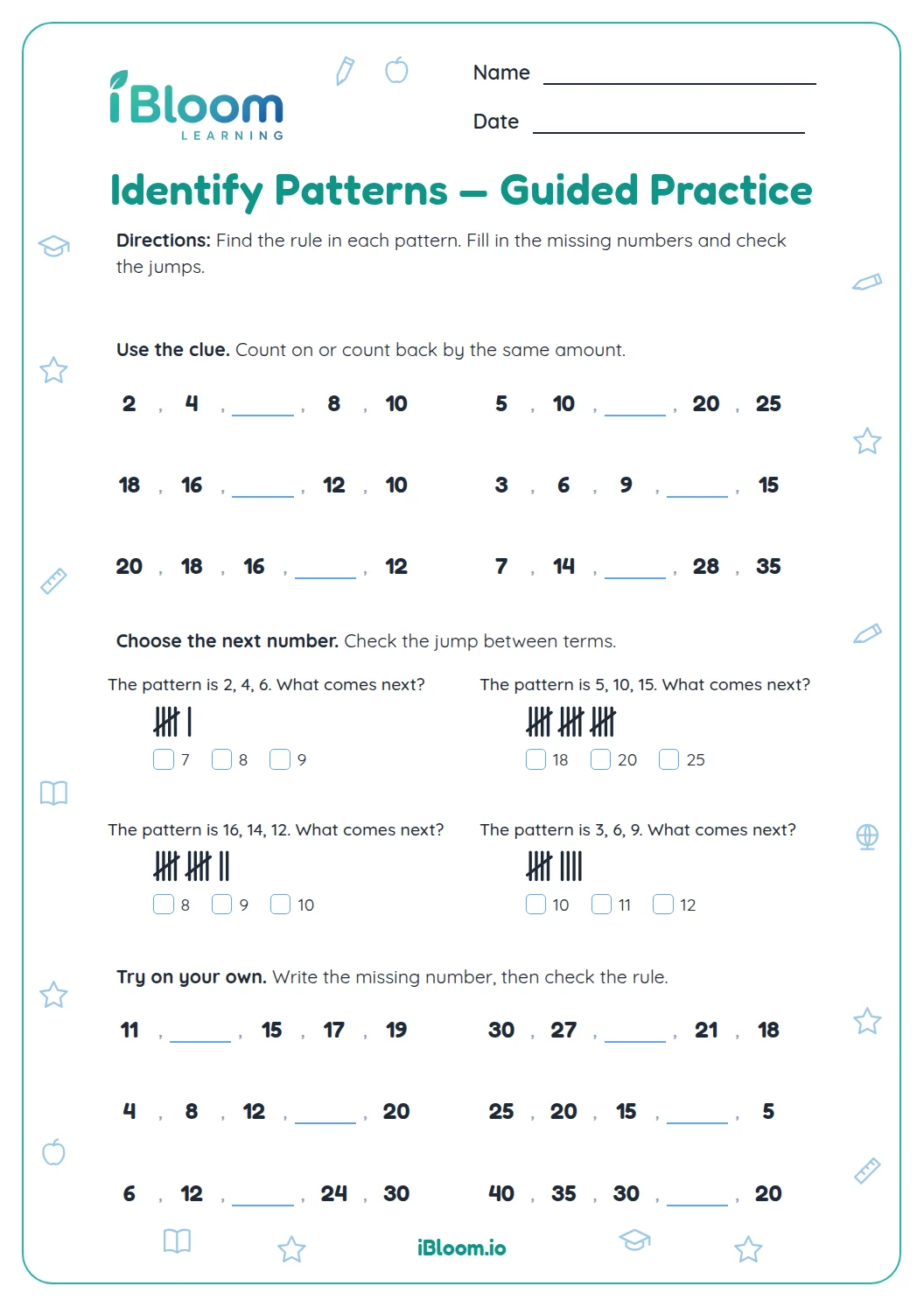
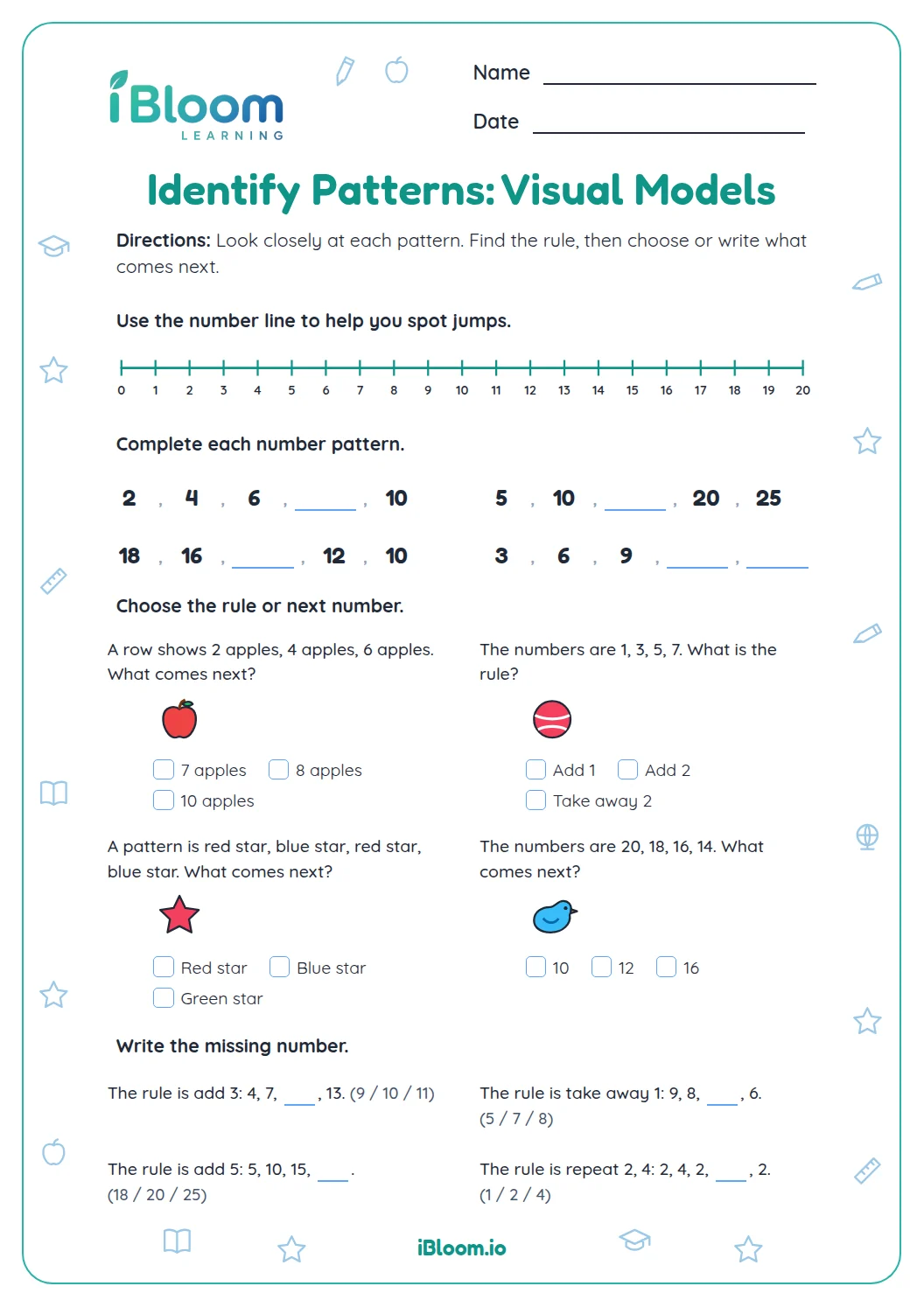
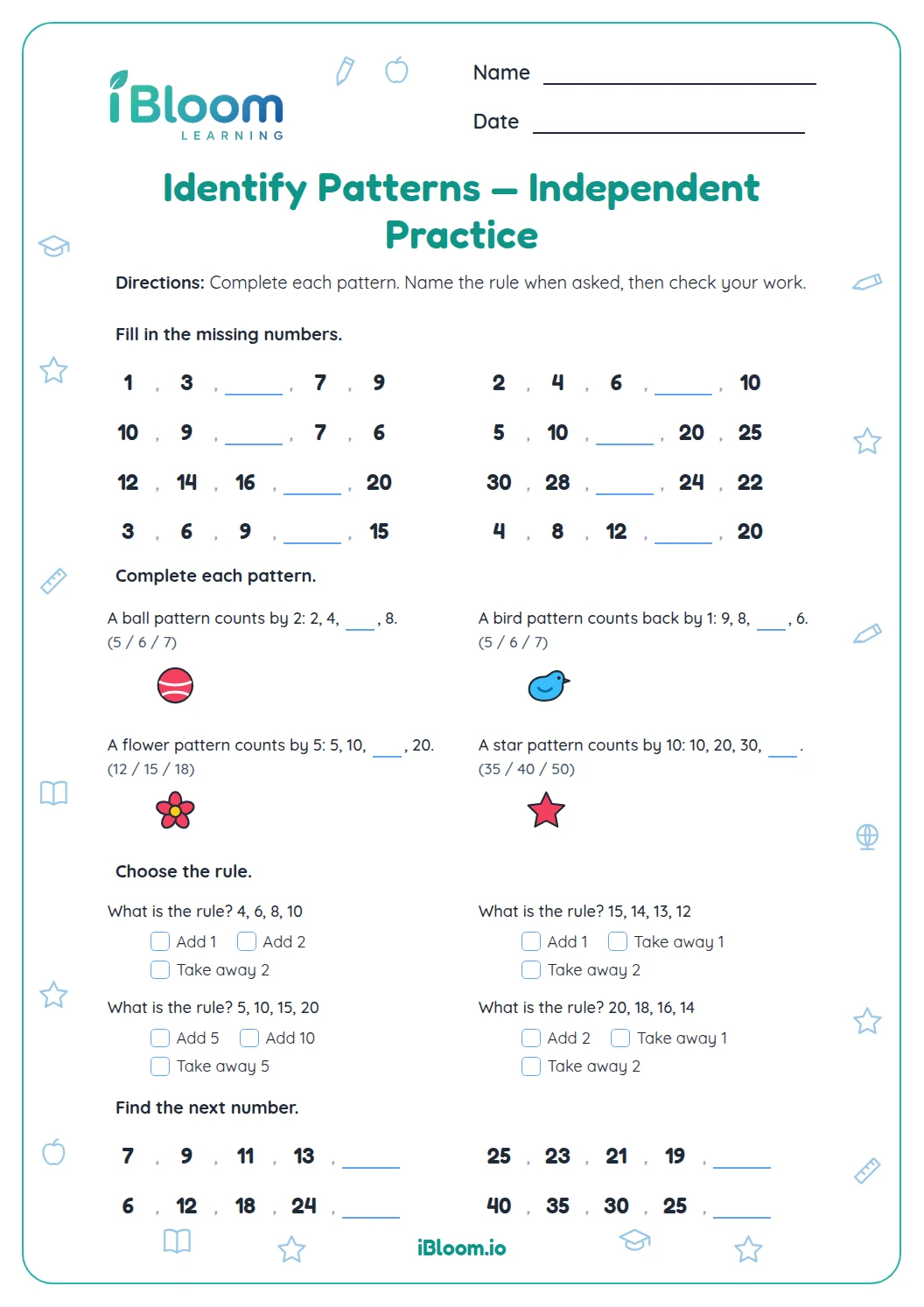
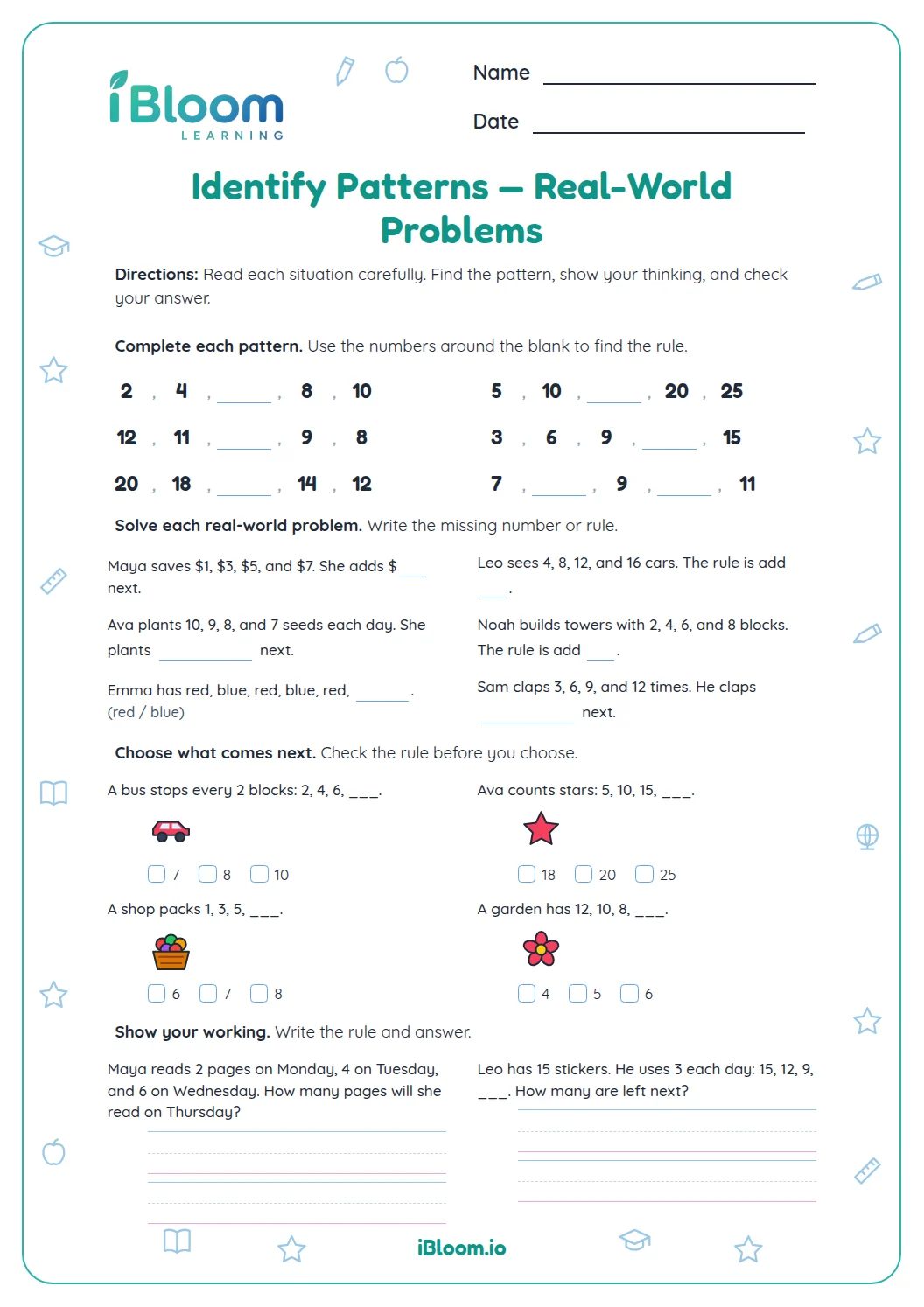
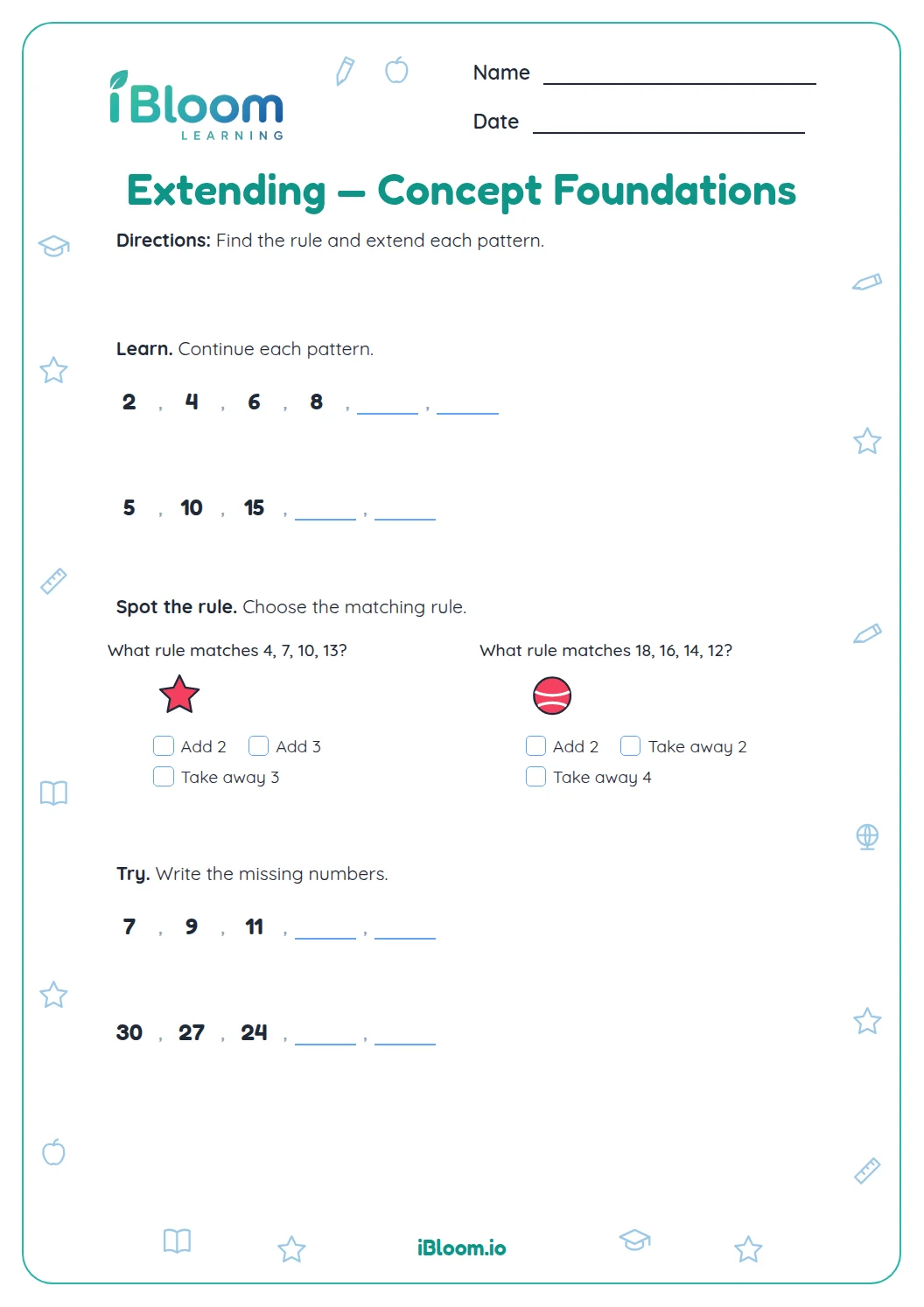
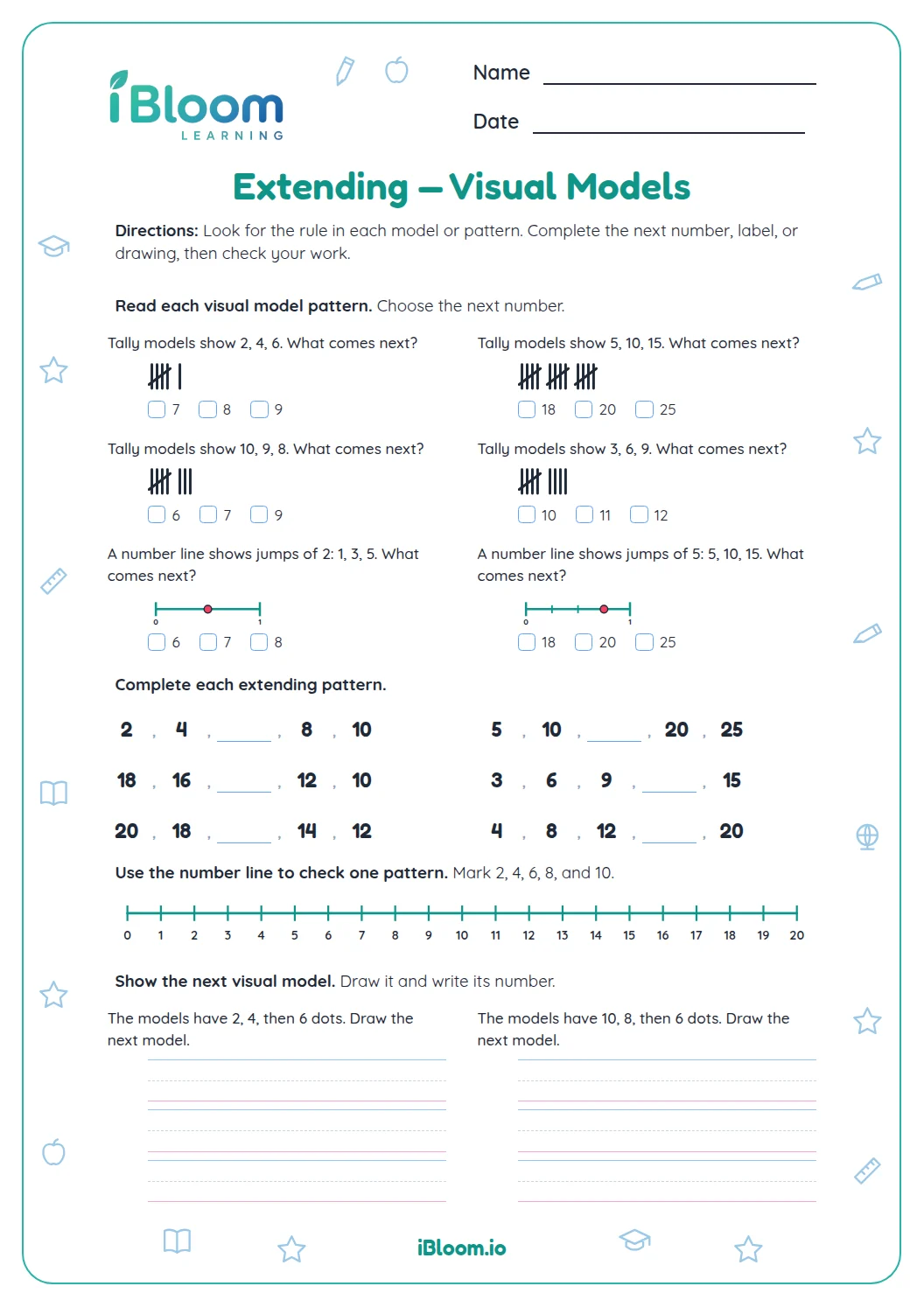
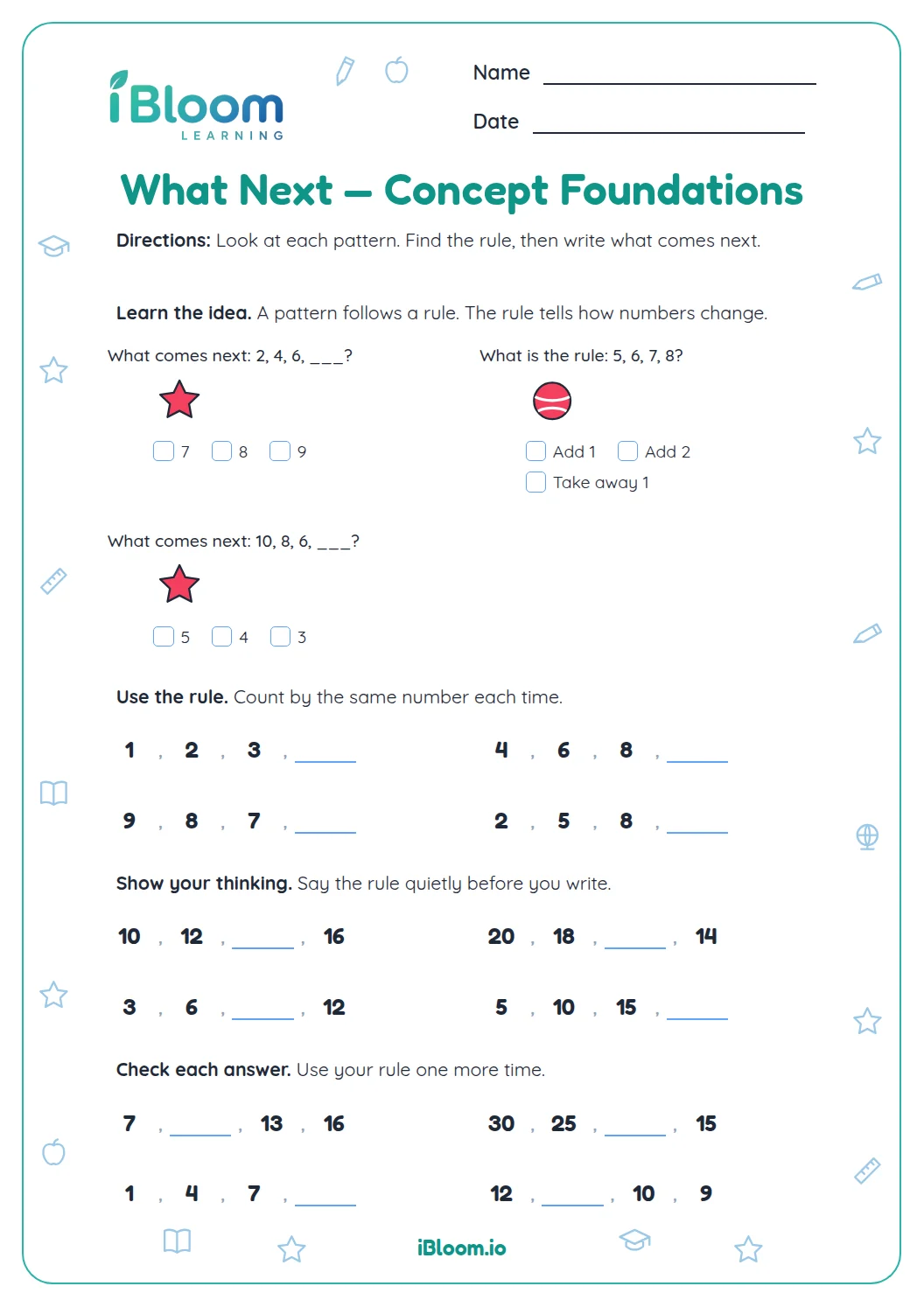
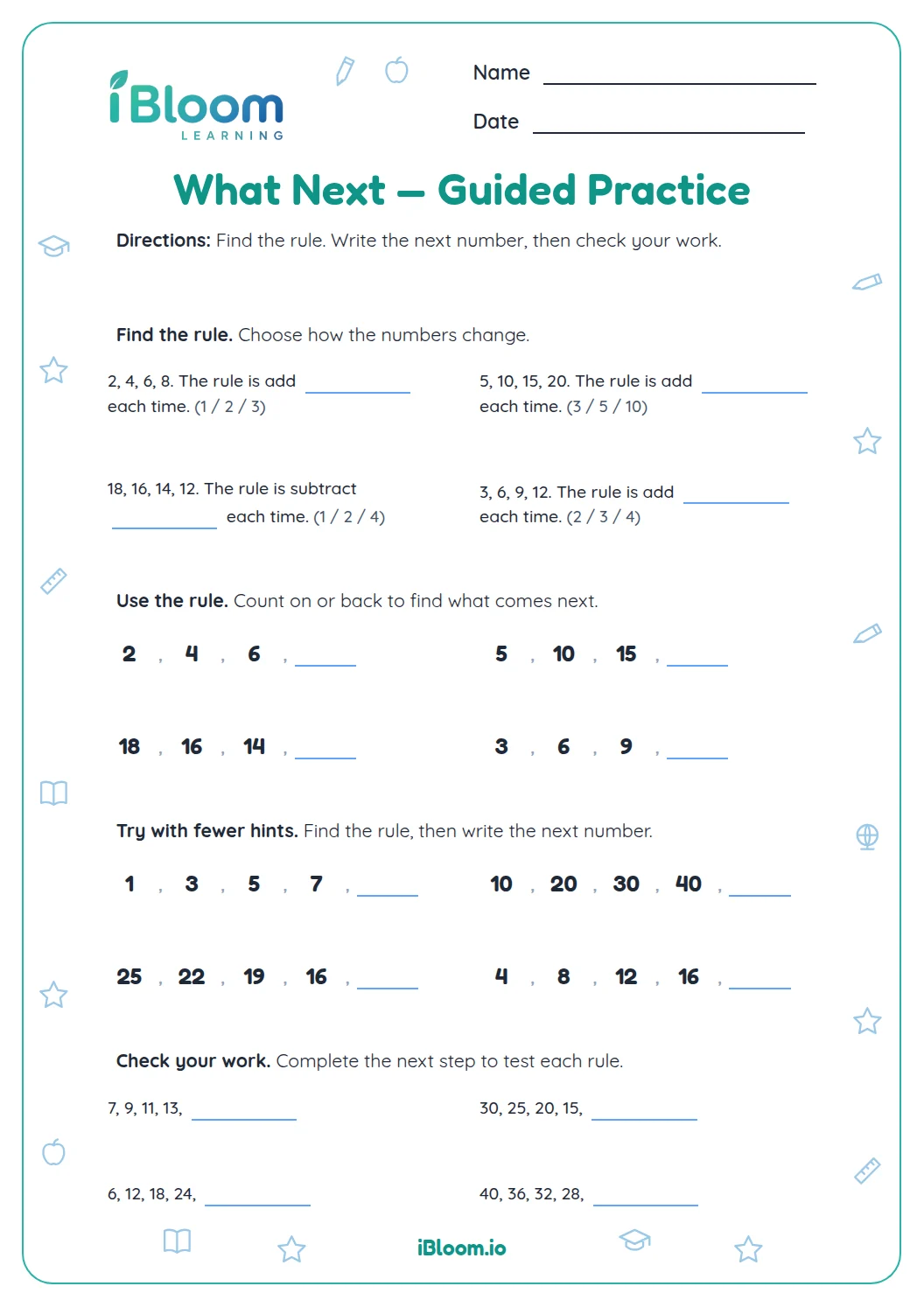
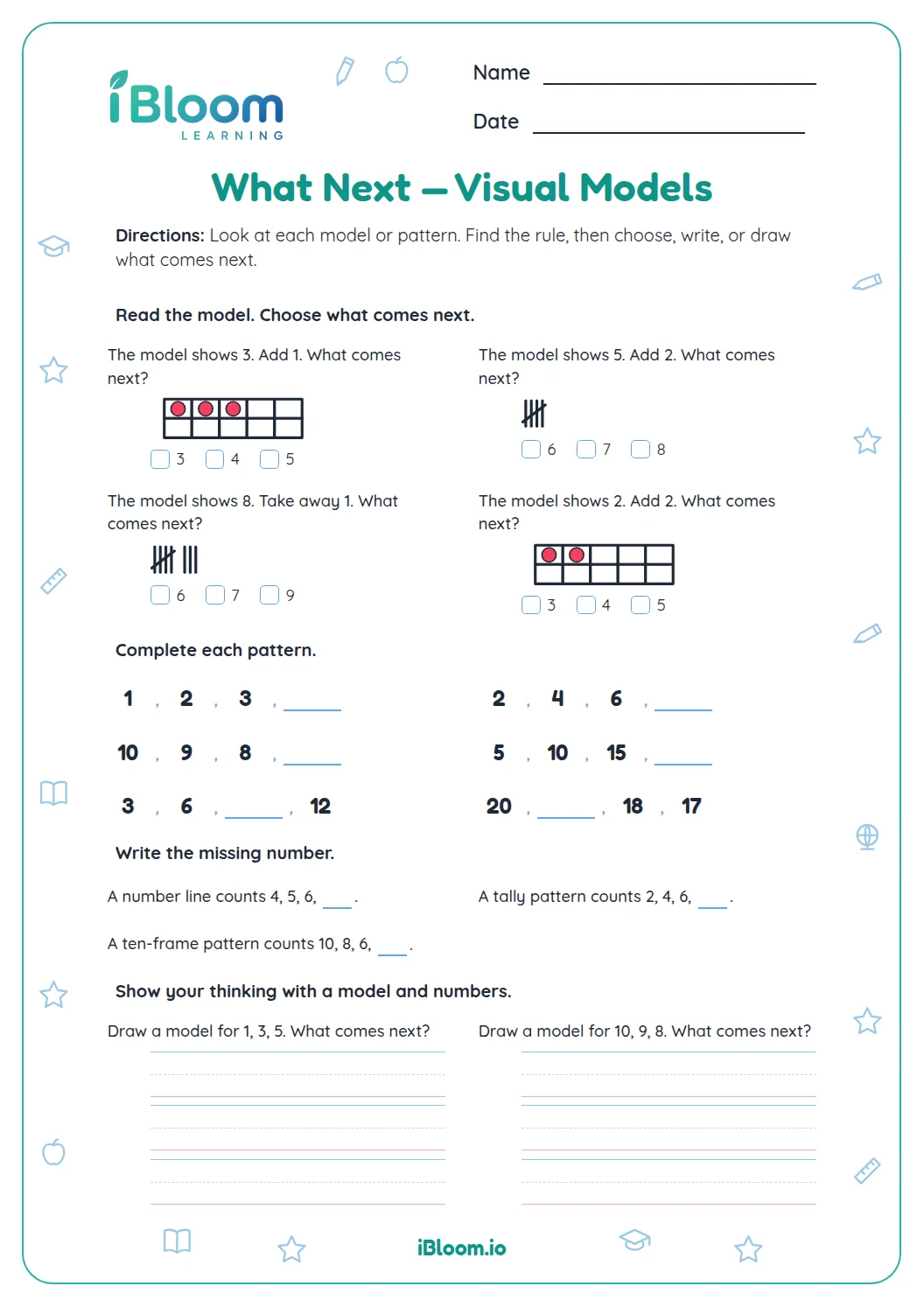
This Grade 1 number-patterns worksheet asks learners to check whether a rule fits, correct a mistaken explanation, complete number patterns, and choose a useful strategy. Its four parts move from checking reasoning to independent sequences and strategy choices. The number sequences connect counting forward and backward with addition and subtraction, practicing CCSS 1.OA.C.5. A separate answer key shows the choices and sample corrections.
Aligned to 1.OA.C.5
How can you tell whether a pattern rule is correct?
Compare the rule with every change in the sequence. In question 1, the numbers go up by 2, so “add 1” does not fit. The correct rule is add 2.
- 12, 4, 6
- 2Leo says: “Add 1.”
- 3Check each step: add 2.
- 4Leo is incorrect; the rule is add 2.
How do you correct a mistaken explanation?
Name the actual rule, then use it to find the next number. In Part B, learners select corrections about adding, subtracting, and repeating pairs. Each choice states both the rule and the next number.
Which strategy helps you see a pattern?
Check the difference when the numbers change by the same amount. Look for a repeating pair when the numbers alternate. Part D asks learners to match each sequence with the strategy that makes its rule easiest to see.
How to use this worksheet
- 1Read the sequence from left to right.
- 2Compare each neighboring pair or look for a repeated group.
- 3Check whether the stated rule matches every step.
- 4When correcting an explanation, write the rule and next number.
- 5Choose a strategy that fits the pattern, then check it with the key.
Common mistakes and quick fixes
The mistake
Looking at only the first two numbers and guessing.
The fix
Check the same change between every neighboring pair.
The mistake
Checking only one pair before accepting a rule.
The fix
Test the rule against every change in the sequence.
The mistake
Giving a next number without explaining the rule when asked.
The fix
Write the number and a phrase such as “add 2 each time.”
Common Core alignment
The number sequences connect counting with adding or subtracting equal amounts.
Connect counting forward and backward with adding and subtracting.
On this sheet: The number sequences grow or shrink by equal amounts, and learners identify the count-on or count-back rule.
Show the official wordingHide the official wording
Relate counting to addition and subtraction (e.g., by counting on 2 to add 2).
What to practice next
Make more practice
Questions parents and teachers ask
What is a pattern rule?
A pattern rule tells how numbers change or repeat. In 2, 4, 6, the rule is add 2 each time; in 5, 10, 5, 10, a pair repeats. This worksheet asks learners to test rules against each step before accepting an explanation.
What should a correction include?
A complete correction names the pattern rule and gives the next number. For example, 1, 3, 5, 7 increases by 2, so the next number is 9. The answer key includes sample wording; a learner can use different words if the rule and number are right.
How many questions are on the worksheet?
There are 15 questions in four parts: four reasoning checks, three correction choices, six missing-number patterns, and two strategy choices. The separate answer key shows the correct choices and sequence values. Learners check each rule against the steps before deciding.
When should a learner look for a repeating pair?
Look for a repeating pair when the sequence switches back and forth between two numbers, such as 7, 9, 7, 9. Checking differences is more useful when the same amount is added or subtracted at every step. Part D asks learners to choose between these approaches.
How can I help without giving away the answer?
Ask the learner to say how one number changes to the next, then test that idea on another pair. For a repeating pattern, ask which group appears again. These prompts help the child explain the rule before choosing or writing an answer.