
About this worksheet
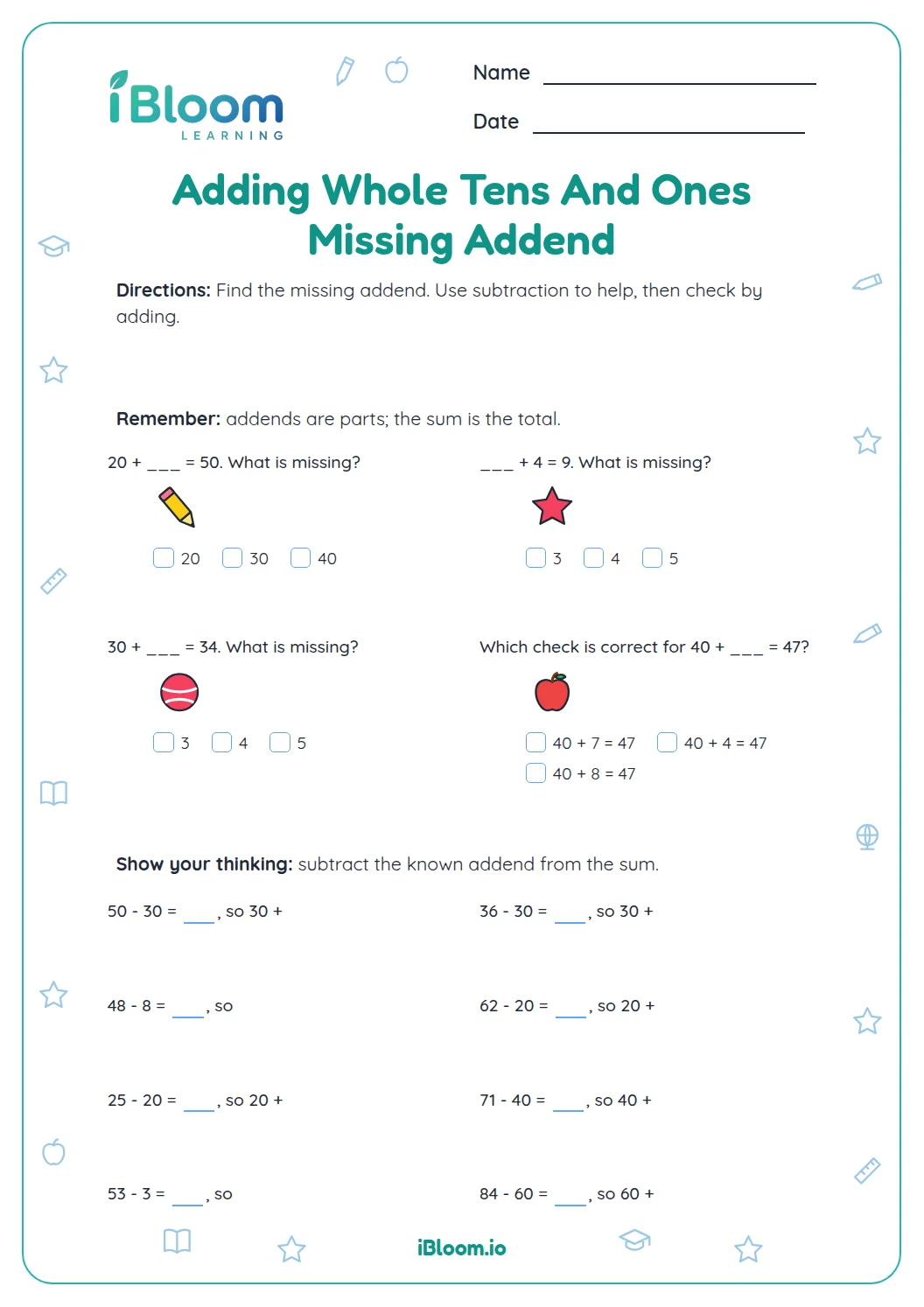
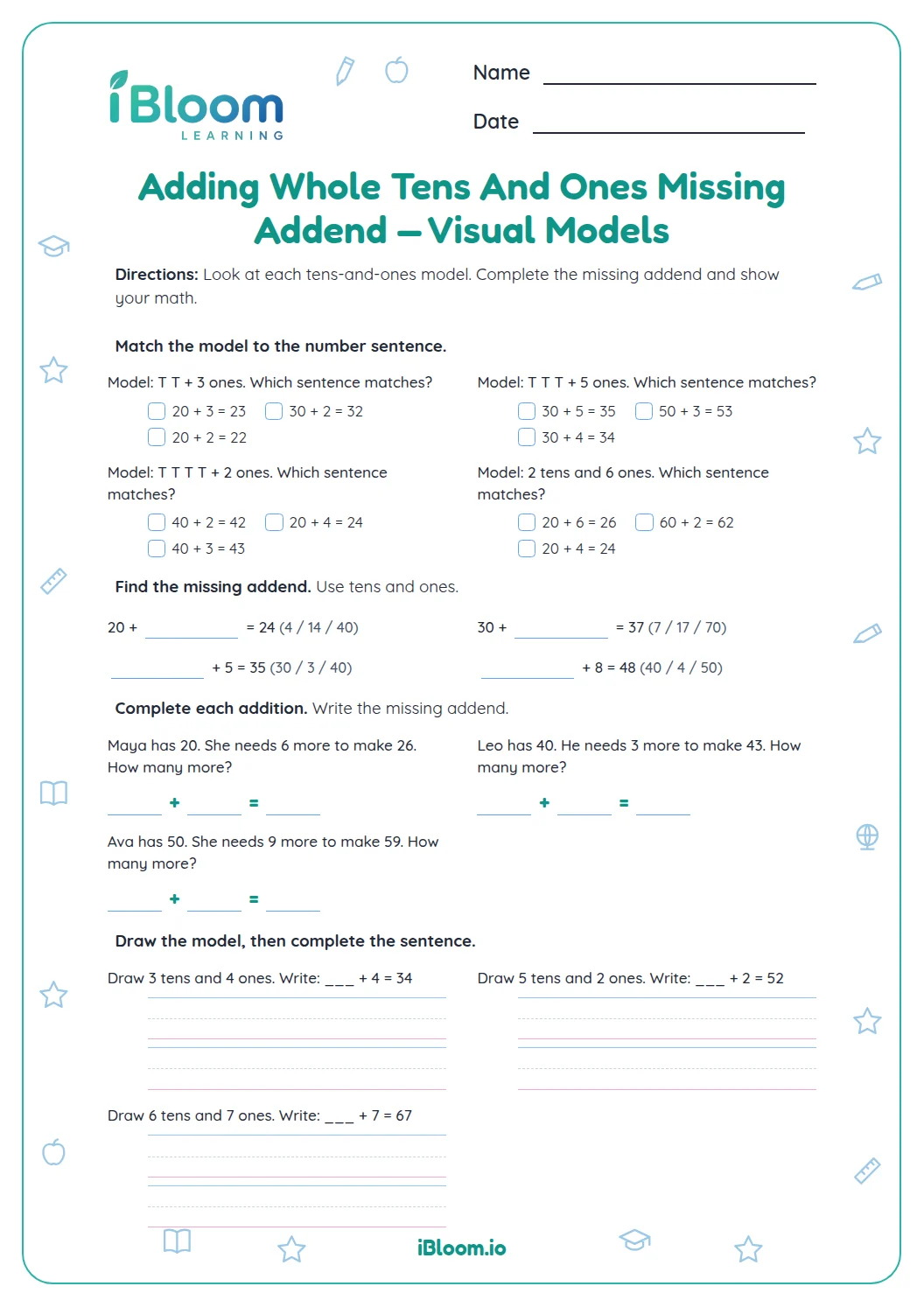
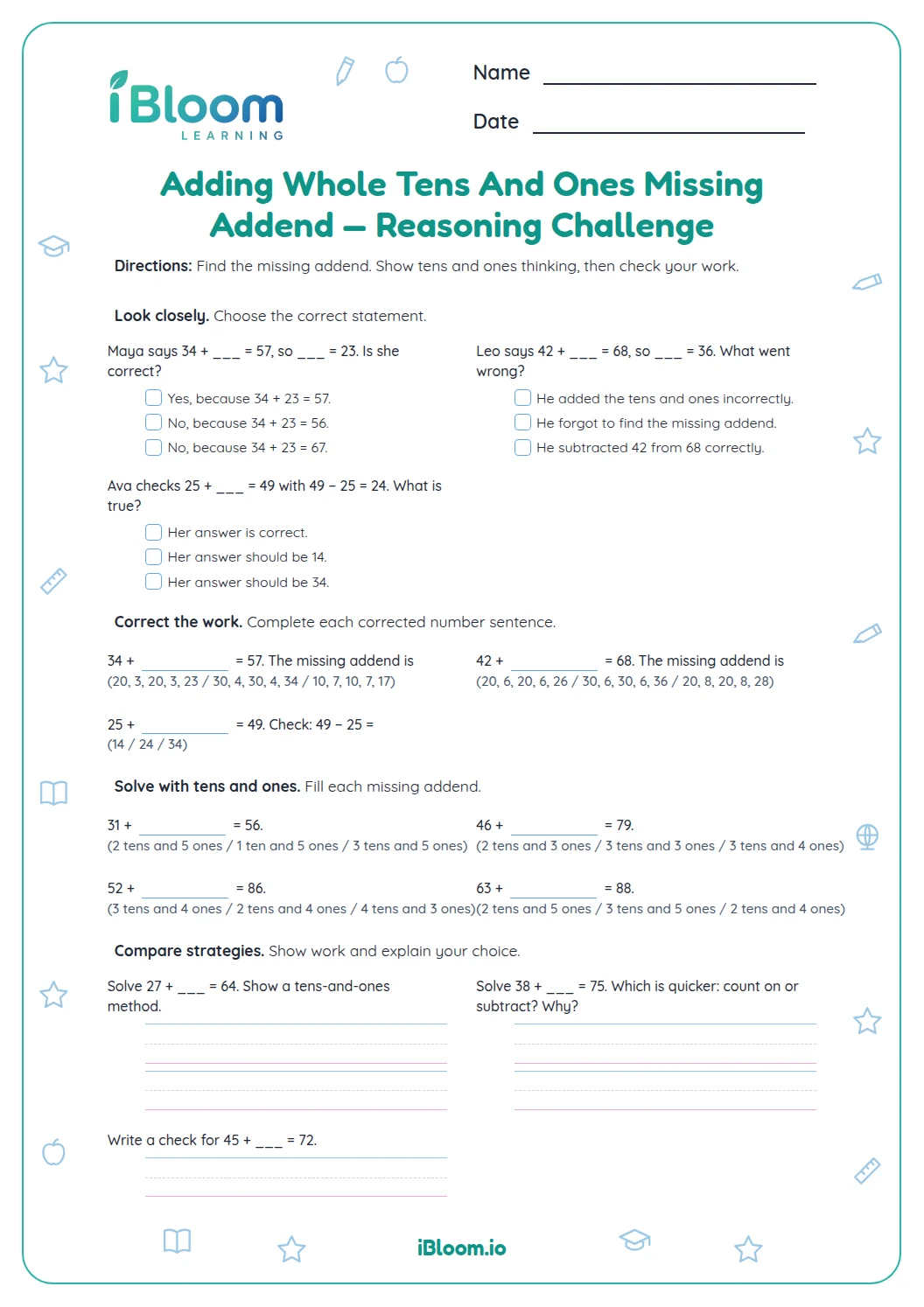
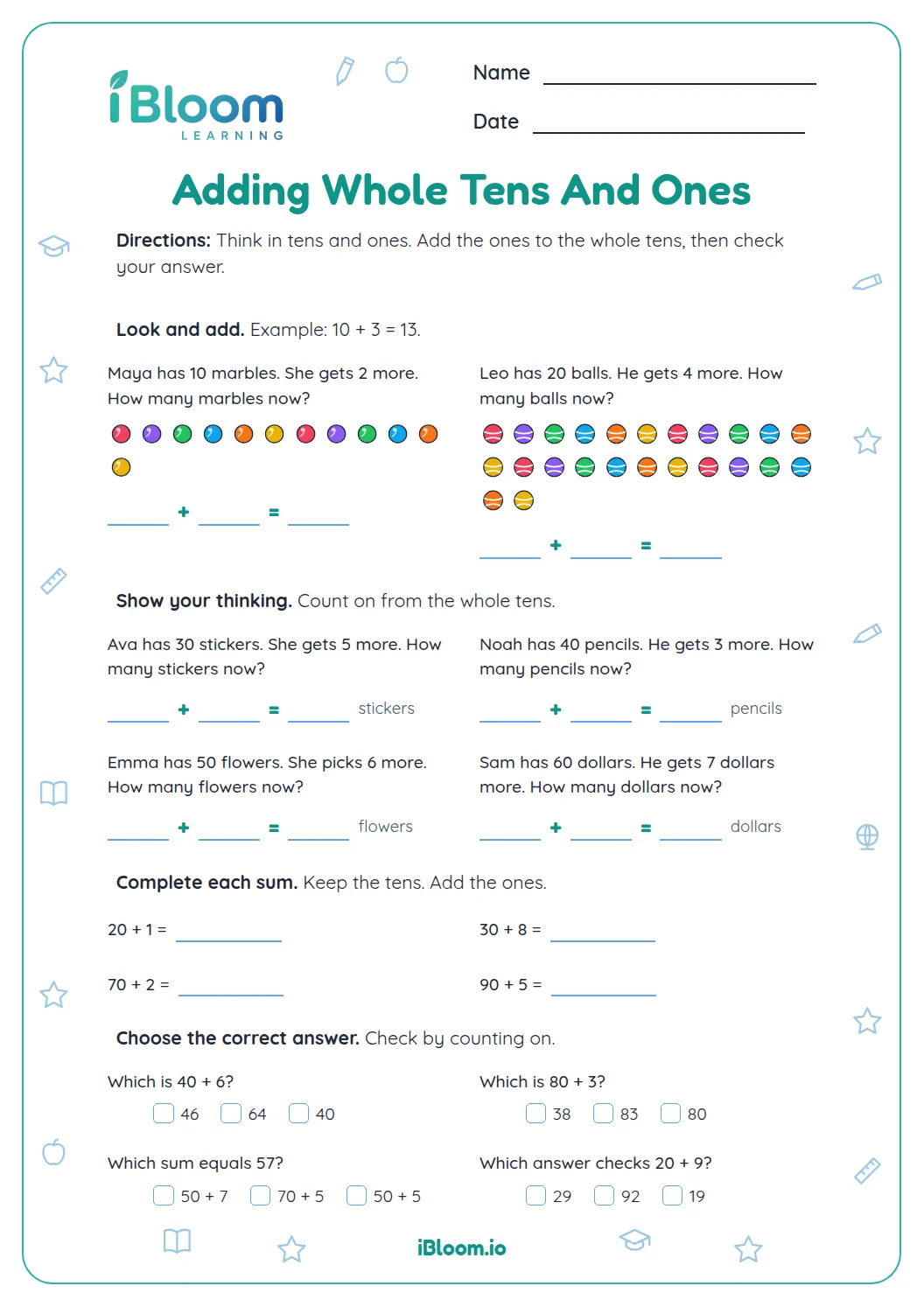
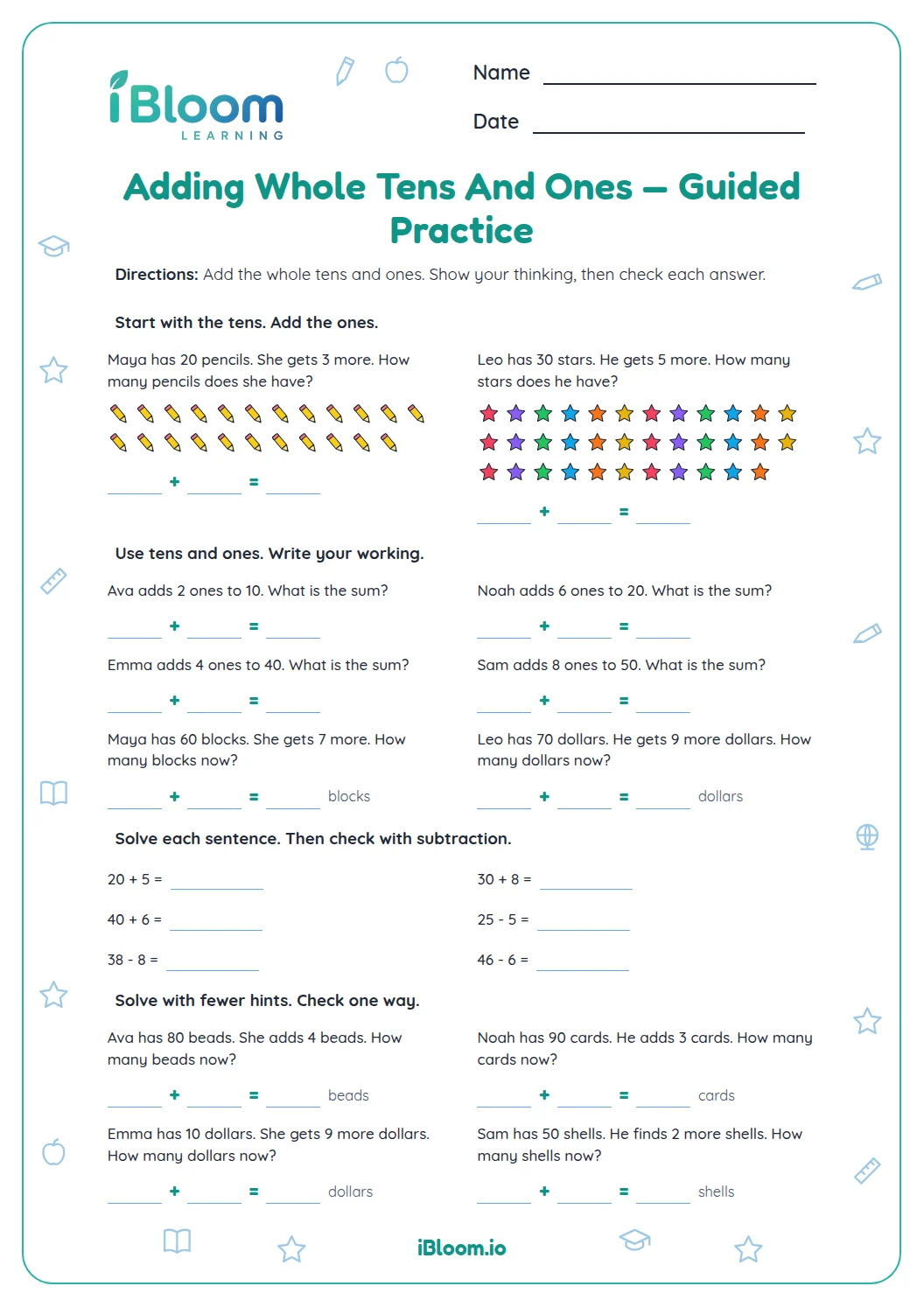
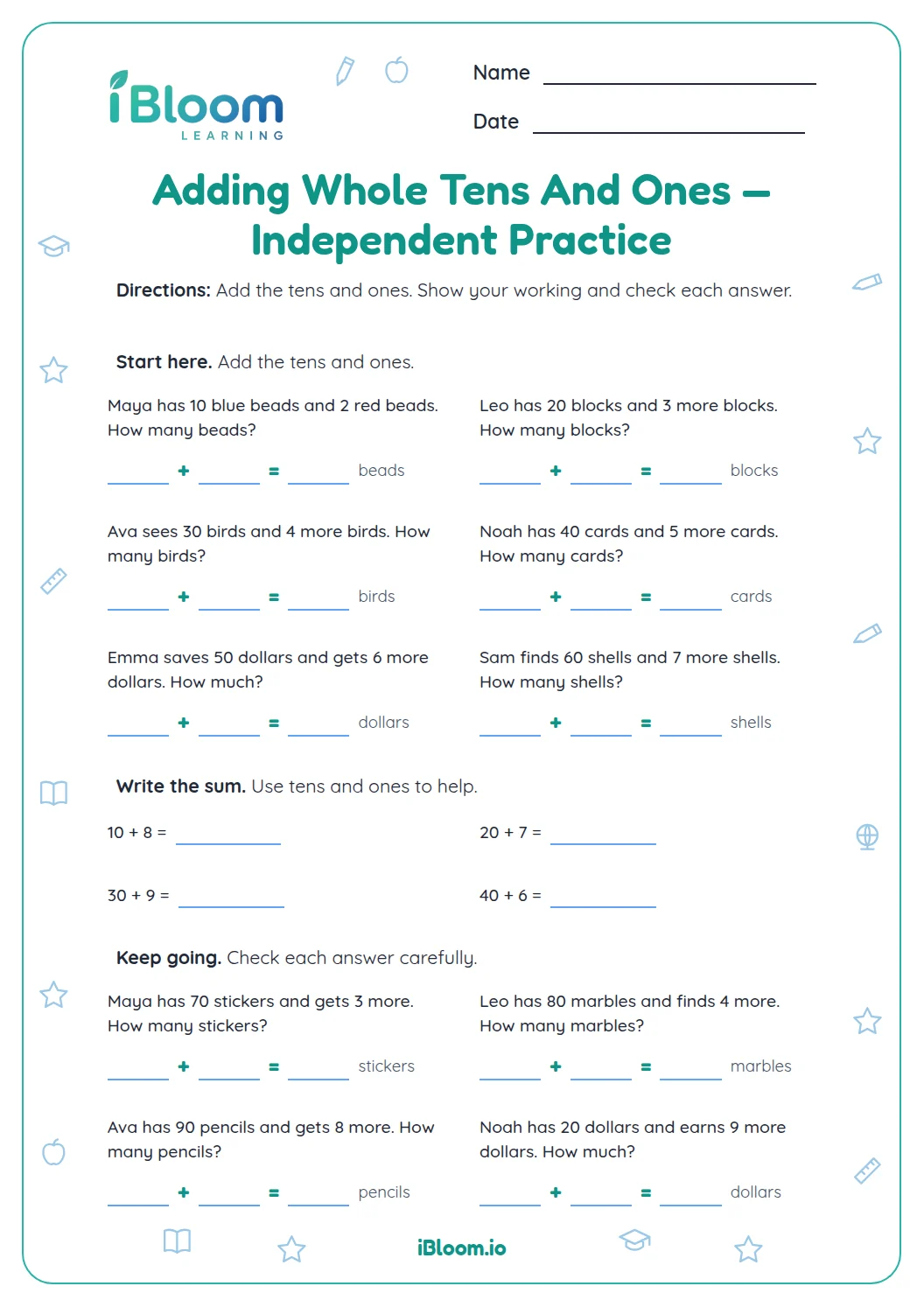
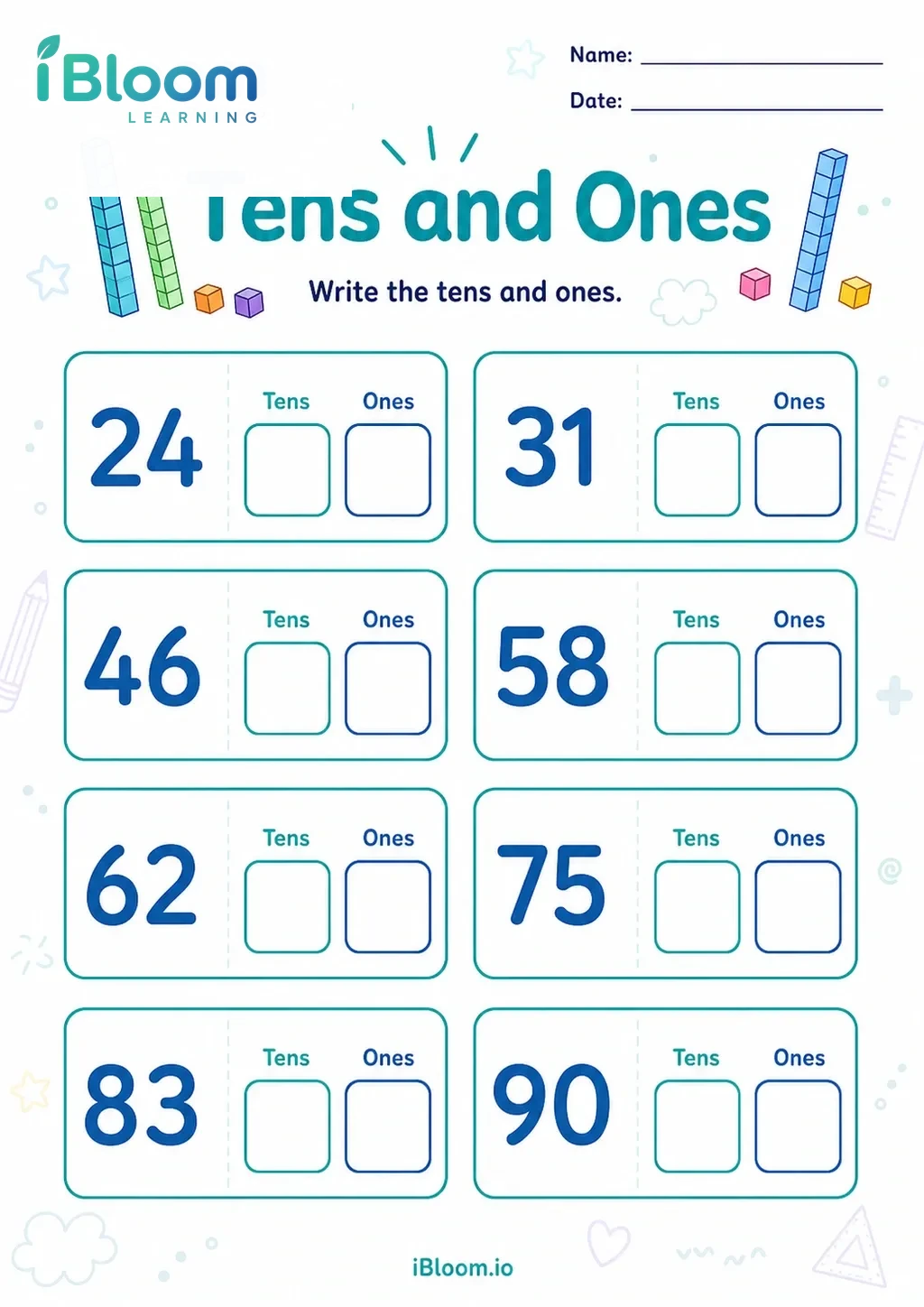
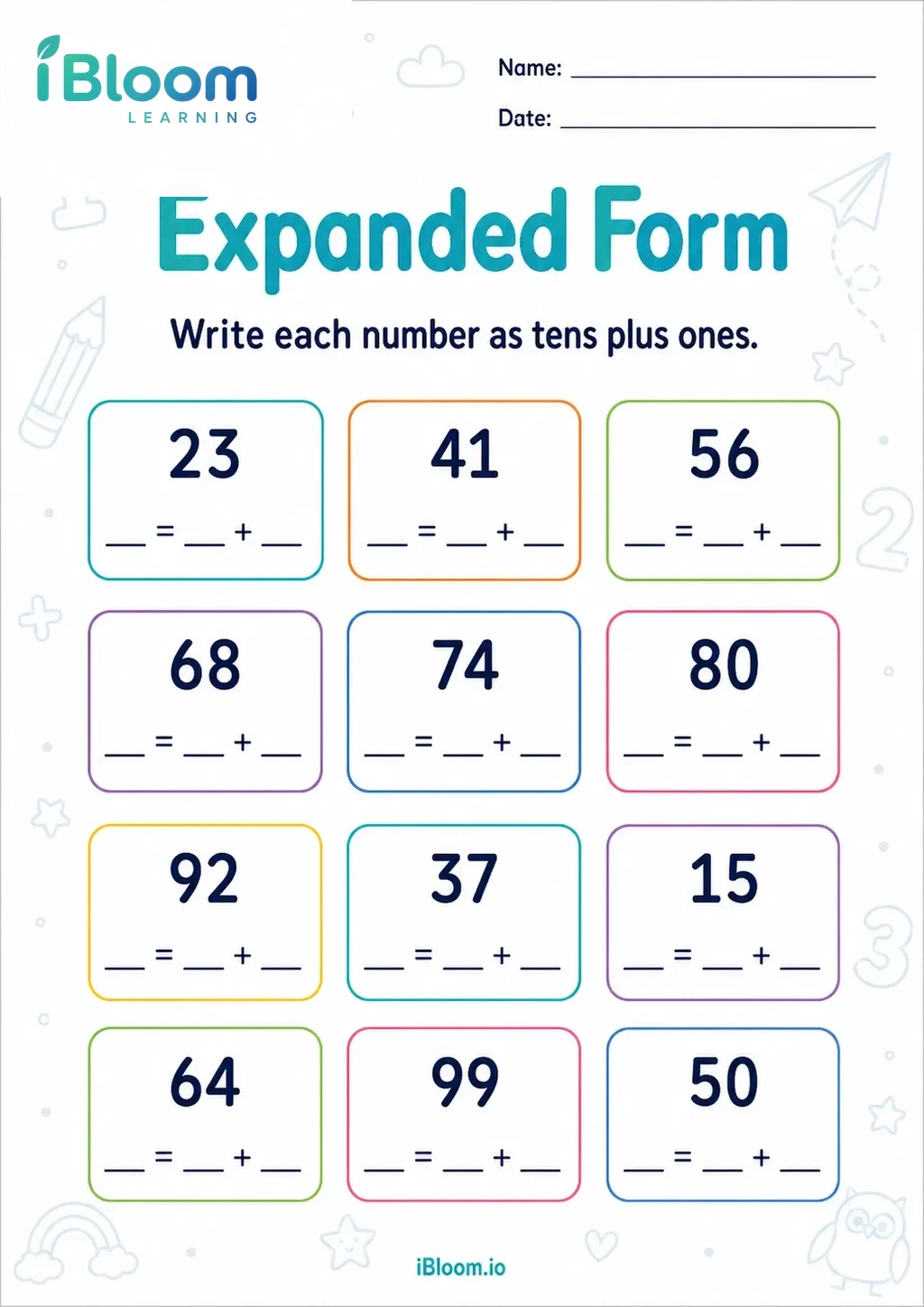
This Grade 1 guided practice sheet focuses on finding a missing addend when adding whole tens and ones within 100. Learners begin with base-ten block drawings and simple number sentences, then solve less scaffolded equations and three short situations. Each problem asks them to reason about the amount needed to reach a total. The work supports CCSS 1.NBT.C.4, and a separate answer key is included.
Aligned to 1.NBT.C.4
How can tens and ones show a missing addend?
A missing addend is the amount needed to reach a total. In question 1, 30 + ___ = 57. Count on from 30 by two tens to 50, then seven ones to 57. The missing number is 27.
- 1Start with 30.
- 2Count on 20 to reach 50.
- 3Count on 7 more to reach 57.
- 4The missing addend is 27.
Can counting on help find the missing part?
Yes. For 42 + ___ = 62 in question 3, count on from 42 by two tens: 52, 62. The missing addend is 20. For an answer with ones, add tens first and then count the remaining ones.
How do you turn a story into an addition sentence?
Find the starting amount and the total. Question 12 starts with 32 crayons and ends with 58, so write 32 + ___ = 58. Count on from 32 to 58: 20 reaches 52, then 6 more reaches 58. The missing addend is 26.
What changes as the practice continues?
The opening questions model how to find the missing amount by separating tens and ones. Later equations leave out those hints, and the final three questions describe amounts in words. Throughout, identify the starting amount, the total, and what is still needed.
A guided routine for missing addends
- 1Read the addition sentence and point to the total.
- 2Show the total as tens and ones, if a model is provided.
- 3Take away the known tens from the total in your thinking.
- 4Count on to find any ones that are still needed.
- 5For a story, write a number sentence with a blank.
- 6Check by adding your answer to the known addend.
Common missing-addend slips and quick fixes
The mistake
Writing the total as the missing addend.
The fix
Add the known number and your answer; the sum must match the total.
The mistake
Counting on one number at a time even when a whole ten is easy.
The fix
Jump by tens first, then count the leftover ones.
The mistake
Subtracting the smaller digits separately without keeping place value.
The fix
Think in tens and ones: 57 is 5 tens and 7 ones, not 5 and 7.
Common Core alignment
The models and equations connect tens and ones to addition within 100.
Add a two-digit number and a one-digit number or multiple of ten using place value.
On this sheet: Add a two-digit number and a one-digit number or multiple of ten using place value.
Show the official wordingHide the official wording
Add within 100, including adding a two-digit number and a one-digit number, and adding a two-digit number and a multiple of 10, using concrete models or drawings and strategies based on place value, properties of operations, and/or the relationship between addition and subtraction; relate the strategy to a written method and explain the reasoning used. Understand that in adding two-digit numbers, one adds tens and tens, ones and ones; and sometimes it is necessary to compose a ten.
What to practice next
Make more practice
Further reading
Questions parents and teachers ask
What is a missing addend?
A missing addend is a number that belongs in an addition sentence but is not shown. In 30 + ___ = 57, the missing part is 27 because 30 + 27 equals 57. Each answer can be checked by adding it to the known amount and confirming the total.
Should children subtract or count on?
Either strategy can work for these problems. Counting on by tens and then ones shows how the amounts fit together, while subtraction can check the result. For 42 + ___ = 62, two jumps of ten reach 62, so the missing addend is 20.
What do the base-ten drawings show?
In 30 + ___ = 57, the total has five tens and seven ones, while the known addend has three tens. Compare the place values: two more tens and seven ones are needed. Children can then check by adding 27 to 30.
Are there word problems?
Yes. The final three questions describe a starting amount and a larger total in short situations. Children can write an addition sentence with a blank, then find what was added or what is still needed. The questions use crayons, books, and beads.
Is an answer key included?
Yes. The separate key lists all 14 missing addends. To check a response, add it to the number already shown and confirm that the sum matches the total. For the story questions, check that the answer describes the amount added or still needed.