
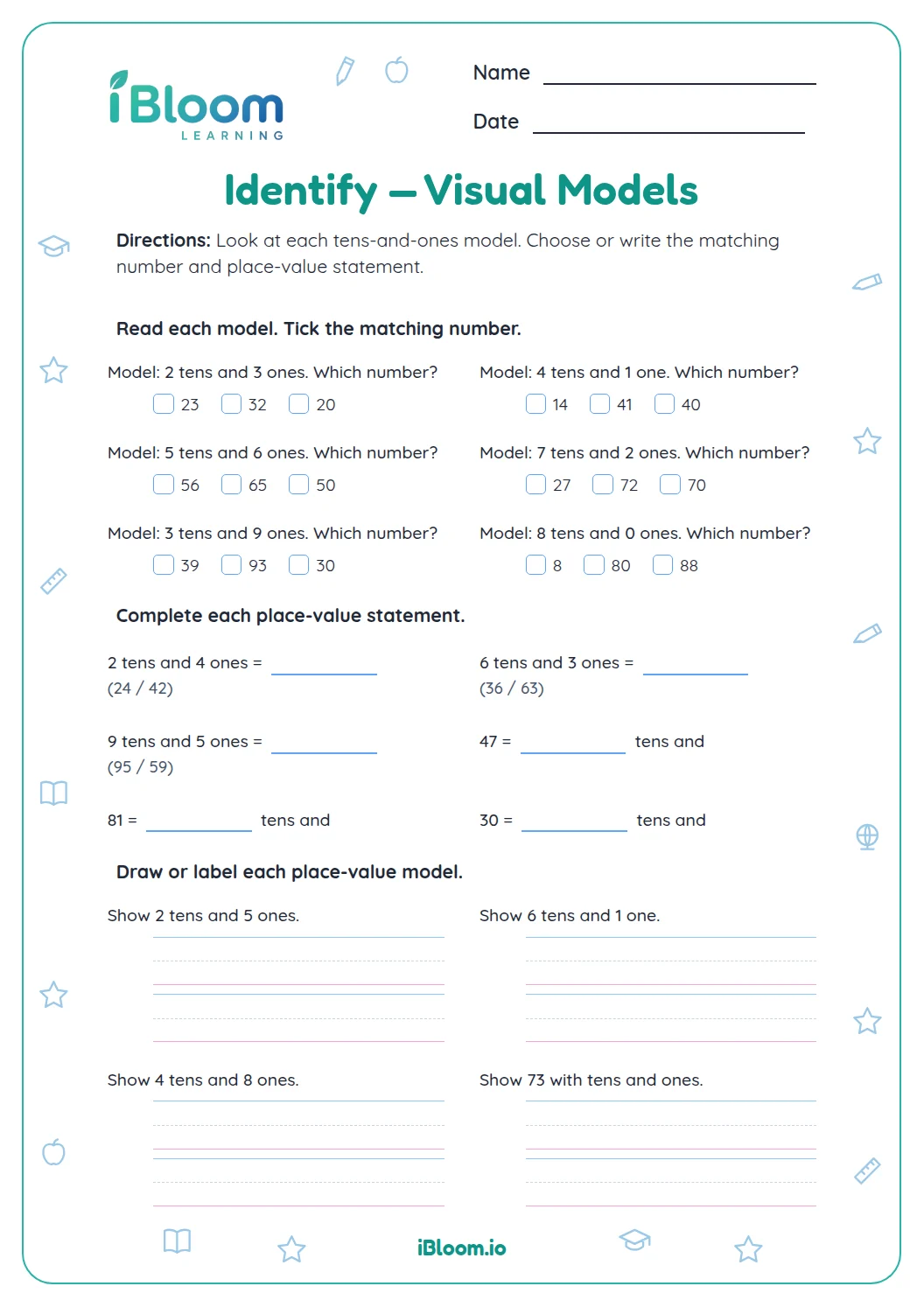
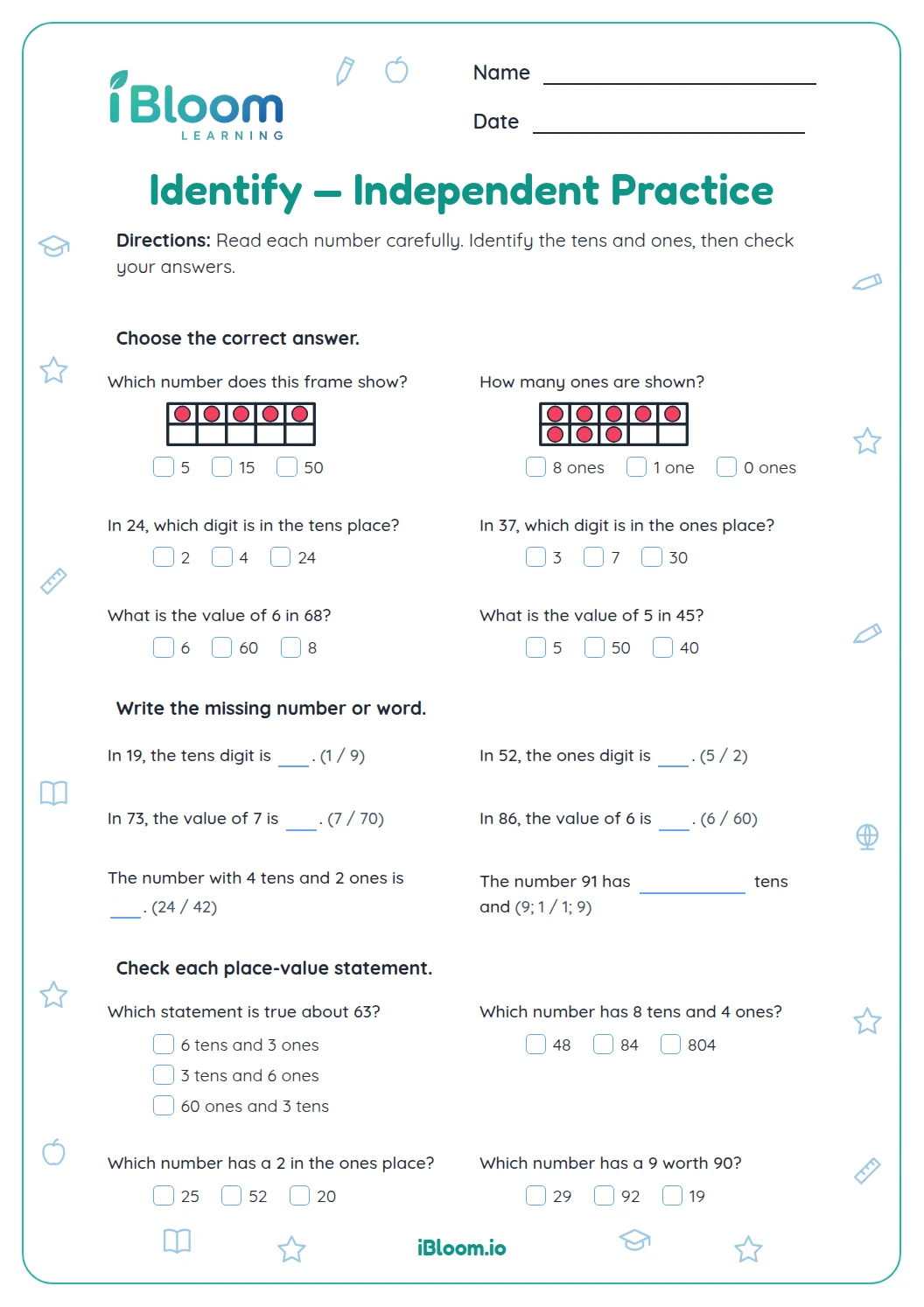
About this worksheet
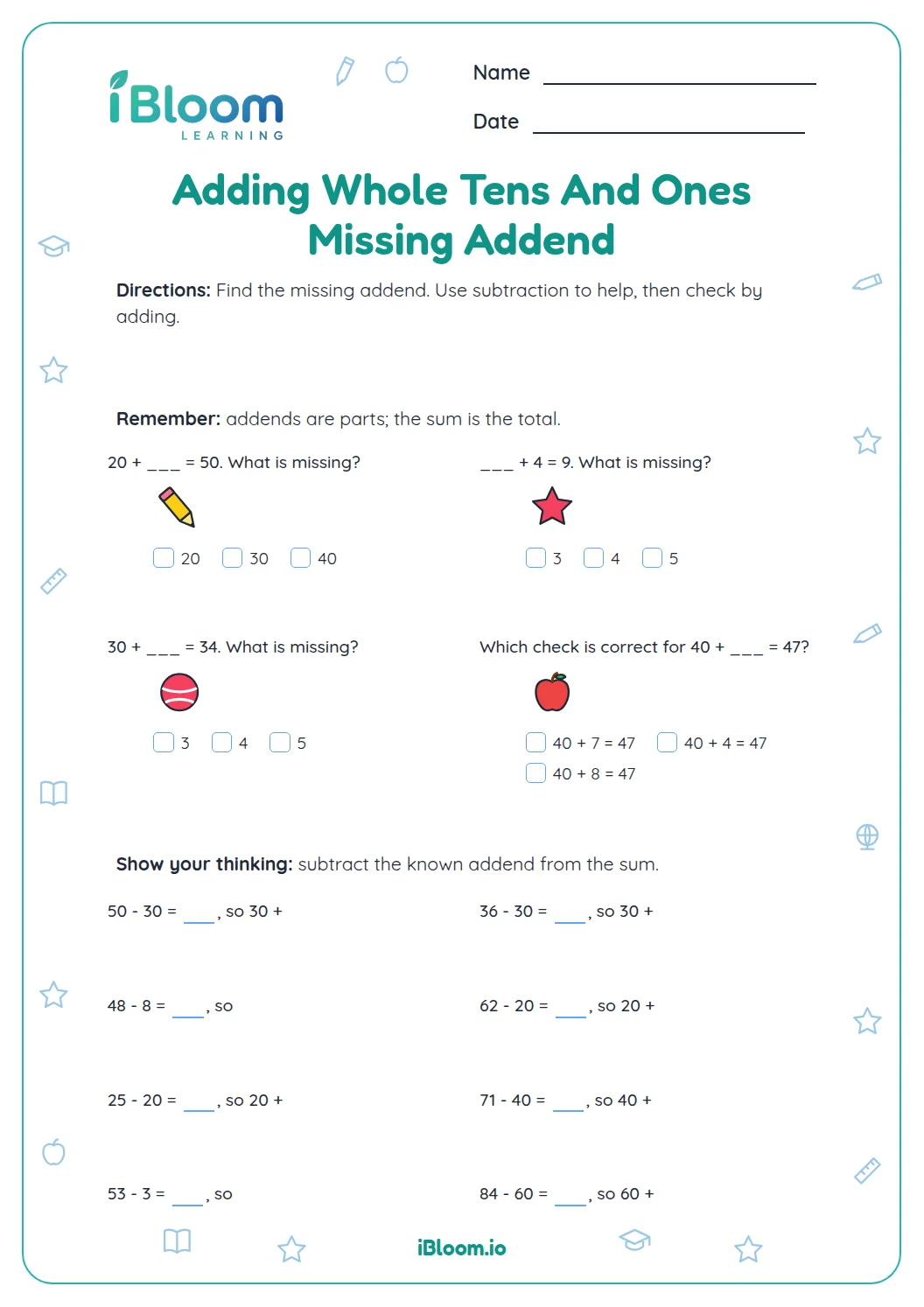
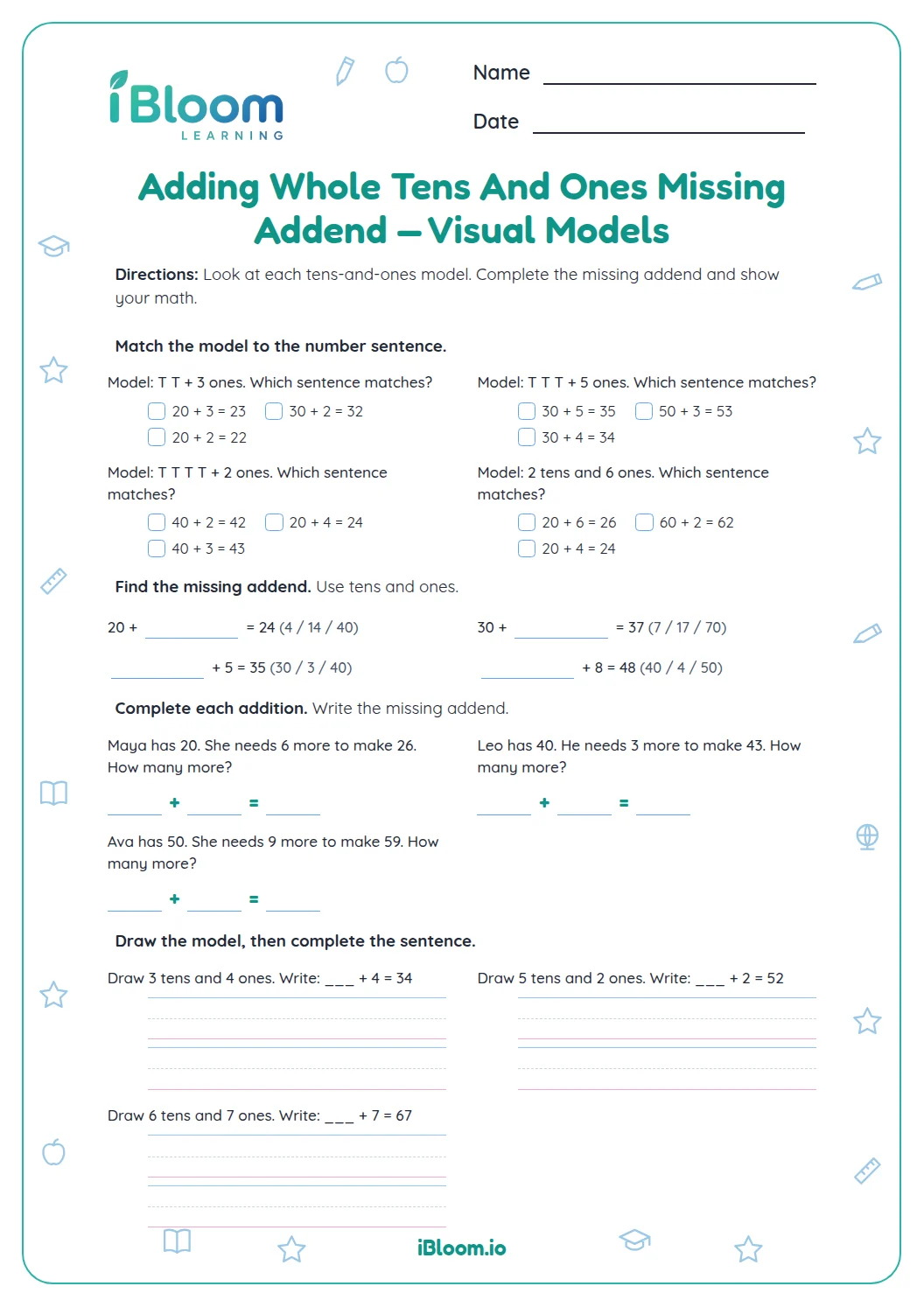
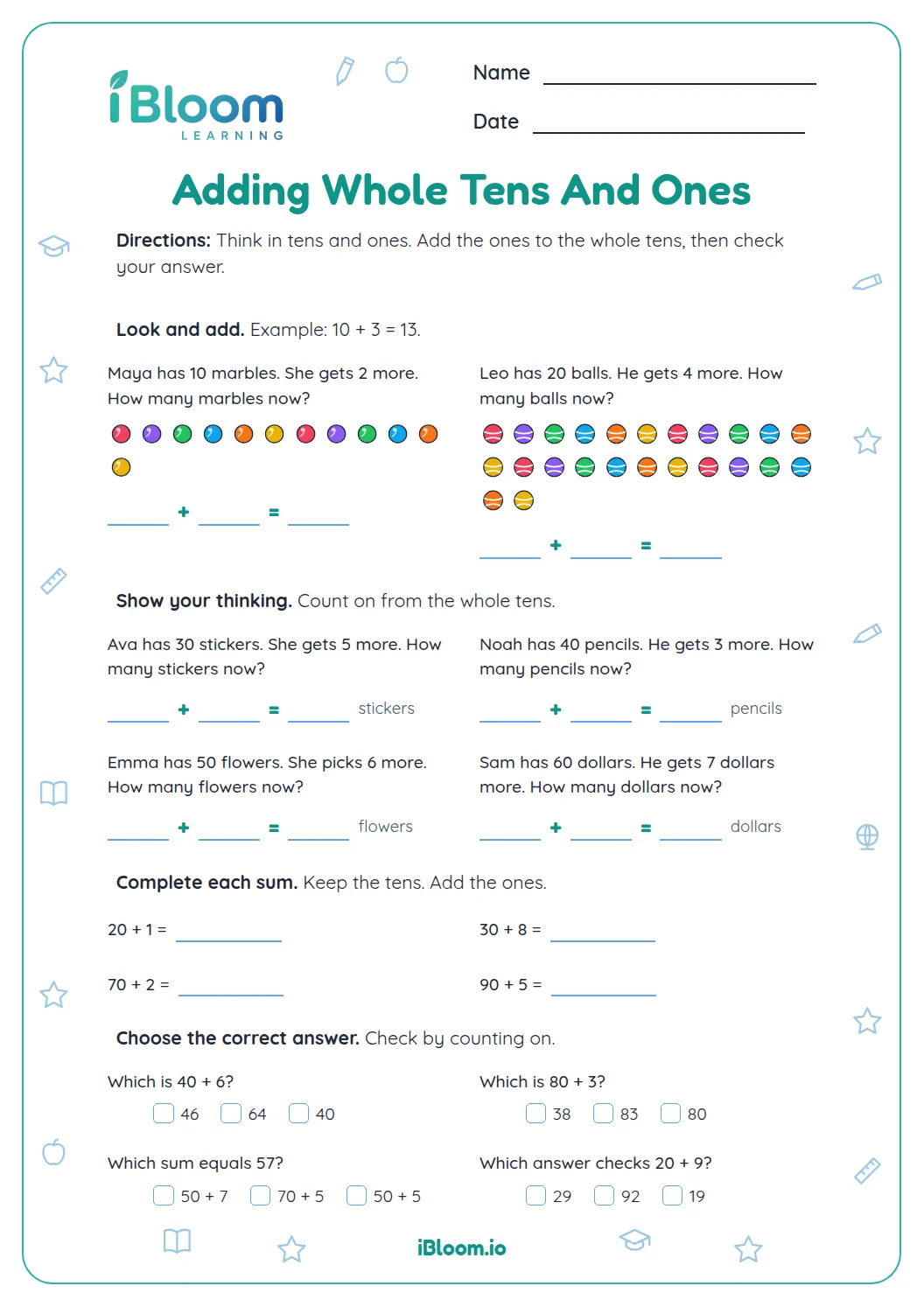
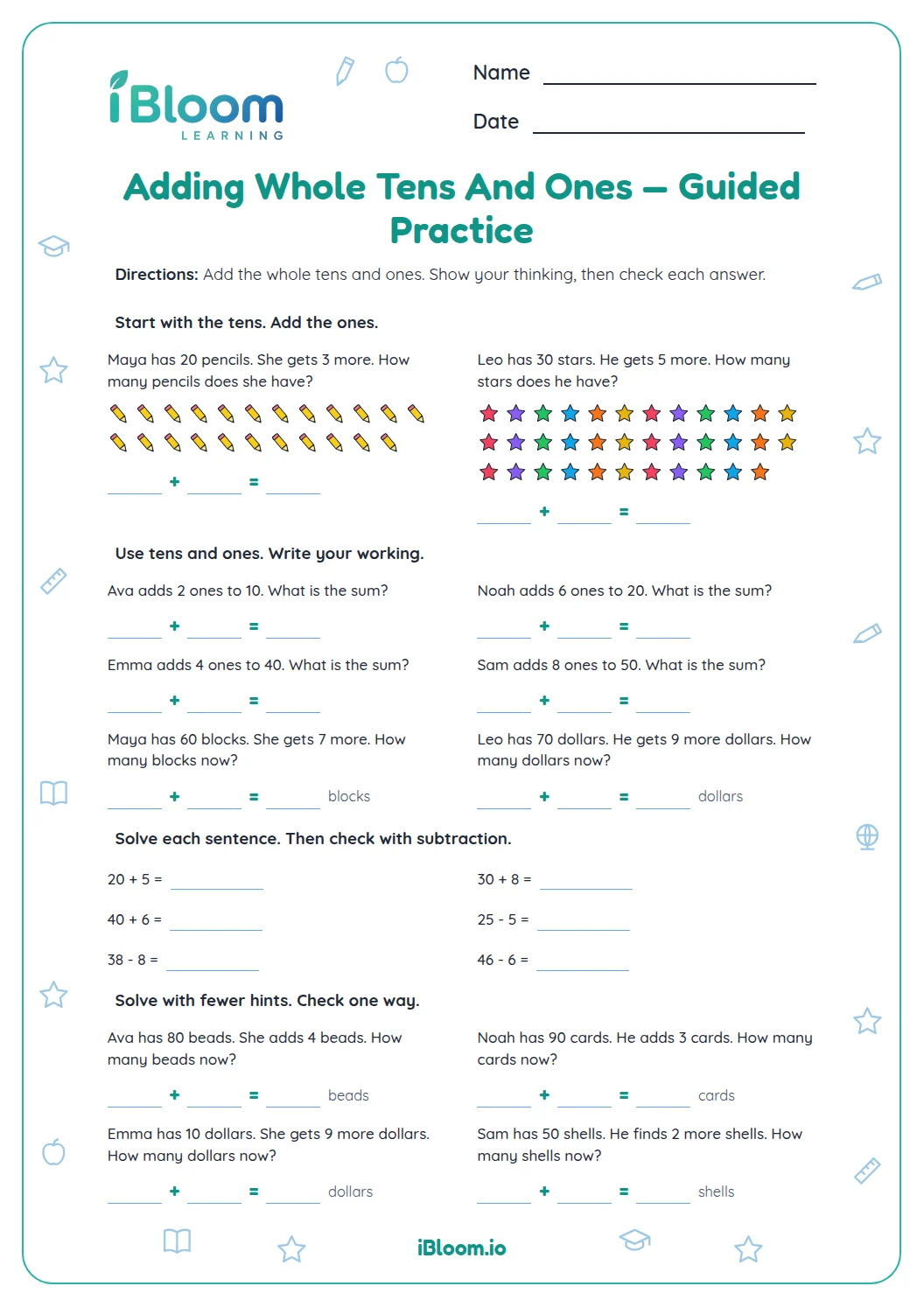
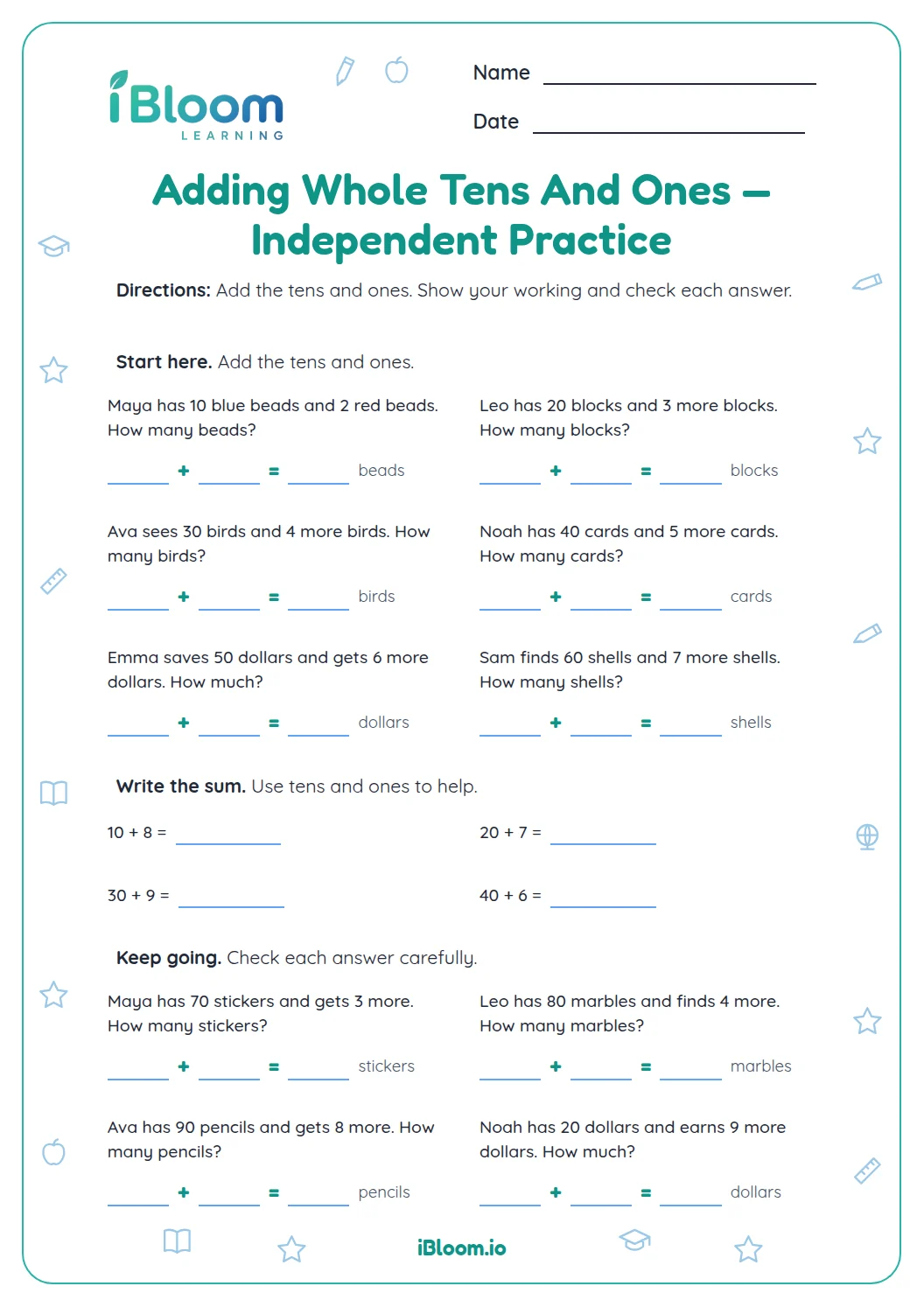
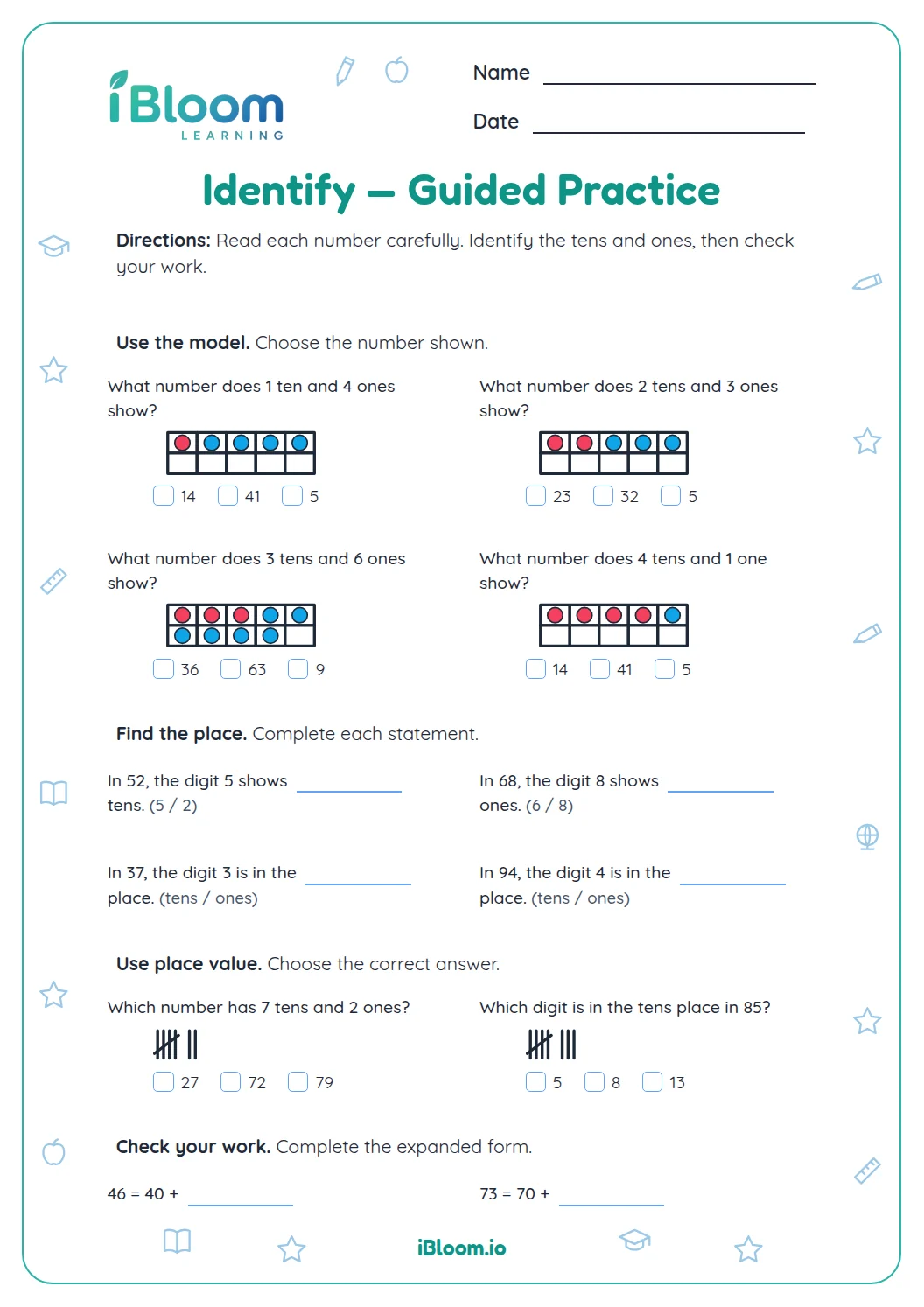
This printable Grade 1 worksheet gives children eight number sentences and eight short everyday stories where a total and one part are known. Students find the missing addend by counting on or using tens and ones. The practice aligns with CCSS 1.NBT.C.4 and includes a separate answer key.
Aligned to 1.NBT.C.4
What does a missing addend mean?
A missing addend is the unknown part in an addition equation. Each story gives a total and one known amount; children choose the amount still needed.
- 1For question 1, 20 + ___ = 29. Counting from 20 to 29 gives 9.
How can tens and ones make the search easier?
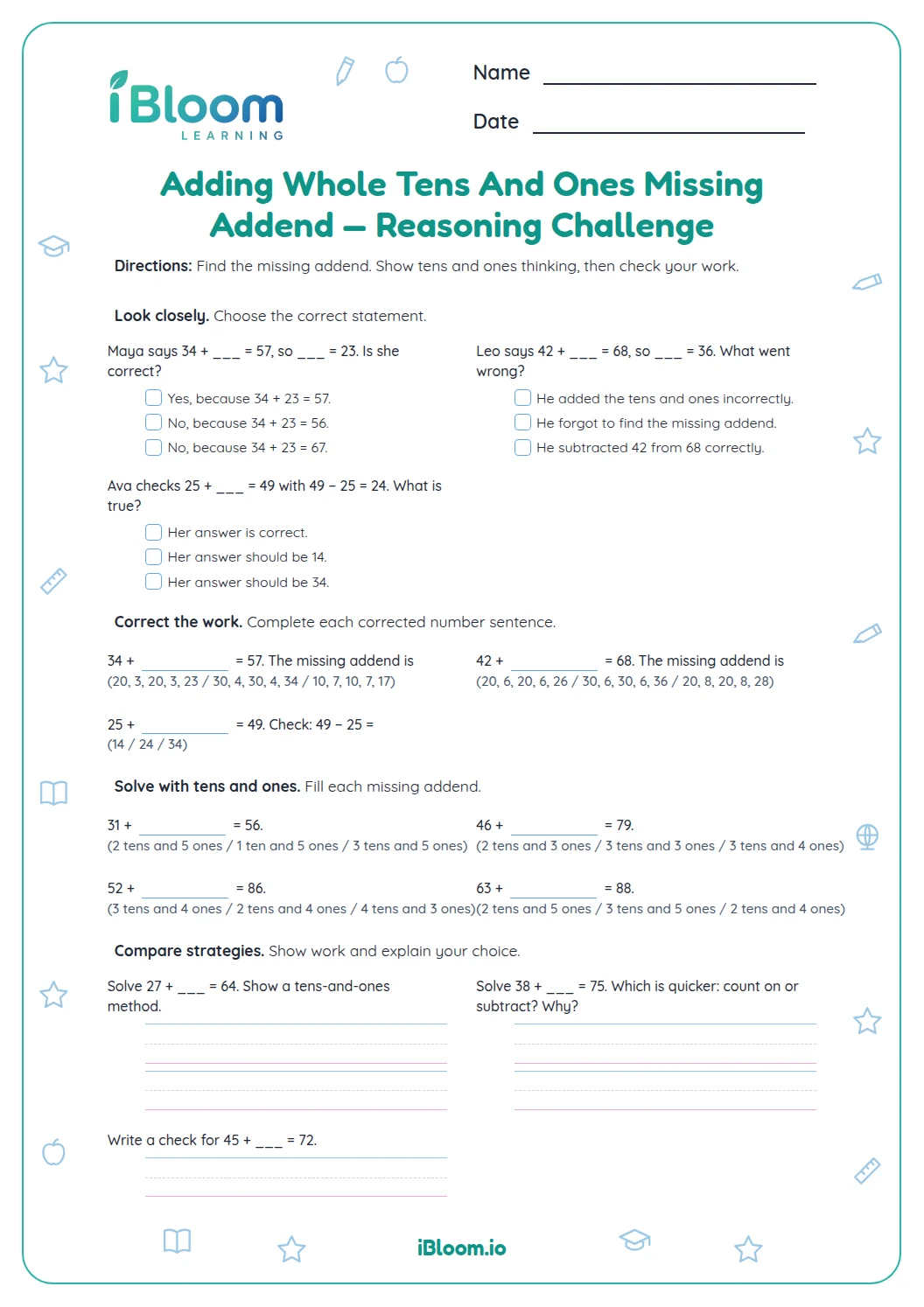
Compare the known part with the total, then find the amount still needed. In question 6, 27 + ___ = 57, so three more tens make 57. In question 7, 34 + ___ = 39, so five ones are needed.
When should a child check with subtraction?
Subtract the known part from the total. In question 6, 57 − 27 = 30, so 27 + 30 returns to 57. Both equations describe the same relationship.
How to use this worksheet
- 1Read the story and mark the total.
- 2Name the part the story already gives.
- 3Write known part + ___ = total.
- 4Count on by tens or ones, or subtract.
- 5Put the unit in the answer when the story names one.
- 6Add your answer back to check the total.
Common mistakes and quick fixes
The mistake
Subtracting the total from the known part.
The fix
Start at the known part and count up to the total, or calculate total minus known part.
The mistake
Stopping after finding the tens difference.
The fix
Check the ones digits too; the unknown could be only a few ones.
The mistake
Treating the known amount as the total.
The fix
Underline the word or number that tells how many there are altogether.
Common Core alignment
This page gives focused practice with the skills named in these standards.
Find a missing addend by using tens, ones, and addition facts.
On this sheet: Students use place-value reasoning and addition relationships to find unknown addends.
Show the official wordingHide the official wording
Add within 100, including adding a two-digit number and a one-digit number, and adding a two-digit number and a multiple of 10, using concrete models or drawings and strategies based on place value, properties of operations, and/or the relationship between addition and subtraction; relate the strategy to a written method and explain the reasoning used. Understand that in adding two-digit numbers, one adds tens and tens, ones and ones; and sometimes it is necessary to compose a ten.
What to practice next
Make more practice
Further reading
Questions parents and teachers ask
What equation shows the unknown amount?
Write the known part first, then leave a blank for the amount still needed. Question 1 is 20 + ___ = 29, so the missing addend is 9. The unknown is one part, and the total stays on the other side of the equal sign.
Can children count on instead of subtracting?
Yes. Start at the known amount and count to the total. For question 7, count from 34 to 39; five ones are needed. Counting by tens also works for problems such as 27 + ___ = 57, where the missing addend is 30.
What kinds of problems are included?
The page has 16 questions: eight number sentences with a missing addend and eight short real-world stories with three answer choices each. Every item asks for one unknown amount that completes the total in its story or equation.
How do I check an answer?
Add the known amount and the proposed missing addend. For question 10, 30 books plus 5 more make 35 books. If the sum matches the total in the prompt, the missing addend is correct. This check works for both number sentences and stories.
Should the answer include the object or unit?
The choices and answer key give the missing number. When discussing a story, it helps to say the number with its object, such as 5 books or 2 children, so the answer clearly matches what the question asks.