

About this worksheet
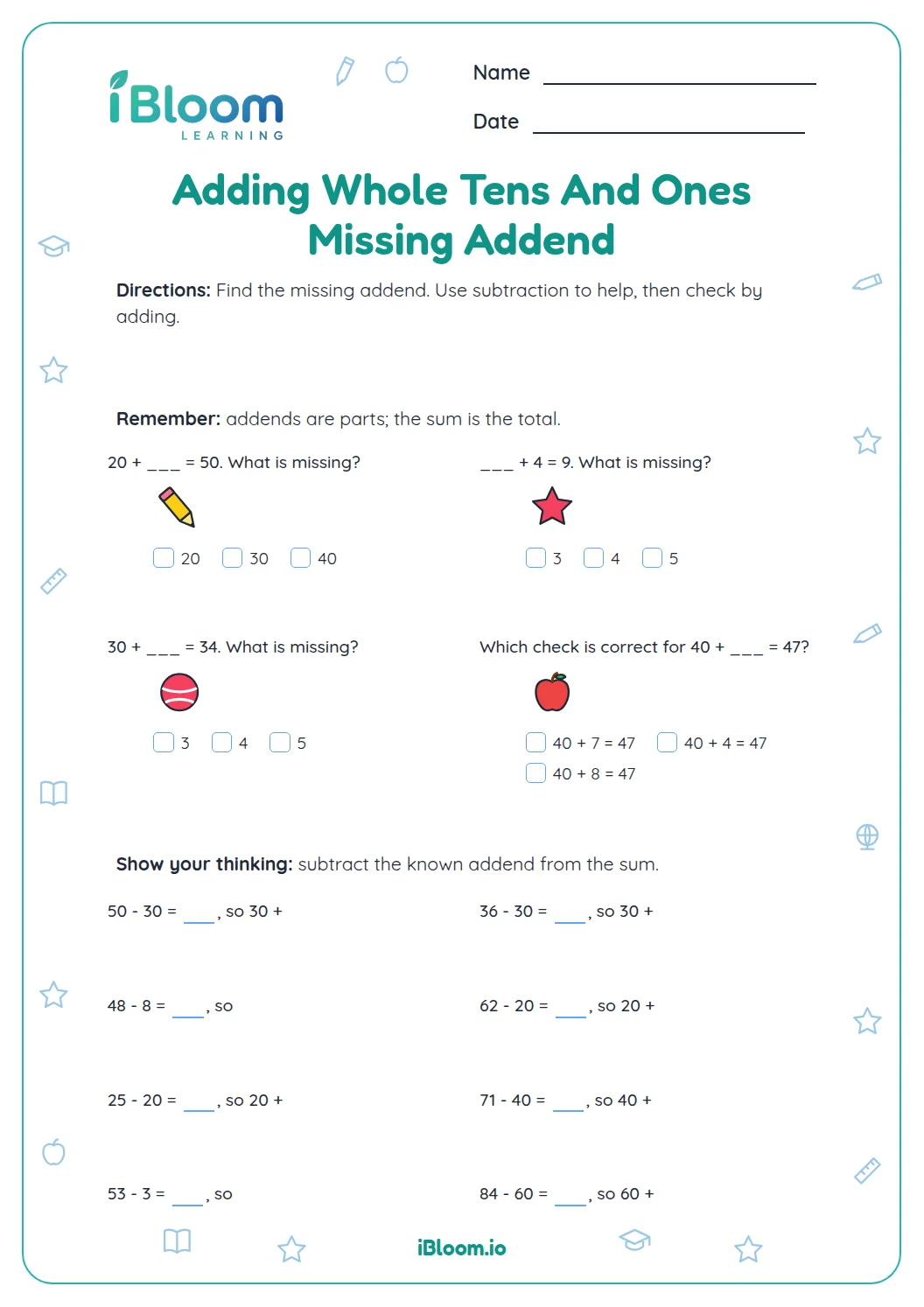
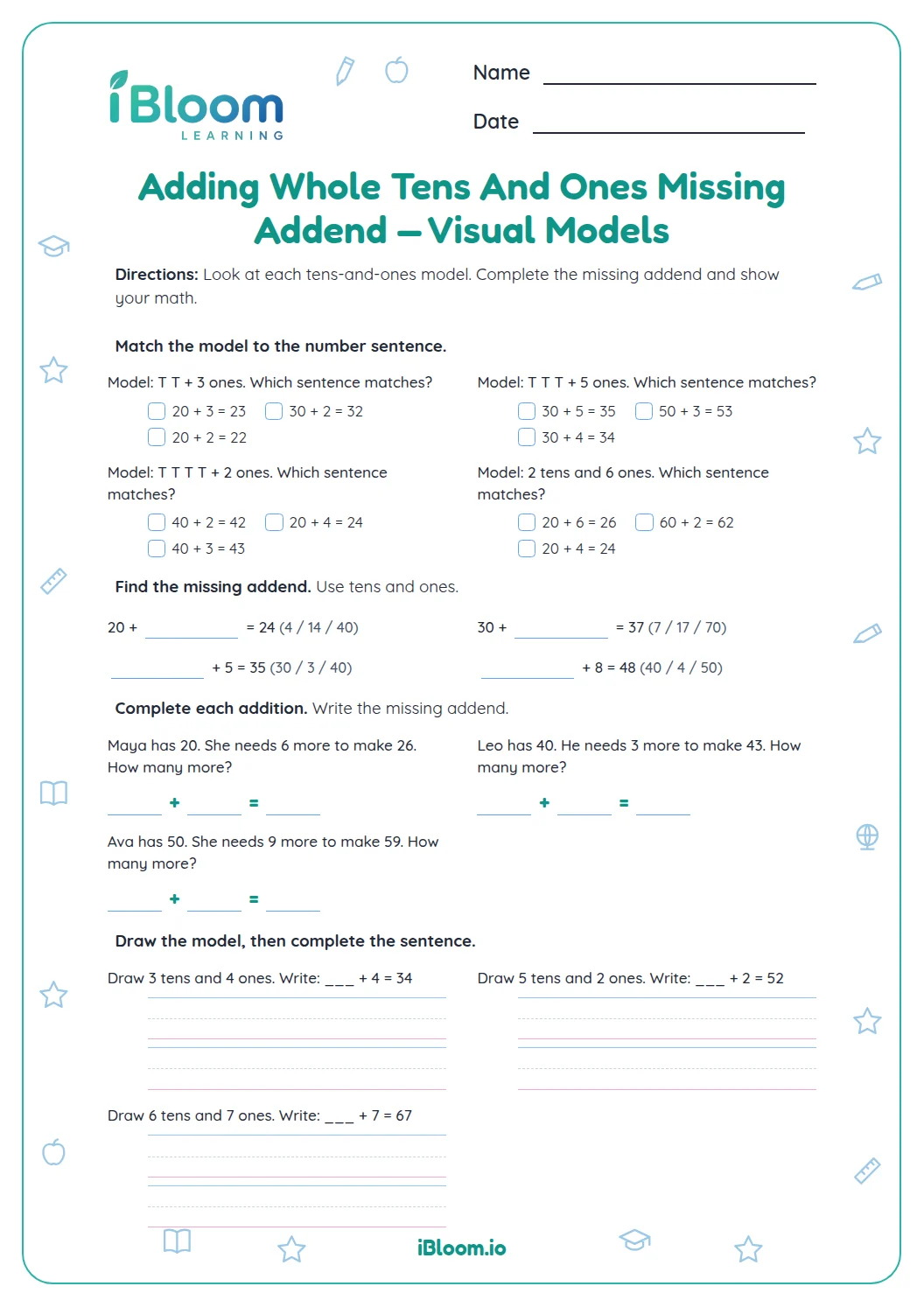
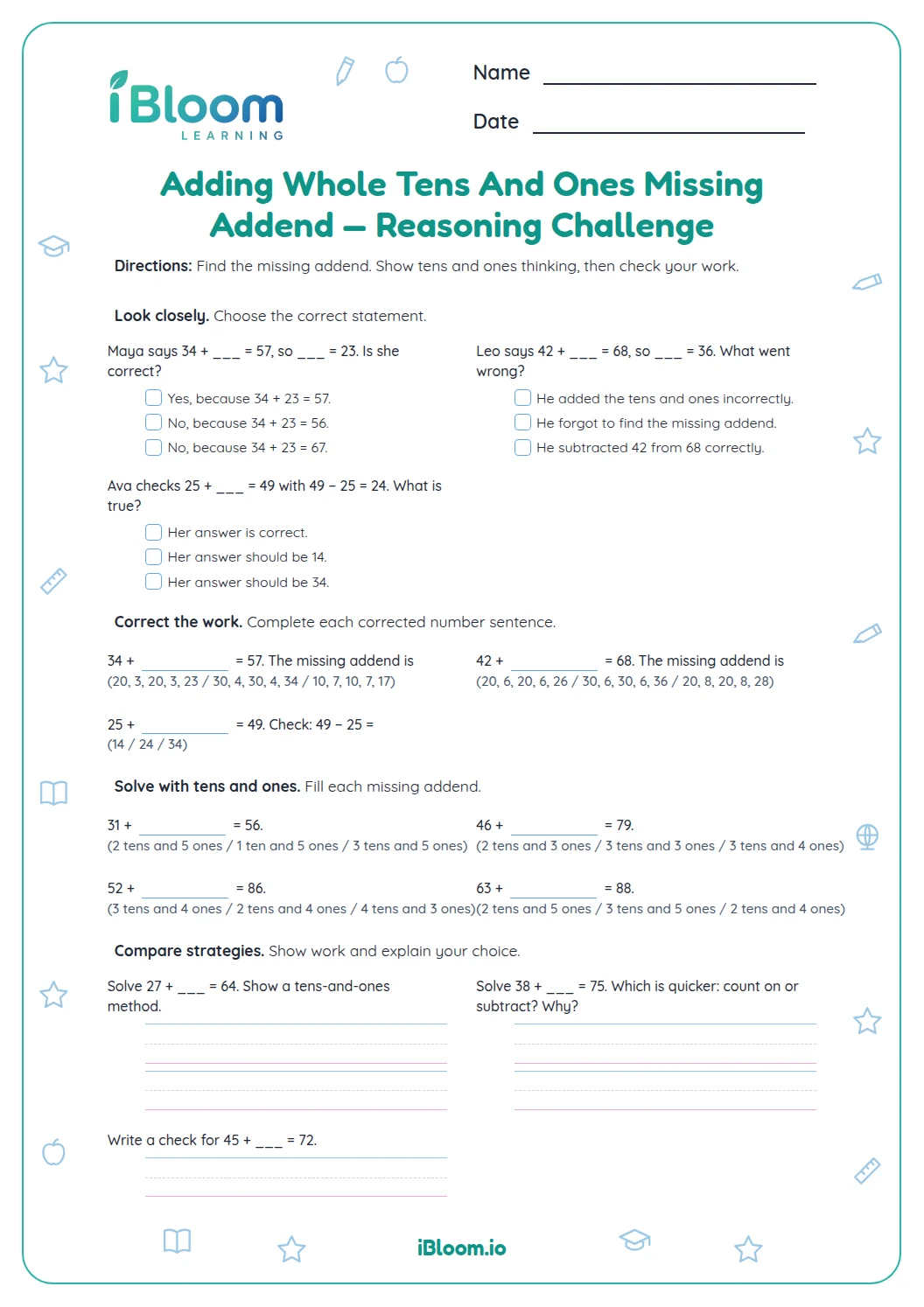
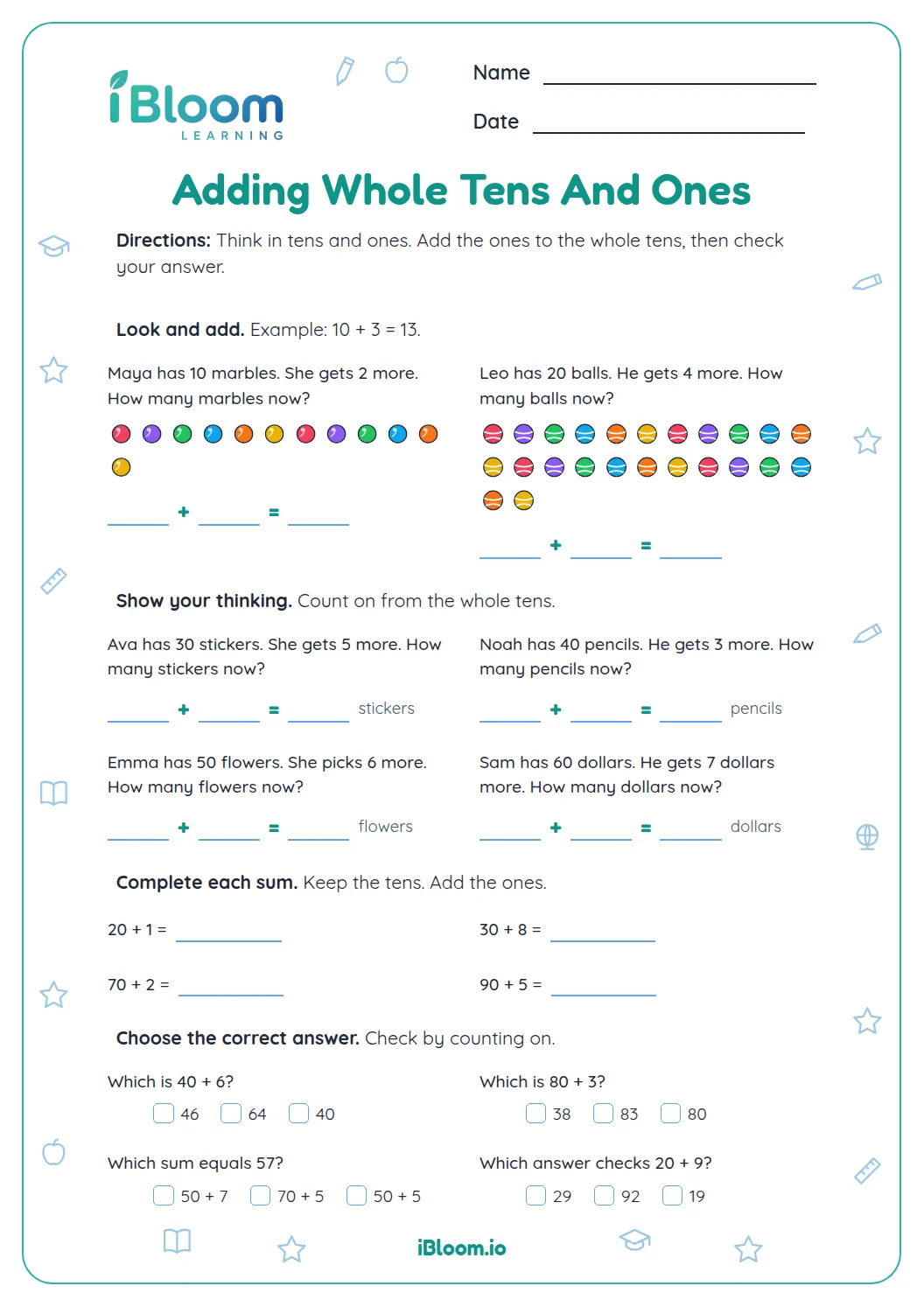
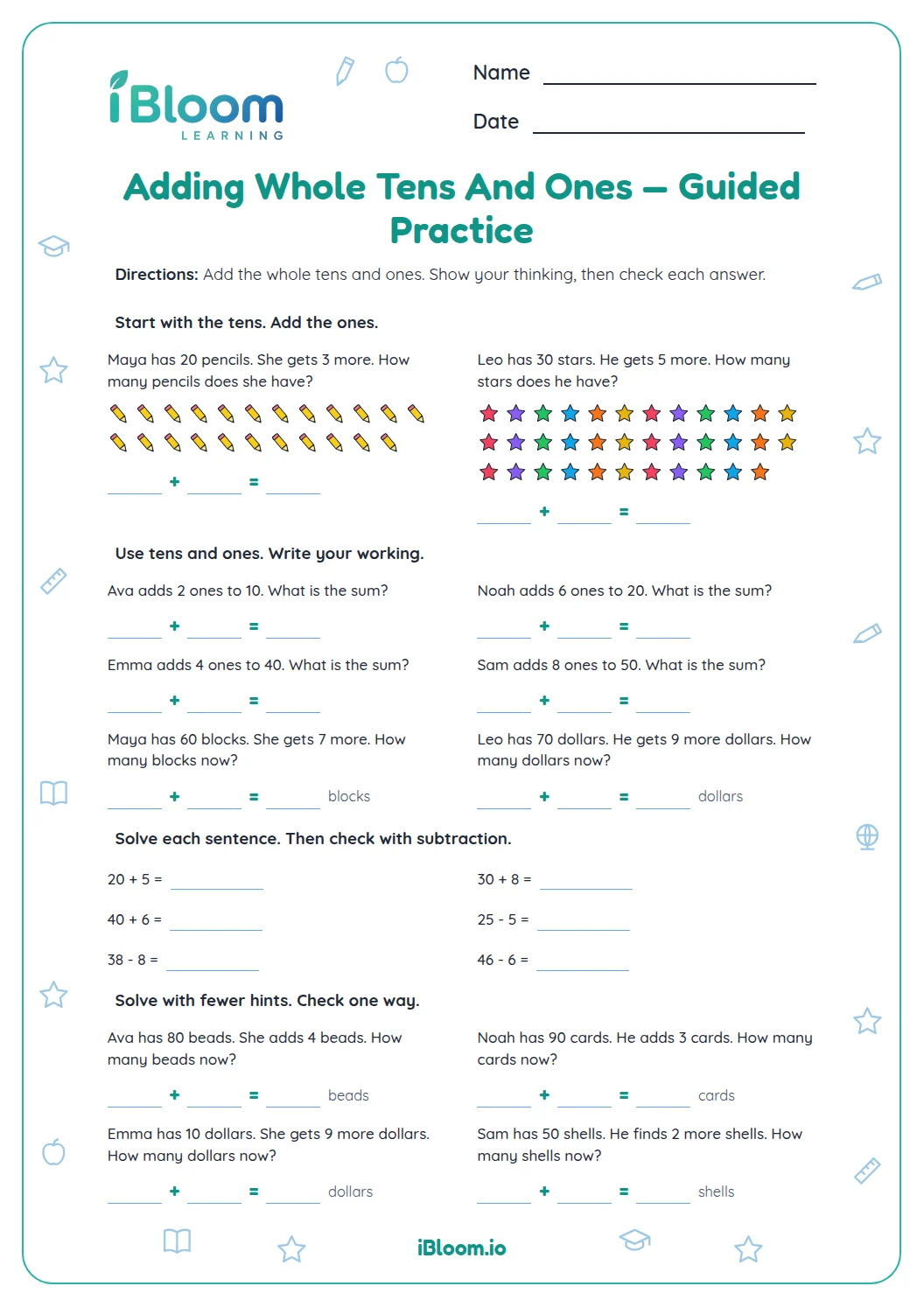
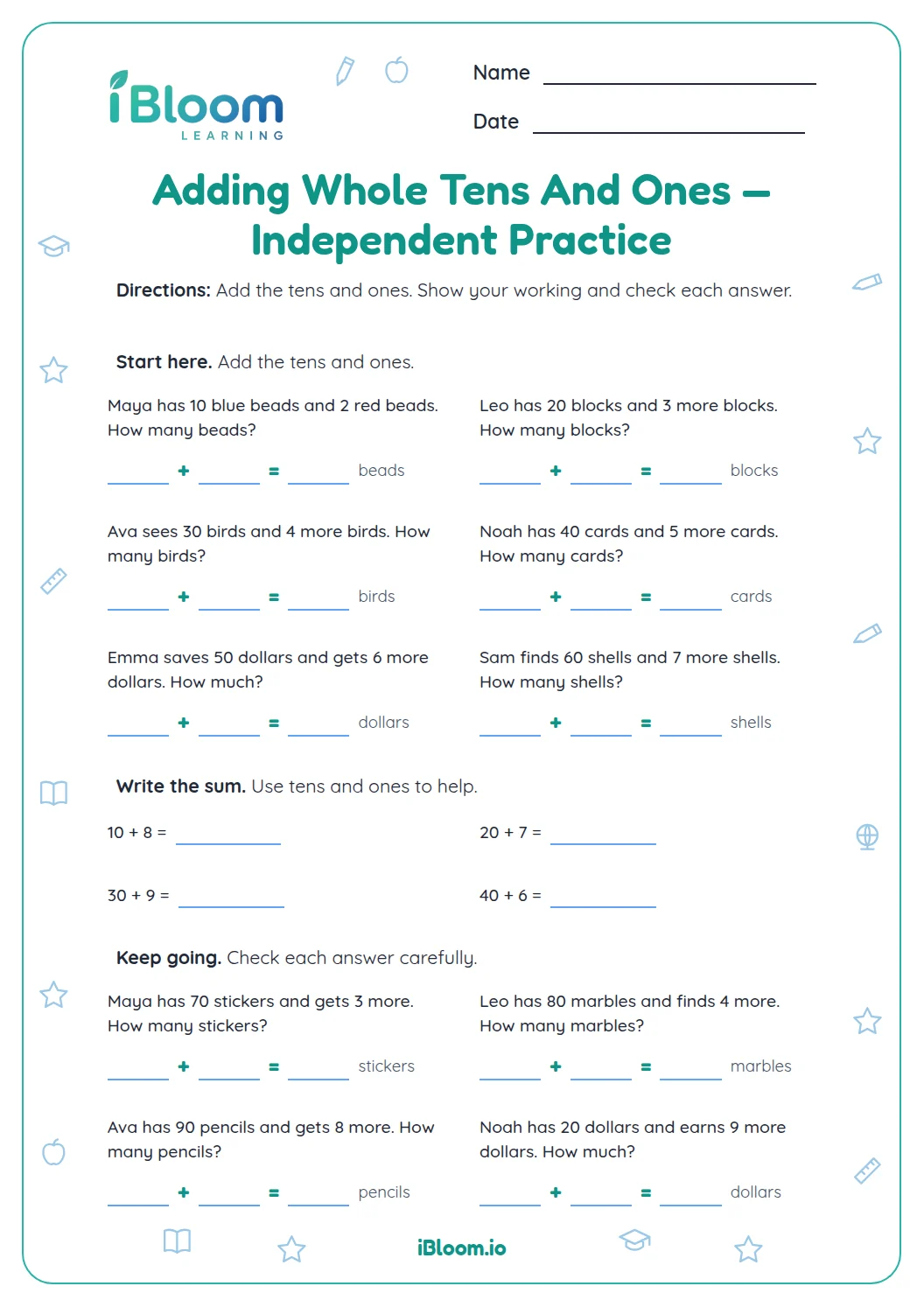
This two-page Grade 1 worksheet practices missing addends when whole tens are added to two-digit numbers. Students complete 10 number sentences and solve four short stories about adding groups of ten. The ones digits stay the same as the tens increase, and the answer key shows each missing addend.
Aligned to 1.NBT.C.4
What does the missing addend represent?
The blank is the amount added to the starting number. In these problems, the missing amount is a whole number of tens, so students can compare the starting amount with the total and count by tens.
How can place value help?
A whole ten adds one or more tens without changing the ones digit. For 24 + ___ = 54, the ones digit stays 4. Count from 2 tens to 5 tens: 3 tens, or 30.
- 124 + ___ = 54
- 2The ones digit stays 4.
- 3Count 24, 34, 44, 54: three jumps of ten.
- 4The missing addend is 30.
How should students solve the stories?
Underline the starting amount and the total. The story states that the new items come in groups of ten, so write the unknown number as a whole-ten addend, then check that the sum matches the total.
How to use this worksheet
- 1Read the equation or story carefully.
- 2Mark the starting number and the total.
- 3Check the ones digit in both numbers.
- 4Count by tens from the starting number to the total.
- 5Write the number of tens as the missing addend.
- 6Add it back to check the equation.
Common slips to check
The mistake
Changing the ones digit when adding a whole ten.
The fix
Keep the ones digit the same and increase the tens.
The mistake
Writing the number of jumps instead of the value of the tens.
The fix
If there are three jumps of ten, write 30.
The mistake
Subtracting the smaller ones digit from the larger one to find a tens addend.
The fix
Use the whole numbers and count by tens from the start to the total.
Common Core alignment
Add a two-digit number and a multiple of 10 using place value strategies.
On this sheet: Students find missing whole-ten addends in sums within 100.
Show the official wordingHide the official wording
Add within 100, including adding a two-digit number and a one-digit number, and adding a two-digit number and a multiple of 10, using concrete models or drawings and strategies based on place value, properties of operations, and/or the relationship between addition and subtraction.
What to practice next
Make more practice
Further reading
Questions parents and teachers ask
What is a missing addend?
A missing addend is the number that must be added to another number to make the total. In 24 + ___ = 54, the blank is 30 because adding three tens to 24 makes 54. This page gives students equations and short stories to practice finding that unknown amount.
How does adding ten affect a two-digit number?
Adding one ten increases the tens digit by one while the ones digit stays the same. For example, 24 becomes 34 after adding 10, then 44 after another 10. The worksheet uses this pattern to help students find missing whole tens.
How many problems and pages are included?
There are 14 questions: 10 number sentences and four short story problems. The printable includes two worksheet pages and a separate two-page answer key. Students can write the missing addends in the equations and show an equation for each story.
What is a good way to check an answer?
Put the missing addend back into the original equation and add the tens. If the sum equals the total and the ones digit remains the same, the answer fits. In a story problem, reread the sentence to confirm that the number represents groups of ten.
What is the answer to 24 + ___ = 54?
The missing addend is 30. The ones digit stays 4, and the tens increase from 2 tens to 5 tens, a difference of 3 tens. The answer key gives the missing number for every equation and story on this worksheet.