







About this worksheet
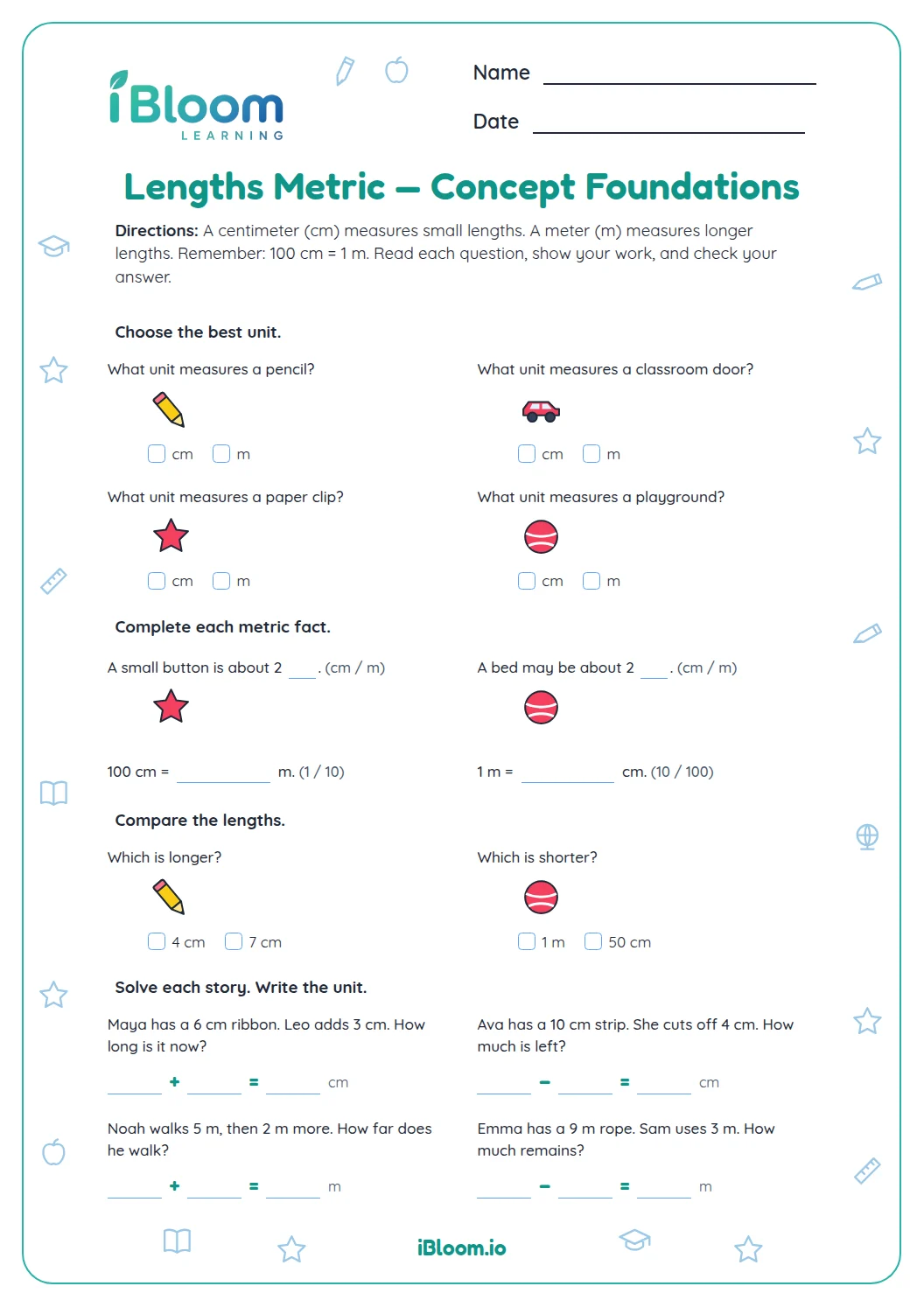
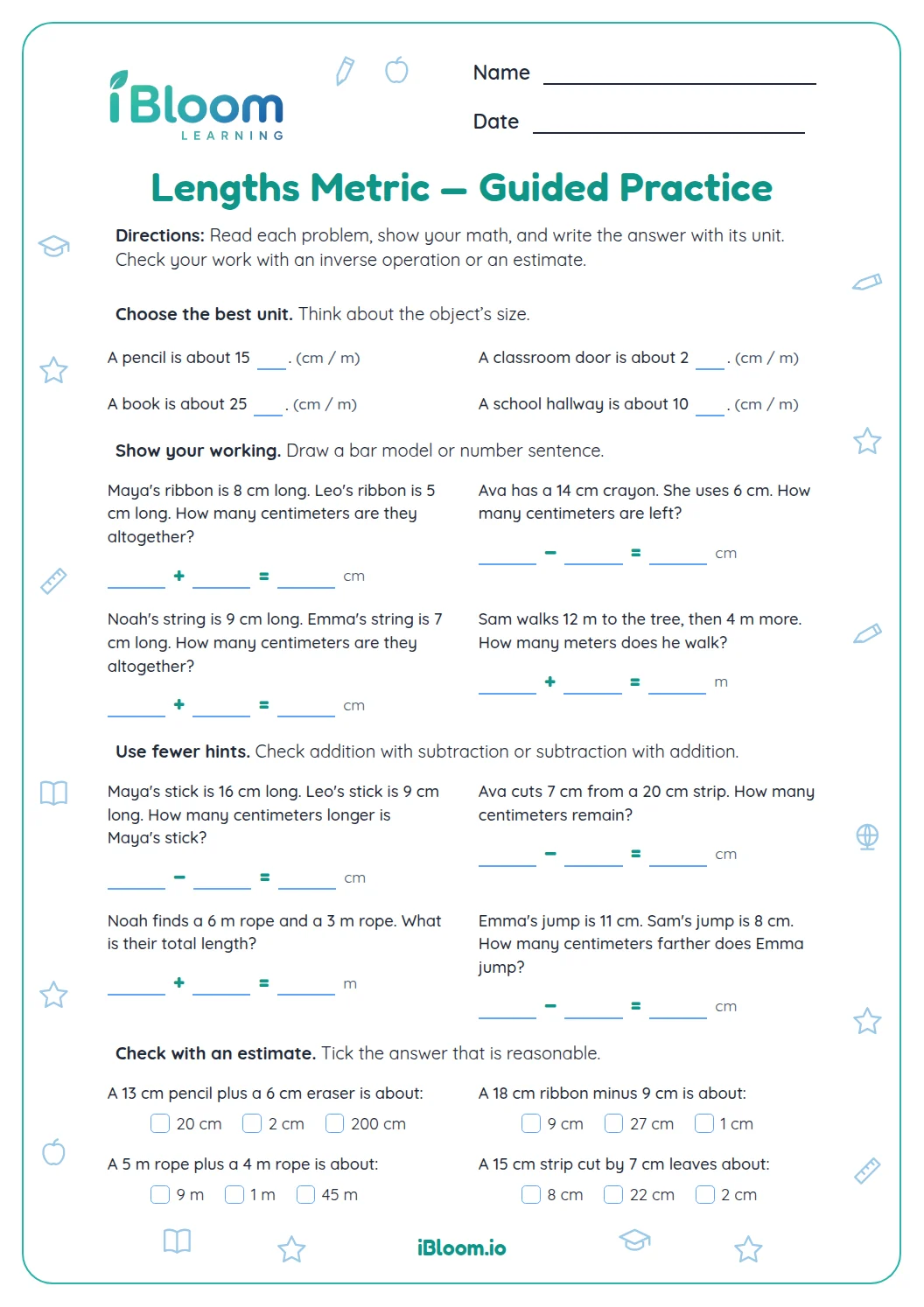
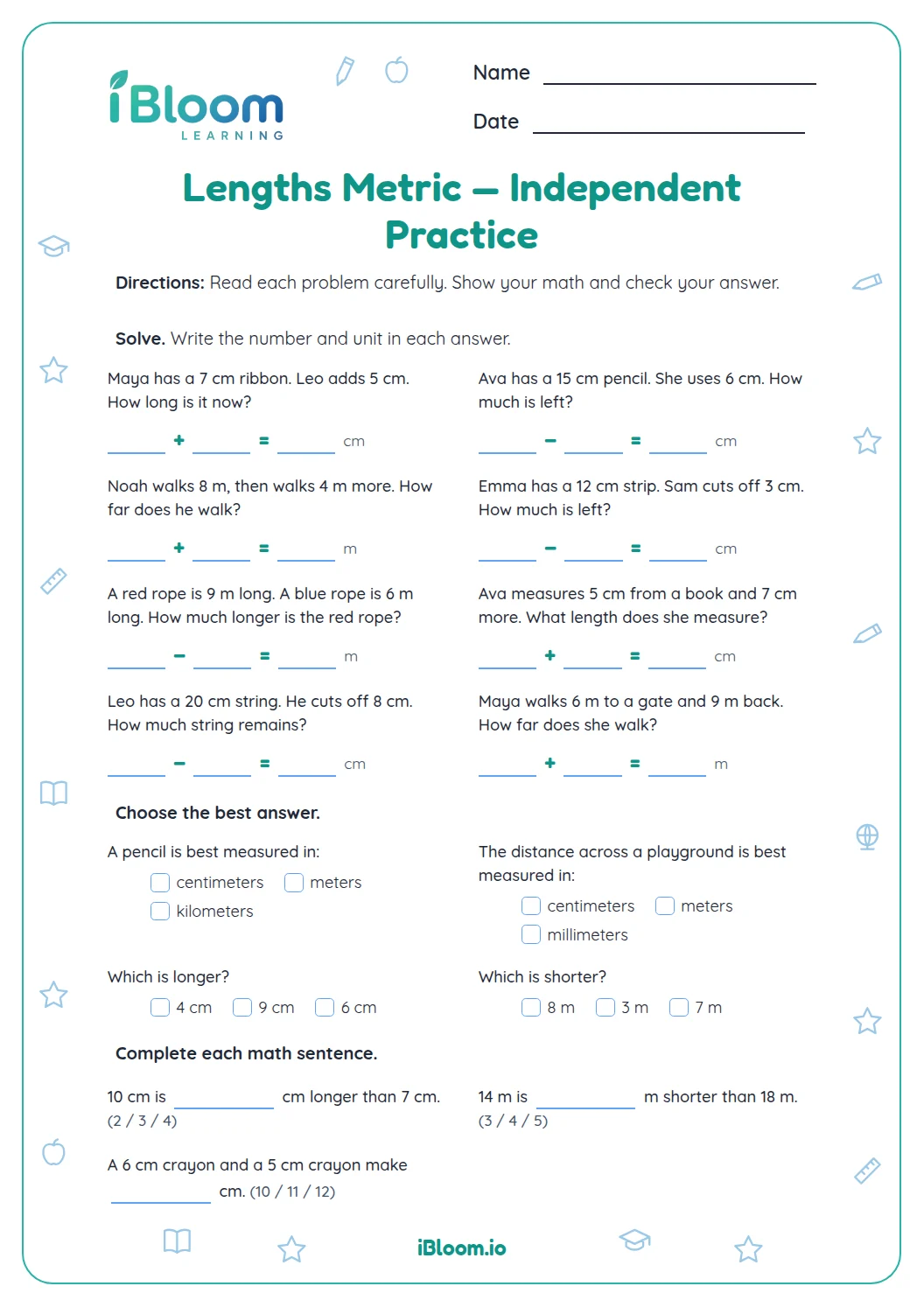
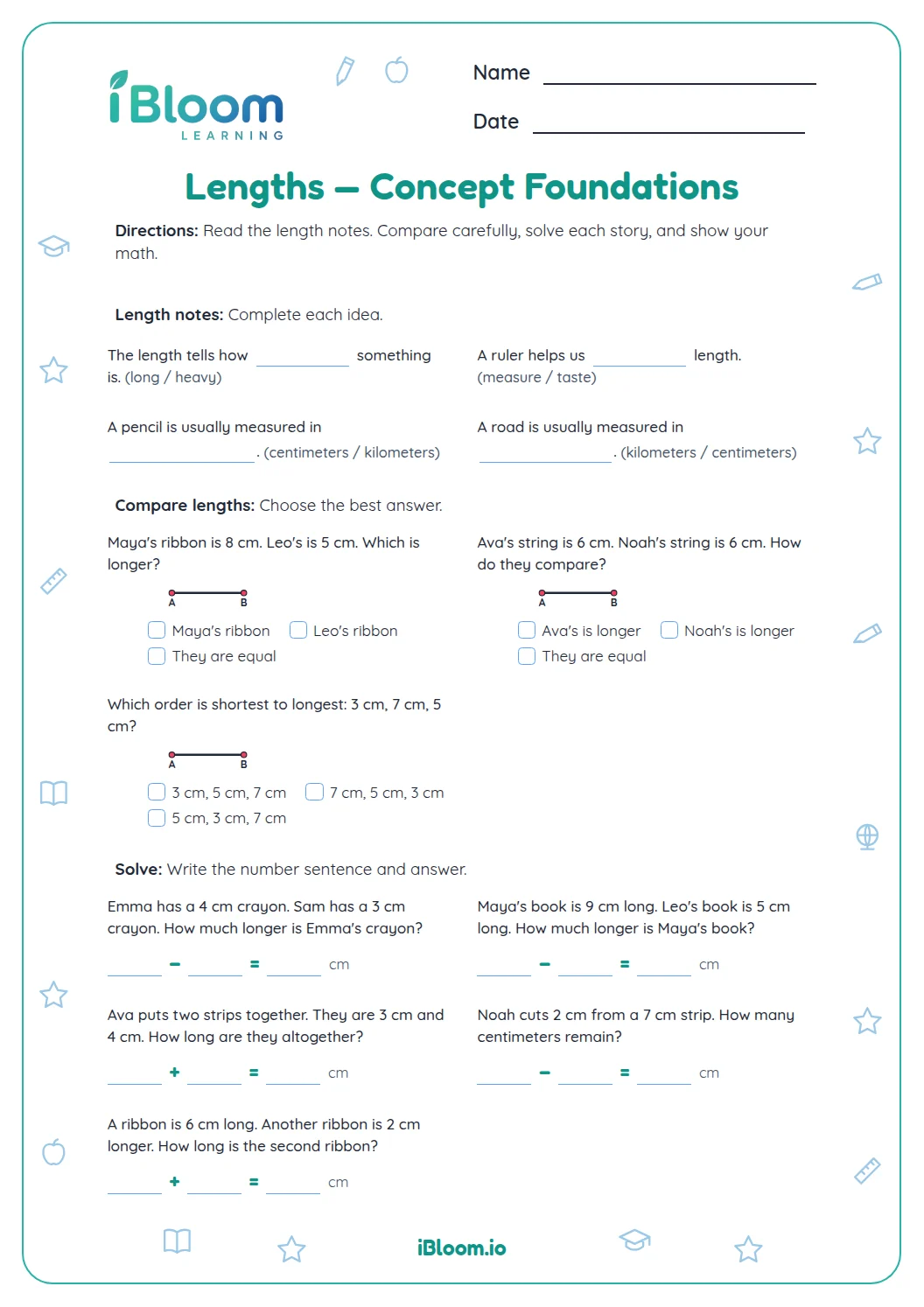
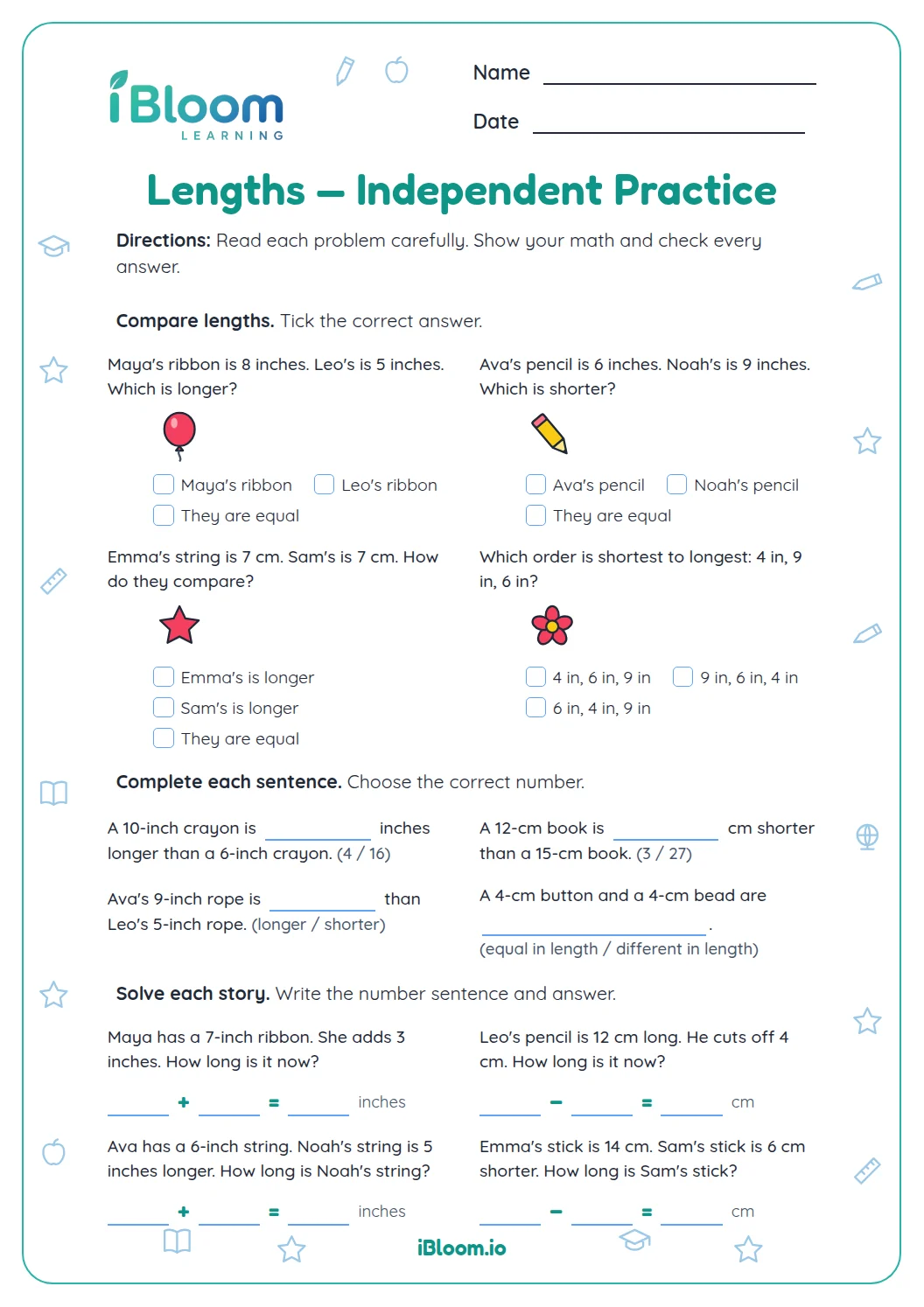
This Grade 1 printable has 14 questions about whole-centimeter length. Students read four ruler models and four small measurement tables, then solve six short stories about joining or separating lengths. The answer key lists each measurement and result. The page practices CCSS 1.MD.A.2.
Aligned to 1.MD.A.2
How do students read each ruler?
Four ruler drawings and four compact tables show lengths in centimeters. Read each model, then record the whole-centimeter measure. Six short stories ask students to add or subtract lengths.
- Part A: read four ruler models
- Part B: read four measurement tables
- Part C: solve six length stories
What does one centimeter measure?
A centimeter is the distance between adjacent centimeter marks. Count the spaces from 0 to the endpoint.
- 1If an object reaches the 3 cm mark, its length is 3 cm.
How to use this worksheet
- 1Find the zero mark at the object’s left end.
- 2Follow the object to its endpoint.
- 3Count the centimeter spaces from zero.
- 4Write the number and cm.
- 5Check that you counted spaces, not tick marks.
Common mistakes and quick fixes
The mistake
Counting the zero mark as one centimeter.
The fix
The first centimeter is the space from 0 to 1; count spaces or tick intervals.
The mistake
Adding when a story asks “how many centimeters shorter.”
The fix
Compare the two lengths and subtract the shorter from the longer.
The mistake
Leaving off centimeters in a length answer.
The fix
Include cm so the number has a measurement unit.
Common Core alignment
This worksheet practices the math described by this standard.
Measure lengths using same-size units and express them as whole-number units.
On this sheet: Students read whole-centimeter lengths on ruler models and use lengths in simple stories.
Show the official wordingHide the official wording
Express the length of an object as a whole number of length units, by laying multiple copies of a shorter object (the length unit) end to end; understand that the length measurement of an object is the number of same-size length units that span it with no gaps or overlaps.
What to practice next
Make more practice
Further reading
Questions parents and teachers ask
How do I read the ruler drawings?
Start at zero and follow the object to its endpoint. Count the centimeter spaces to that mark. Four questions show ruler drawings, four show a length table, and the final six ask about adding or subtracting lengths. The key shows the correct measurement.
What does one centimeter mean on a ruler?
One centimeter is the distance between neighboring centimeter marks. On a number line, the first centimeter runs from 0 to 1, so the zero mark itself is not one centimeter. Count the spaces to the endpoint, then check the table values directly in the later items.
How many questions are included?
There are 14 questions: four ruler readings, four table readings, and six short stories about length. Students record whole-centimeter measures, then add or subtract in the final set. A separate answer key lists every response and helps check each calculation.
Can a first grader use this worksheet?
Yes. The worksheet uses whole centimeters and number lines that begin at zero. A child who is new to measuring can point to each space while counting, then compare the count with the number at the endpoint. The answer key supports a quick check.
What should I check if an answer is off by one?
If an answer is off by one, check whether the child counted the tick marks instead of the spaces between them. The first space from 0 to 1 measures one centimeter. Count each space once, then verify where the endpoint falls on the line.