









About this worksheet
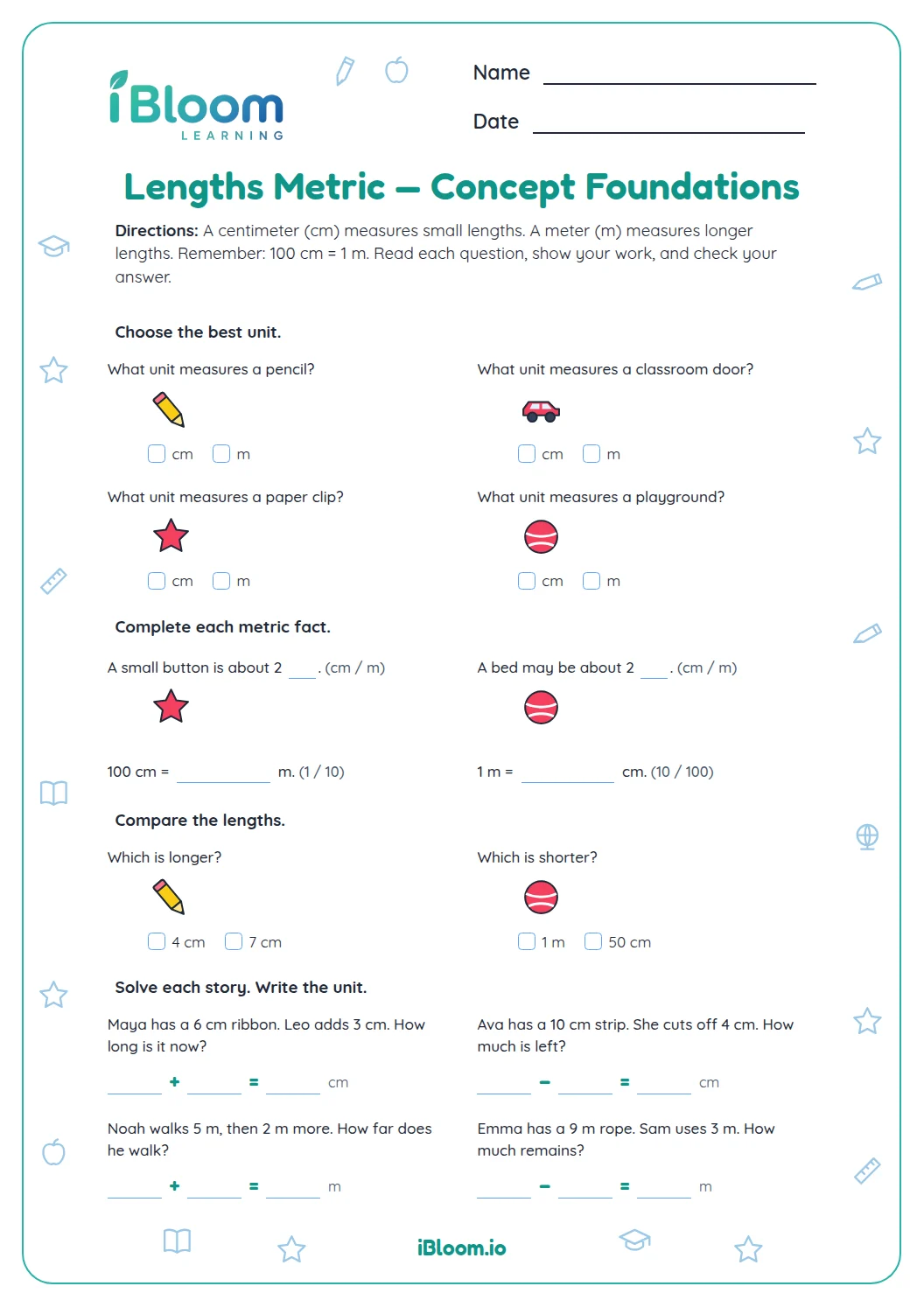
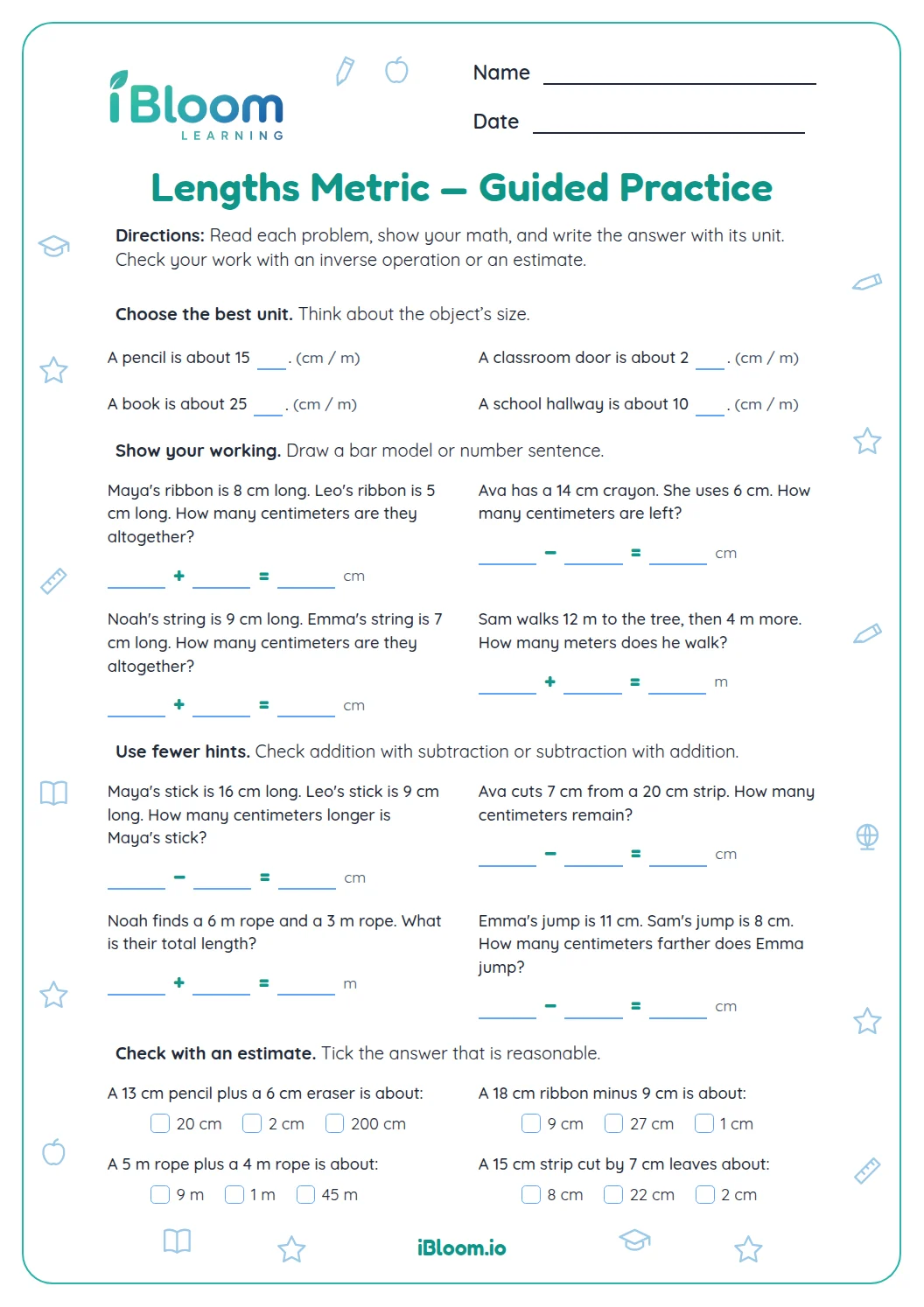
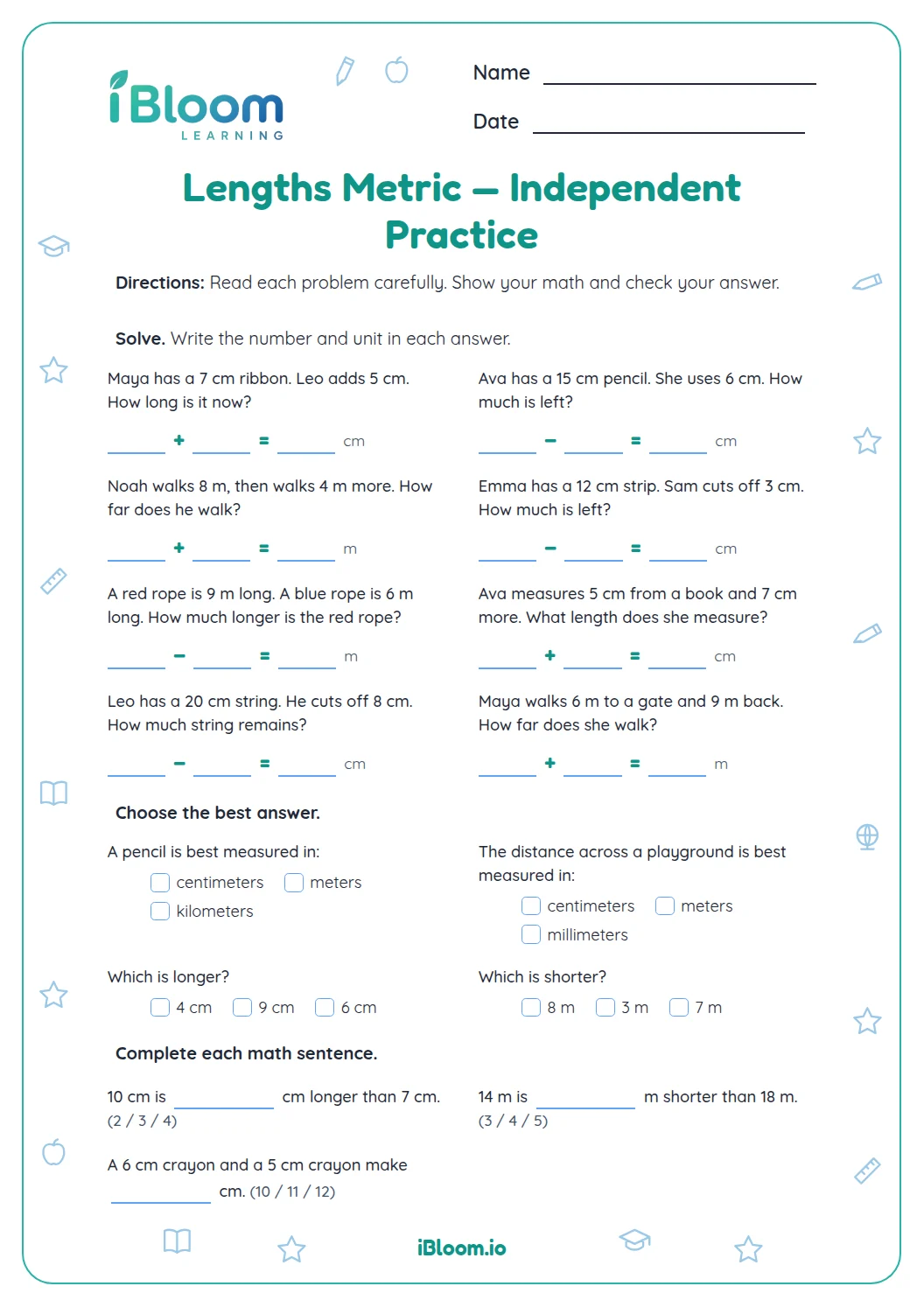
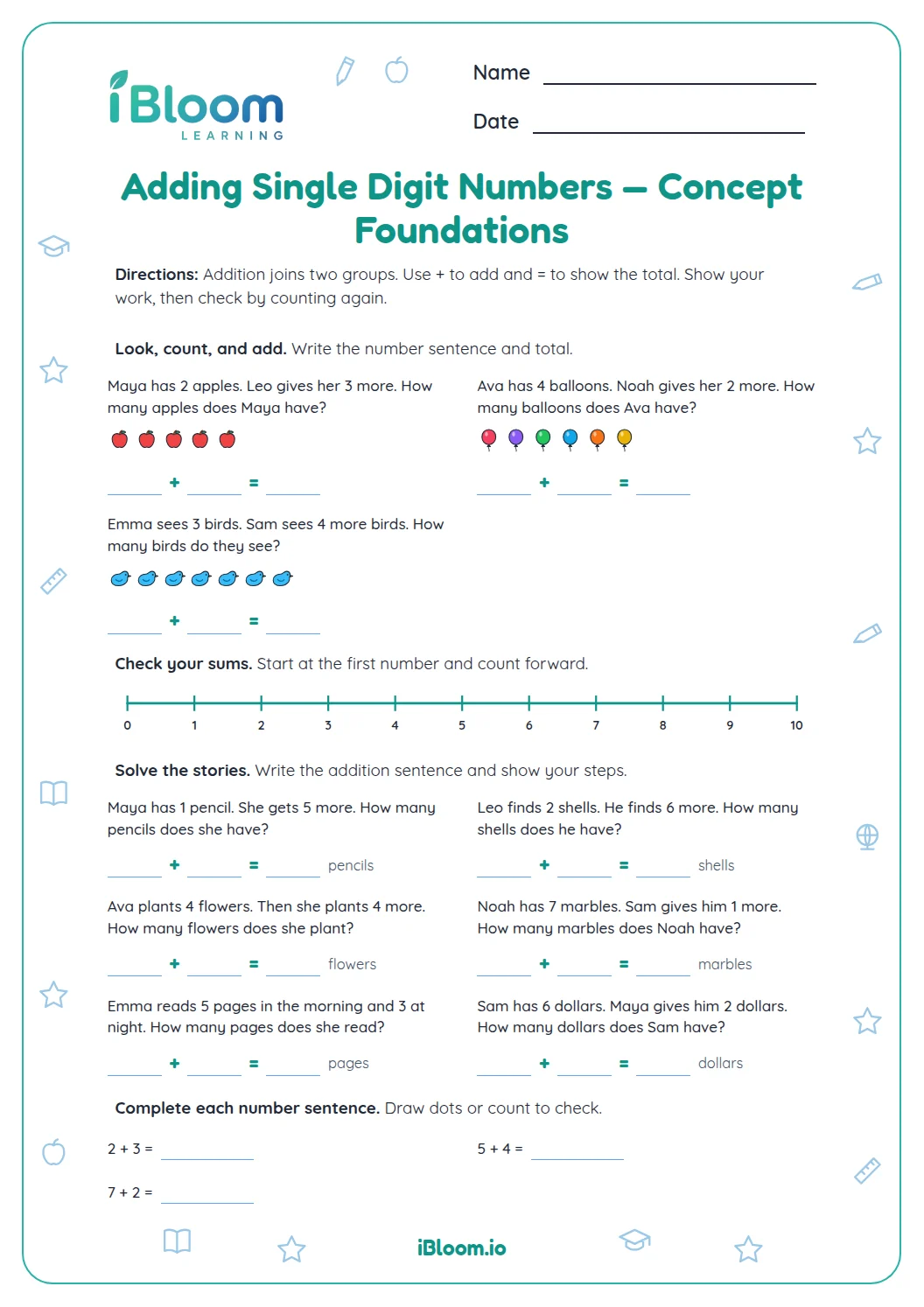
This free printable gives Grade 1 students 14 compact questions about metric length. Children use the relationship 1 m = 100 cm, choose sensible units, compare lengths, and solve short stories by joining or taking away centimeters. Part A focuses on unit clues, Part B uses addition and subtraction stories, and Part C checks corrections and comparisons. The separate answer key shows each correct choice.
Aligned to 1.OA.A.1 and 1.MD.A.1
How does the sheet use meters and centimeters?
Part A checks whether a length and its unit make sense. For example, question 1 compares 1 m with 90 cm; since 1 m is 100 cm, 1 m is longer.
What addition and subtraction stories are included?
Part B asks students to join two lengths or find what remains. In question 9, 30 cm + 20 cm = 50 cm, with centimeters kept in the answer.
How do students check a length claim?
Part C asks students to correct a unit claim, find a missing length, and compare two measurements. Question 12 uses 9 cm − 4 cm = 5 cm to find a shorter ribbon.
How to work through the page
- 1Read the number and unit together.
- 2Use 1 m = 100 cm when a question compares meters and centimeters.
- 3For a joining story, add the lengths; for a piece taken away, subtract.
- 4Check that the answer keeps the same unit as the lengths in the story.
Common mistakes and quick fixes
The mistake
Treating 1 m as 10 cm.
The fix
Recall that 1 meter equals 100 centimeters before comparing.
The mistake
Adding when a length is removed.
The fix
Ask whether the story joins lengths or takes some away.
The mistake
Writing meters for a centimeter sum.
The fix
Keep the unit from the quantities being added.
Common Core alignment
This practice connects length comparisons and addition and subtraction stories to the listed Grade-level standard.
Solve addition and subtraction word problems about joining, taking away, and comparing. Within 20.
On this sheet:
Show the official wordingHide the official wording
Use addition and subtraction within 20 to solve word problems involving situations of adding to, taking from, putting together, taking apart, and comparing, with unknowns in all positions, e.g., by using objects, drawings, and equations with a symbol for the unknown number to represent the problem.
Compare lengths indirectly and order lengths using a third object.
On this sheet:
Show the official wordingHide the official wording
Order three objects by length; compare the lengths of two objects indirectly by using a third object.
What to practice next
Make more practice
Further reading
Questions parents and teachers ask
What does 1 m equal in centimeters?
One meter equals 100 centimeters. The worksheet uses that relationship in unit questions, including comparing 1 m with 90 cm and finding the centimeters in a 1 m rope. Have the child say “one hundred centimeters” before choosing an answer.
How many questions are on the worksheet?
There are 14 questions in three parts. Students choose sensible units, solve short length stories, and correct or compare length statements. The answer key lists each response, so an adult can check the work without solving the questions again.
Do children need a ruler?
No ruler is needed because every length is supplied in the question. A real meter stick can help demonstrate why 1 m is longer than 90 cm, but the printed questions ask students to reason from the stated measurements.
What operations appear in the length stories?
The stories use addition to join lengths and subtraction to find a remaining or missing length. For example, a 30 cm rope joined to a 20 cm rope measures 50 cm altogether. Students keep the unit in each answer.
How should a child check the answer key?
First compare the number and unit in the answer with the question. For a subtraction answer, add the removed length back to see whether it restores the starting length. For comparisons, check that the selected length is actually larger or smaller.