



About this worksheet
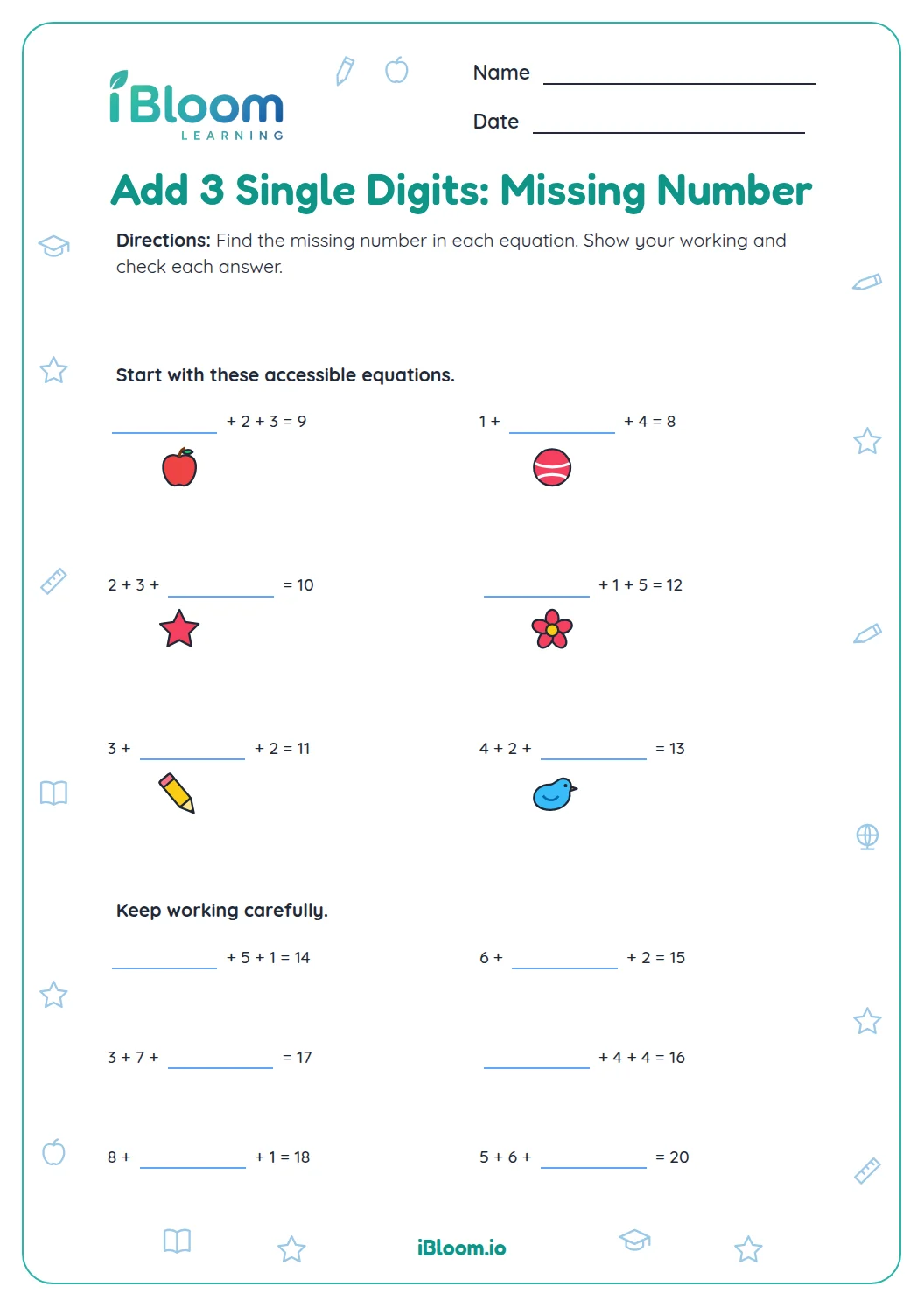
This Grade 2 worksheet uses short stories about collections, pages, flowers, and snacks to practice adding three single-digit numbers. Students first choose the equation that represents each story, then write and solve another set of three-addend problems. The answer key includes the equation or total for all 16 questions.
Aligned to 2.OA.B.2
How do you choose the matching equation?
List each group in the story in the order it appears. In question 1, Mia has 2 red, 3 green, and 4 yellow apples, so 2 + 3 + 4 = 9 matches the three groups.
- 12 red + 3 green + 4 yellow
- 22 + 3 + 4 = 9 apples
How can you add three groups?
Questions 1–4 ask students to choose the equation that represents each story. Questions 5–16 ask students to write a total for another set of three-addend stories.
What is different on the second part?
The first four questions are multiple choice: students select the equation that includes every group. In the final twelve, students write the addition and total in the answer space.
How do you check a story total?
Check that each group from the story appears once in the equation. Then add and reread the question to confirm the answer names the right kind of item.
How to use this worksheet
- 1Read the story and mark its three groups.
- 2Check that the equation includes all three groups once.
- 3Add two numbers, then add the third.
- 4For questions 5–16, write the total in the blank.
- 5Reread the story and label the answer with its unit.
Common mistakes and quick fixes
The mistake
Leaving out one group from the story.
The fix
Mark all three quantities before choosing or writing an equation.
The mistake
Adding a number that is not in the story.
The fix
Match every addend to a quantity in the text.
The mistake
Giving a total without naming what it counts.
The fix
Add the story unit, such as apples, pages, or flowers.
Common Core alignment
This worksheet gives focused practice with 2.OA.B.2.
Use add three single-digit numbers to show the reasoning in each item.
On this sheet: The questions ask learners to apply add three single-digit numbers throughout the sheet.
Show the official wordingHide the official wording
Fluently add and subtract within 20 using mental strategies. By end of Grade 2, know from memory all sums of two one-digit numbers.
What to practice next
Make more practice
Further reading
Questions parents and teachers ask
What does the first part ask students to do?
For questions 1–8, students read a short story and choose the equation that adds its three groups. The other choices leave out a group or use a number that does not match the story. The second part asks students to write and solve.
Can the three numbers be added in any order?
Yes. Addition can be grouped in different ways and the total stays the same. A student might add the first two groups, or combine two numbers that make 10 before adding the last group. For example, students may add 2 + 3 first, then add 4 to make 9.
What is included in the answer key?
The key marks the equation that matches each of the first four stories and gives a labeled total for each of the remaining twelve. Students can compare both the number sentence and the total with their own work. The last eight problems leave room to record the calculation and the story unit.
How long does the worksheet take?
Plan about 20 minutes for the two-page practice, depending on whether students explain their choices or write each addition step. The first part can be completed together before students try the solve-and-write stories. A quick check is to add the three quantities again in a different order.
What skills does this page practice?
Students identify three quantities in a story, represent them with addition, and find a total. The stories keep each addend to a single digit, while some totals reach 18. The final totals stay within 20, and each addend is a single-digit number.