




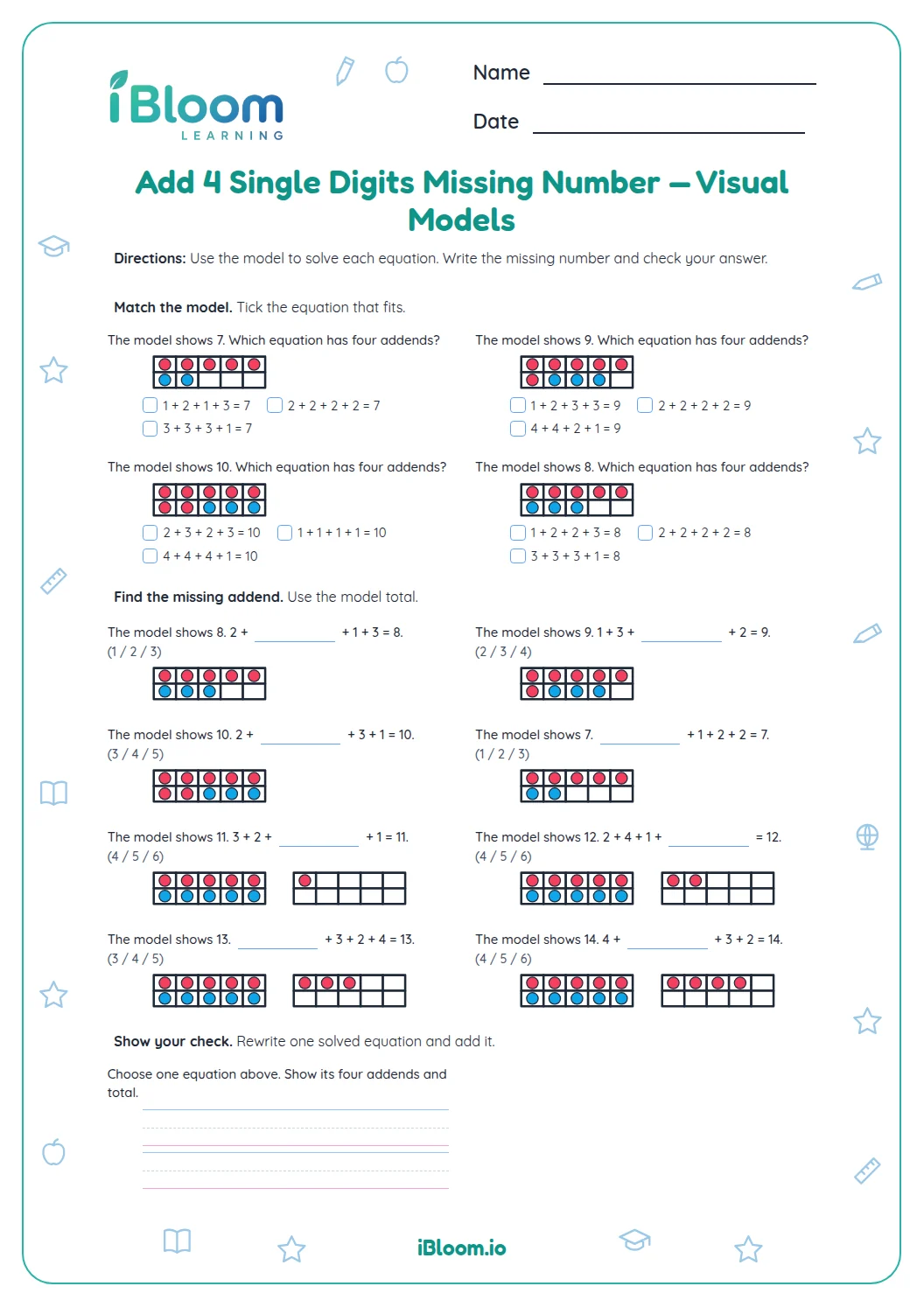
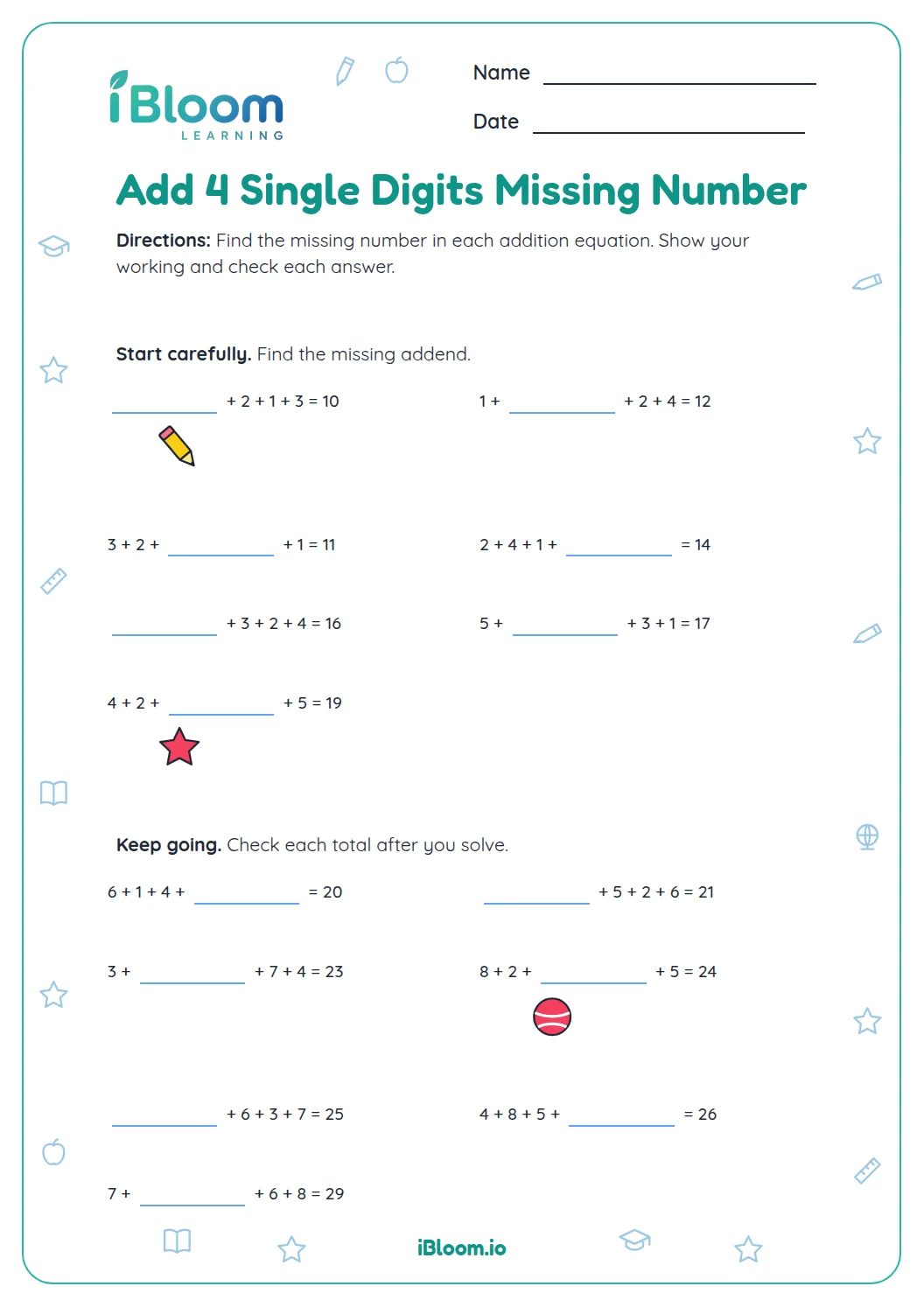
About this worksheet
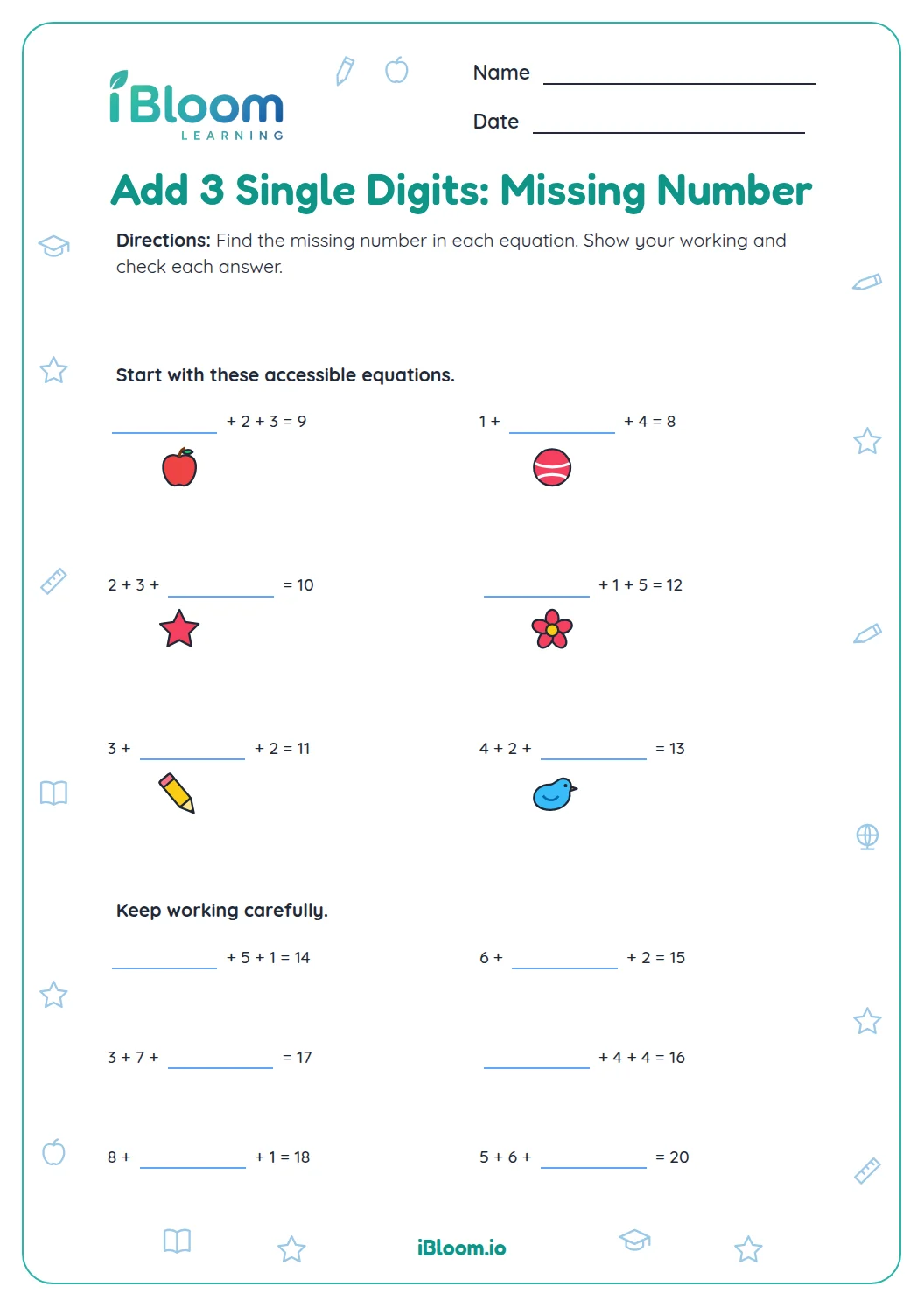
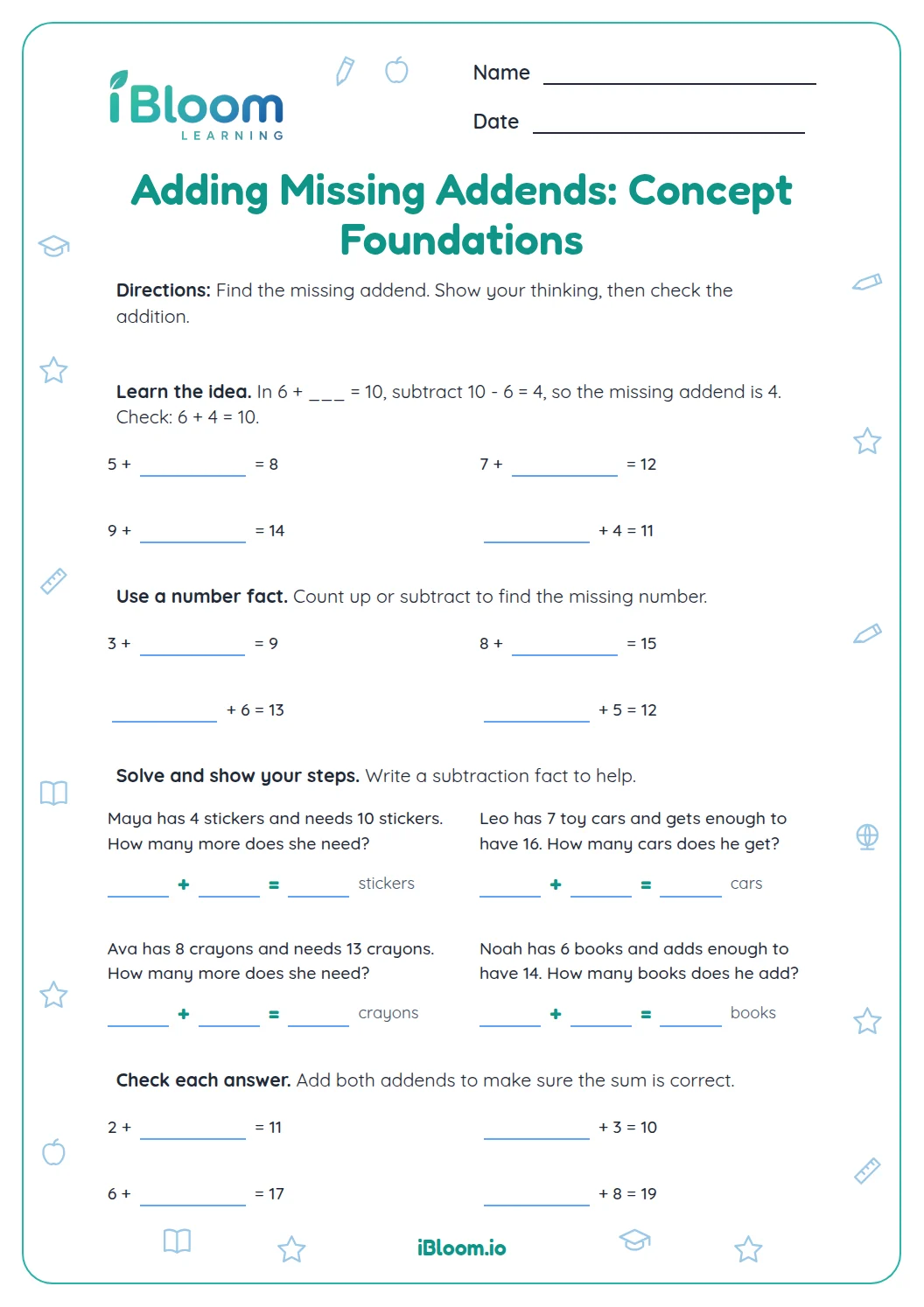
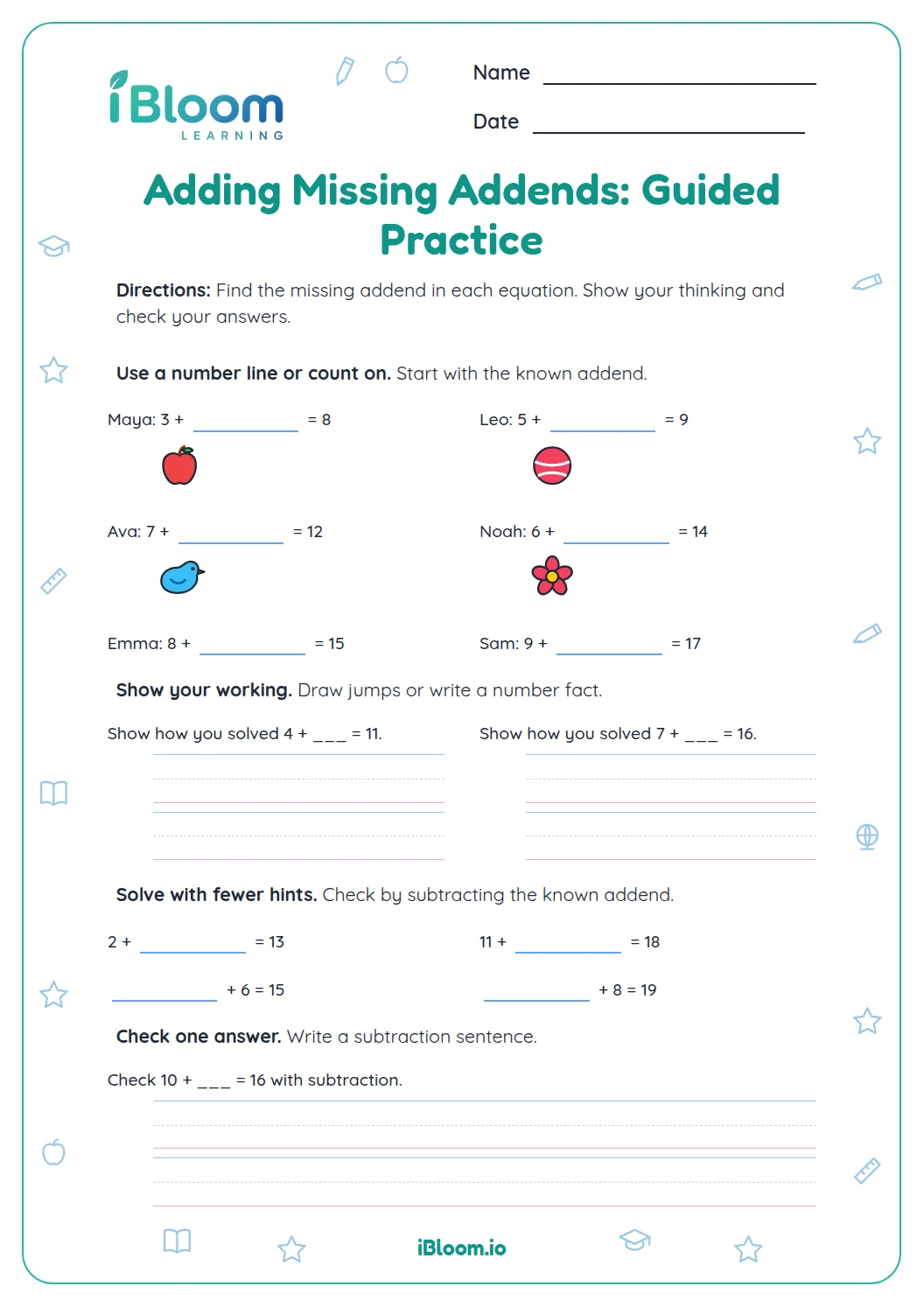
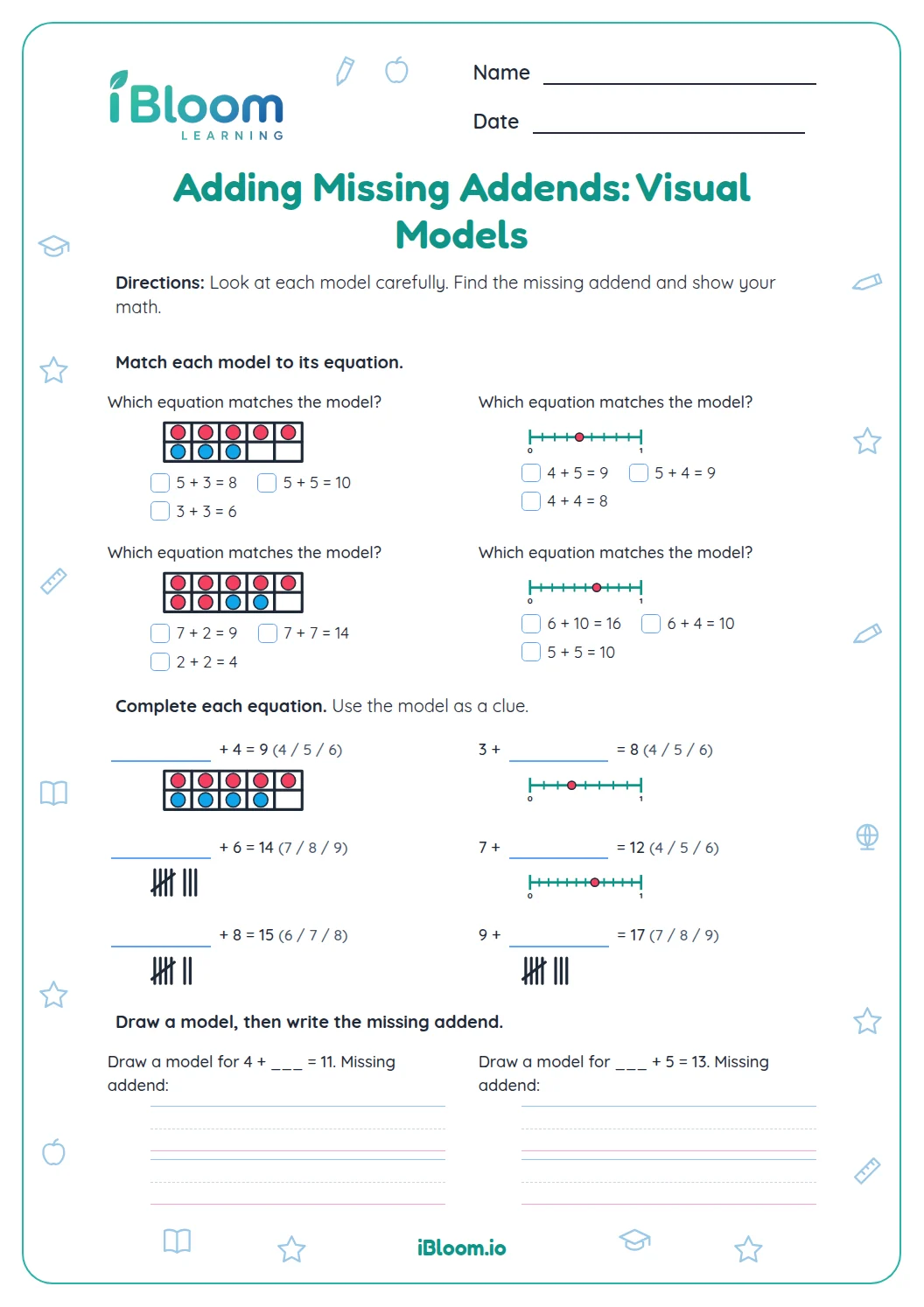
This free Grade 2 addition worksheet builds a method for finding a missing number in a sum of three single digits. Its 16 questions move from choosing a missing addend to completing equations and solving two short stories. All totals stay within 20. Children add the two known numbers first, then count on or subtract to find the missing part. The practice supports CCSS 2.OA.B.2 through mental addition and subtraction within 20. A separate answer key gives all 16 answers.
Aligned to 2.OA.B.2
How do the two known addends help?
An addend is a number being added. Even when the blank is in the middle or at the start, the two printed addends are parts of the same total. Combine them before looking for the missing part.
In question 1, 4 and 3 make 7. Count from 7 up to 10, or use 10 − 7. Both methods give 3.
- 14 + 3 + ___ = 10
- 24 + 3 = 7
- 310 − 7 = 3
- 4Check: 4 + 3 + 3 = 10
What does each part practice?
Part A has four multiple-choice equations. Part B has ten equations with the blank in different positions, including one answer of zero. Part C has two stories about three groups.
Several known pairs make ten. In 7 + ___ + 3 = 15, combine 7 and 3 mentally, even though the blank sits between them. Five more makes 15.
How can children check a missing addend?
Put the answer into the blank and add all three numbers. The result must equal the total after the equals sign. Checking only two addends can hide a mistake.
For the bead story, 3 + 4 = 7 known beads and 12 − 7 = 5 green beads. Checking 3 + 4 + 5 = 12 accounts for every color.
How to use this worksheet
- 1Read question 1 together and name the total, 10.
- 2Add 4 and 3, then count on from 7 to 10.
- 3Let the child finish Part A and explain one choice.
- 4In Part B, look for known pairs that make ten.
- 5Write a three-addend equation for each story, then check with the key.
Mistakes to check together
The mistake
Writing 7 for question 1 because 4 + 3 = 7.
The fix
Seven is the known subtotal; ask how many more make 10.
The mistake
Subtracting just one known number from the total.
The fix
Combine both known addends before subtracting.
The mistake
Rejecting zero in 5 + 5 + ___ = 10.
The fix
Five plus five already equals ten, so zero more is needed.
Common Core alignment
Use addition and subtraction within 20 to find missing parts of three-addend sums.
On this sheet: Children combine known addends and count on or subtract to find the missing addend.
Show the official wordingHide the official wording
Fluently add and subtract within 20 using mental strategies. By end of Grade 2, know from memory all sums of two one-digit numbers.
What to practice next
Make more practice
Further reading
Questions parents and teachers ask
Does the blank always come last?
No, the blank appears at the beginning, in the middle, and at the end of these sums. The method stays the same in every position: add the two known numbers, then find the amount needed to reach the total. Have your child check by filling the blank back in.
Why is zero one of the answers?
Zero is correct when the two known addends already make the total. In 5 + 5 + ___ = 10, adding five and five gives ten, so the missing addend is zero. Read the completed equation aloud to show that adding zero leaves the total unchanged.
Can my child use counters?
Yes, counters can make the missing part easier to see. For question 1, set out ten counters, then separate a group of four and a group of three. The three counters left represent the blank. Next, connect that action to the subtraction fact 10 − 7 = 3.
How are the story problems connected to the equations?
Each story has three groups and one total, just like the number sentences. The bead story gives two color groups and asks for the third. Children can write 3 + 4 + ___ = 12, find five green beads, and check that all three groups total twelve.
What does the answer key include?
The key gives answers for all sixteen questions, including the correct choices, the ten missing numbers, and the two story answers with units. Check the arithmetic as well as the final number. If an answer differs, ask the child to add all three completed addends before trying again.