


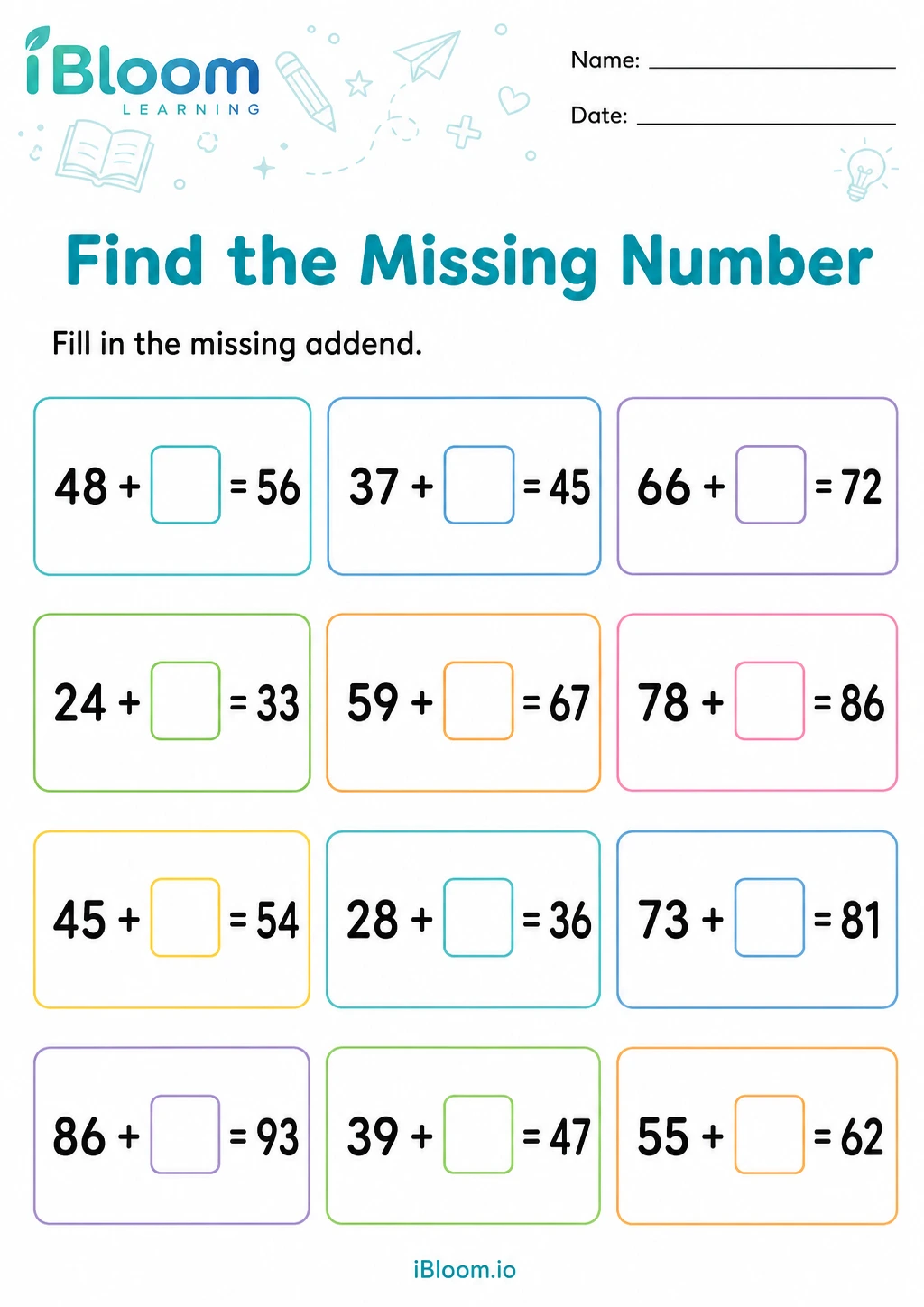
About this worksheet
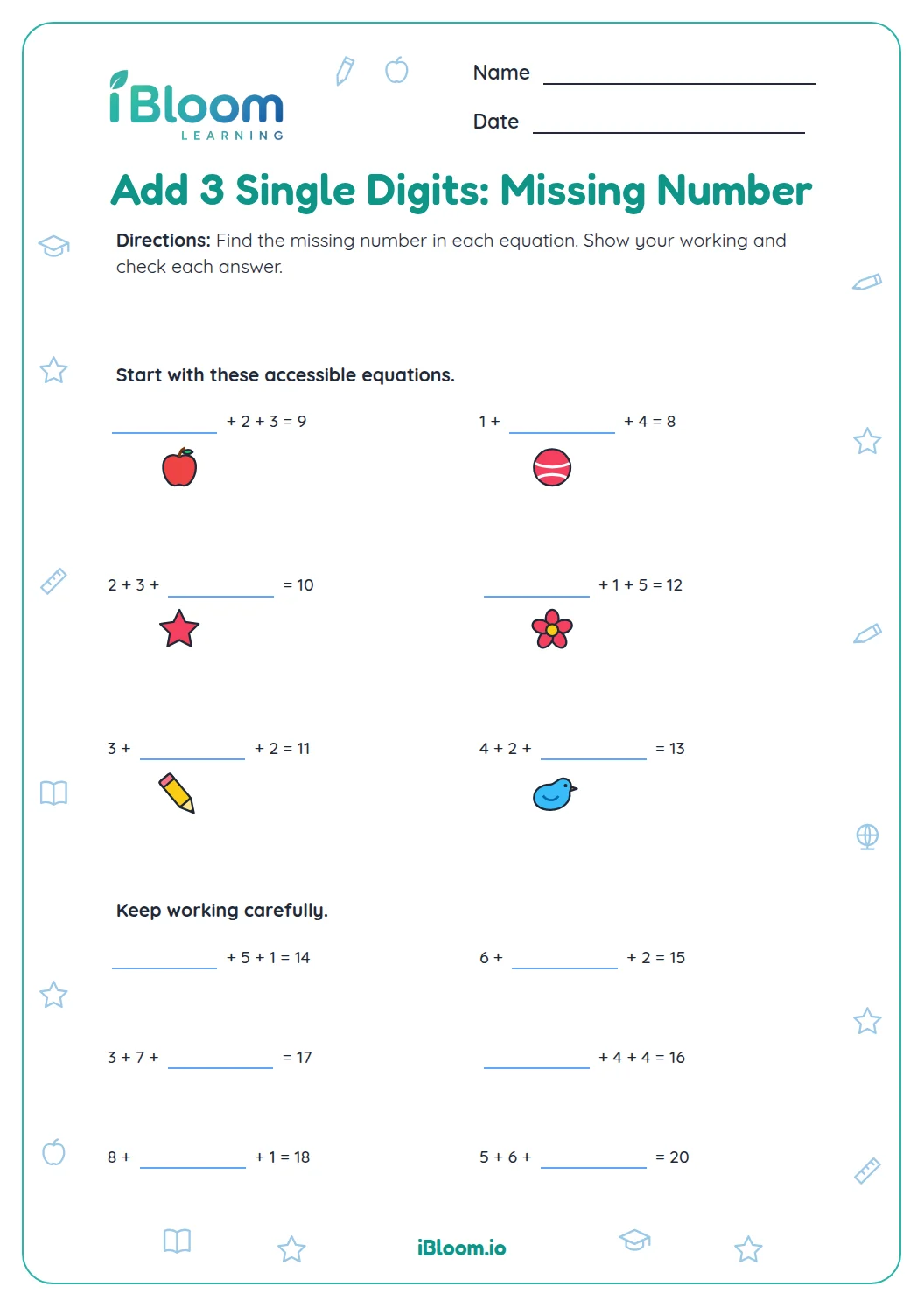
This Grade 2 addition worksheet has 16 number sentences with three single-digit addends and one blank. Children use the two known addends and the total to find the missing number, with the blank appearing in different positions. Every total is within 20. Two printable practice pages and a separate answer key give children room to solve and check each equation.
Aligned to 2.OA.B.2
How can I find the missing addend?
Add the two numbers that are already shown. Then count on from that sum to the total, or subtract the sum from the total. The amount left is the missing addend.
Can the blank move to a different place?
Yes. The unknown may come before, between, or after the known addends. The order does not change the total, so use the same strategy wherever the blank appears.
What does one problem look like?
For 3 + ___ + 4 = 12, combine 3 and 4 to get 7. The total is 12, so 5 is missing. Check: 3 + 5 + 4 = 12.
How to use this worksheet
- 1Find the two addends that are shown.
- 2Add those known numbers.
- 3Compare their sum with the total.
- 4Write the amount needed to reach the total.
- 5Add all three addends to check.
Common mistakes and quick fixes
The mistake
Putting the known sum in the blank.
The fix
The blank is one addend; compare the known sum with the total to find what is still needed.
The mistake
Adding the total to the visible addends.
The fix
The total is the answer to the whole addition sentence, so use it as the target.
The mistake
Checking only two addends.
The fix
Substitute the missing number and add all three addends.
Common Core alignment
This worksheet practices the standard below through mental addition within 20.
Find a missing addend using mental addition within 20.
On this sheet: Every equation uses three single-digit addends and a total within 20.
Show the official wordingHide the official wording
Fluently add and subtract within 20 using mental strategies.
What to practice next
Make more practice
Further reading
Questions parents and teachers ask
Can the missing number be in any position?
Yes. The blank appears in different positions among the three addends. Add the two numbers you can see, then find the amount needed to reach the total. Check by replacing the blank and adding all three numbers. The answer key shows the completed sentence for each item.
Are the answers always one digit?
Yes. Each blank is a single-digit addend, and the totals stay within 20. Children can count on from the known sum or subtract it from the total. Either strategy works when the final addition sentence is true. The worksheet gives space to record each answer.
What is a quick way to check an answer?
Put the number into the blank and add all three addends. For example, 2 + 5 + 3 = 10, so a missing addend of 5 is correct when the total is 10. The separate answer key lists each result.
How many questions and pages are included?
There are 16 equations on two worksheet pages, followed by two answer-key pages. The questions vary the position of the blank and the values, while keeping the same three-addend skill throughout. A parent or teacher can check the completed equations against the separate key.
Should children count on or subtract?
Both are useful ways to find the gap. A learner might count from the known sum up to the total, or subtract that sum from the total. Choose a strategy the child can explain, then check it in the original equation.
What practice can follow this sheet?
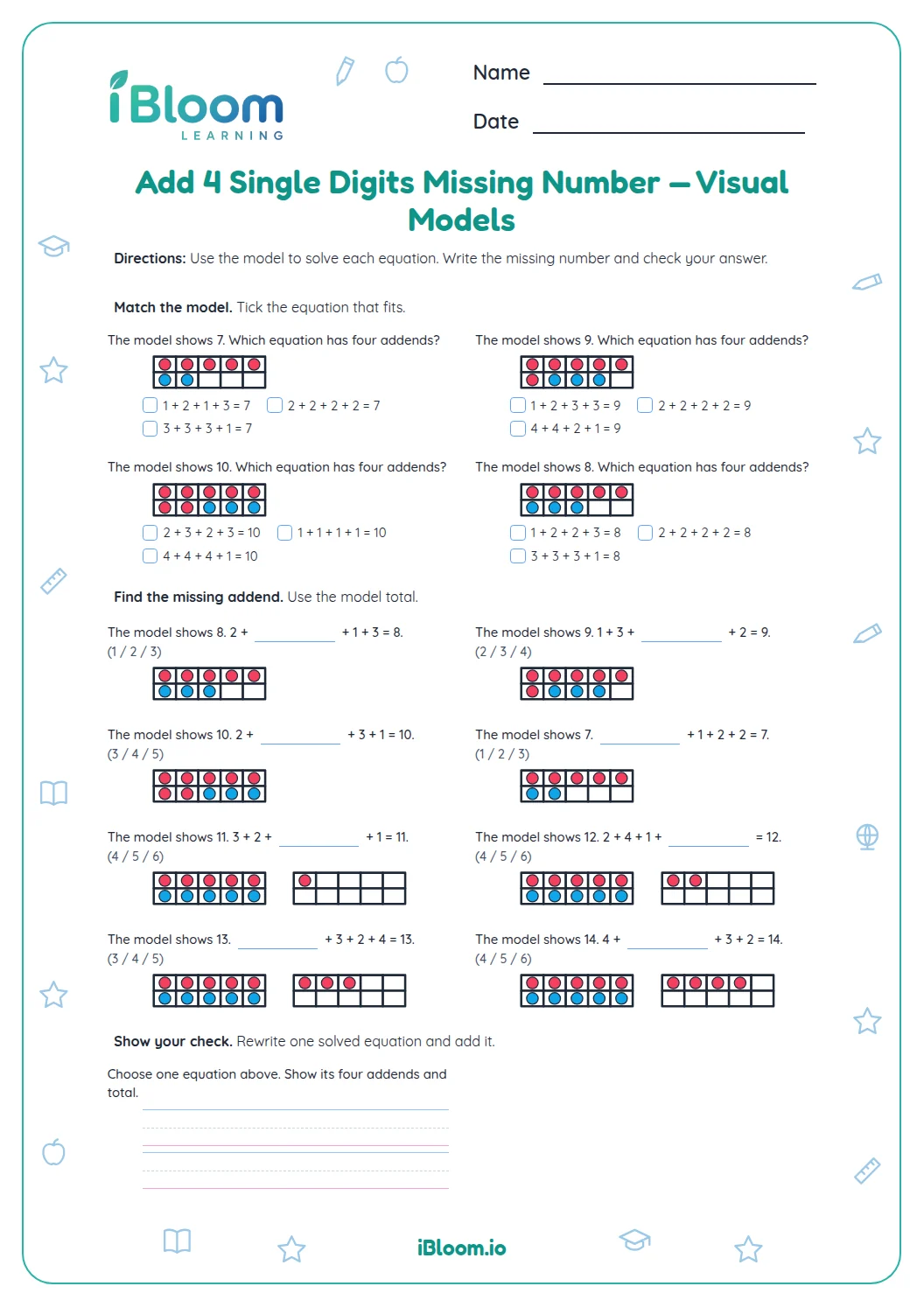
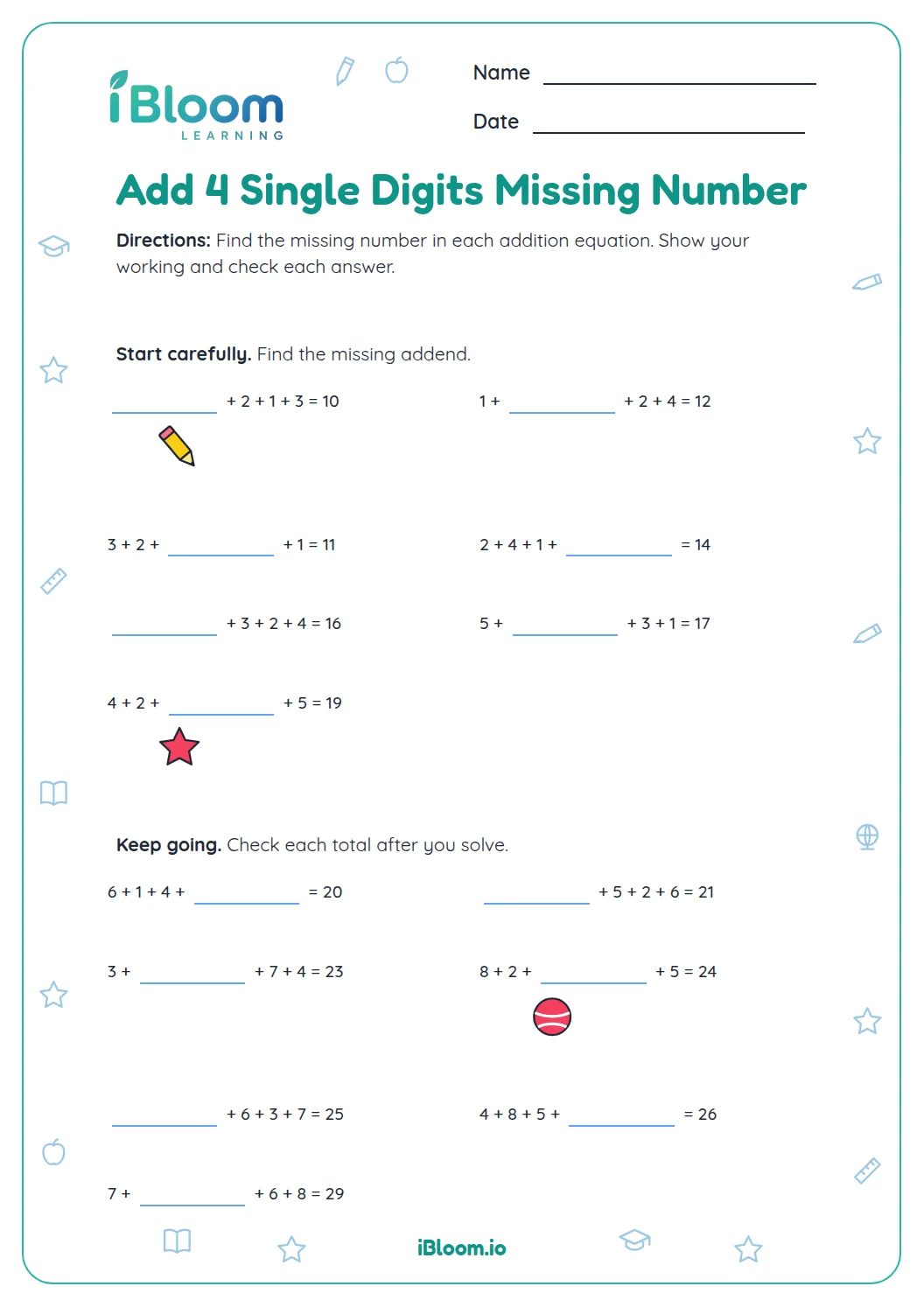
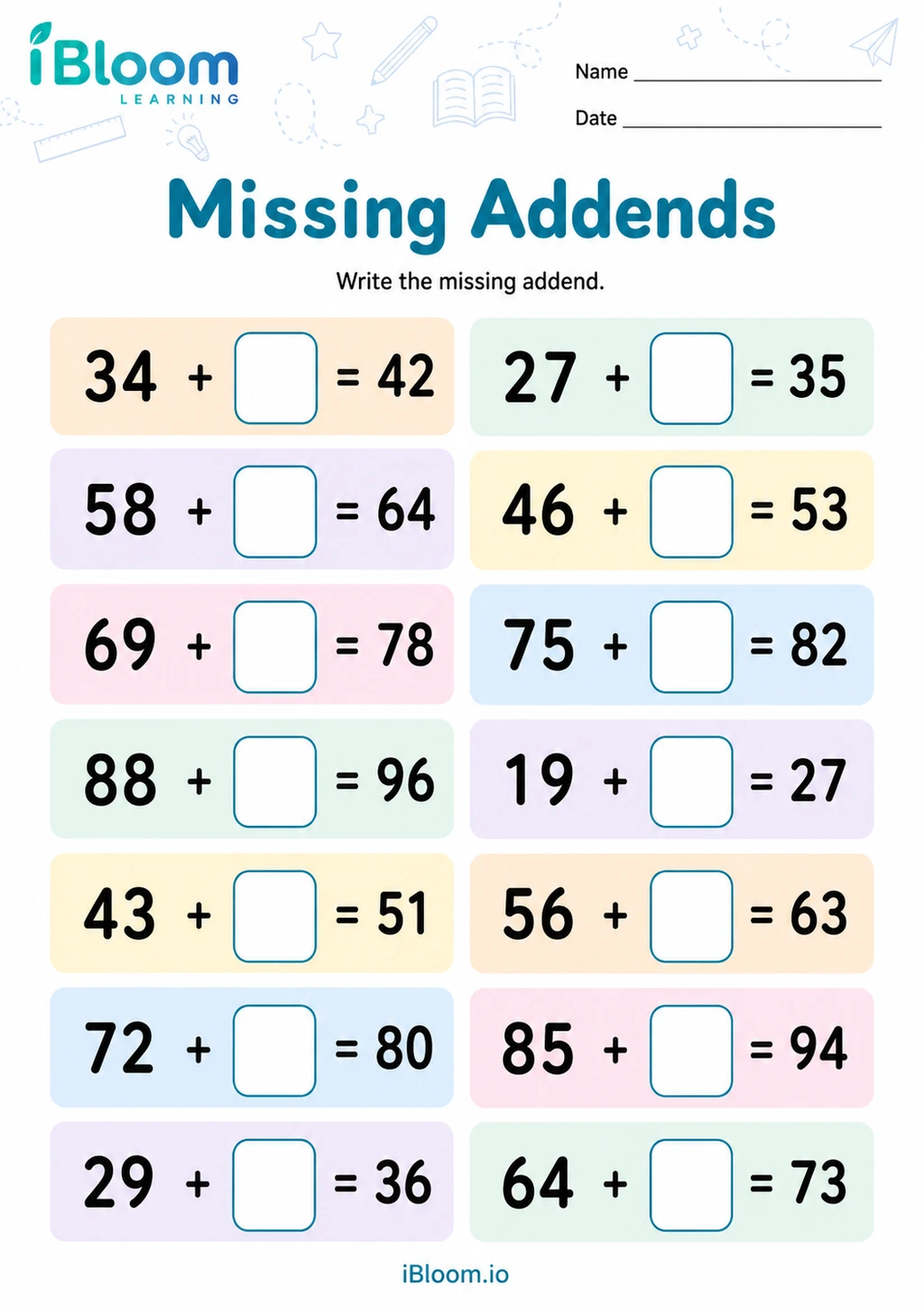
After this sheet, try adding three single-digit numbers when every addend is shown, then return to missing-addend equations with four addends or a two-digit addend. These choices keep the unknown-number idea while adding a little more number work. The sibling links lead to those practice pages.