


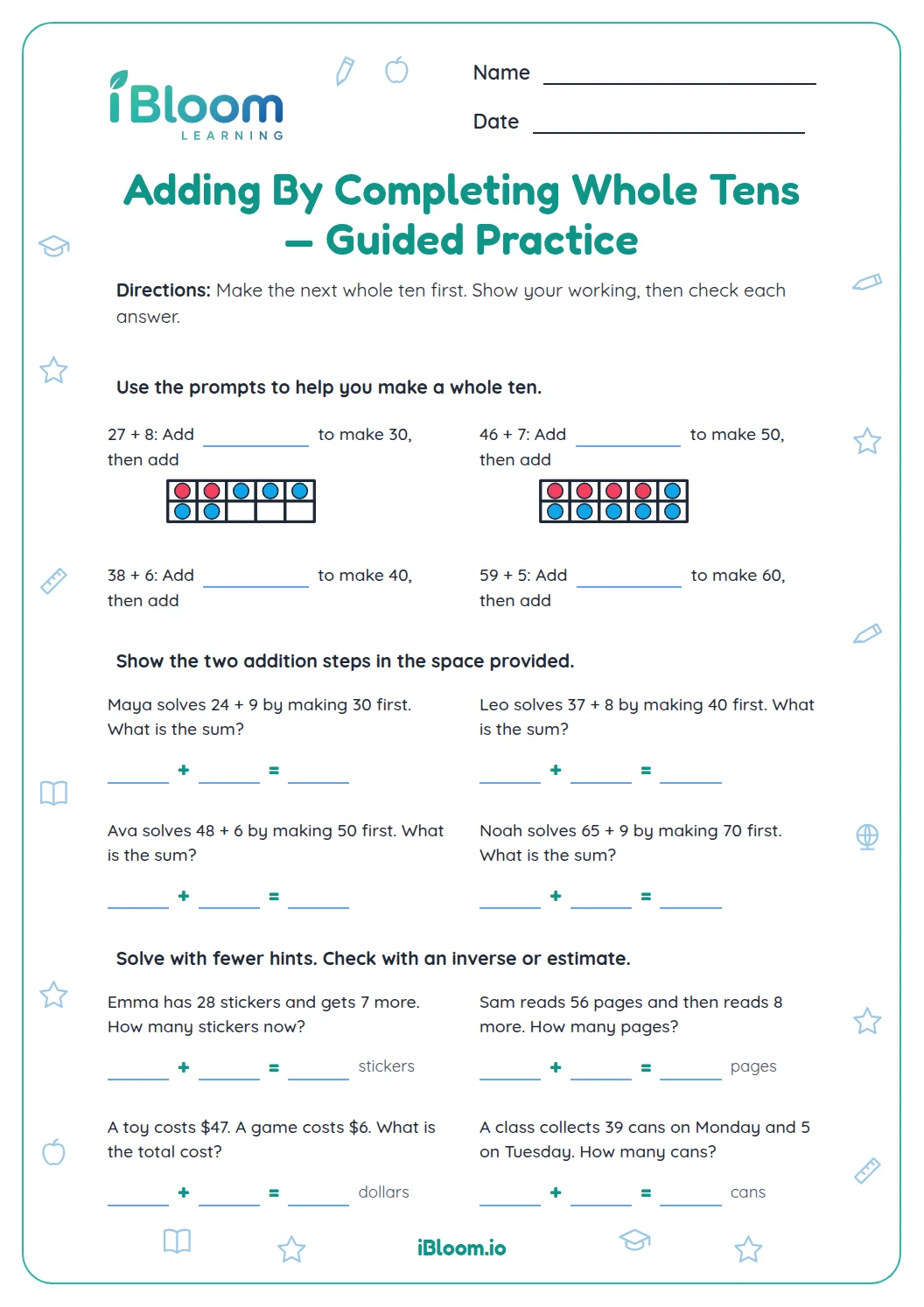
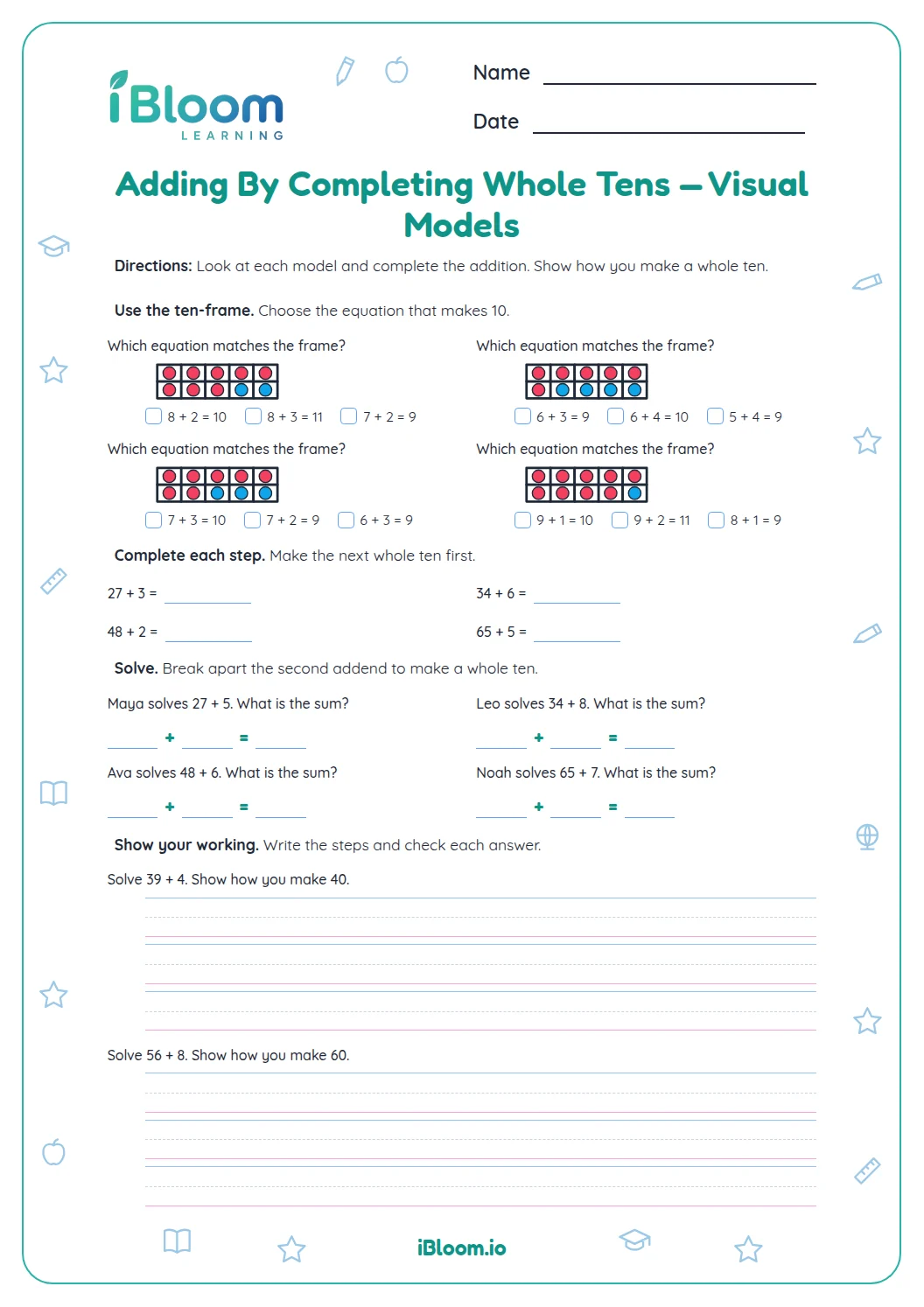
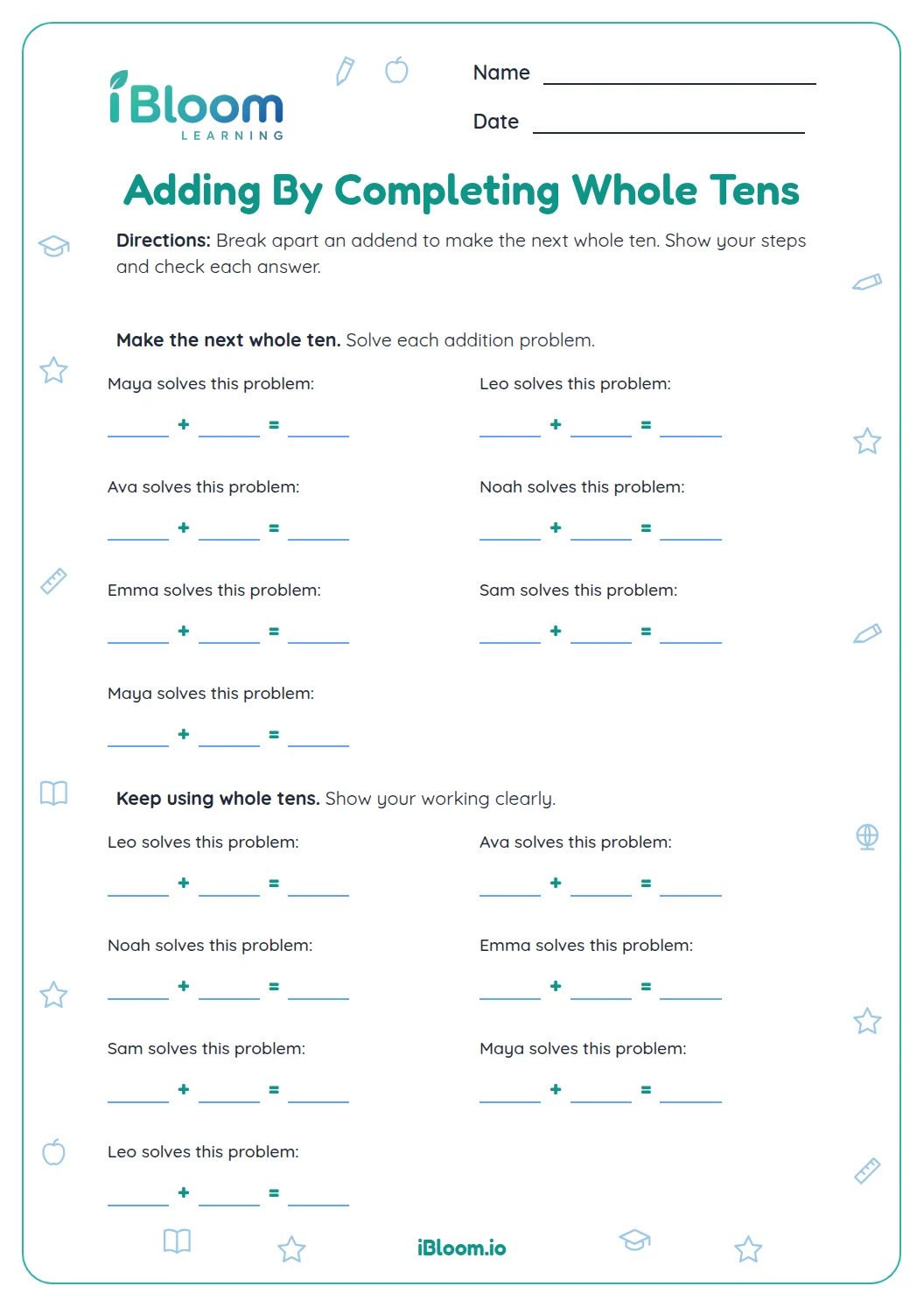
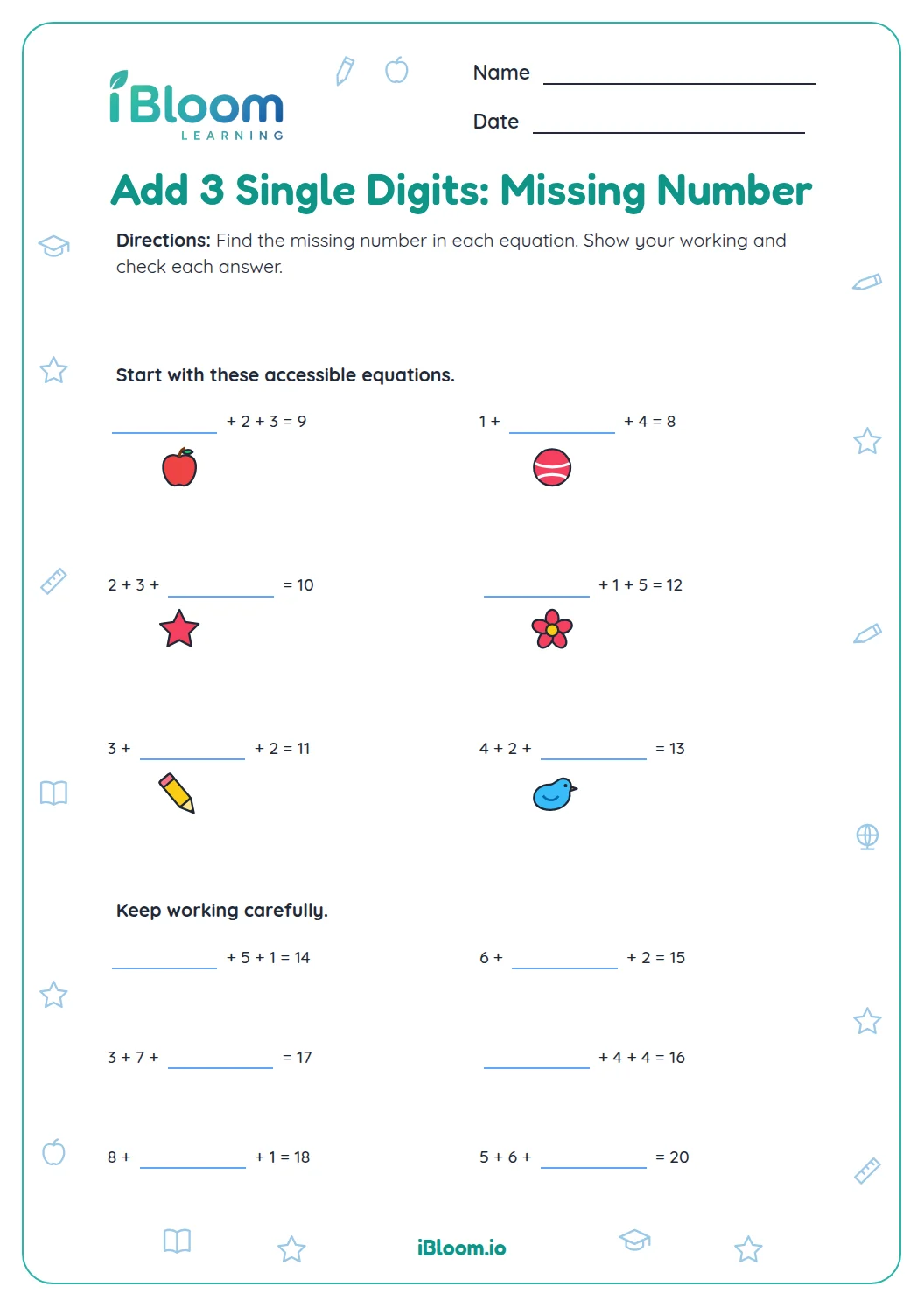


About this worksheet
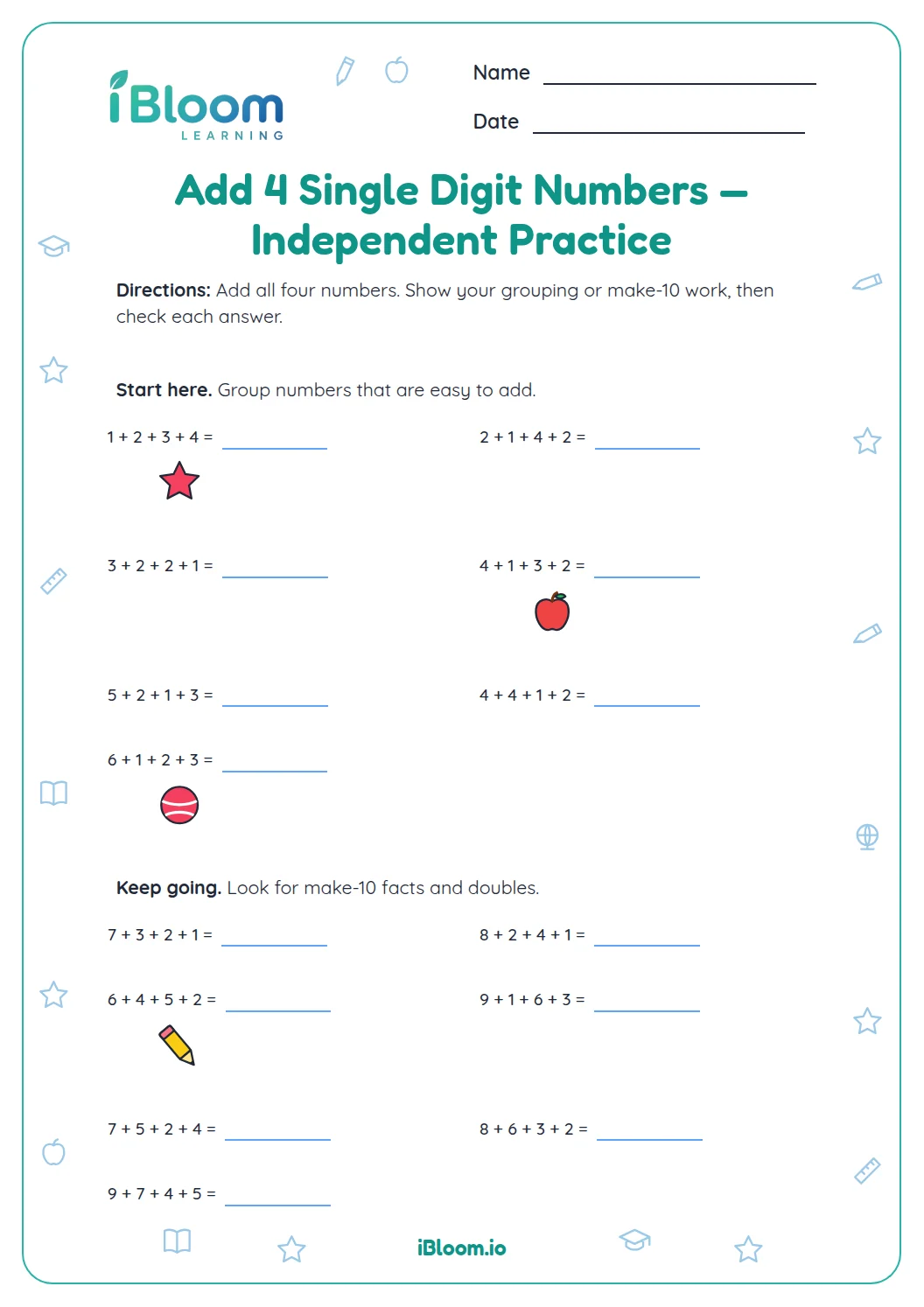
This free Grade 2 worksheet gives children 16 three-addend sums to solve independently. Every addend is a single digit and every total is within 20. Part A offers six sums with a pair that makes ten. Part B has six sums that invite doubles or another useful pair. Part C mixes four more sums, including zero as an addend. Children write one total in each blank. The sheet practices Common Core 2.OA.B.2 through mental addition strategies, and a separate answer key makes it easy to check that all three numbers were included.
Aligned to 2.OA.B.2
Which two numbers should children add first?
Children can begin with any pair. A pair totaling ten is especially convenient because the last addend can be added directly to ten. In question 1, the useful pair sits at the two ends of the expression.
The six questions in Part A put make-ten pairs in different positions. Let children circle or lightly mark the pair they used, then write the total in the blank.
How does the make-ten strategy work?
Question 1 is 8 + 5 + 2. Combining 8 and 2 gives ten, and adding the remaining five gives fifteen. The order changes, but each original addend is still used exactly once.
- 18 + 5 + 2
- 28 + 2 = 10
- 310 + 5 = 15
- 4Write 15 in the blank.
What should independent practice look like?
Part B invites other known facts, including doubles such as 4 + 4 and 6 + 6. Part C lets children choose their own first step across a mixed set. All answers fit within 20.
Give children time to work through the sums before showing the key. If an answer is incorrect, ask which two numbers they added first and which number was still left. This reveals whether the slip came from a fact or from leaving out an addend.
How to use this worksheet
- 1Read the three part directions before beginning.
- 2Let the child complete Part A, marking a make-ten pair if useful.
- 3Encourage a known pair or double in Part B.
- 4Have the child choose a strategy for each Part C sum.
- 5Check with the key and redo any missed sum using all three addends.
Mistakes to notice and fix
The mistake
Stopping after 8 + 2 and writing 10 for question 1.
The fix
Mark the pair already used, then add the remaining 5 to reach 15.
The mistake
Adding a number twice while rearranging the sum.
The fix
Point to each original addend once as it is used; there should be exactly three.
The mistake
Treating zero as one extra object in 0 + 8 + 7.
The fix
Zero adds nothing. The sum stays the same as 8 + 7, which is 15.
Common Core alignment
Use mental strategies to add three one-digit numbers with totals within 20.
On this sheet: Children combine two addends mentally, then include the third; every total is within 20.
Show the official wordingHide the official wording
Fluently add and subtract within 20 using mental strategies. By end of Grade 2, know from memory all sums of two one-digit numbers.
What to practice next
Make more practice
Further reading
Questions parents and teachers ask
How many sums are on the worksheet?
There are 16 sums, and each has three single-digit addends. Part A contains six make-ten questions, Part B contains six questions using helpful pairs, and Part C contains four mixed questions. Children write one total for each equation, then use the separate key to check.
Are all of the answers within 20?
Yes, every total is within 20, and the largest answer is 20. That keeps attention on mental addition facts and on remembering the third addend. Children can use a make-ten pair, a double, or another fact they know to work through each three-number sum.
Does my child have to add from left to right?
No, children may combine any two addends first. In question 1, adding 8 and 2 before adding 5 makes the calculation easier. Ask your child to explain which pair they chose, while checking that each of the three original numbers was used exactly once.
What if my child cannot find a pair that makes ten?
Use another known fact when a make-ten pair is unavailable. In Part B, 4 + 4 + 3 can begin with the double 4 + 4 = 8, followed by 8 + 3 = 11. The aim is to choose a useful first step for each sum.
How can I keep this as independent practice?
Explain the part directions, then let your child solve the sums before giving feedback. Keep the answer key separate until checking time. For a missed answer, ask which pair came first and which addend remained. That question helps the child locate the slip and try again.