
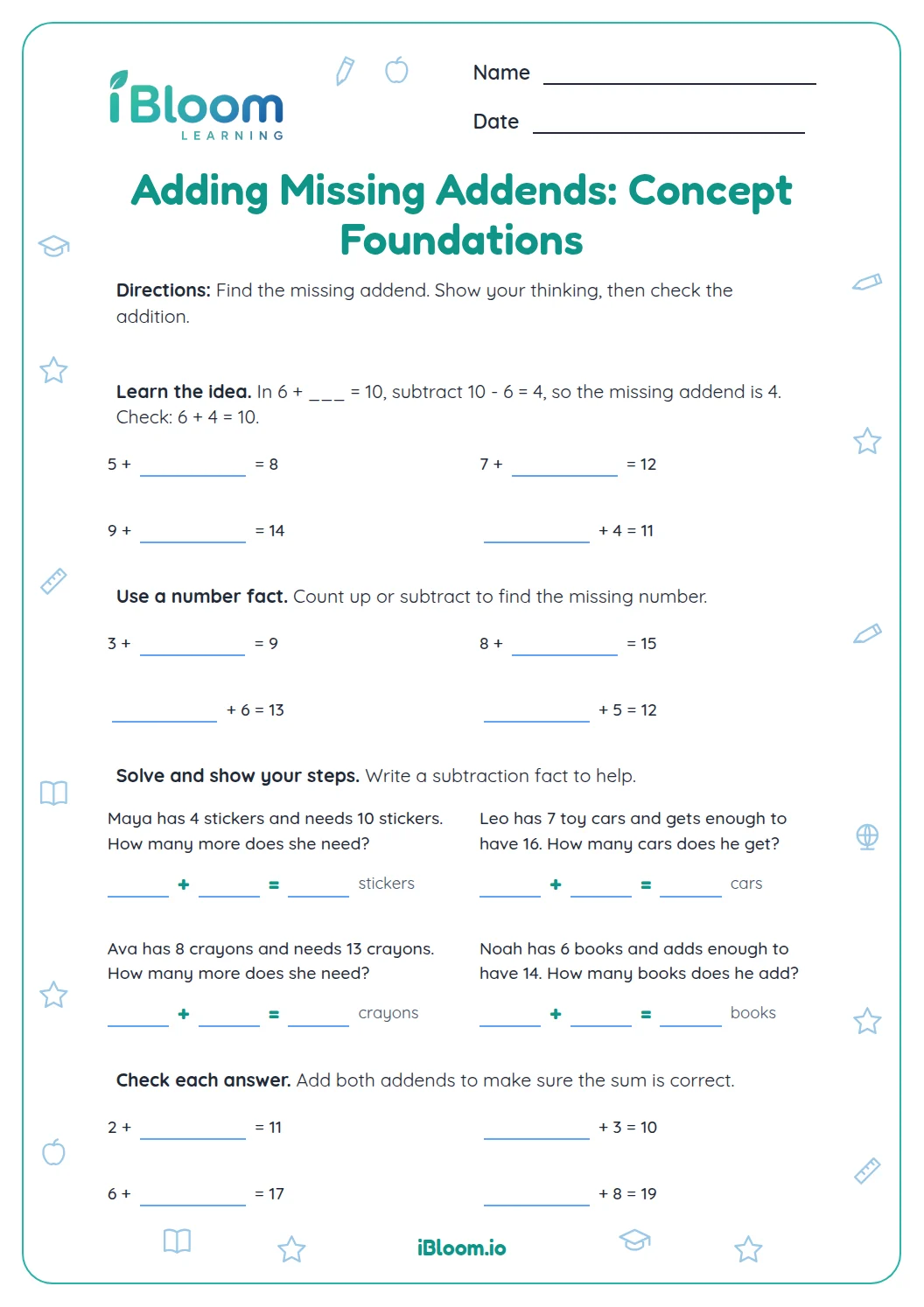
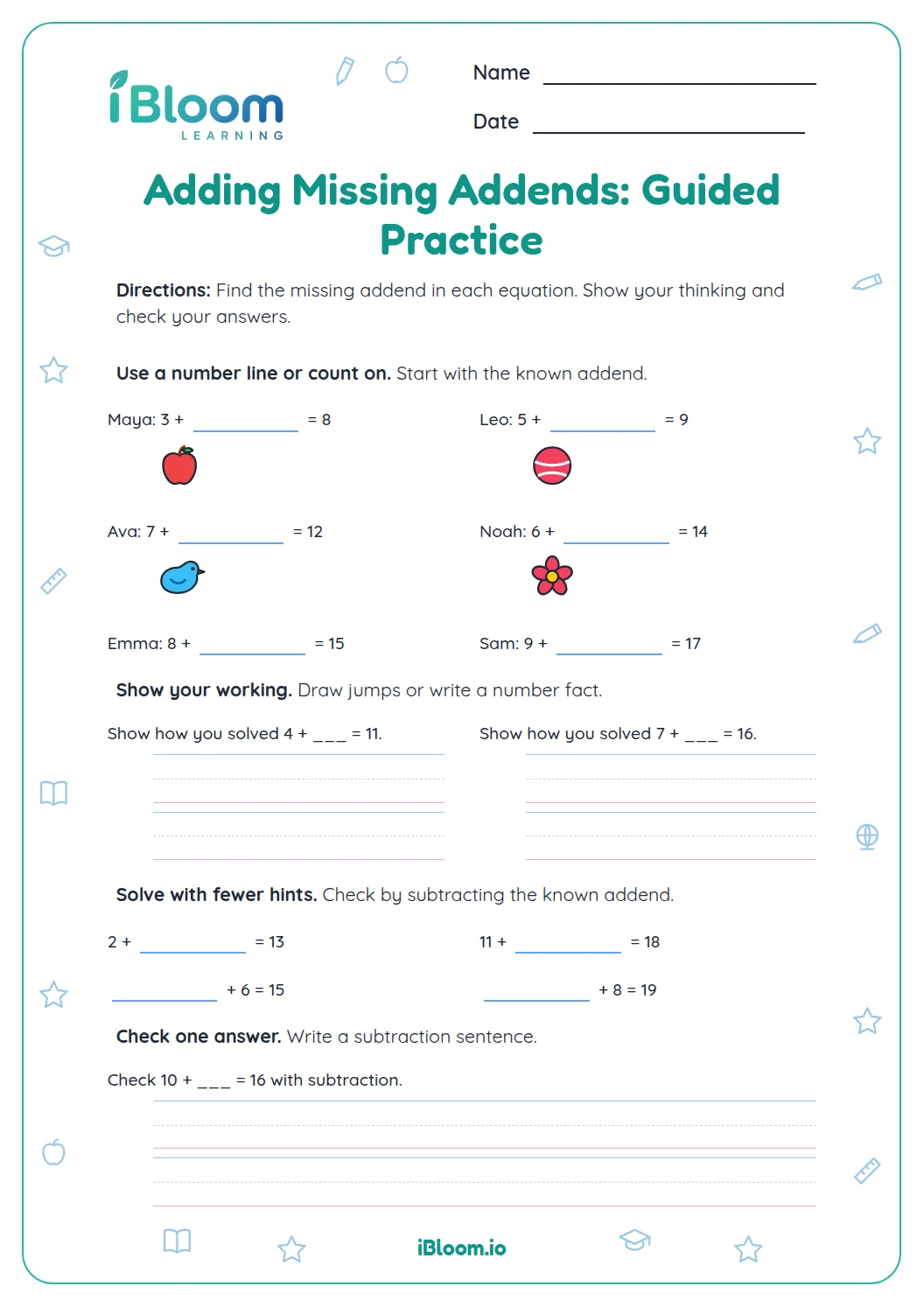
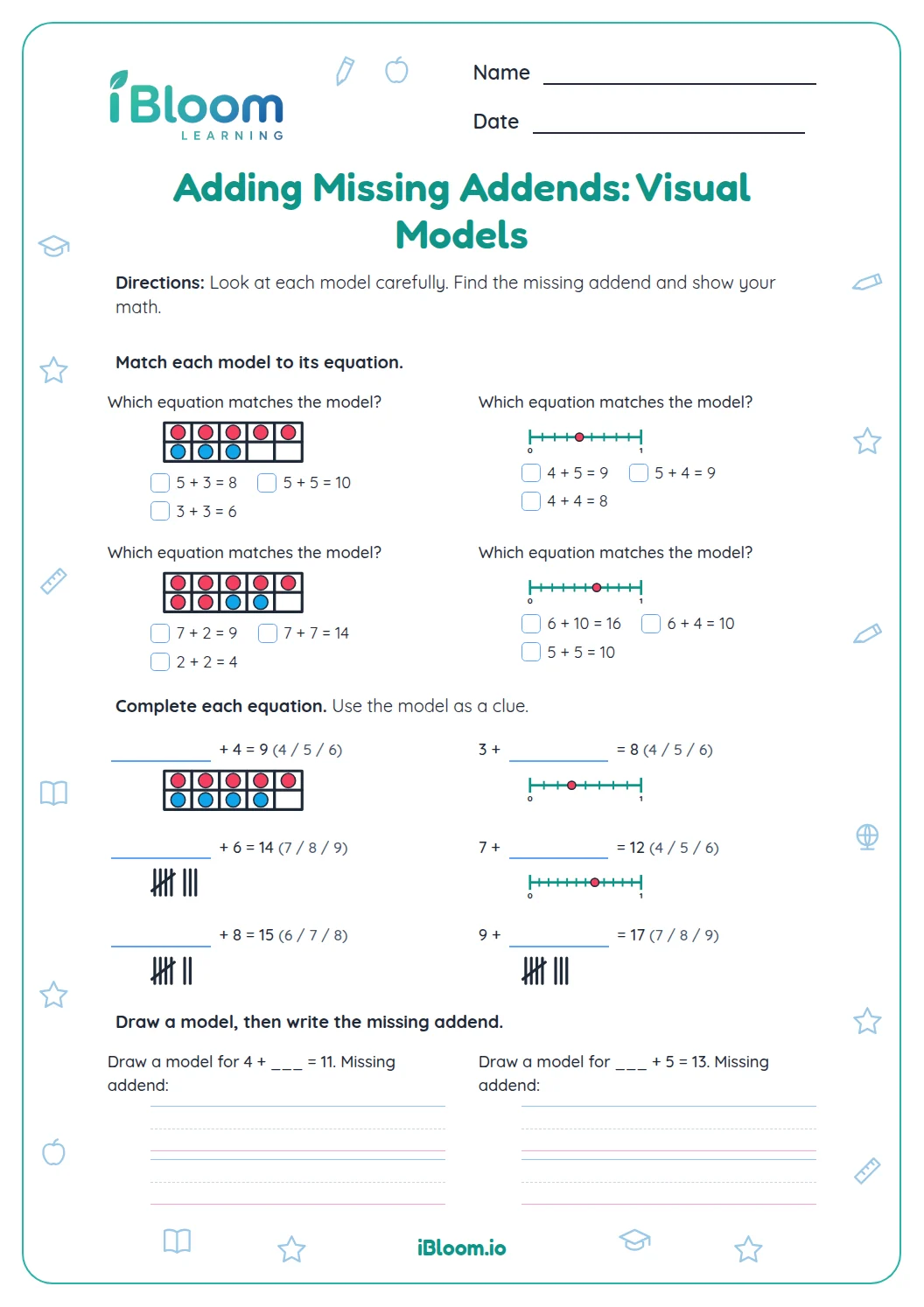
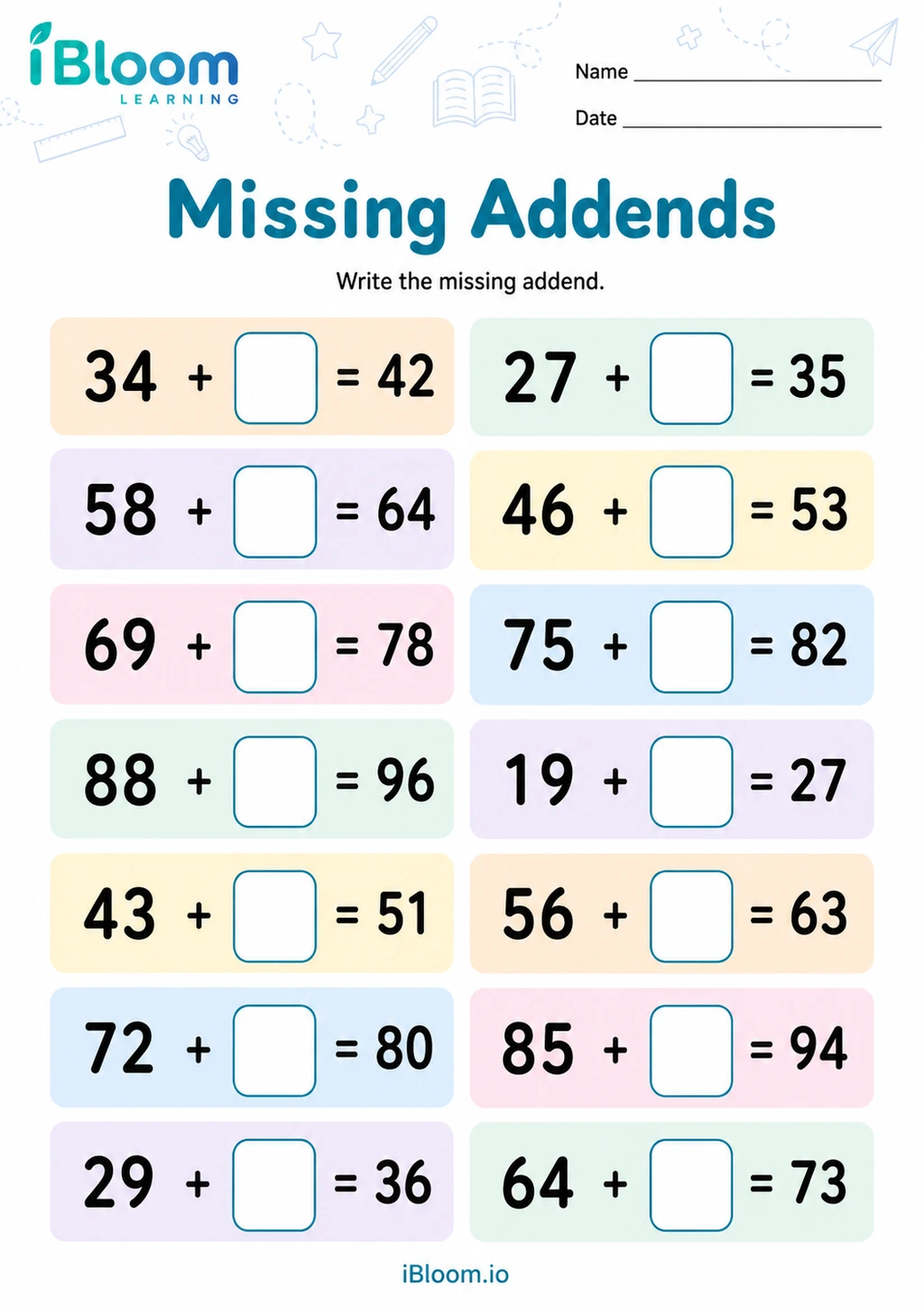
About this worksheet
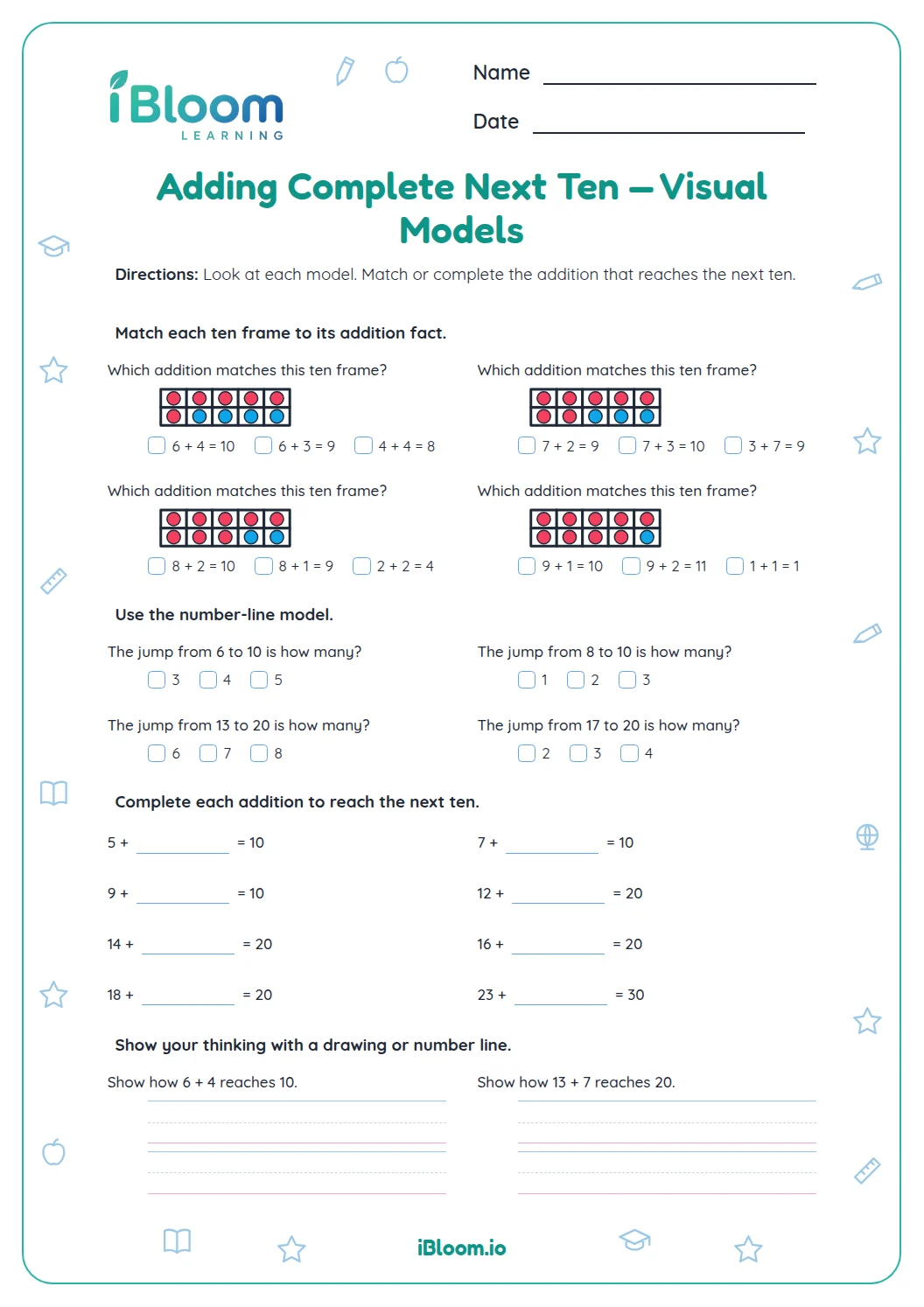
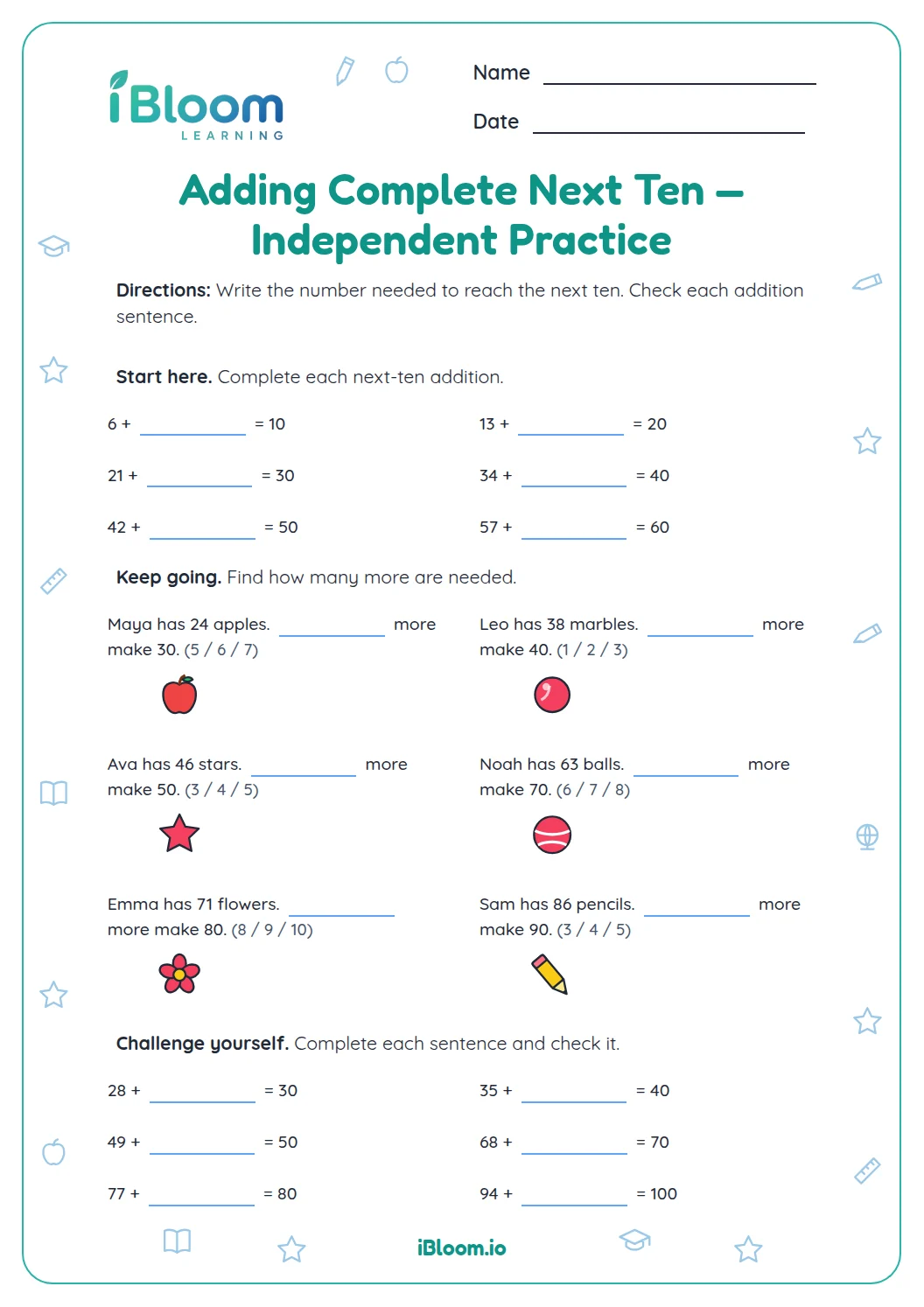
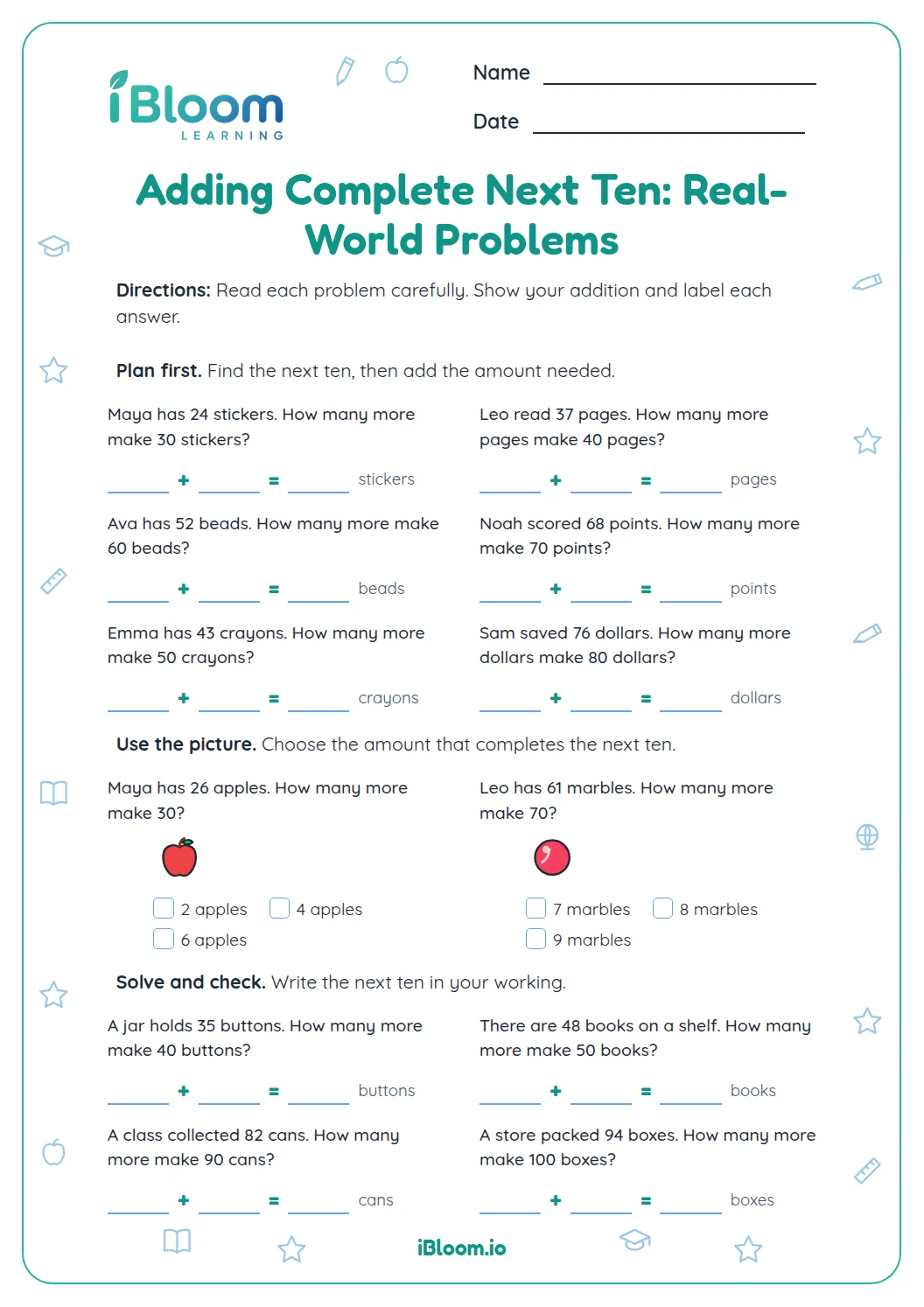
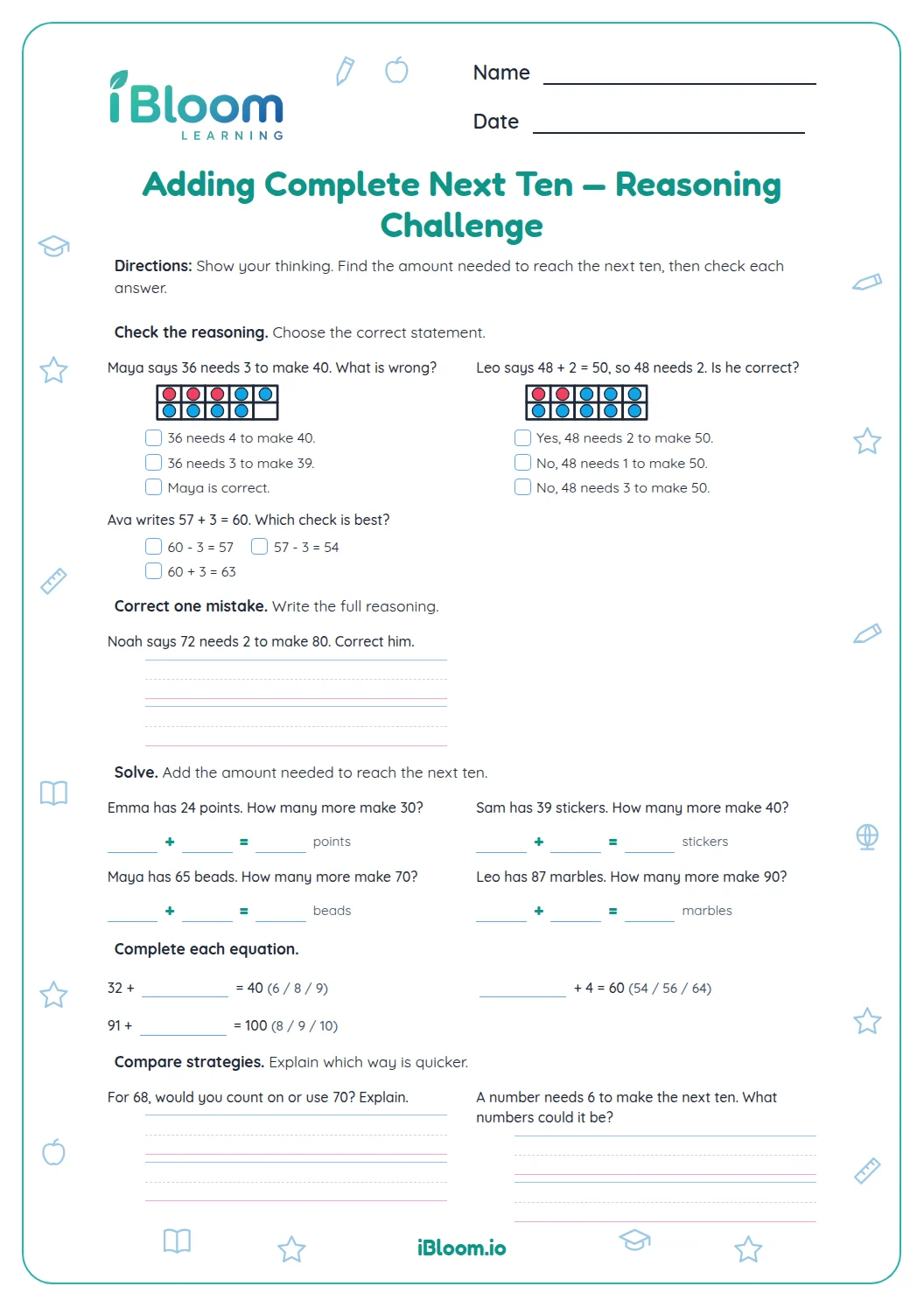
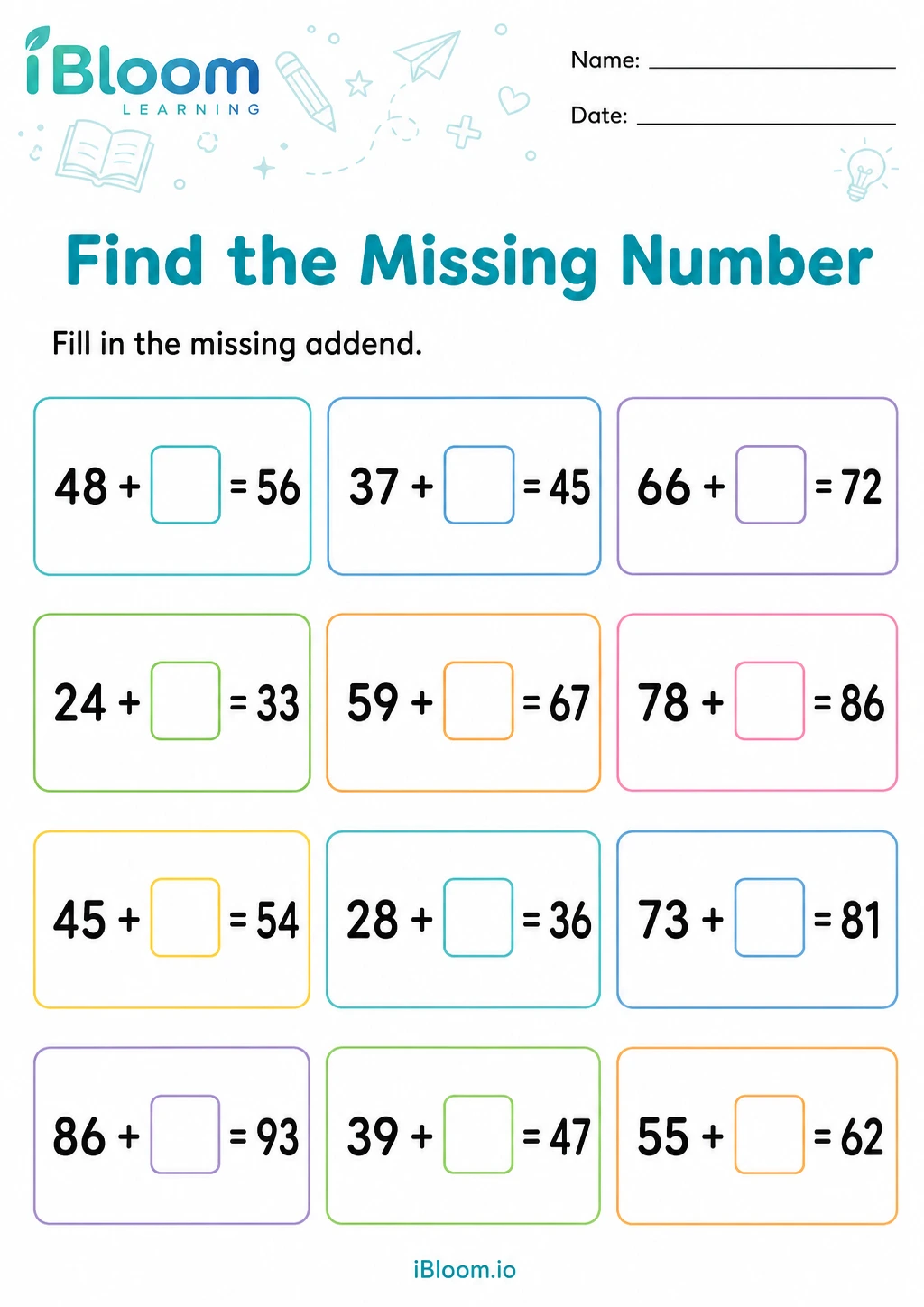
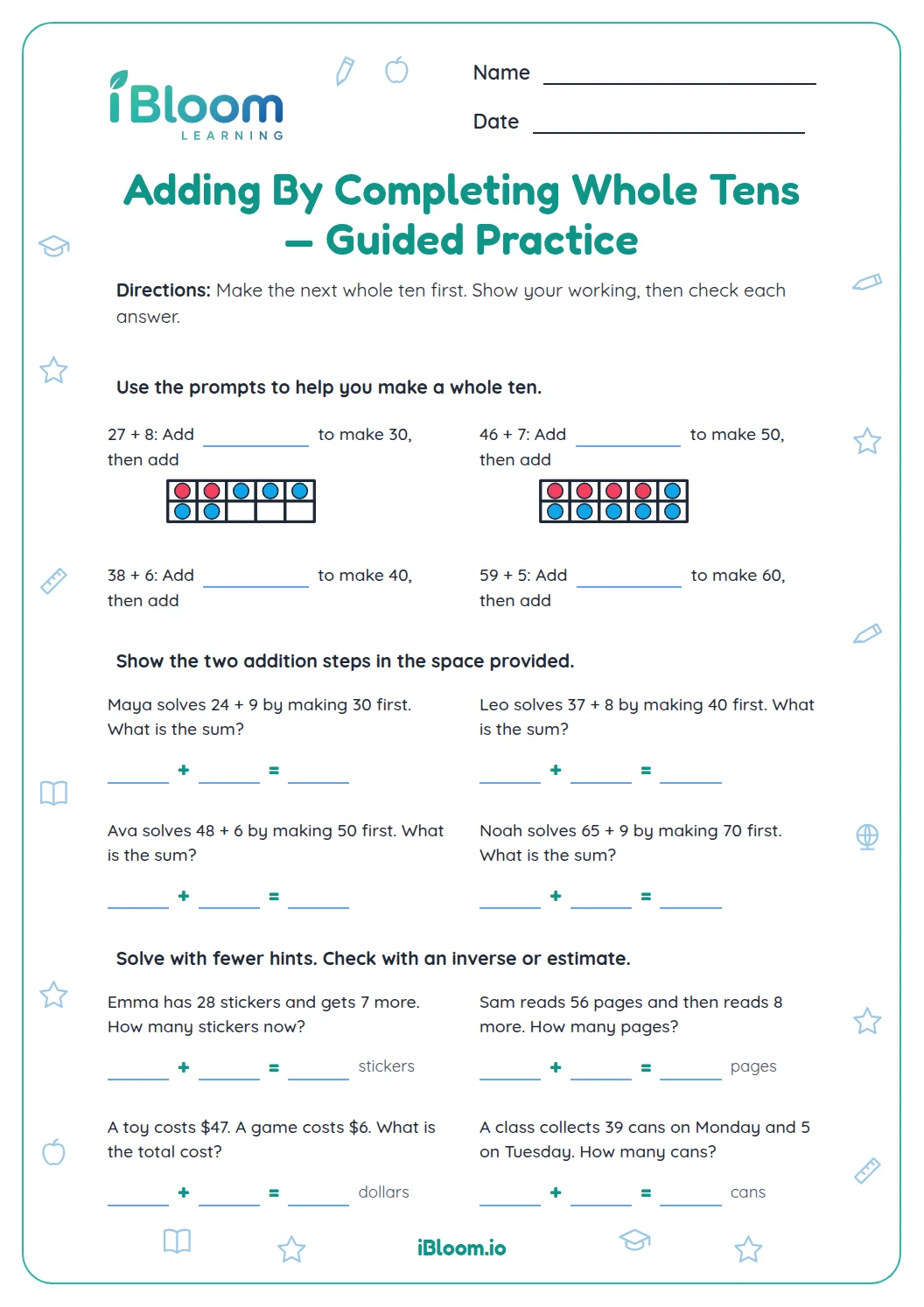
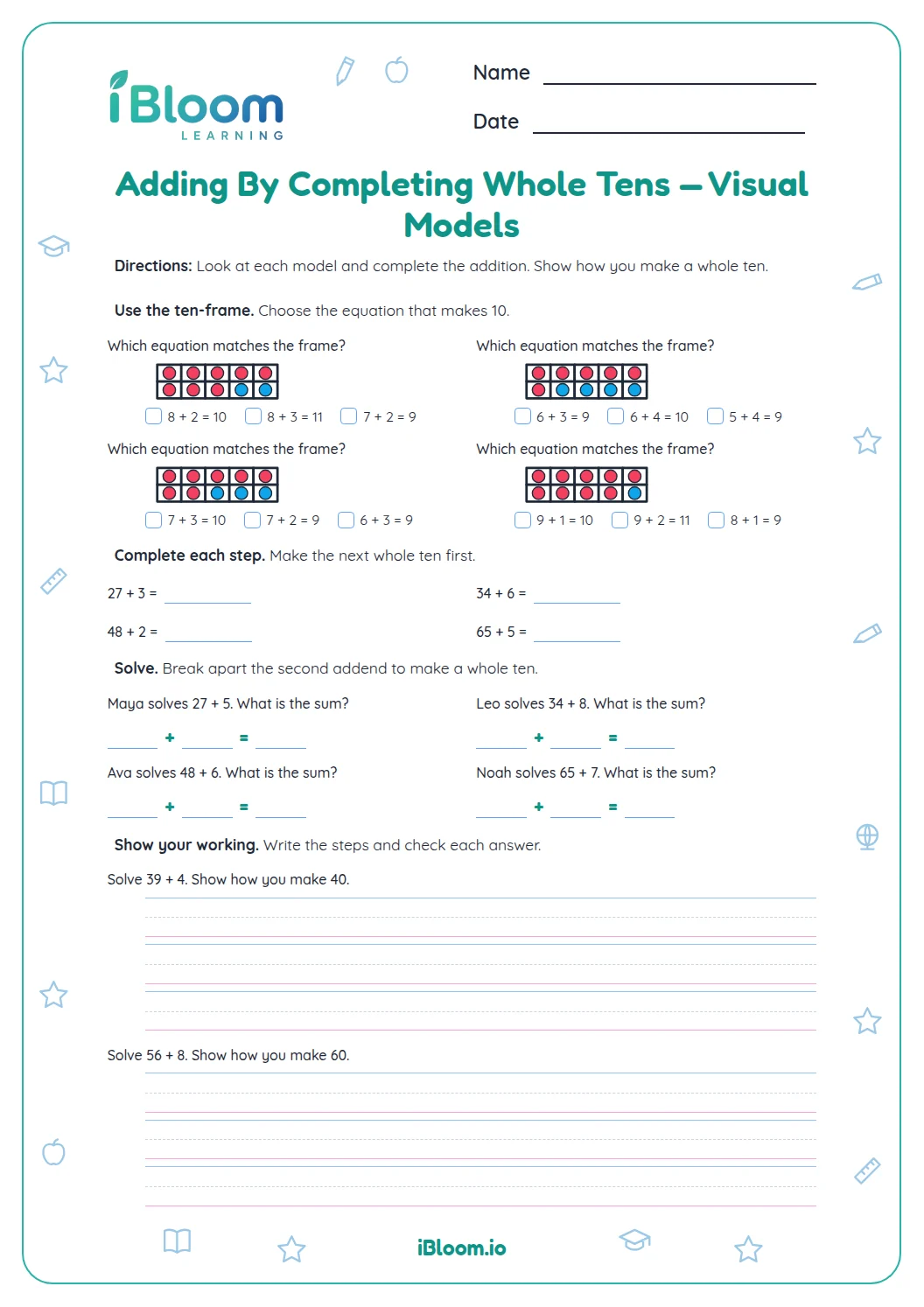
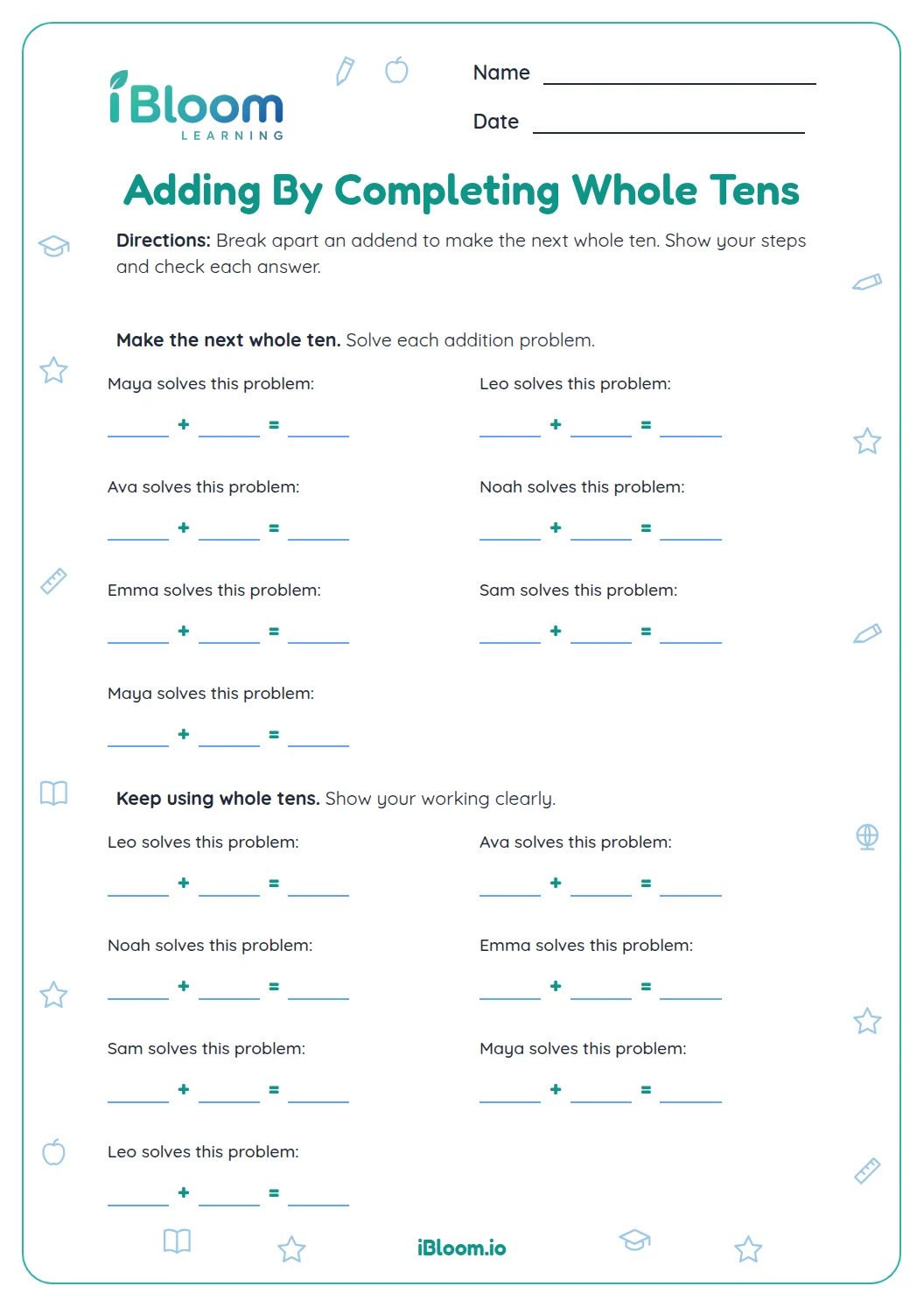
This free Grade 2 worksheet develops the idea of adding just enough ones to reach the next ten. Four ten-frame questions make the empty spaces visible, six number sentences carry that pattern into larger two-digit numbers, and two short stories apply it to supplies. Students solve 12 questions using place value and addition within 100, supporting Common Core 2.NBT.B.5. The separate answer key makes it easy to check whether a child found the amount to add or accidentally wrote the total.
Aligned to 2.NBT.B.5
What do the empty ten-frame spaces tell us?
Each frame has ten spaces. In Part A, students find how many spaces still need counters. The first two questions complete 10; the next two complete 20 using two frames. Ask children to connect each empty space with one more unit being added.
How does the same idea work with 26 or 73?
Focus on the ones. In 26, the two tens stay together while six ones need four more to make another ten. The result is three tens, or 30. Question 6 uses the same fact with 46, showing why the amount needed depends on the ones digit.
- 126 + ___ = 30
- 226 has 2 tens and 6 ones.
- 36 + 4 = 10, making one more ten.
- 426 + 4 = 30.
What should students write for the supply stories?
Part C asks how many more items are needed. For the 37 pencils, the answer is 3 pencils, not 40 pencils. Students can write 37 + 3 = 40 in the working space, then place the missing amount with its unit in the answer box.
After checking the sheet, say a new number ending in 6 and ask how many more make the next ten. Let the child explain why the same fact still works.
How to work through this sheet
- 1Point to a full row of five and a full frame of ten.
- 2Use question 1 to count empty spaces and fill the blank.
- 3For two frames, keep the full ten and complete the second frame.
- 4Compare 26 and 46 in Part B; name the shared ones fact.
- 5Write addition equations for the two stories and check the missing amounts.
Mistakes to notice and how to help
The mistake
Writing the target total in the blank.
The fix
Read the whole equation with the answer inserted and ask whether it is true.
The mistake
Counting the starting number as the first step.
The fix
For 26, start counting additions at 27; four steps reach 30.
The mistake
Adding ten instead of completing the next ten.
The fix
Focus on the empty spaces or the ones digit: 26 needs 4, while 26 + 10 is 36.
Common Core alignment
Use ones and tens to find missing addends within 100.
On this sheet: Students complete the next multiple of ten using frames, place value, and mental addition.
Show the official wordingHide the official wording
Fluently add and subtract within 100 using strategies based on place value, properties of operations, and/or the relationship between addition and subtraction.
What to practice next
Make more practice
Further reading
Questions parents and teachers ask
What does the next ten mean on this worksheet?
The next ten is the next larger number ending in zero. For 26 it is 30, and for 73 it is 80. Each question gives that target, so children can focus on the amount needed to reach it rather than choosing a target themselves.
How should a child use the ten frames?
Have the child count the empty spaces in the frames. Each empty space represents one more counter needed to reach 10 or 20. Then read the matching number sentence aloud. This connects a visible gap with the missing addend written in the blank.
Why do 26 and 46 need the same amount added?
Both numbers have six ones, so both need four more ones to make another ten. Their tens digits are different, but the six-plus-four fact stays the same. Questions 5 and 6 place this pair together so children can notice and explain the pattern.
Should children count on or use a known fact?
Either approach works for these questions. A child can count 27, 28, 29, 30 while keeping track of four steps, or recall that six and four make ten. After counting, connect the result to the ones fact so the strategy becomes easier to reuse.
How can I use the answer key to discuss an error?
Compare the missing amount with the total given in the question. If a child writes 40 for the pencil story, ask how many pencils must be added to 37. Use the equation 37 + 3 = 40 to distinguish the amount added from the final total.