
About this worksheet
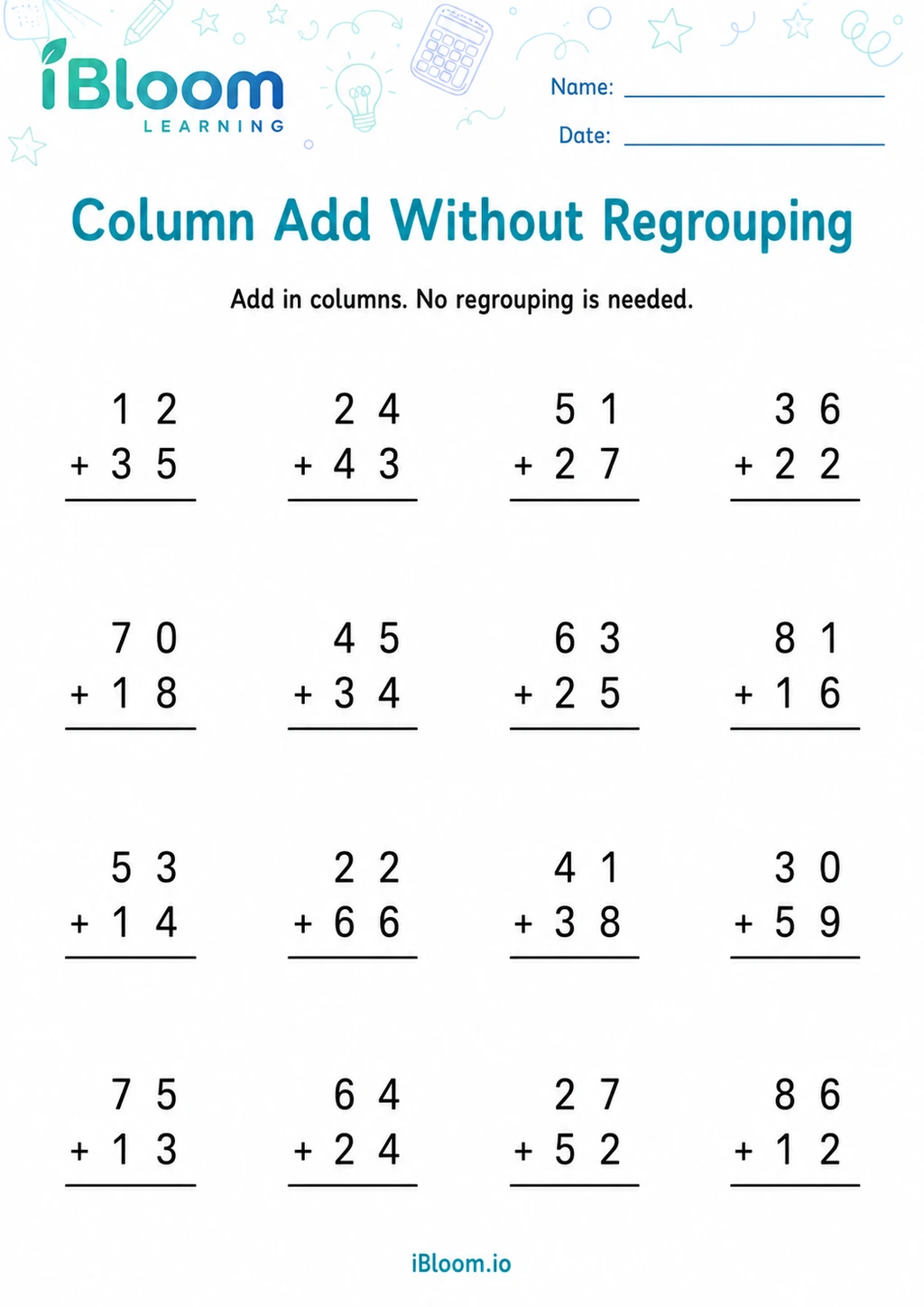
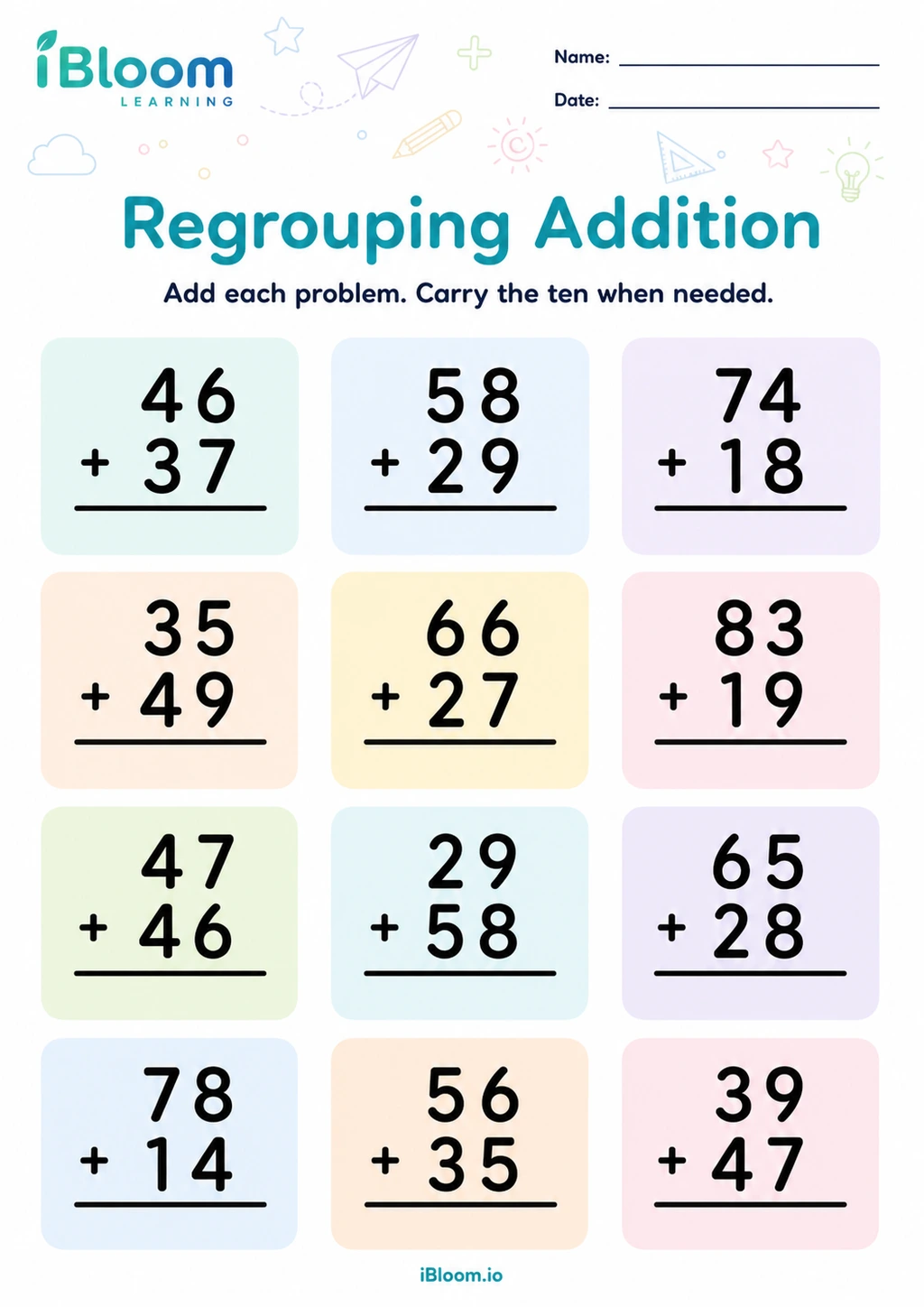
This two-page Grade 2 addition worksheet practices completing the next ten and adding on within 100. Learners start with a ten-frame, find missing amounts, add after making a ten, and solve short stories. A final error check connects place value to addition. The page aligns with CCSS 2.NBT.B.5, adding within 100 using place-value strategies.
Aligned to 2.NBT.B.5
How do you complete the next ten?
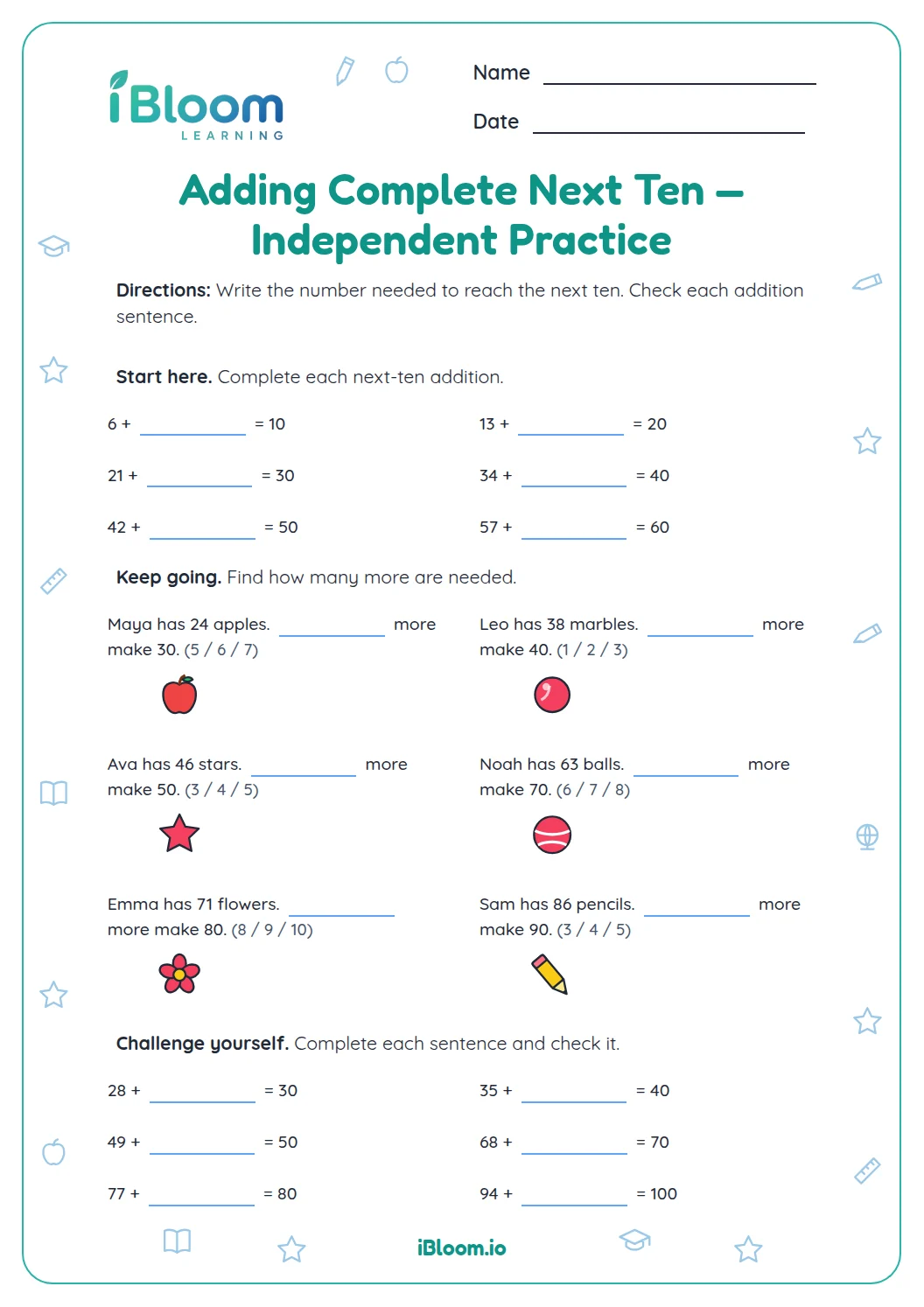
Find how many ones bring the number to the next multiple of ten. For 29, one more makes 30. That small jump is the bridge used in later sums.
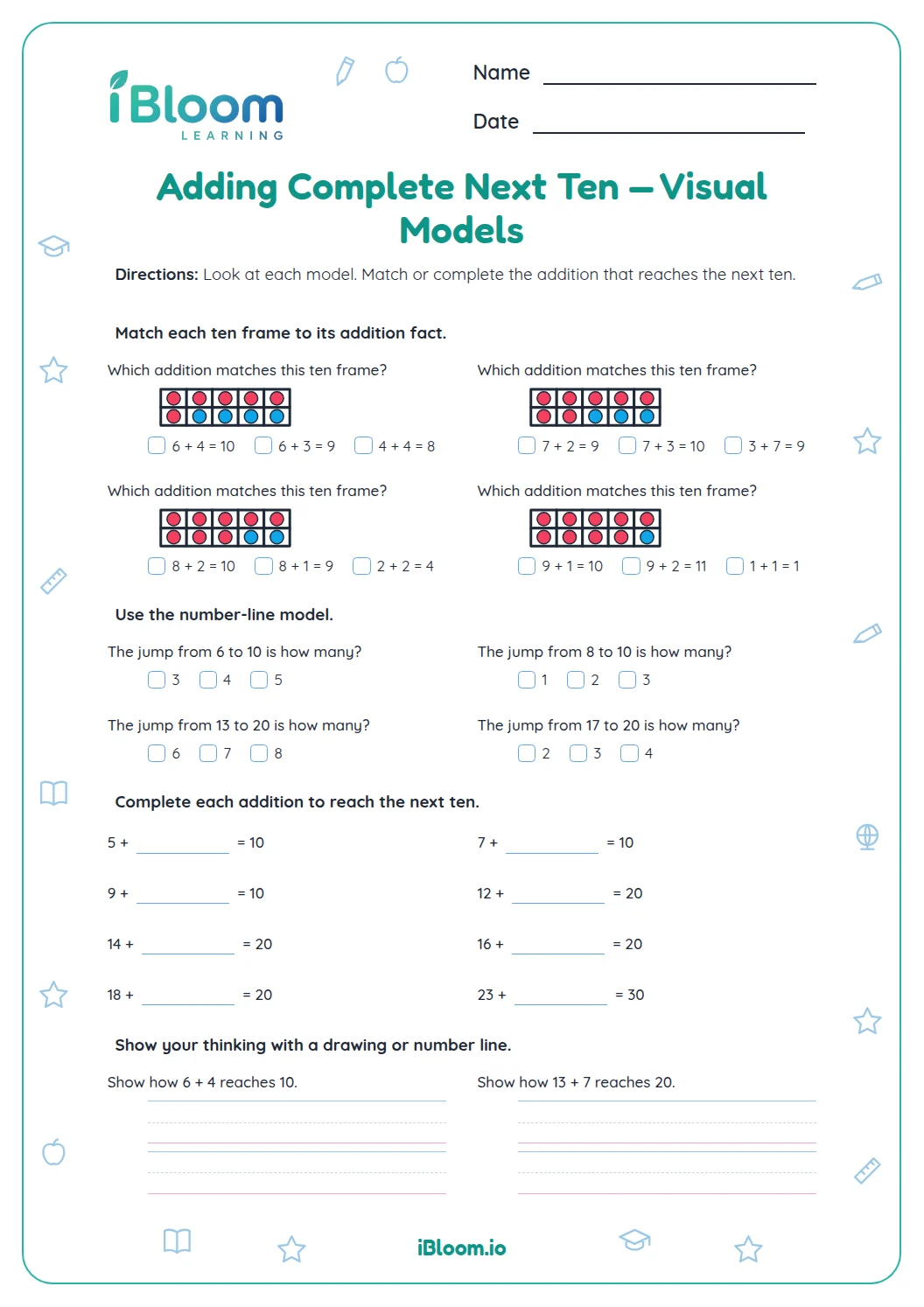
The worksheet opens with a ten-frame showing seven counters, then moves to missing amounts and addition sentences.
- 147 + 3 + 5
- 247 + 3 makes 50.
- 3Add the 5 that remains: 50 + 5 = 55.
How does the strategy work in a story?
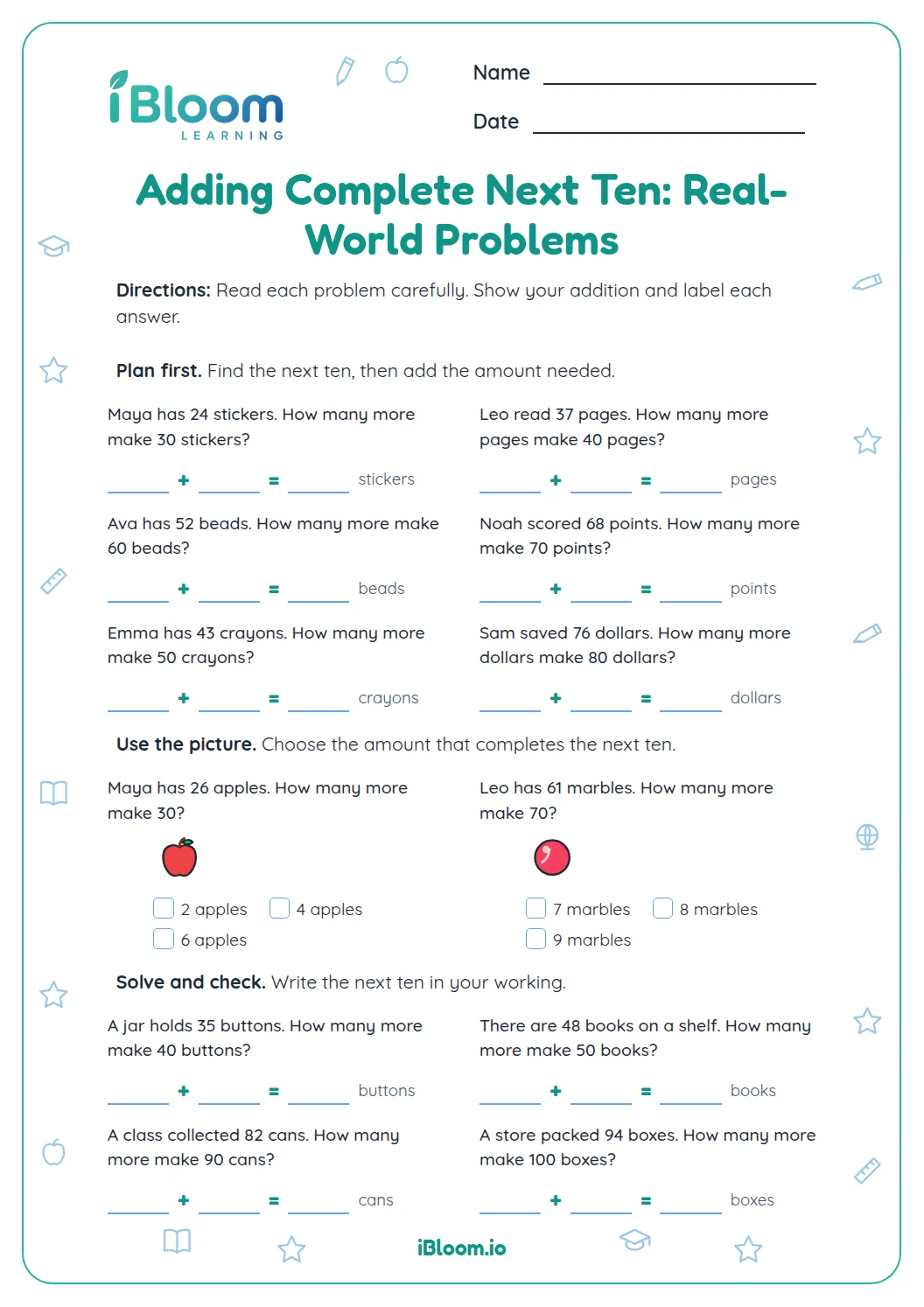
In the bead story, 38 + 7 can be split into 38 + 2 + 5. The first 2 make 40; adding the remaining 5 gives 45. The situation supplies the same numbers as the computation.
How can a learner check an addition answer?
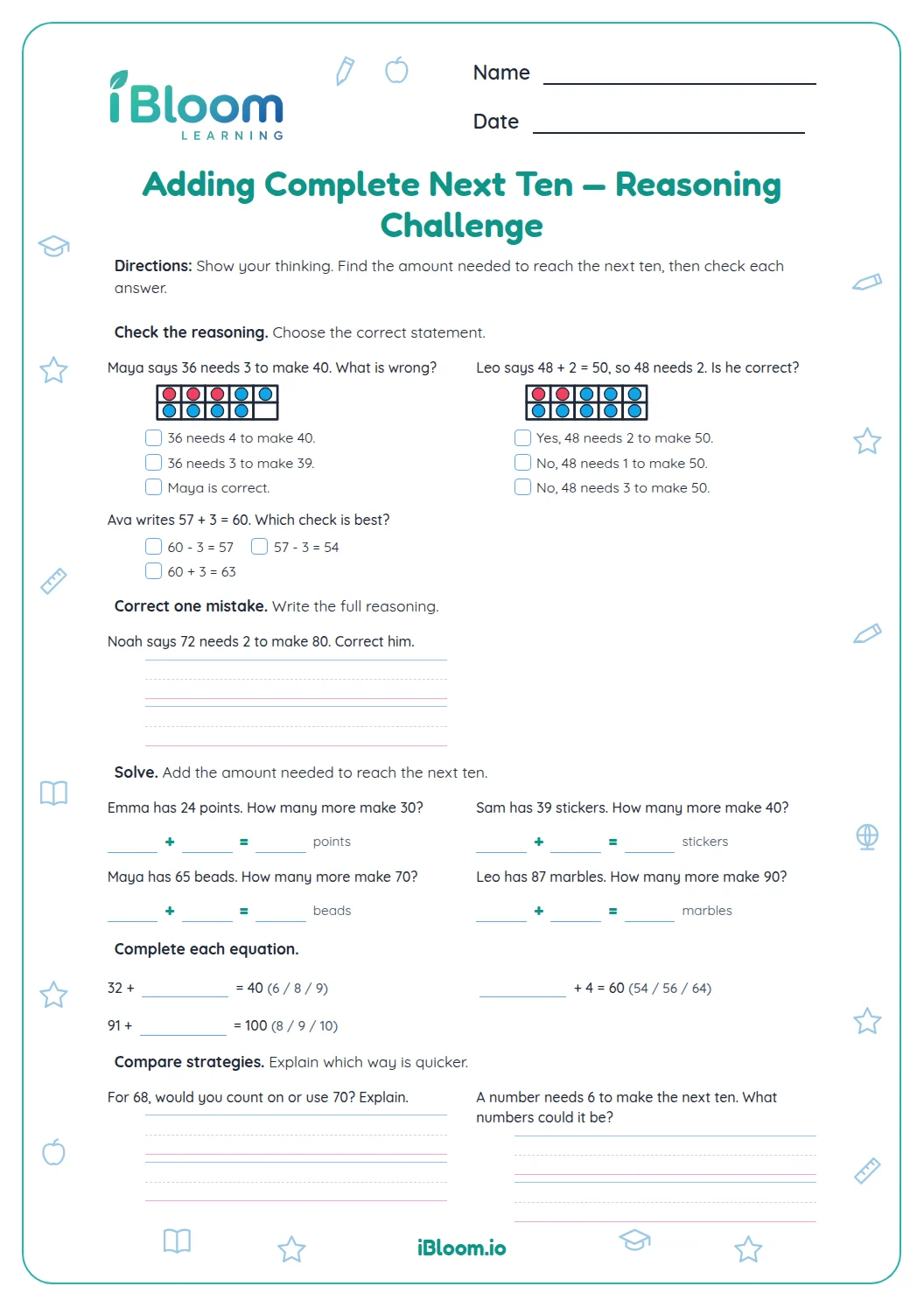
Use subtraction to check a sum or estimate whether it is close to a sensible ten. In the final question, 68 + 5 is 73; writing 613 treats 13 ones as if they could stay in the ones place.
How to use this worksheet
- 1Use the ten-frame to find how many counters are needed to reach ten.
- 2For each missing amount, subtract the starting number from the target ten.
- 3In a three-addend sum, split the addends to make a ten first.
- 4For a story, write the addition sentence before solving.
- 5Check the result with subtraction or an estimate.
Common mistakes and quick fixes
The mistake
Writing 13 in the ones place when 8 + 5 = 13.
The fix
Trade 10 ones for 1 ten: 68 + 5 becomes 70 + 3 = 73.
The mistake
Adding all three addends without noticing a ten can be made.
The fix
Use the addend that completes the ten, then add the leftover amount.
The mistake
Giving the difference to the target instead of the missing amount.
The fix
Subtract the starting number from the next ten; for 54 to 60, the gap is 6.
Curriculum alignment
Learners add within 100 by making tens and using place-value relationships.
Add within 100 by making a ten and combining the remaining ones.
On this sheet: The number sentences and stories use addition within 100, including a make-a-ten strategy.
Show the official wordingHide the official wording
Fluently add and subtract within 100 using strategies based on place value, properties of operations, and/or the relationship between addition and subtraction.
What to practice next
Make more practice
Further reading
Questions parents and teachers ask
What does “complete the next ten” mean?
It means adding enough ones to reach the next multiple of ten. For example, 54 needs 6 to reach 60. The worksheet begins with that idea before using it in larger addition sentences. The ten-frame uses seven counters, leaving three spaces to fill.
How does a ten-frame help?
A ten-frame makes the empty spaces easy to count. With seven counters, three spaces remain, so three more counters complete ten. The first worksheet problem uses this visual model. Each missing amount is the distance from its starting number to the next ten.
How can I solve 47 + 3 + 5?
First add 3 to 47 to make 50. Then add the remaining 5, giving 55. This is the make-a-ten strategy used in the middle part of the worksheet. The first story uses 38 and 7, which bridge through 40 to 45.
How many questions and pages are included?
There are 14 questions in four parts, spread over two worksheet pages. The set has two worksheet pages and two answer-key pages. The answer key takes two pages because it shows the completed practice clearly. The answer key includes every intermediate and final amount.
What is the error in 68 + 5 = 613?
The 8 ones plus 5 ones make 13 ones, which must be regrouped as 1 ten and 3 ones. The sum is 73. Question 14 asks the learner to correct this place-value mistake. The correct sum keeps the three remaining ones after regrouping one ten.