




About this worksheet
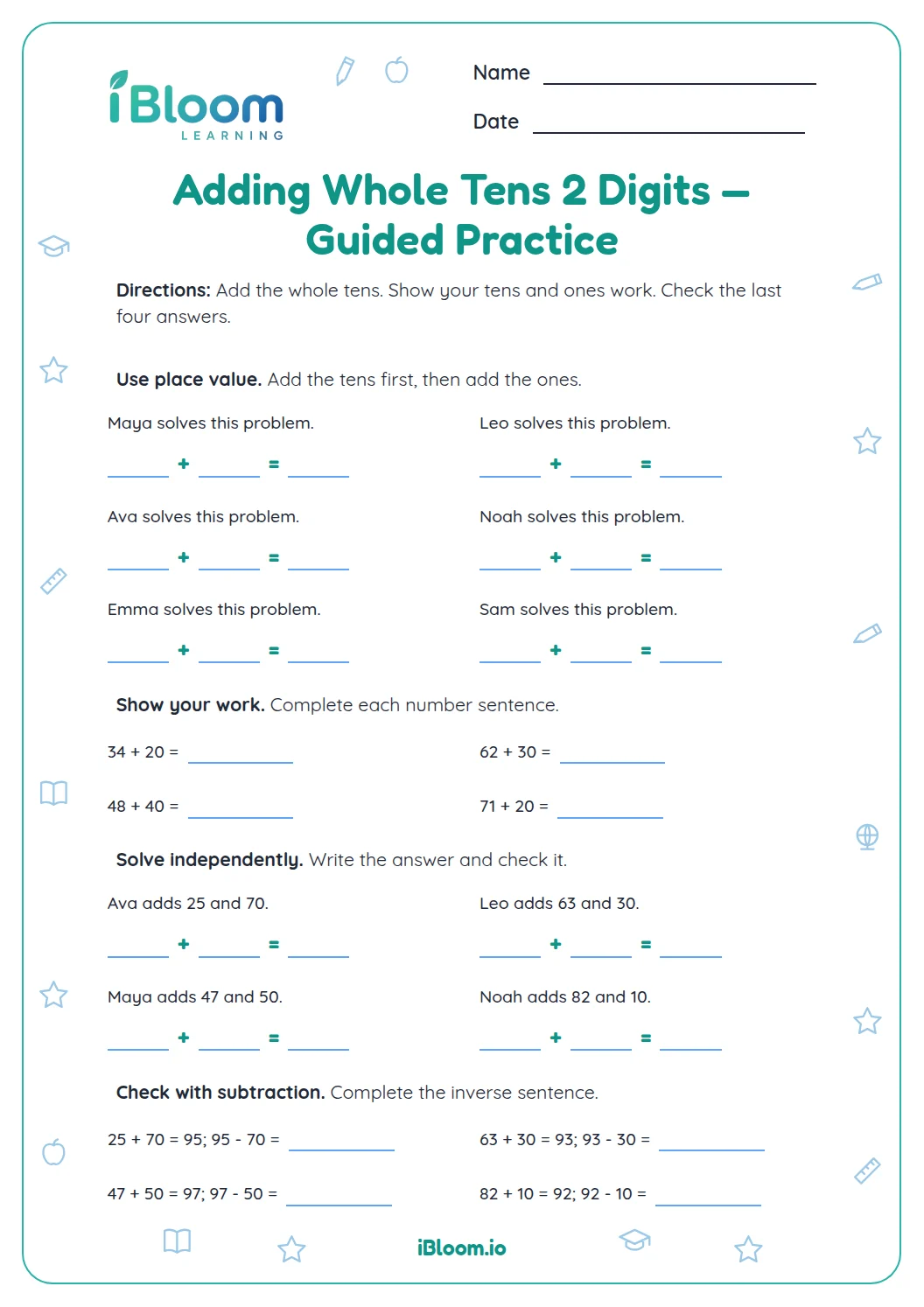
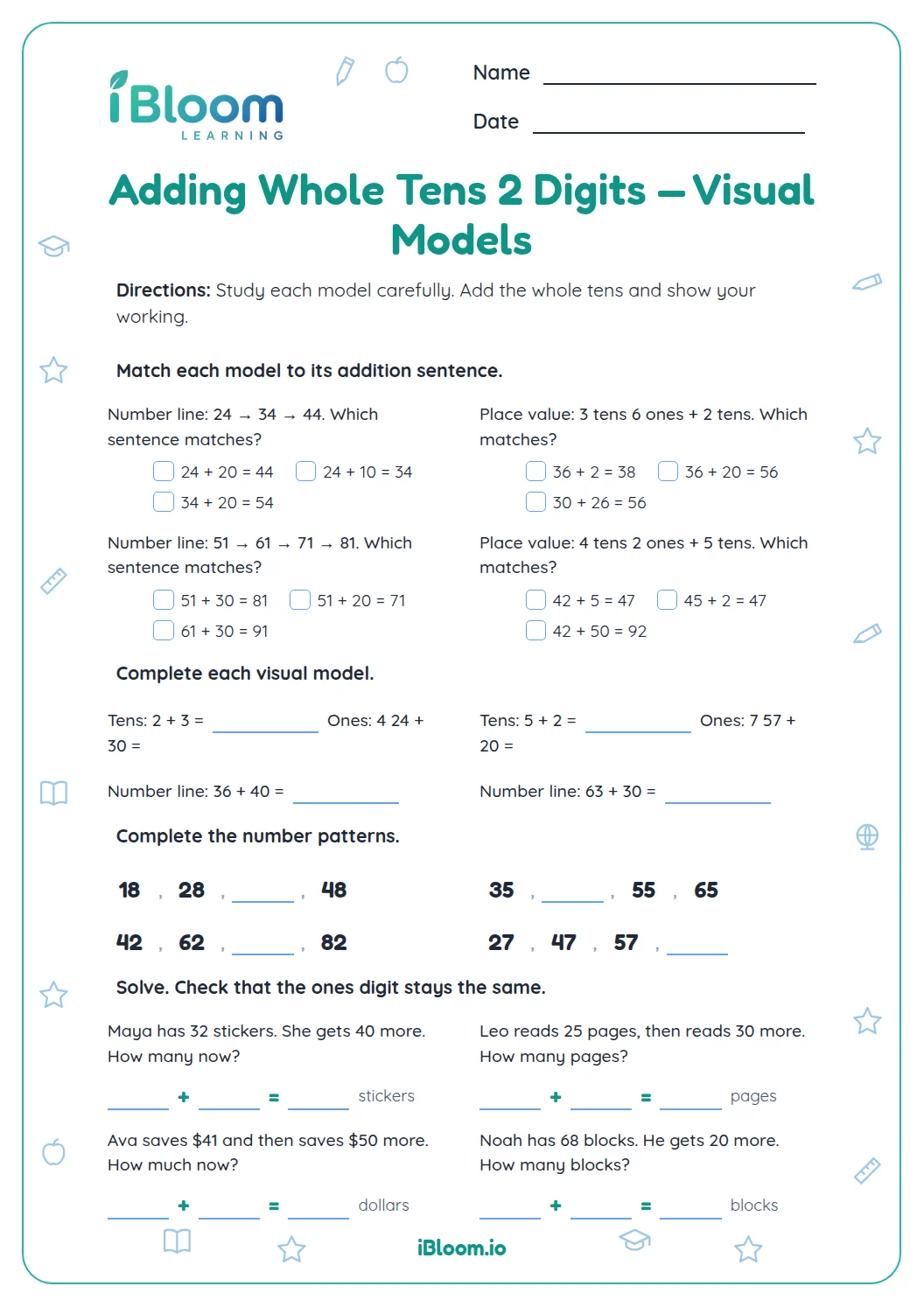
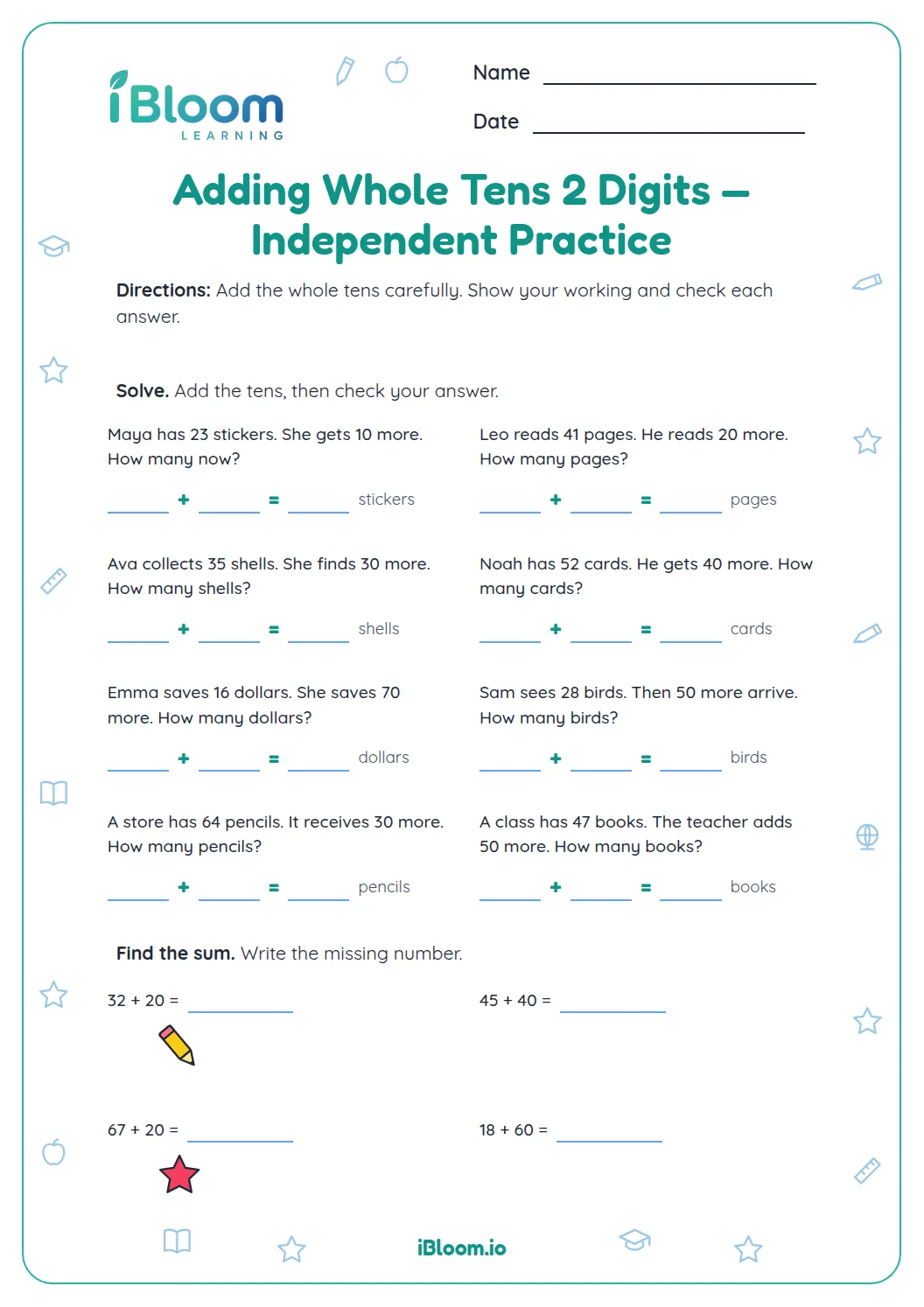
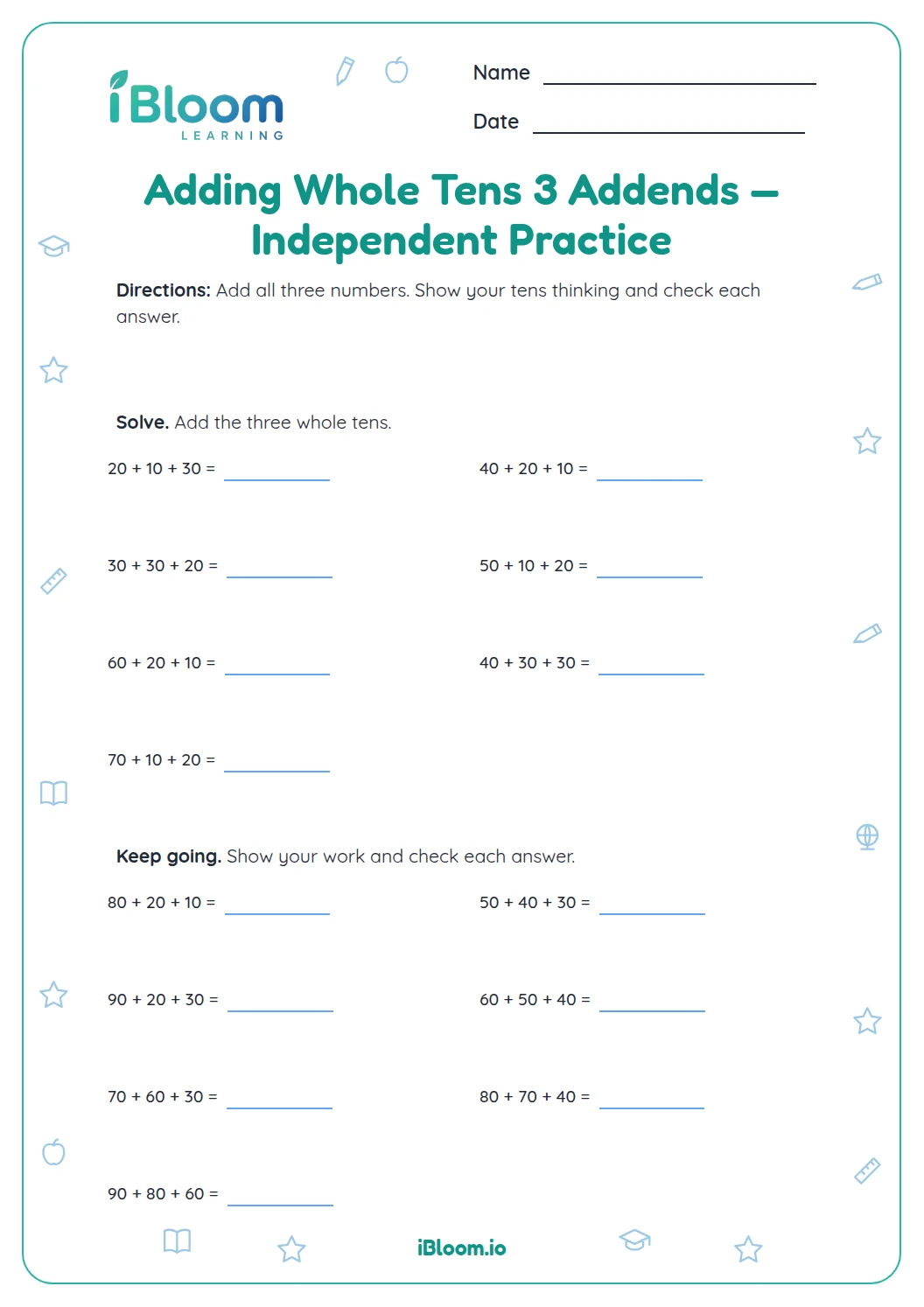
This Grade 2 concept-foundations worksheet shows how to add a whole-ten amount to two one-digit numbers. Children use two number bonds to combine the ones first, then practice number sentences and short story questions. Some ones totals compose a new ten. The page practices addition within 100 and sums of two one-digit numbers, aligned with Common Core 2.NBT.B.5 and 2.OA.B.2. A separate key lists the answers.
Aligned to 2.NBT.B.5 and 2.OA.B.2
What does the number bond show?
The bonds group the two one-digit addends together. In question 1, 2 and 3 make 5; then 20 and 5 make 25. Question 2 shows a one-digit sum that composes a ten.
When do the ones make a new ten?
If the two one-digit addends total 10 or more, compose a ten and keep the leftover ones. For example, 8 + 5 makes 13, so 30 + 8 + 5 is 43.
How do stories use the same idea?
The last four questions describe a starting amount in tens and two smaller groups. Children can write all three amounts in an addition sentence, combine the one-digit groups, then add to the tens.
How to use this worksheet at home or in class
- 1Look at the two parts in the number bond.
- 2Add those one-digit numbers to find their total.
- 3If their total is at least 10, regroup ten ones as one ten.
- 4Add the resulting amount to the whole tens.
- 5For a story problem, identify the starting tens and both single-digit groups.
Common mistakes and quick fixes
The mistake
Adding only the two one-digit numbers and stopping.
The fix
After finding that sum, combine it with the whole tens shown in the problem.
The mistake
Forgetting to regroup when the ones total is 10 or more.
The fix
Mark the new ten, then add it to the whole-ten amount.
The mistake
Adding the whole tens to only one of the small groups.
The fix
Use the number bond to combine both small groups before adding the tens.
Common Core alignment
This worksheet links addition facts within 20 with place-value addition within 100.
Use place value strategies to add the three amounts within 100.
On this sheet: The page combines a whole-ten amount with two one-digit addends, including ones that compose a ten.
Show the official wordingHide the official wording
Fluently add and subtract within 100 using strategies based on place value, properties of operations, and/or the relationship between addition and subtraction.
Add the one-digit amounts fluently before combining them with tens.
On this sheet: Each item first requires a sum of two one-digit numbers, then combines that sum with whole tens.
Show the official wordingHide the official wording
Fluently add and subtract within 20 using mental strategies. By end of Grade 2, know from memory all sums of two one-digit numbers.
What to practice next
Make more practice
Further reading
Questions parents and teachers ask
What is a whole ten?
A whole ten is a number such as 20, 30, or 70, made of complete groups of ten. In this worksheet, children add that amount to two one-digit numbers, such as 20 + 2 + 3. The number bond groups the one-digit parts together first.
Why add the two small numbers first?
Combining the two one-digit addends makes their total easier to see. The number bond provides a quick model; after finding the whole in the bond, the child combines it with the whole tens. If the small numbers make 10 or more, a new ten is composed.
How many examples use number bonds?
Two questions use number bonds, followed by eight number sentences and four story problems. The bonds group the one-digit addends first. Some later sums make a new ten, and the story section asks children to use the same addition structure without a number-bond drawing.
What is the answer to 20 + 8 + 5?
For 20 + 8 + 5, the answer is 33. First, 8 + 5 makes 13, or one ten and 3 ones. Combine that extra ten with 20 to make 30, then add the remaining 3 ones. This shows how the one-digit parts can be grouped before adding the whole tens.
What does the answer key include?
The separate answer key lists a total for all 14 questions. For story questions, it gives the number of objects or seats after adding all three amounts. Children can use their own equations or drawings to show how they combined the one-digit groups and whole tens.