


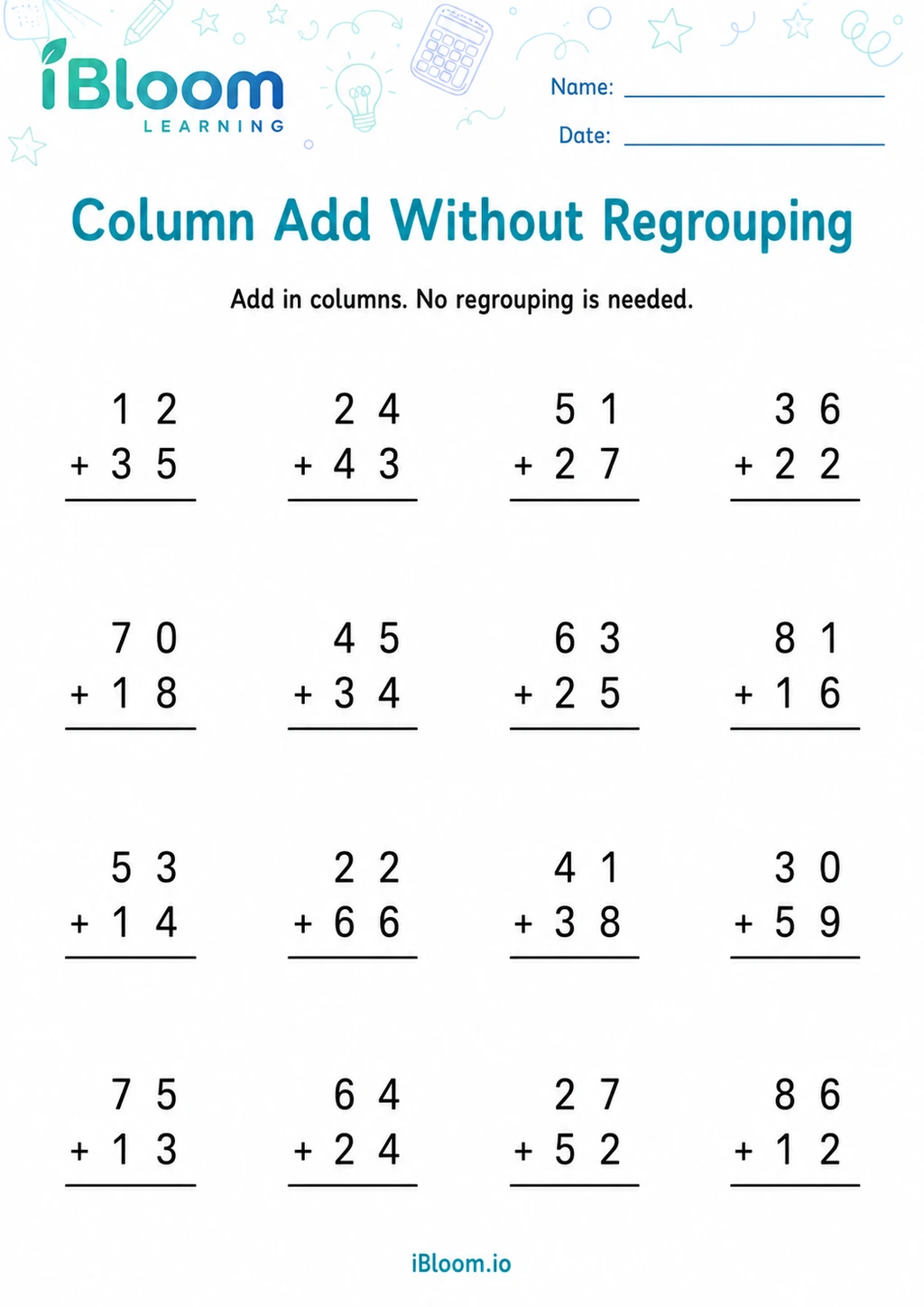
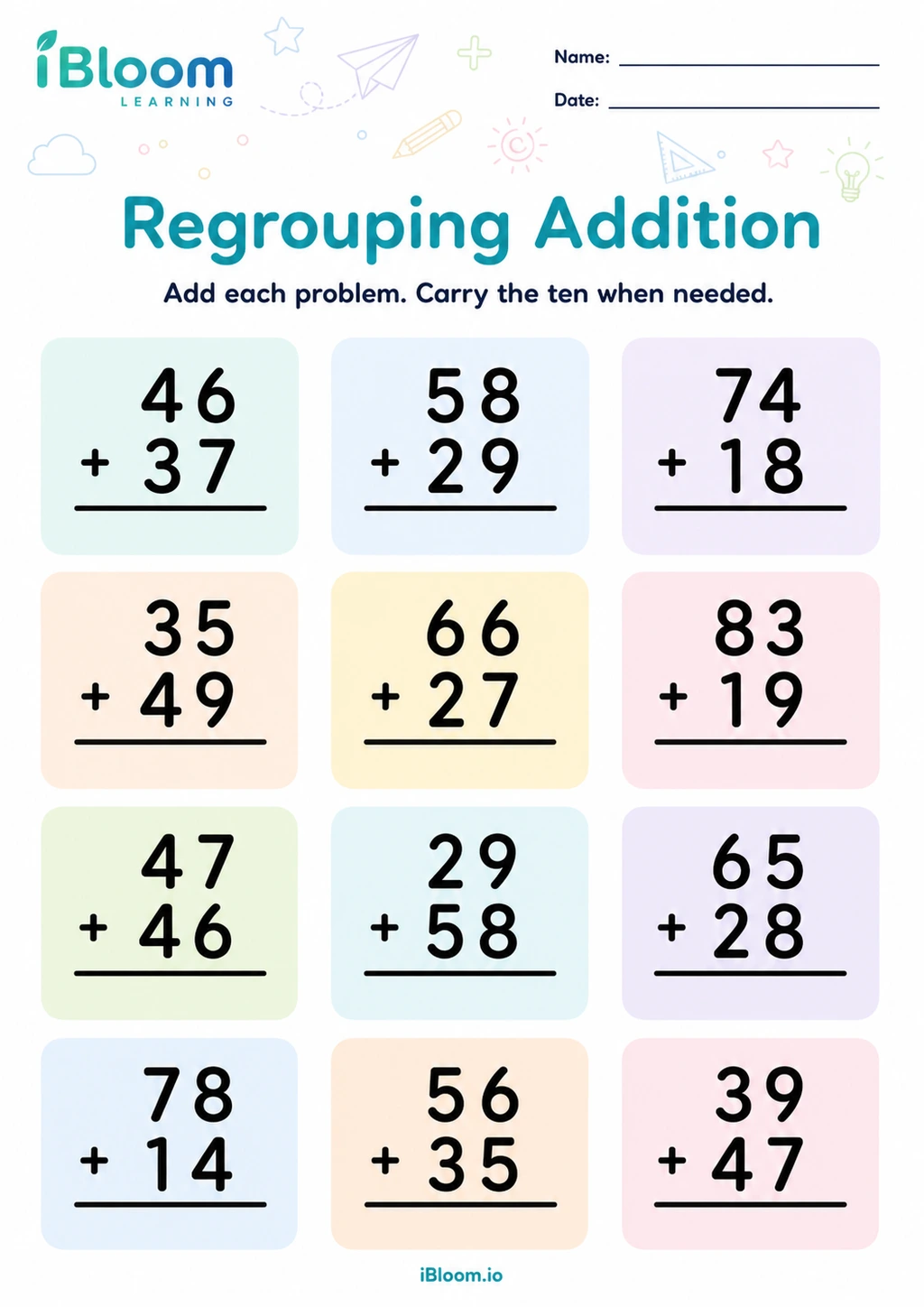
About this worksheet
Use base-ten blocks, number sentences, and short stories to add a whole ten and two one-digit addends. The sheet has 14 questions and a separate answer key. CCSS 2.NBT.B.5.
Aligned to 2.NBT.B.5
What is the main move in adding whole tens to one-digit numbers?
Use base-ten blocks, number sentences, and short stories to add a whole ten and two one-digit addends. The sheet has 14 questions and a separate answer key. CCSS 2.NBT.B.5.
How does one problem work from start to finish?
Question 2 adds 5 ones to 30. The drawing has three tens rods; adding five ones gives 35.
- 1Question 2: 30 + 2 + 5
- 230 + 7 = 37
How can students check each result?
Name the value of each tens rod. Read the one-digit addend as ones. Review the answer key only after completing the calculation.
How to use this worksheet
- 1Name the value of each tens rod.
- 2Read the one-digit addend as ones.
- 3Combine the tens and ones to form the total.
- 4For a number sentence, count on from the whole ten.
Common mistakes and quick fixes
The mistake
Treating each tens rod as one: reading three rods as 3 instead of 30.
The fix
Fix: Say “three tens is 30” before adding ones.
The mistake
Adding the digits and writing 8 for 30 + 8.
The fix
Fix: Keep the tens digit and write 8 in the ones place: 38.
The mistake
Changing the tens value while adding a one-digit number.
The fix
Fix: Check that the total is between the starting ten and the next ten.
Common Core alignment
This page connects the printed practice to the following Common Core standard.
Add within 100 by using place-value strategies and properties.
On this sheet:
Show the official wordingHide the official wording
Fluently add and subtract within 100 using strategies based on place value, properties of operations, and/or the relationship between addition and subtraction.
What to practice next
Make more practice
Further reading
Questions parents and teachers ask
What does a tens rod represent?
Each long block represents 10. In question 2, three tens rods stand for 30; the two addends, 2 and 5, make 7 ones. Add the ones first, then combine them with 30 to find 37. The model helps connect each digit to its place value.
Will any problem require regrouping?
No. Each starting number is a whole ten and each addend is a single digit, so the total keeps the same tens digit and adds ones. The largest total on this page is below 100. This gives the child another chance to connect the printed evidence with the answer.
How many questions use a model?
Six questions show base-ten blocks, and eight more use number sentences or short word problems. Across all three parts, each task adds a whole ten and two one-digit numbers. The drawings make the tens and ones visible before students solve similar sums without a model.
How can I explain 70 + 8?
Think of 70 as seven tens. Add eight ones to make 78. The tens stay seven tens because eight ones do not make another group of ten. On this page, each starting value is a whole ten, so students can add the ones and keep the tens value in place.
What comes after this skill?
A natural next step is adding a two-digit number and a one-digit number, including cases where the ones make a new ten. The linked pages include that practice and then move to adding larger two-digit numbers. This worksheet builds the place-value idea by combining whole tens with two single-digit addends.