


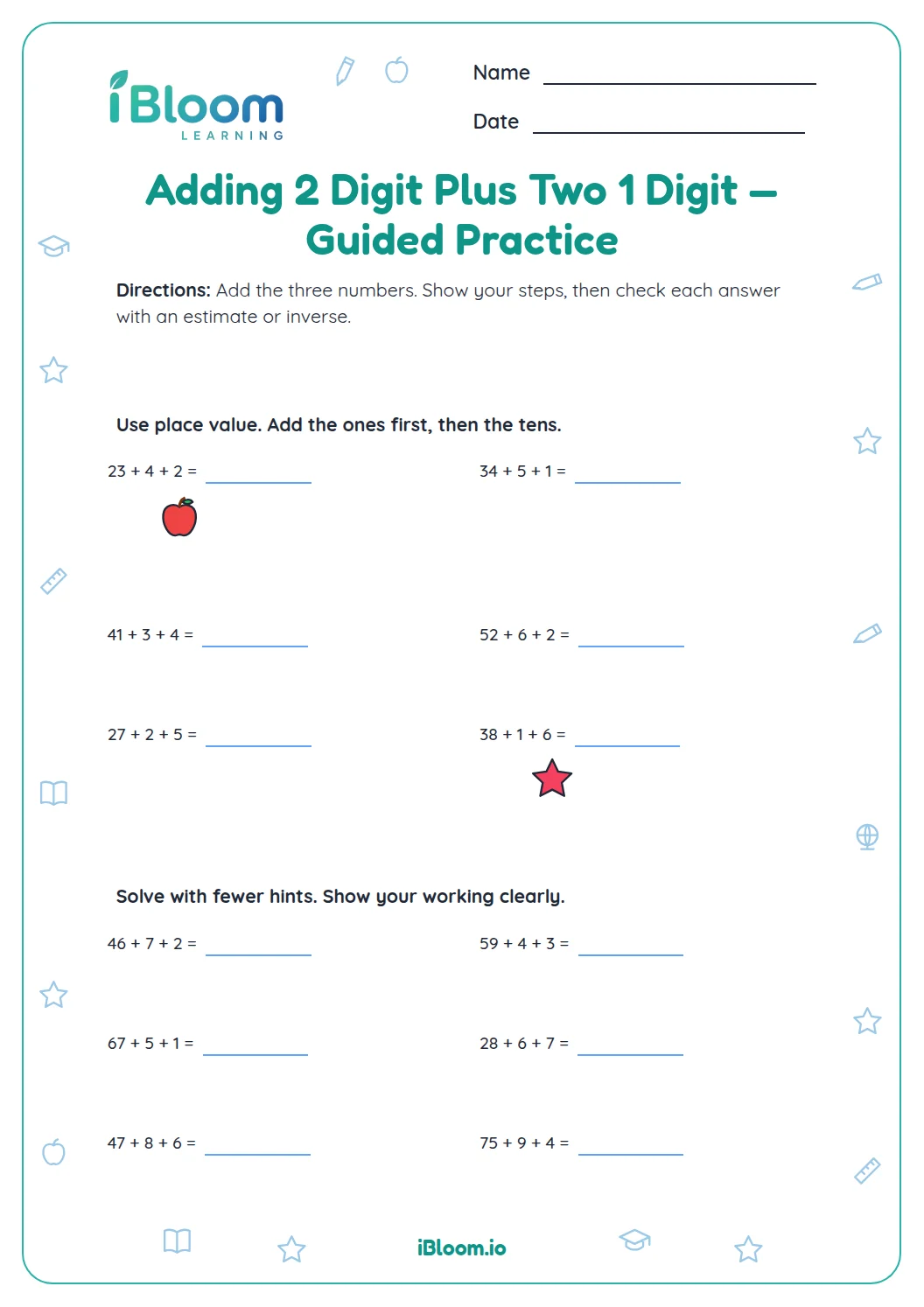
About this worksheet
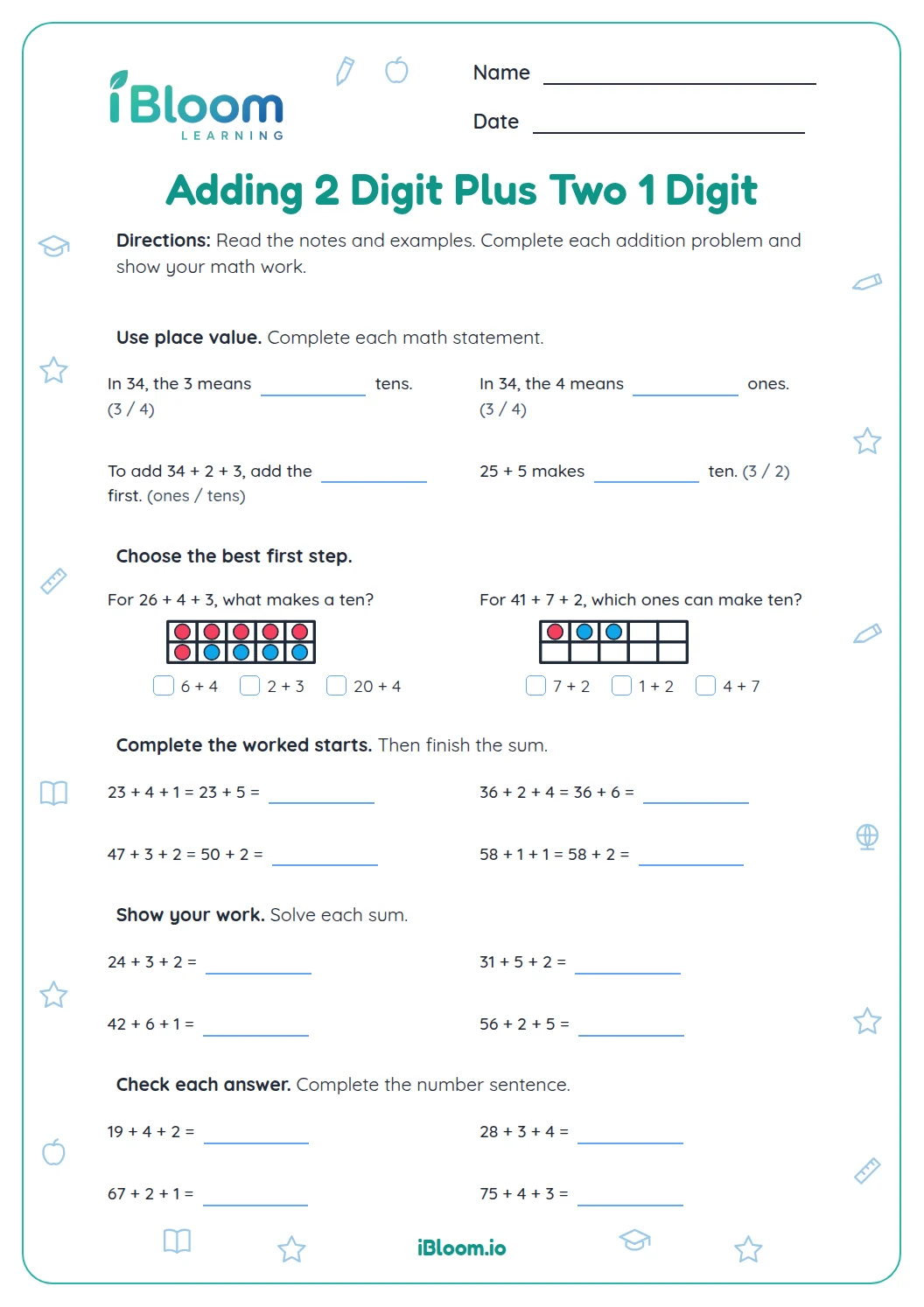
This Grade 2 worksheet gives children 14 real-world stories that combine a whole-ten amount with two one-digit amounts. In each item, children choose the total after adding all three groups. The problems build place-value addition and flexible strategies aligned with Common Core 2.NBT.B.5. A separate answer key lists each total.
Aligned to 2.NBT.B.5
What addition is in each story?
Each problem starts with a whole ten and adds two single-digit groups. The stories use books, beads, crayons, points, and other familiar quantities to give the numbers a reason.
Children can solve by combining the two one-digit addends first or by adding each group to the whole ten.
How can I model one problem?
Take question 2: 30 books are on a shelf. Add 5 animal books and 2 space books. Combine 5 + 2 = 7, then 30 + 7 = 37. Choose 37 from the options.
- 130 + 5 + 2
- 2Combine the one-digit addends: 5 + 2 = 7
- 3Add the tens: 30 + 7 = 37 books
- 4Choose 37.
How can a child check a total?
Use a second strategy to check: add the first one-digit number to the whole ten, then add the last one-digit number. For 30 + 5 + 2, the steps are 35 and then 37.
Make sure the answer is greater than the starting amount because the story adds more items.
How to use this worksheet
- 1Underline the starting whole-ten amount.
- 2Circle the two amounts that are added.
- 3Combine the one-digit numbers, then add that sum to the tens.
- 4Choose the matching total.
- 5Check by adding the one-digit amounts one at a time.
Common mistakes and quick fixes
The mistake
Adding only one of the two small groups.
The fix
Mark both added quantities before writing the equation.
The mistake
Changing the tens digit when adding ones.
The fix
Keep the tens whole: 30 plus 7 is 37.
The mistake
Answering with only the number of new items.
The fix
Reread the question to see whether it asks for the new total.
Common Core alignment
The stories ask children to add within 100 using place-value and addition strategies.
Add within 100 by using place value and addition strategies.
On this sheet: The story problems add a whole-ten amount and two one-digit amounts within 100.
Show the official wordingHide the official wording
Fluently add and subtract within 100 using strategies based on place value, properties of operations, and/or the relationship between addition and subtraction.
What to practice next
Make more practice
Further reading
Questions parents and teachers ask
What does “whole ten” mean here?
A whole ten is a multiple of ten, such as 20, 30, or 80. Each story adds two one-digit amounts to that starting number. The key lists each total. These are starting amounts, not just the number of new items.
Can children add the two small numbers first?
Yes. For 30 + 5 + 2, combine 5 and 2 to make 7, then add 30 to get 37. Children may also add one small amount at a time: 30 + 5 = 35, then 35 + 2 = 37.
How many problems are on the worksheet?
There are 14 word problems across two practice pages, with a separate answer key. Each story asks children to add a whole-ten amount and two one-digit amounts. The stories use familiar groups such as books, points, and shells. The answer key follows the worksheet for checking.
Can children write an equation before choosing?
Yes. Writing the three addends can make the story easier to organize. Children may combine the two one-digit amounts first or add them one at a time to the whole ten, then choose the matching total. The equation should include the starting amount and both additions.
What should the total tell us?
The answer is the full amount after both new groups are added. For example, 30 books plus 5 animal books and 2 space books makes 37 books altogether, not just the 7 added books. Use the labels in the story to keep the total connected to its objects.