






About this worksheet
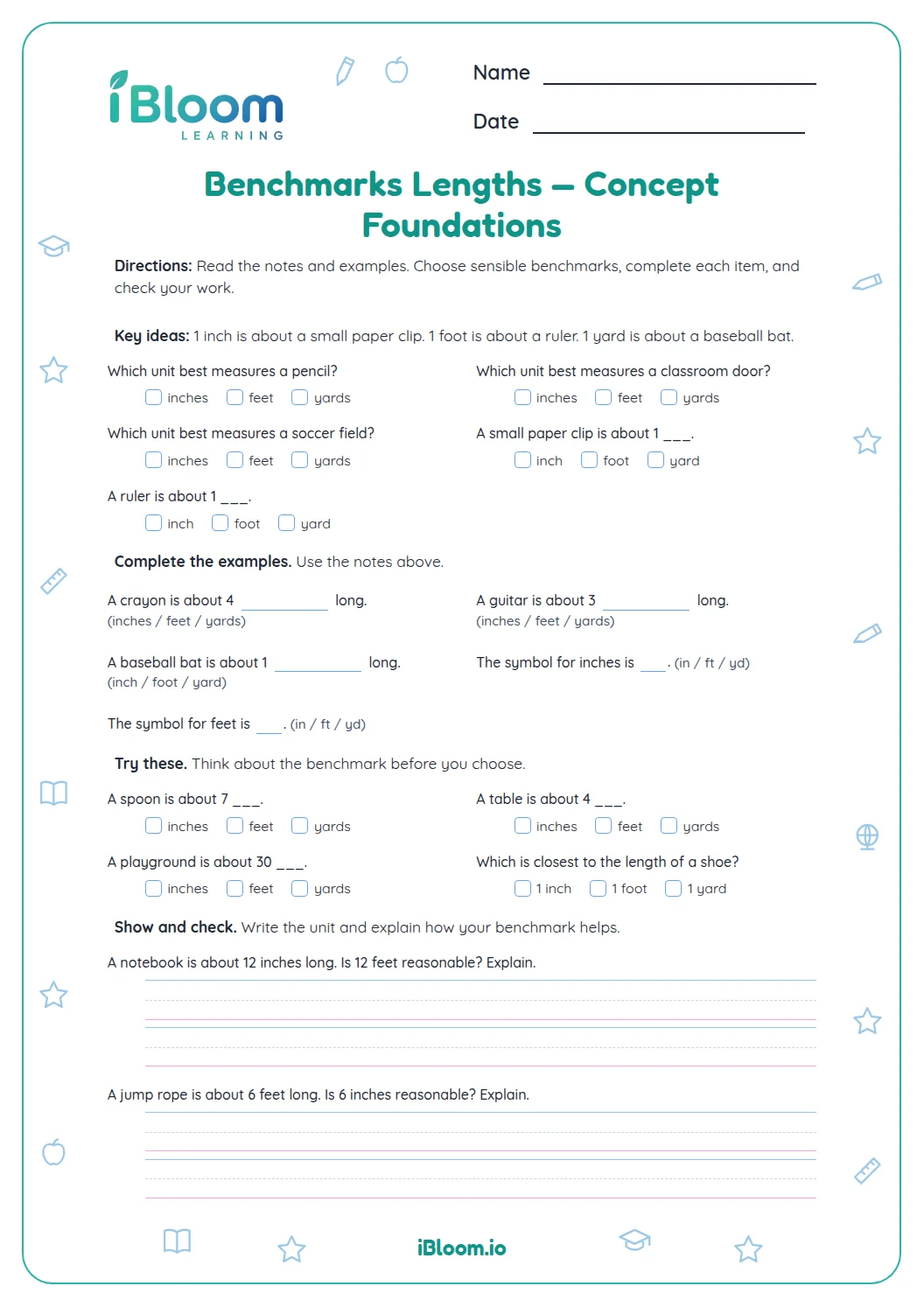
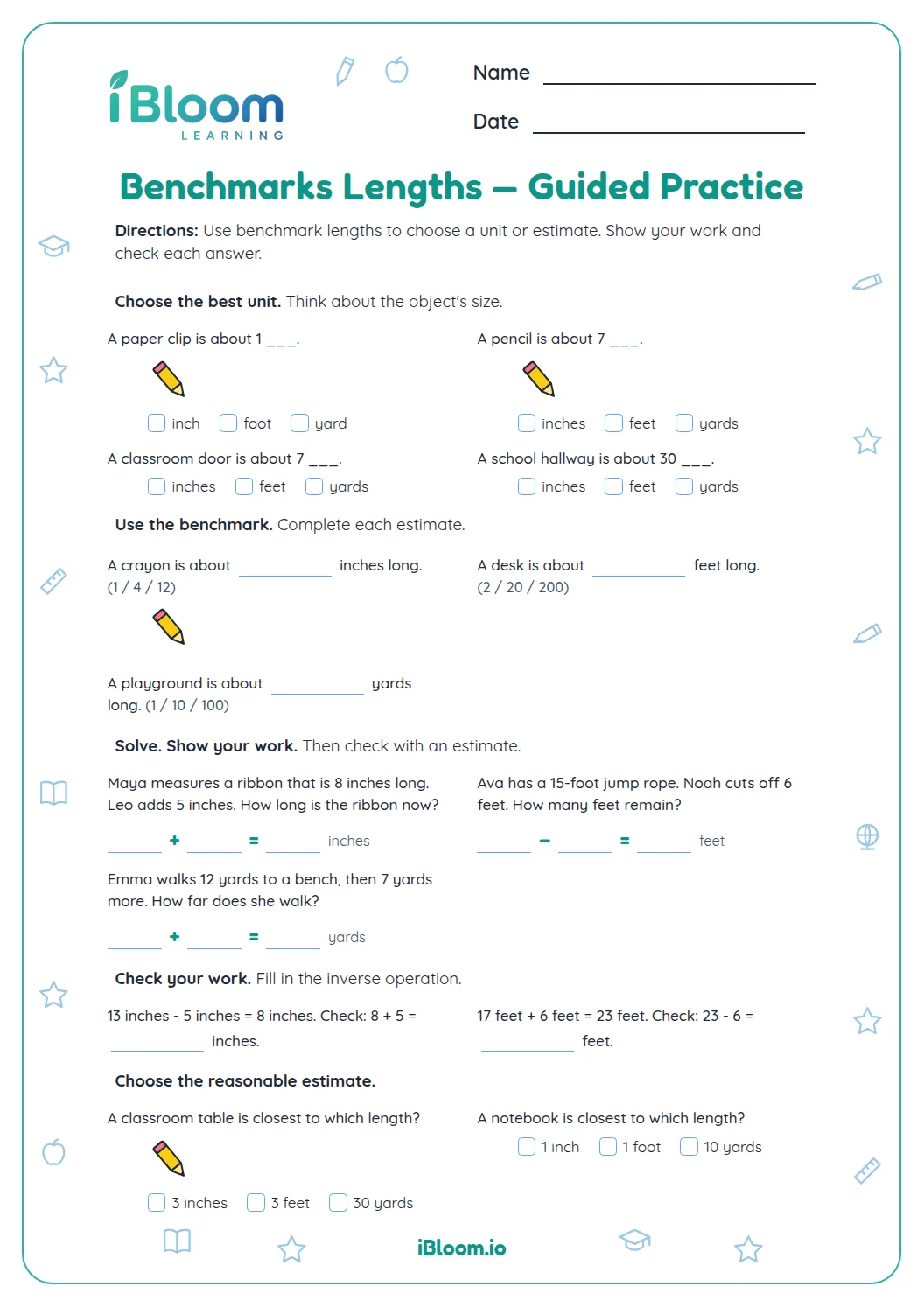
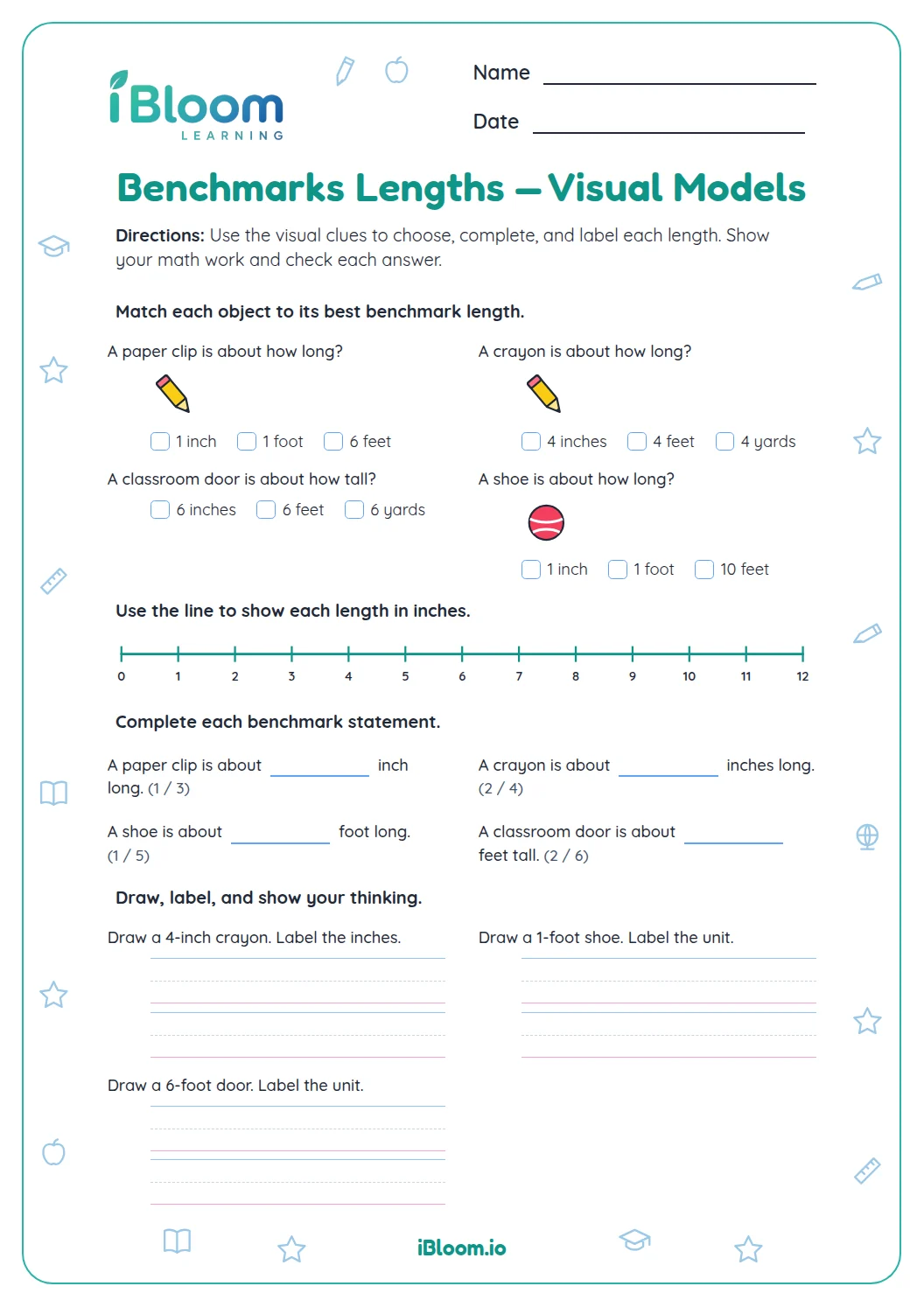
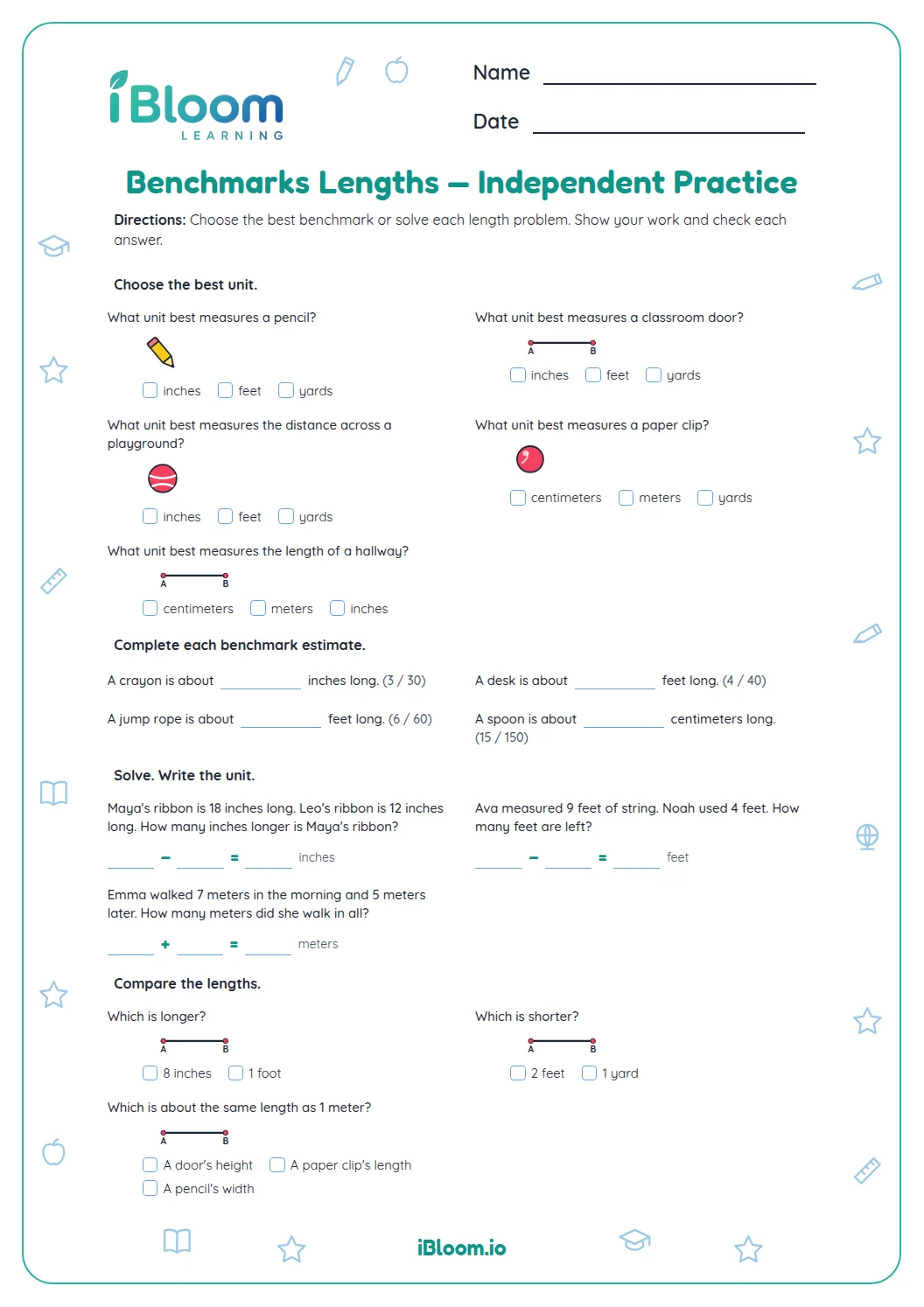
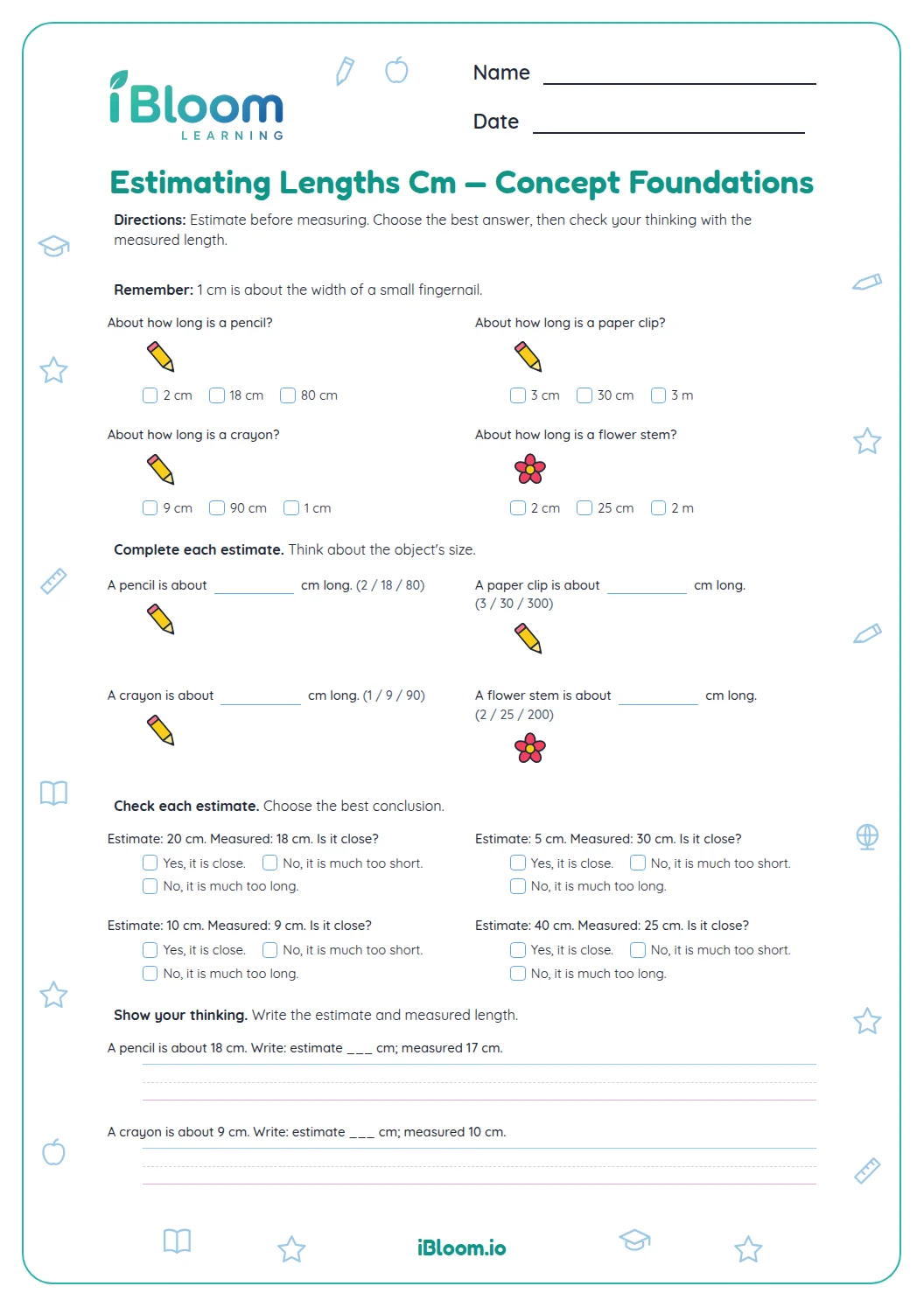
This Grade 2 worksheet asks children to estimate lengths using familiar objects and the units inches, feet, centimeters, and meters. Fourteen questions compare sensible estimates for classroom objects, a ribbon, and everyday items. Children use benchmarks rather than trying to measure each object exactly. A separate answer key supports review and the page practices CCSS 2.MD.A.3.
Aligned to 2.MD.A.3
Which units fit small and large objects?
Inches and centimeters work for small objects such as a crayon or book. Feet and meters fit larger lengths such as a desk, child, or classroom. Question 4 pairs a paperback book with centimeters; question 7 asks readers to catch a meter estimate that is far too large.
- 1A paperback book is about 20 ___ long.
- 2Books are much shorter than a meter.
- 3Choose centimeters.
How can a benchmark help reject an estimate?
Compare the proposed length with a familiar object. Three inches is much shorter than a 3-foot ribbon, so it is not a sensible estimate for the ribbon. Saying why an estimate is too short or too long strengthens the comparison.
How can learners choose between customary and metric units?
First decide the approximate size, then select a unit that describes that size. A classroom is several meters long, not a few centimeters. The same idea helps distinguish a child’s height in feet from a small object’s length in inches.
How can learners work through this sheet?
- 1Picture the object before choosing a unit.
- 2Decide whether it is small, hand-sized, or room-sized.
- 3Choose inches or centimeters for smaller objects.
- 4Choose feet or meters for larger lengths.
- 5Reject estimates that are far too short or long.
Common mistakes and quick fixes
The mistake
Using inches for a room-sized length.
The fix
Compare the object with a doorway or classroom and choose feet or meters.
The mistake
Mixing up centimeters and meters.
The fix
Remember that 100 centimeters make 1 meter; a small book is measured in centimeters.
The mistake
Choosing a number without checking the unit.
The fix
Say the estimate with its unit and picture the length before selecting it.
Common Core alignment
The questions ask learners to estimate object lengths using familiar units.
Estimate lengths using inches, feet, centimeters, and meters.
On this sheet: Children choose sensible estimates in customary and metric units.
Show the official wordingHide the official wording
Estimate lengths using units of inches, feet, centimeters, and meters.
What to practice next
Make more practice
Further reading
Questions parents and teachers ask
Is a crayon closer to 3 inches or 3 feet long?
A crayon is closer to 3 inches long. Three feet is as long as a yard, far longer than a crayon. Question 2 checks whether children can match a familiar small object with a sensible customary unit. Picture a crayon beside a ruler.
Why is a classroom measured in meters instead of centimeters?
A classroom is large, so meters are a convenient unit. Eight centimeters is shorter than many classroom objects, while several meters can describe the room’s length. Question 13 asks learners to compare those two estimates. Think about the distance across the room.
What is a benchmark for estimating a book’s length?
A paperback book may be about 20 centimeters long. That familiar size is much closer than 20 meters, which is longer than many rooms. Question 7 asks children to explain why 20 meters is far too long for a paperback book. Picture a book in your hands.
How can learners compare 3 feet and 3 inches?
One foot equals 12 inches, so 3 feet equals 36 inches. A ribbon that is 3 feet long cannot also be only 3 inches long. Question 9 asks whether that smaller estimate is sensible. Compare the ribbon with a short ruler.
Does the worksheet include exact measurements?
The questions focus on estimating, so learners choose a reasonable length and unit instead of measuring each item with a ruler. The answer key gives the best choice and helps adults discuss why a much smaller or larger estimate does not fit.