

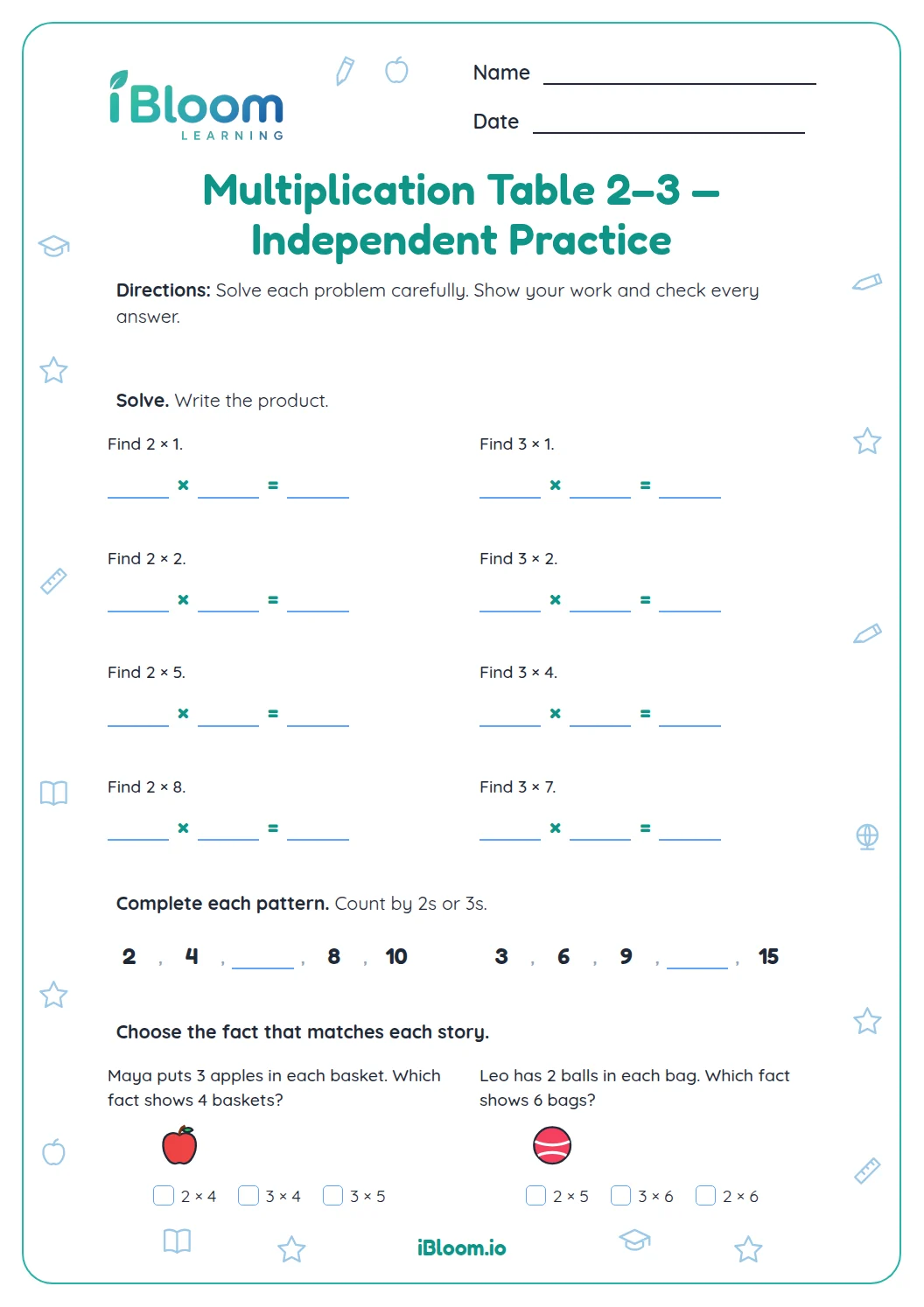
About this worksheet
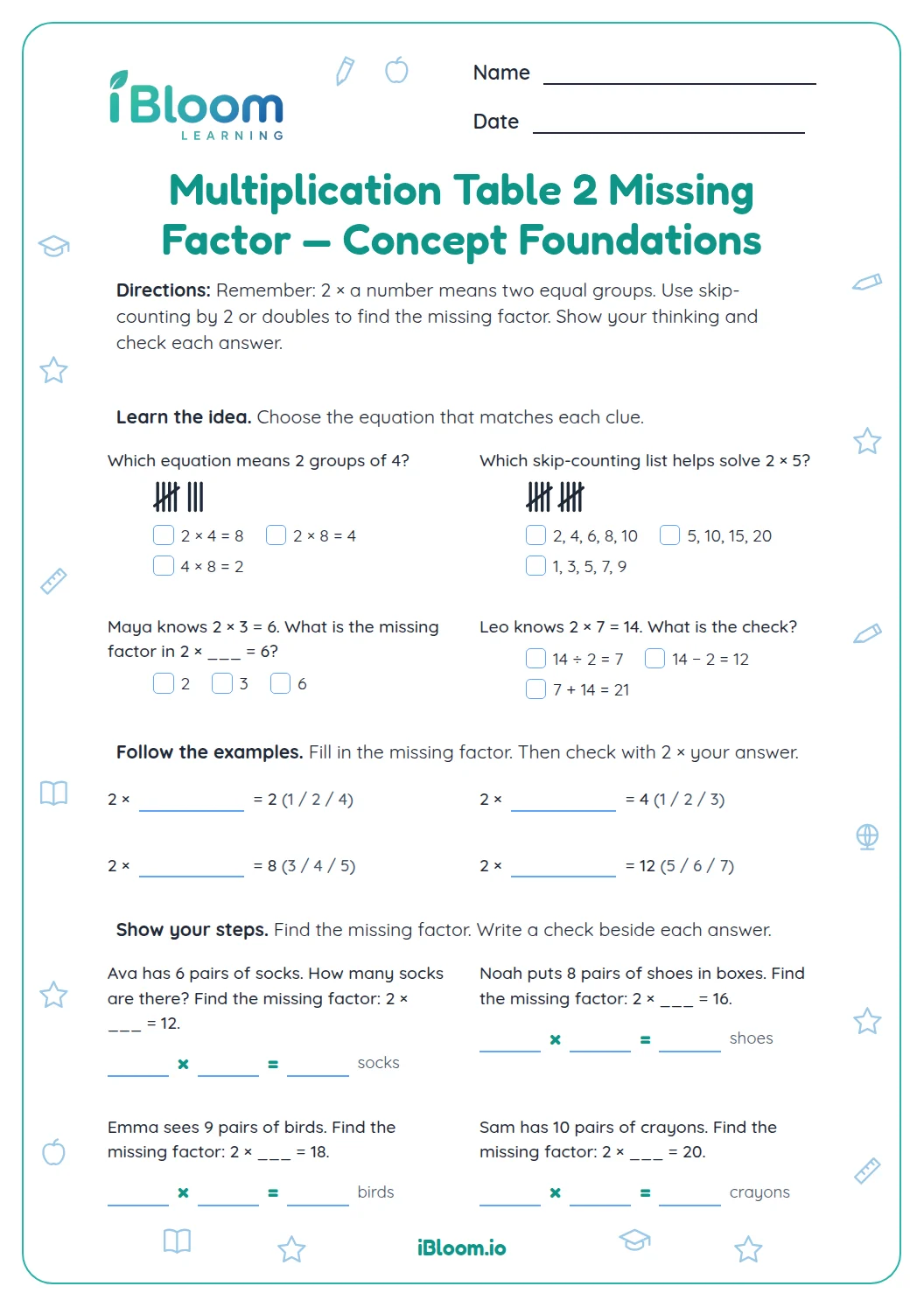
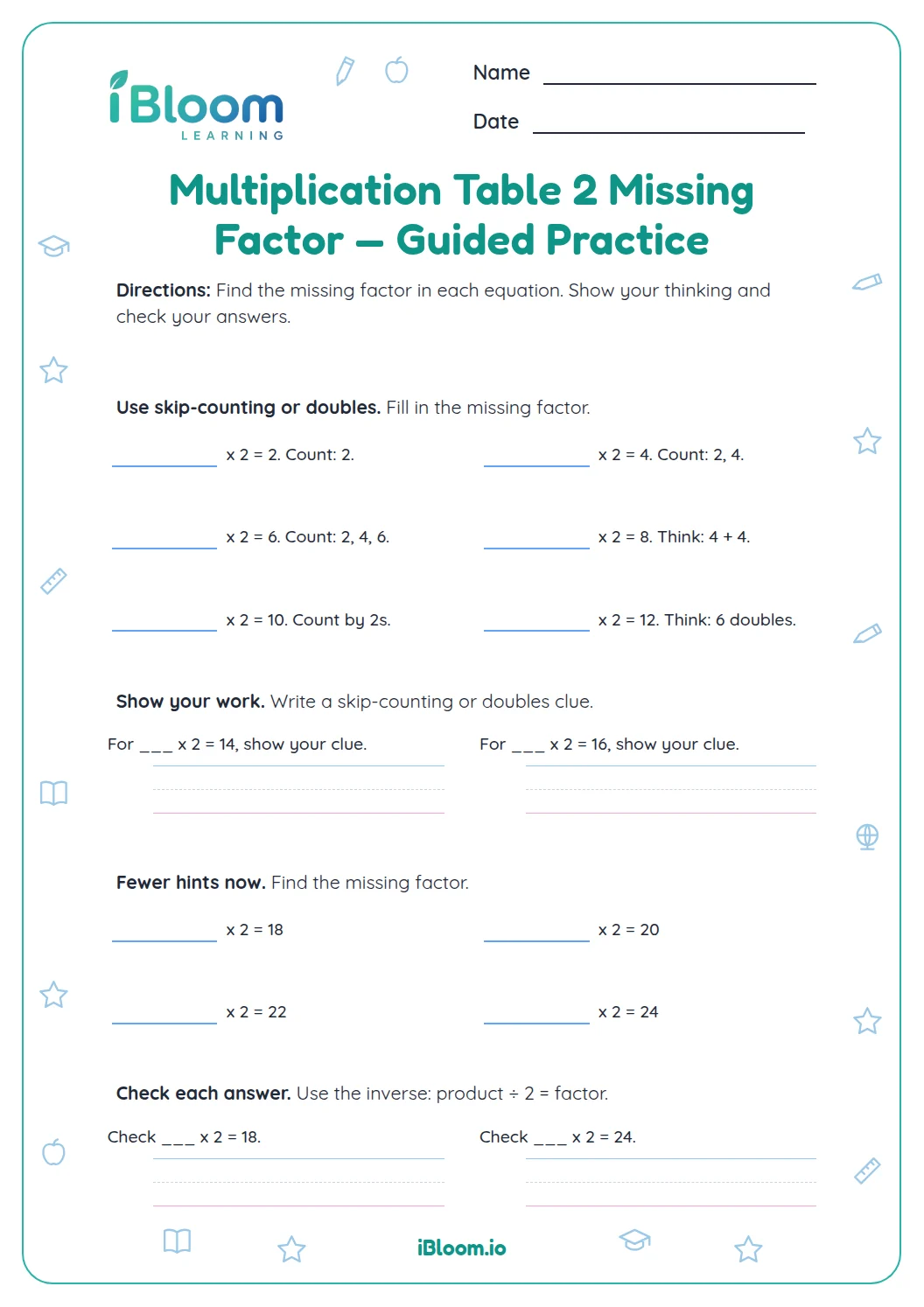
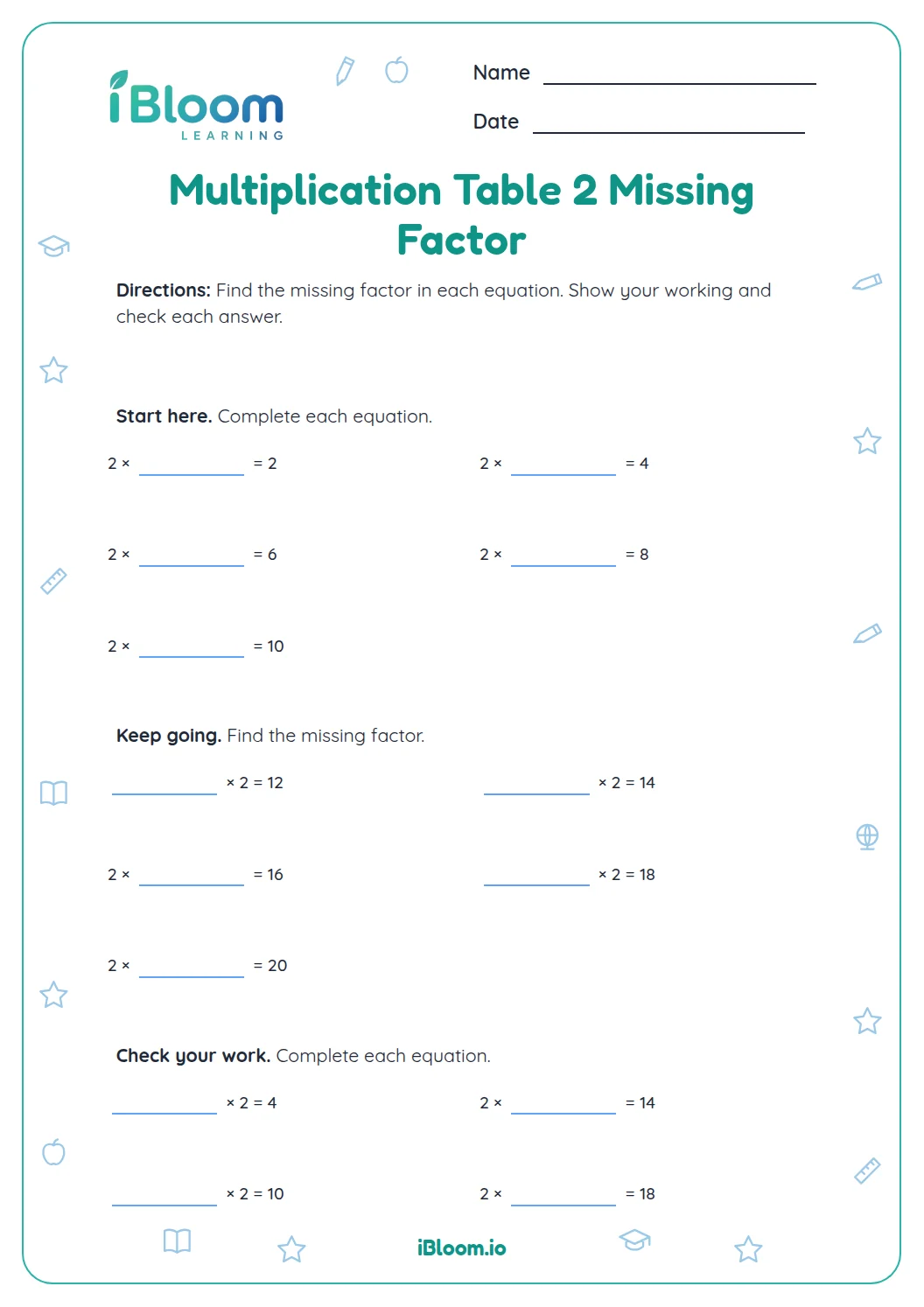
This Grade 2 worksheet practices missing factors in the multiplication table of 2. Students complete six equations, count two arrays, solve six equal-group stories, and choose equations for two more situations. The practice uses the unknown-factor relationship described in Common Core 3.OA.A.4. The story answers include units where they help explain what the missing factor represents.
Aligned to 3.OA.A.4
How can equal groups reveal a missing factor?
In 2 × ___ = 14, the total is 14 and each group has 2. Counting by twos or dividing 14 into groups of 2 shows that there are 7 groups.
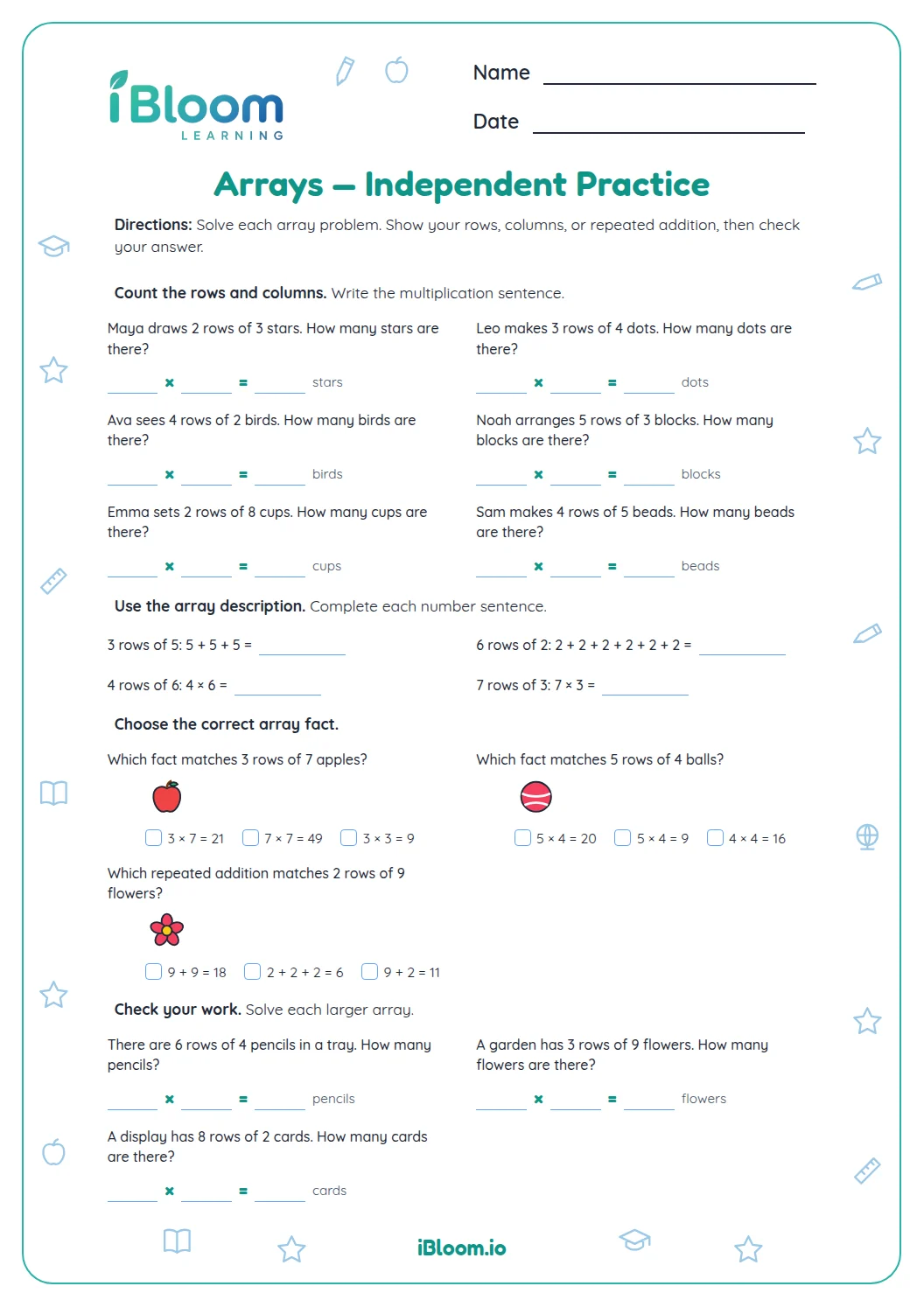
The two array questions show equal rows of counters. The story questions use trays, cards, bikes, chairs, teams, and other equal-group situations.
- 12 × ___ = 6
- 2Count 2, 4, 6: three groups of 2 make 6.
- 3The missing factor is 3.
What equation matches a sharing story?
When a total is split into two equal groups, divide by 2 to find the amount in each group. When each group has two objects, divide by 2 to find the number of groups. Read the question to tell which factor is missing.
How can a child check a missing factor?
Put the proposed number back into the equation and multiply. For example, 2 × 8 = 16, so 8 is the missing factor.
Read the total and identify the known factor.
- 1Count by twos or use a related division fact.
- 2For a story problem, decide whether the unknown is the group size or the number of groups.
- 3Write the missing number in the equation.
- 4Multiply to check that the factors make the given total.
Common mistakes and quick fixes
The mistake
Writing the total as the missing factor.
The fix
Build or count groups of 2 until you reach the total.
The mistake
Mixing up the number of groups and the number in each group.
The fix
Sketch two groups or say the equation aloud before solving.
The mistake
Stopping after finding a number without checking.
The fix
Multiply the known factor by your answer and compare with the total.
Common Core alignment
This practice connects to 3.OA.A.4 through the skill named on the worksheet.
Find a missing factor when a multiplication equation names the product.
On this sheet: Students solve multiplication facts with an unknown factor and use division or equal groups to find it.
Show the official wordingHide the official wording
Determine the unknown whole number in a multiplication or division equation relating three whole numbers.
What to practice next
Make more practice
Further reading
Questions parents and teachers ask
How do you find the missing factor in a twos fact?
Think about equal groups of 2 or use division by 2. In 2 × ___ = 14, ask how many groups of 2 make 14. Counting by twos or calculating 14 divided by 2 shows that the missing factor is 7.
How can an array help find a missing factor?
An array shows equal rows and columns. Count the objects in one row to find the group size, or count the rows to find the number of groups. The worksheet uses two-row arrays so children can connect the model to multiplication facts.
What kinds of real-world problems are included?
Students solve situations about muffins, stickers, bikes, chairs, teams, and cards. Some stories ask how many objects are in each of two groups; others give two objects per group and ask how many groups there are. The final items ask students to choose equations for equal sharing.
How can a child check a missing-factor answer?
Put the answer back into the multiplication equation and multiply. For example, if the total is 16 and one factor is 2, check that 2 × 8 equals 16. A drawing of two equal groups can also show why the answer works.
How many problems are on this worksheet?
There are 14 questions in four parts: six missing-factor equations, two arrays, four equal-group story problems, and two equation choices. The two-page worksheet focuses on twos facts, and a separate two-page answer key gives the answers and units for the stories.