


About this worksheet
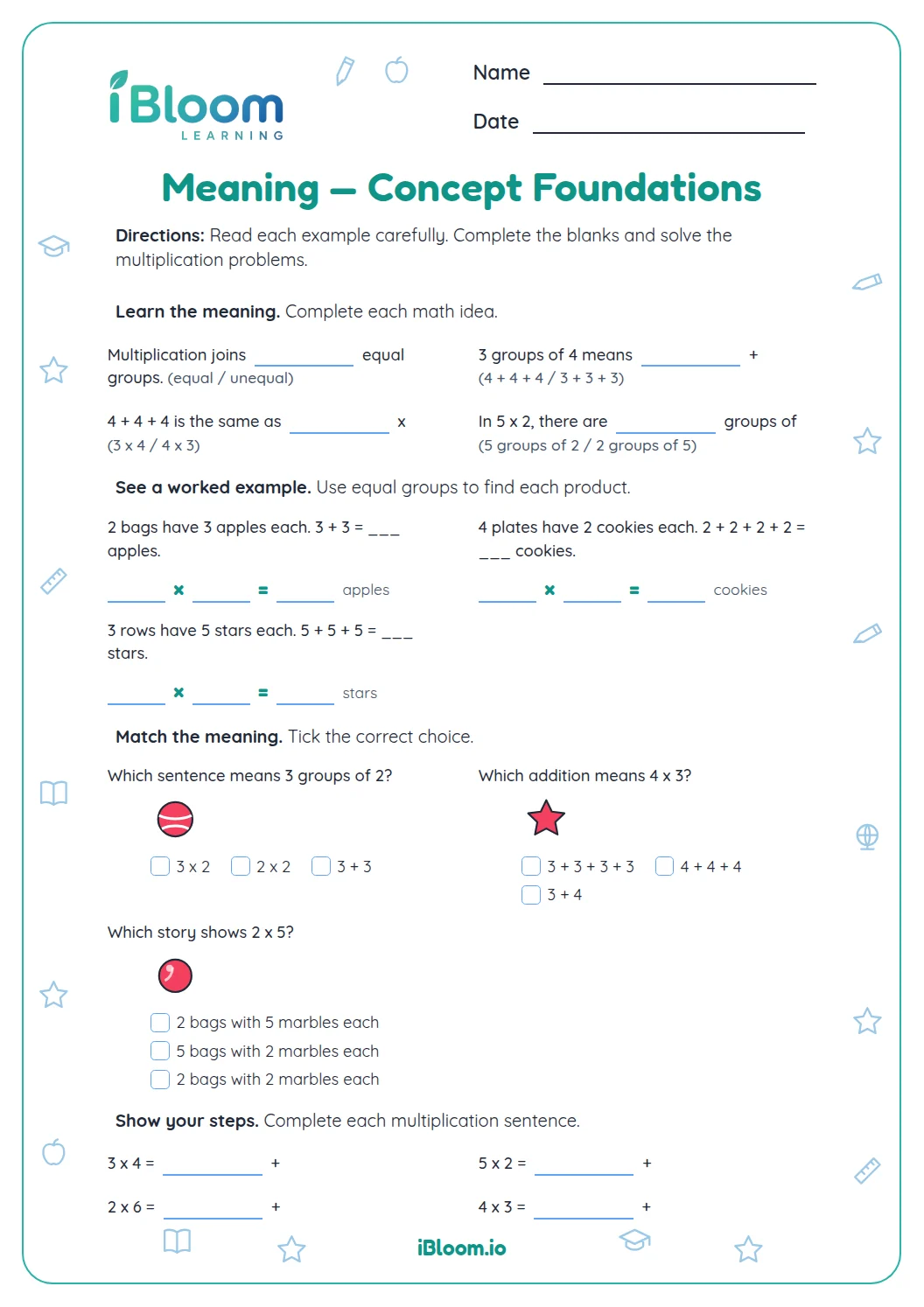
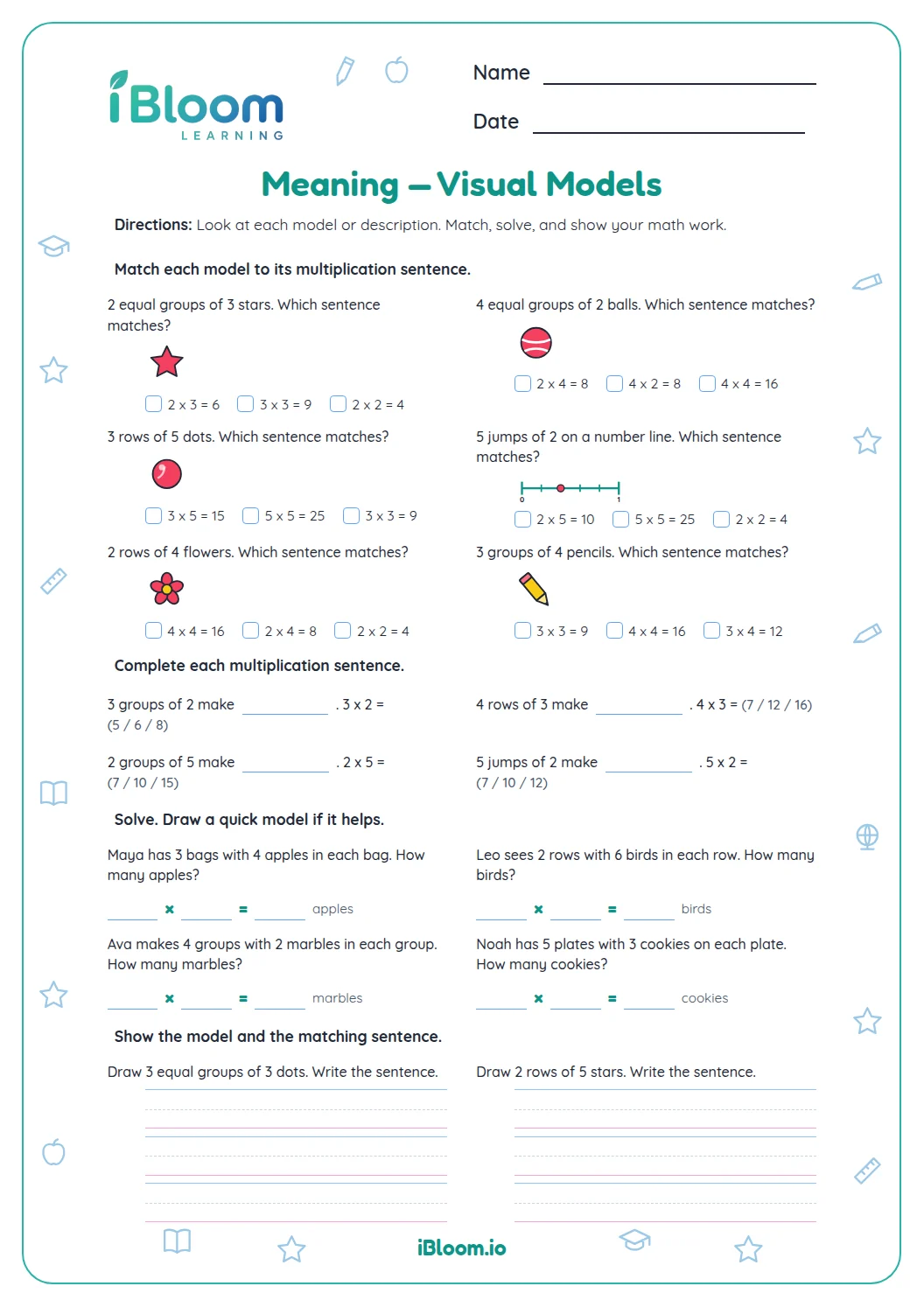
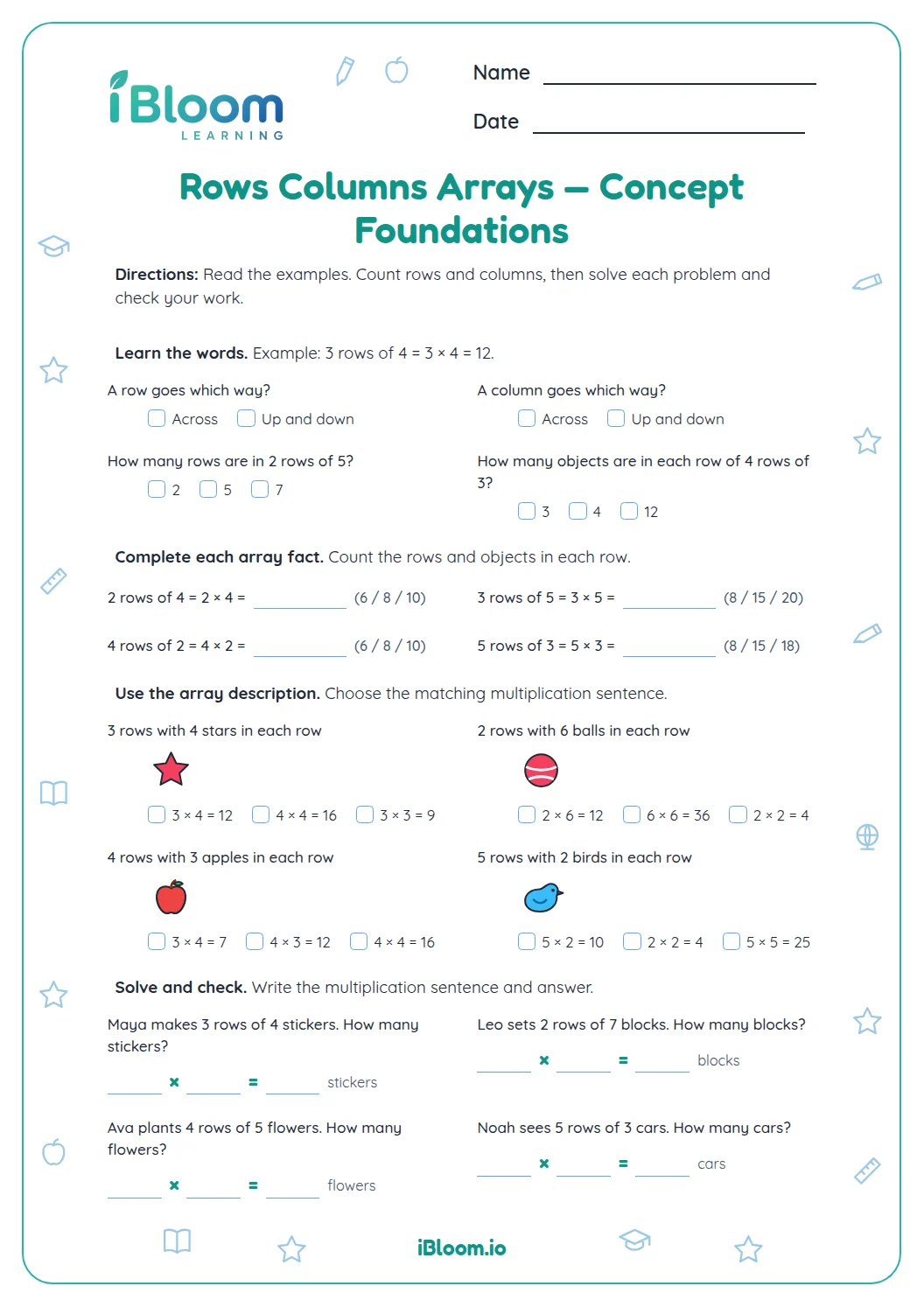
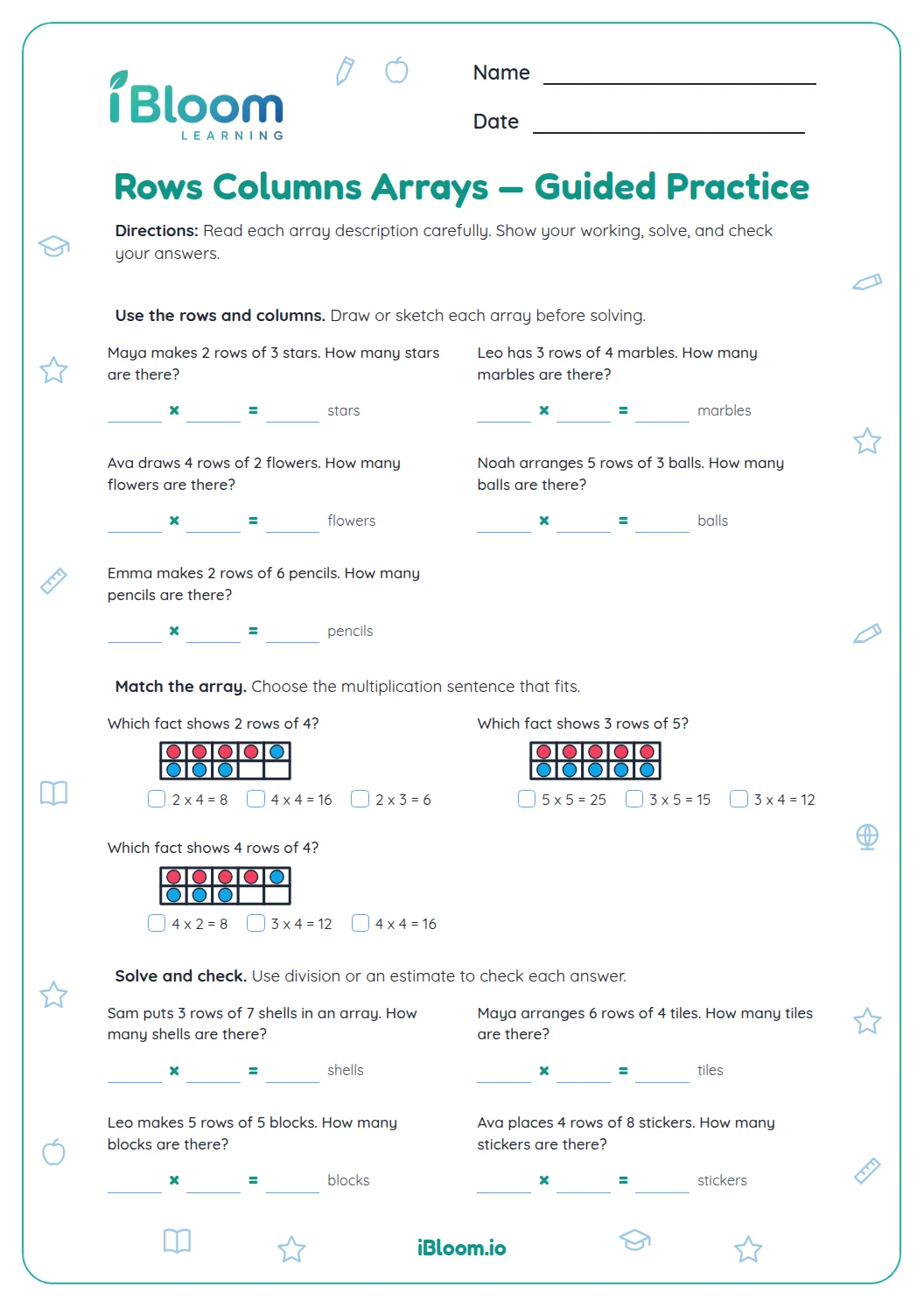
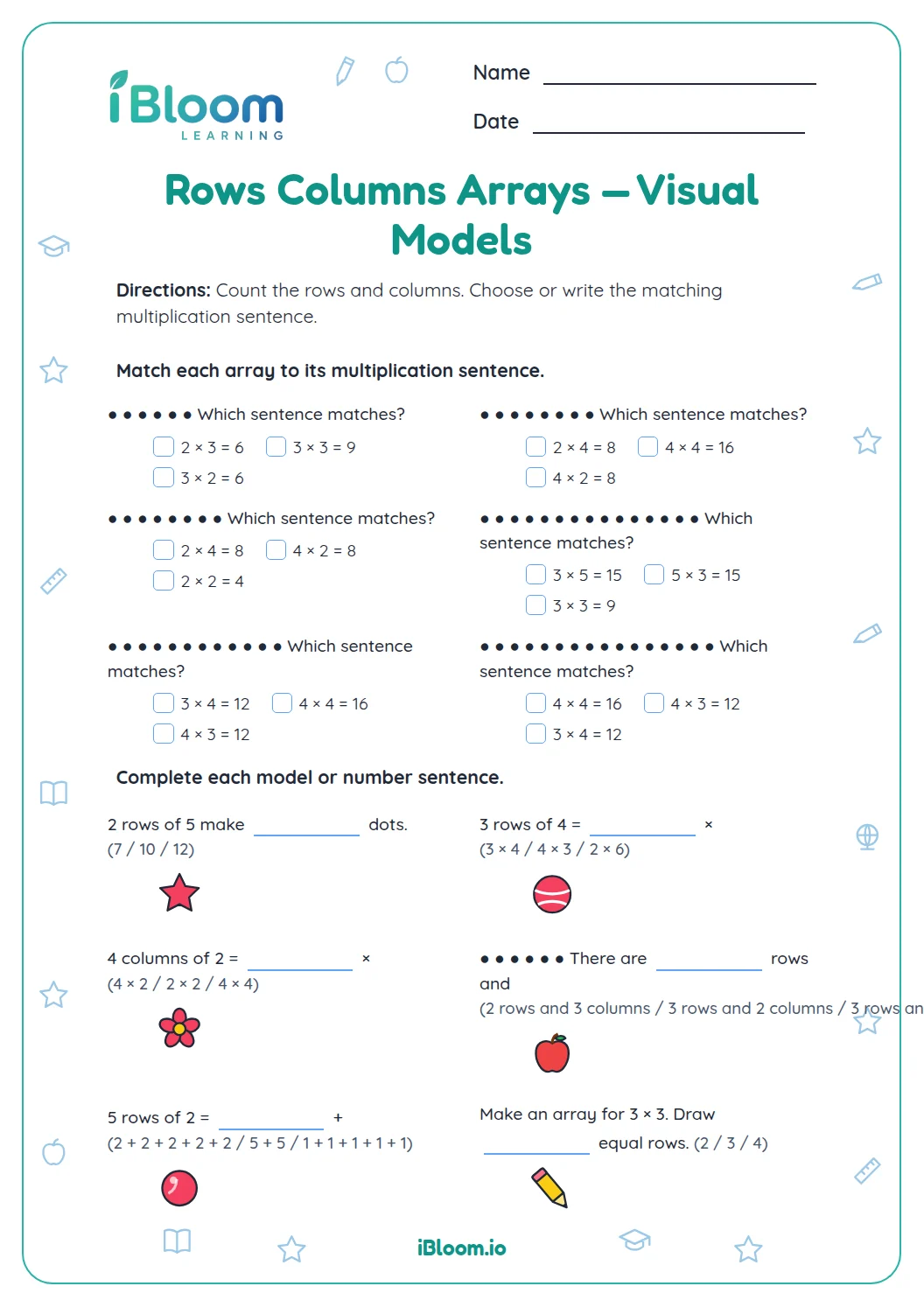
This free printable worksheet helps Grade 2 children connect the 2 times table to equal rows of dots. Part A mixes eight dot arrays with a tally model and a number line. The arrays show one through five rows of two dots, then two rows holding six through ten dots each. Children use the models to find the missing factor, then complete four equations in Part C and draw two models in Part D. These tasks practice finding an unknown number in a multiplication equation, as described in Common Core 3.OA.A.4. The answer key gives the factors and describes both drawings.
Aligned to 3.OA.A.4
What does each part of an array tell us?
The page begins with ten arrays. The first five show one through five rows with two dots in each row; the next five show two rows holding six through ten dots each.
Point along one row first. Then move a finger down the array to count rows. This makes the two counts visible instead of treating every number as a total.
How do you solve ___ × 2 = 8?
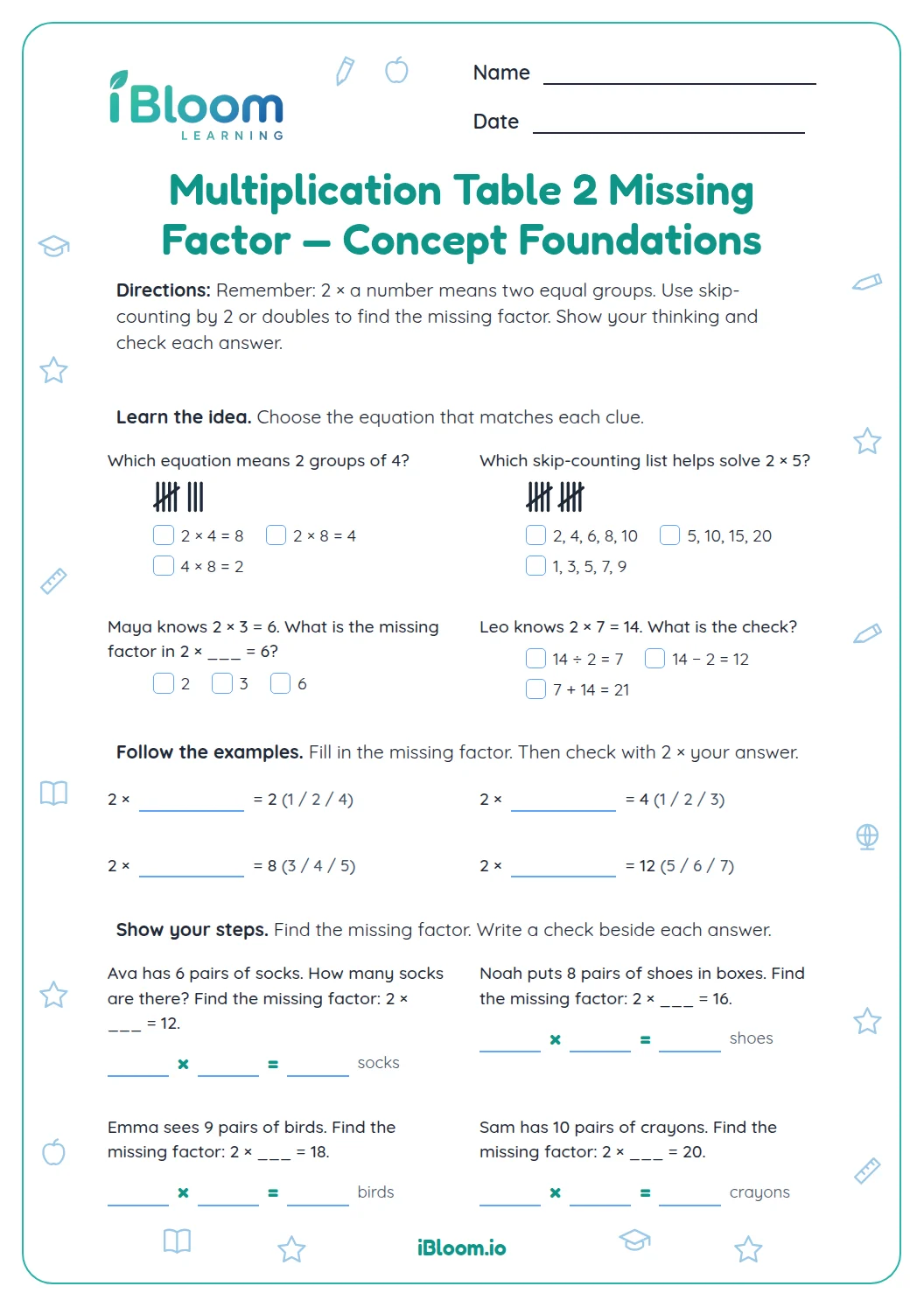
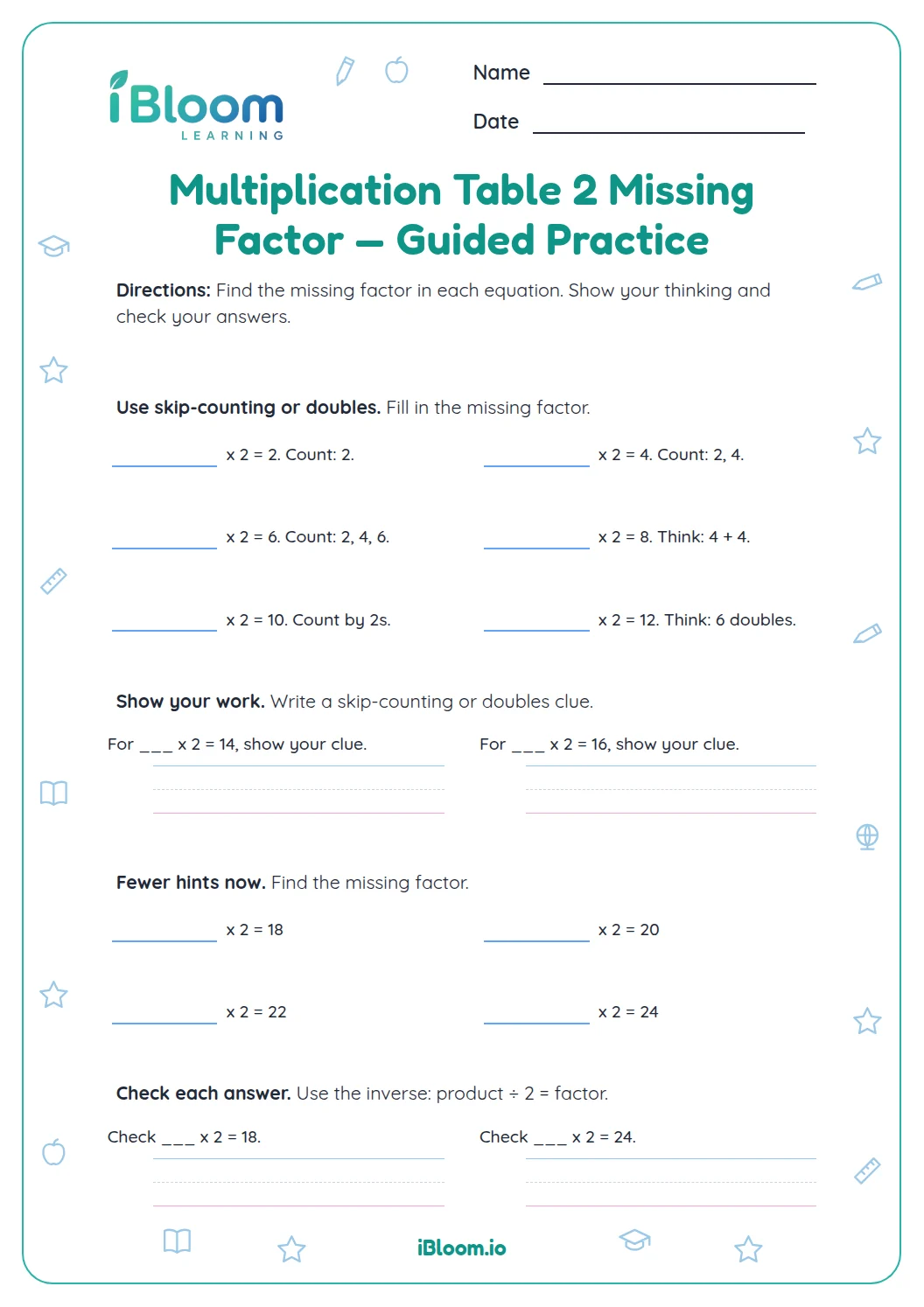
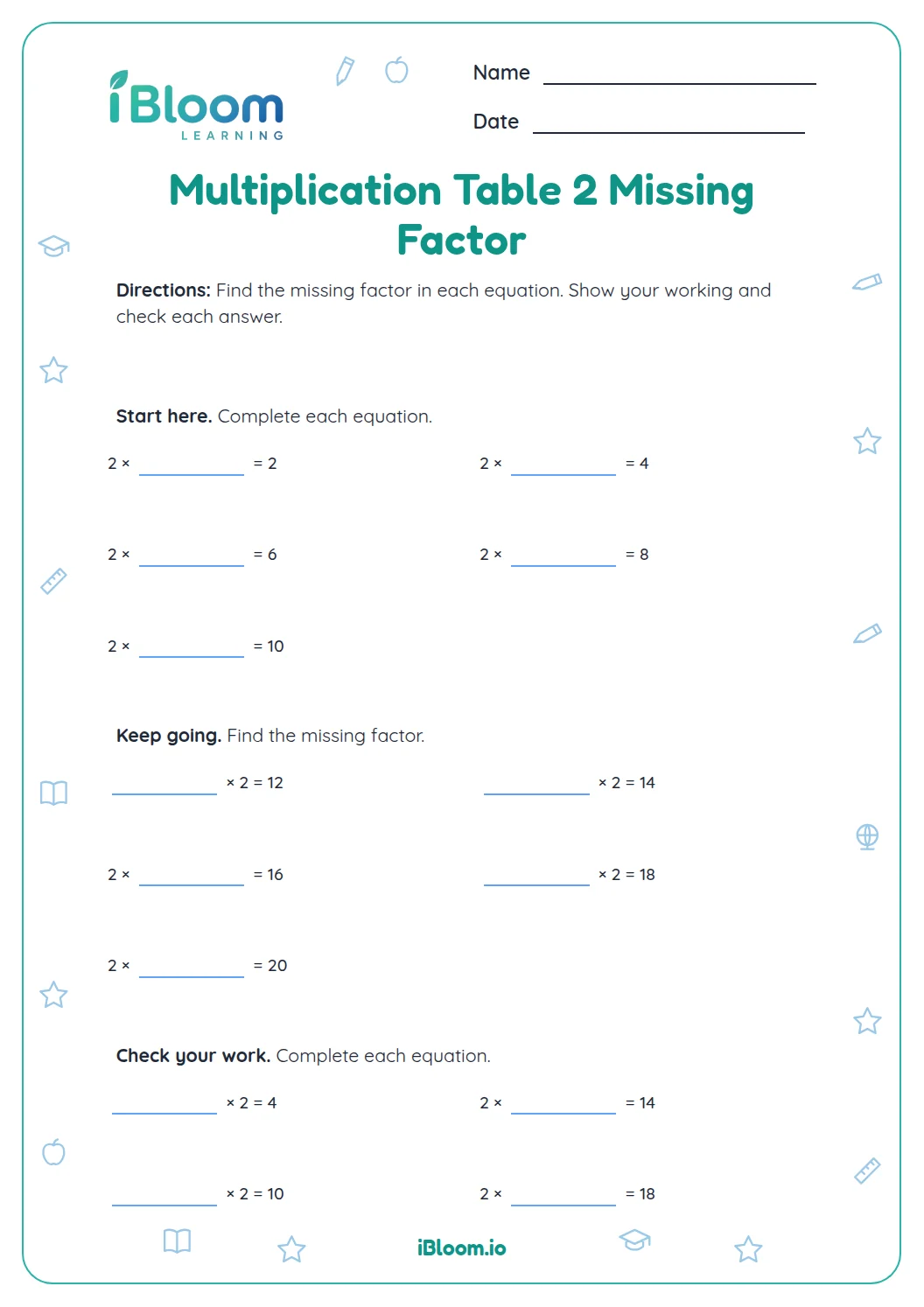
In Parts A and B, count rows or the dots in one row, depending on where the blank appears. Part C removes the models so children can solve six equations independently.
- 14 rows with 2 dots in each row
- 22 + 2 + 2 + 2 = 8
- 34 × 2 = 8, so the missing factor is 4.
Why do the arrays change in Part B?
Part B holds the number of rows at two and changes the number of dots in each row. In question 6, two rows of six dots match 2 × ___ = 12. Children write 6 because that is the size of each row.
The ten models cover the factors 1 through 10. Part C revisits four of those facts without drawings, asking children to picture equal rows or count by twos as a check. Part D asks children to draw two equal rows for totals of 10 and 18 and write each completed equation.
How to use this worksheet
- 1Make three rows of two counters and name the rows, dots per row, and total.
- 2Read Part A as “some rows of two dots” and count the rows in each model.
- 3In Part B, point to the two rows and count only one row to find the missing factor.
- 4Let the child finish Part C by picturing a model or counting by twos.
- 5Check each blank by multiplying it by 2 and comparing the result to the printed total.
Mistakes to notice and fix
The mistake
Writing 8 in the blank for ___ × 2 = 8.
The fix
Eight is the total; count the four equal rows to find the factor.
The mistake
Writing 2 in every Part B blank because there are two rows.
The fix
The 2 is already given. Count the dots inside one row.
The mistake
Treating 2 × ___ = 12 as 2 + ___ = 12 and writing 10.
The fix
Make two equal rows of six dots and count the twelve dots altogether.
Curriculum alignment
Find an unknown factor in a multiplication equation using equal rows.
On this sheet: Children find unknown factors in six equations and ten array models.
Show the official wordingHide the official wording
Determine the unknown whole number in a multiplication or division equation relating three whole numbers.
What to practice next
Make more practice
Further reading
Questions parents and teachers ask
Which facts does this worksheet cover?
Ten dot arrays cover missing factors 1 through 10. Six equations revisit facts without drawings. For a model, point to each row or to the dots in one row, then check the total by multiplying the factor by 2.
Should my child count every dot?
Counting every dot can confirm the total, but the blank asks for a factor. In the arrays, count rows or dots per row. In the array questions, count rows or dots in one row. Then count all the dots only as a final check of the multiplication equation.
Why is the blank in different positions?
The blank identifies a different part of the array in each section. In Part A it stands for the number of rows, with two dots per row. In Part B the two rows are given, and the child finds the number of dots in each row.
Can we use counters with the printed arrays?
Yes. Rebuild an array with buttons or counters and move one whole row at a time. For question 4, arrange four rows of two counters and say “four groups of two make eight.” Compare your model with the printed dots, then check the matching equation.
How can I check the four equations without pictures?
Multiply each missing factor by 2 and compare it with the given total. The factors for questions 11 through 14 are 7, 3, 8, and 10. If an answer is uncertain, rebuild that fact with equal rows of counters before checking the key.