


About this worksheet
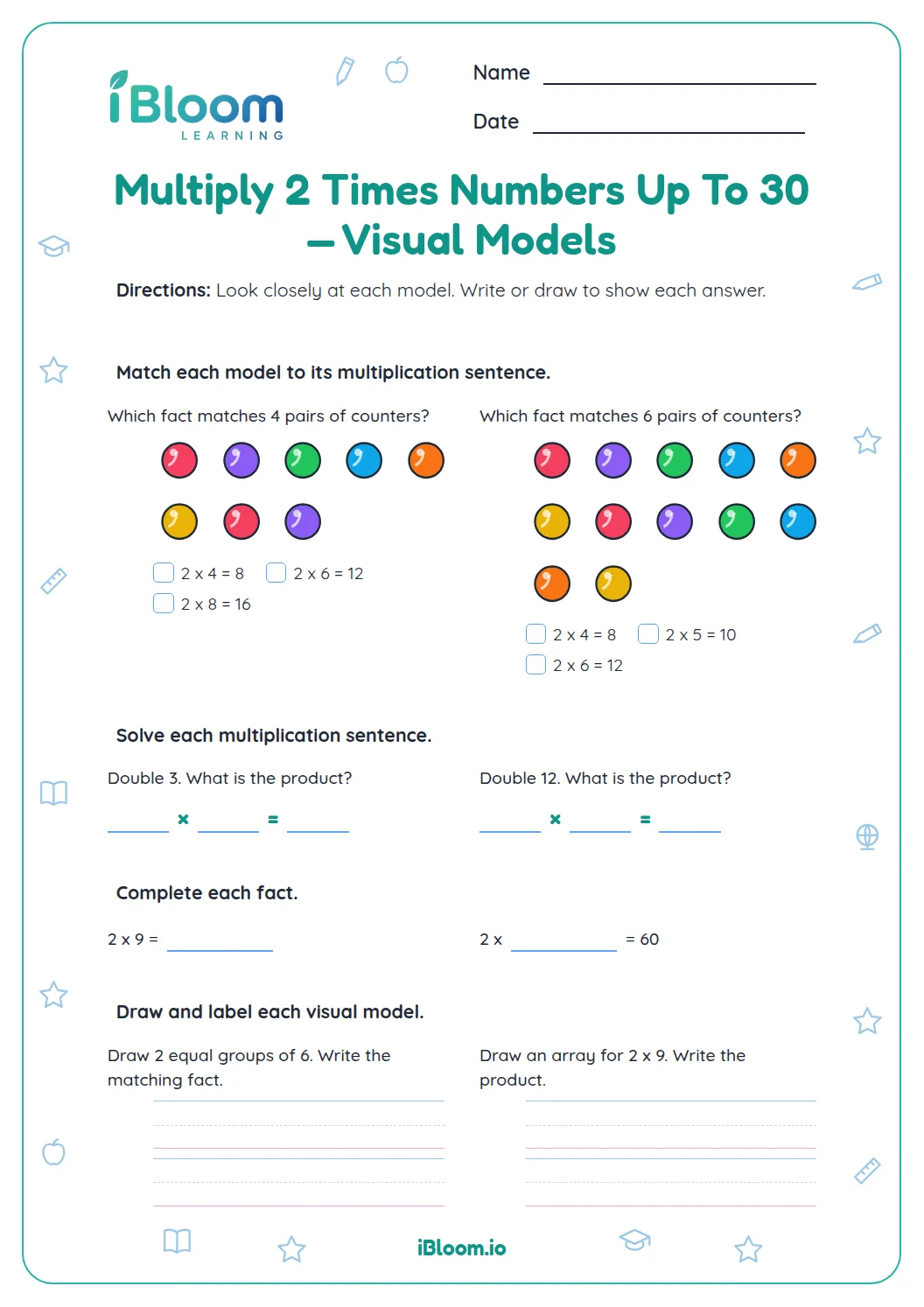
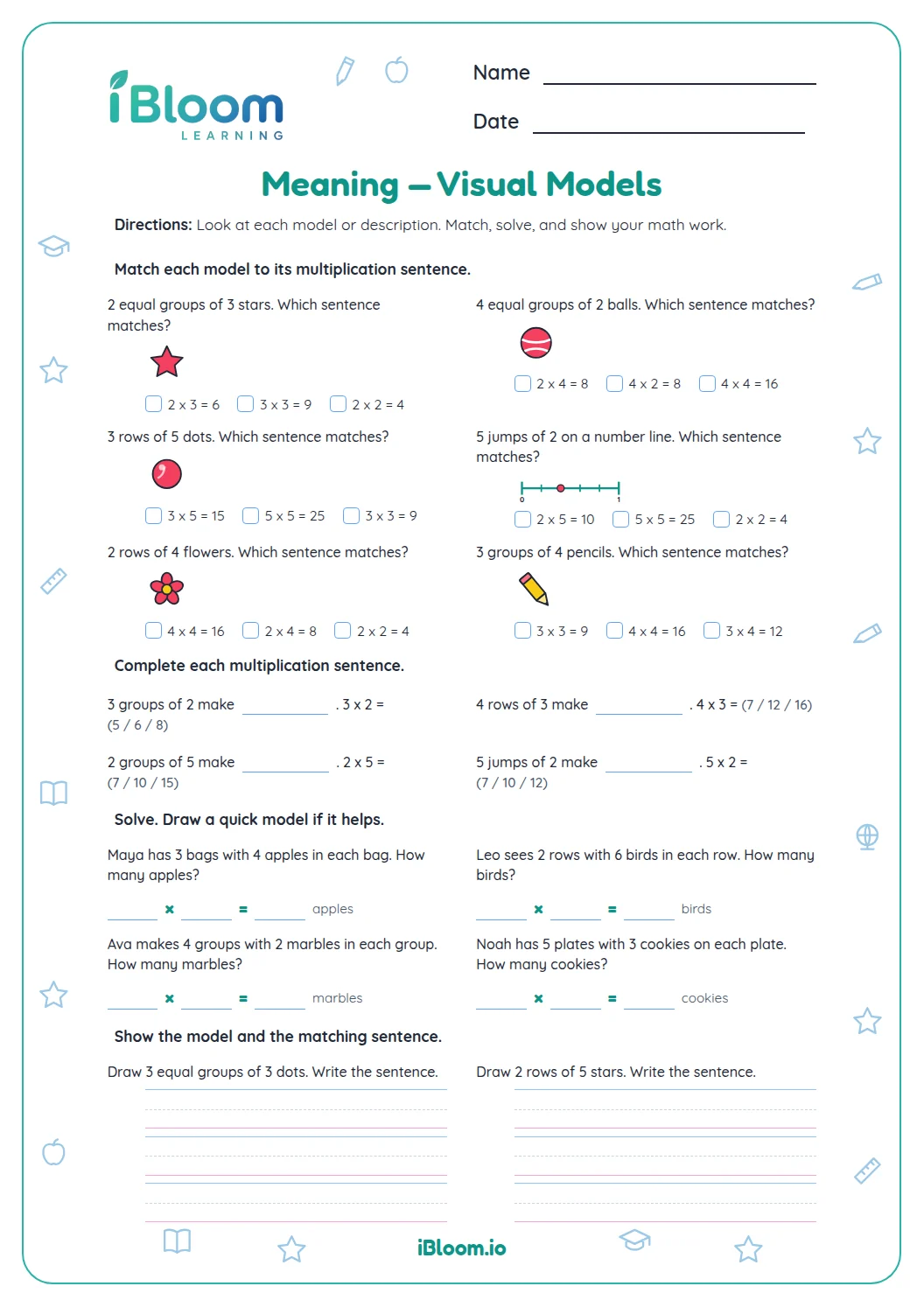
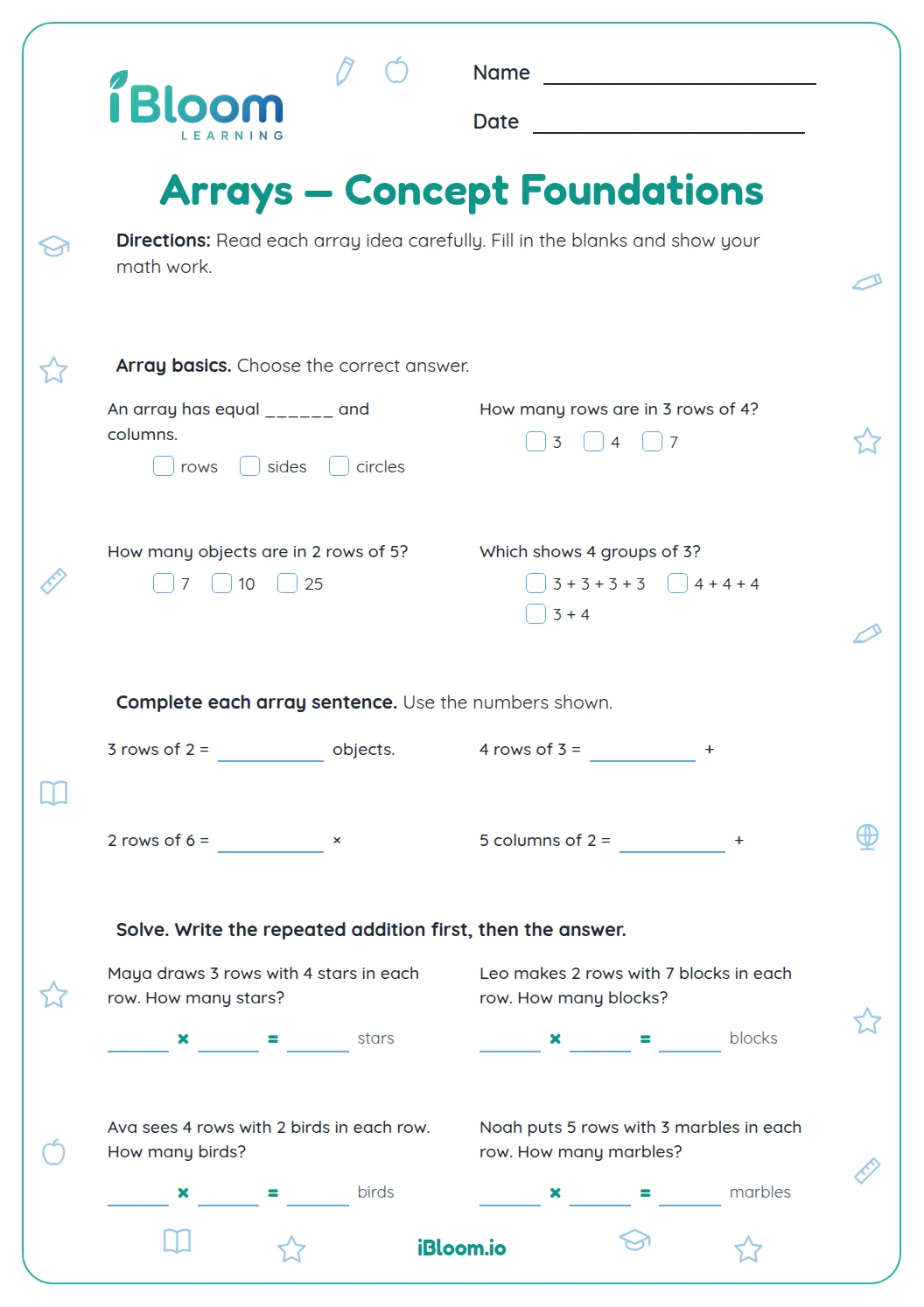
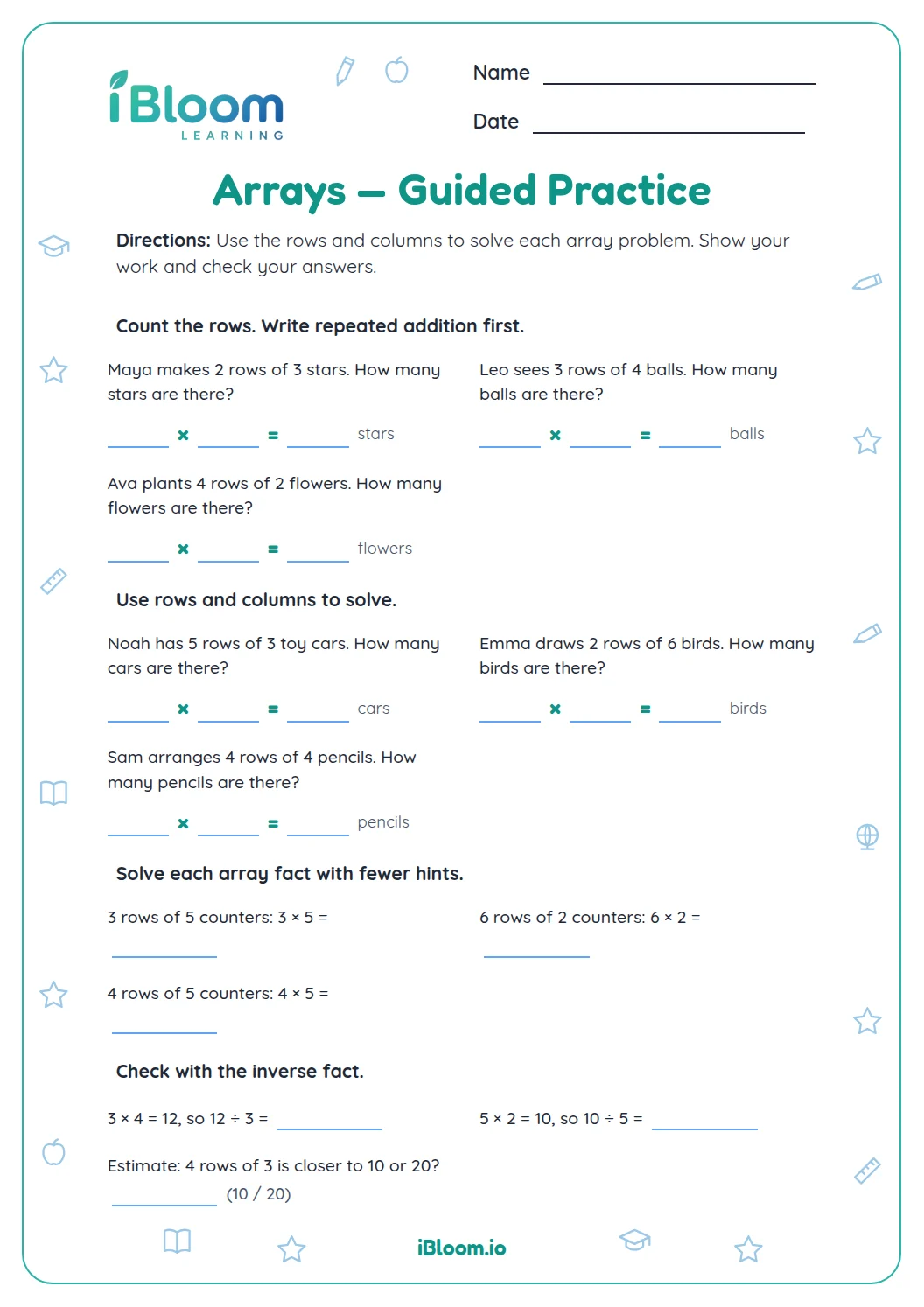
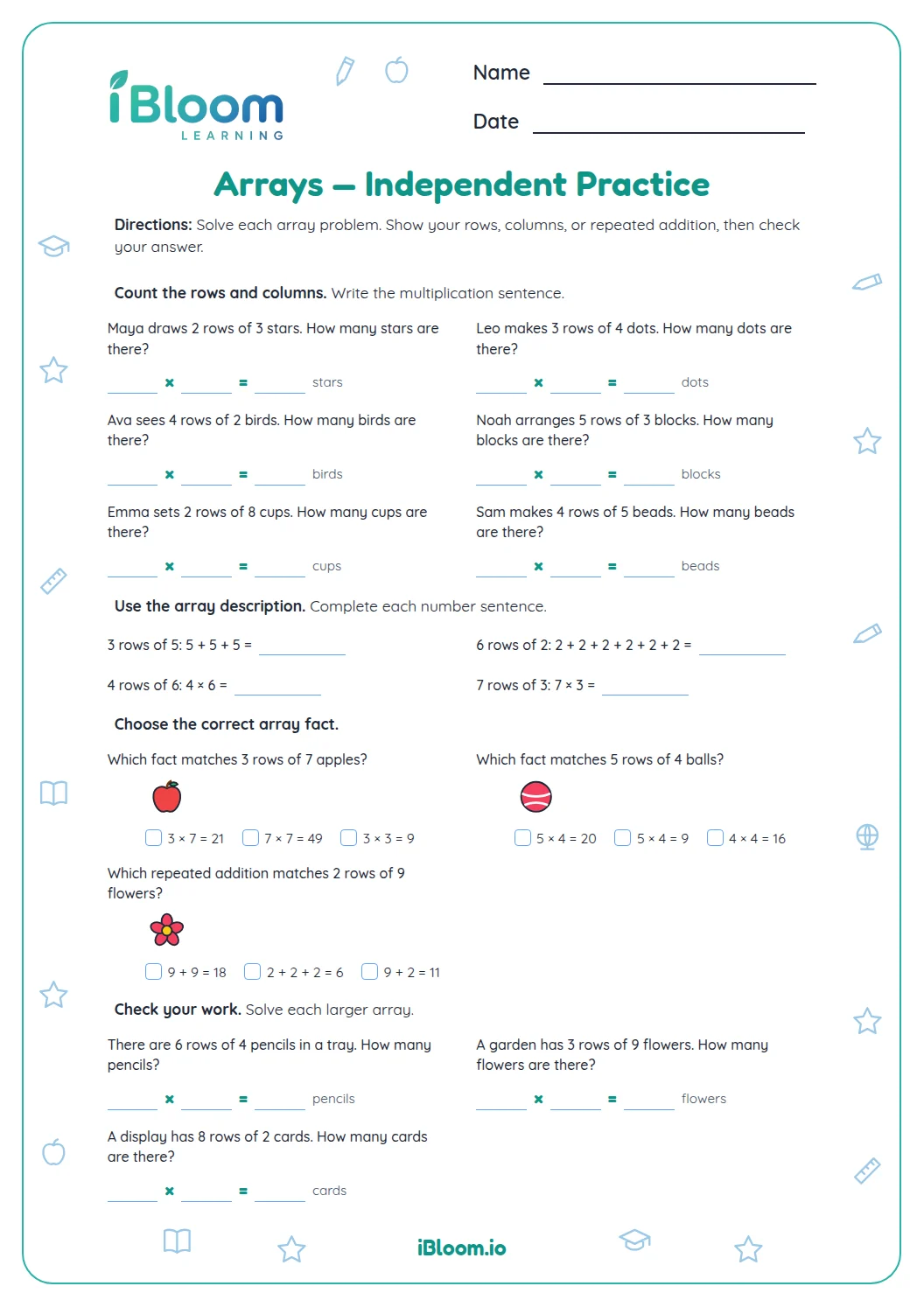
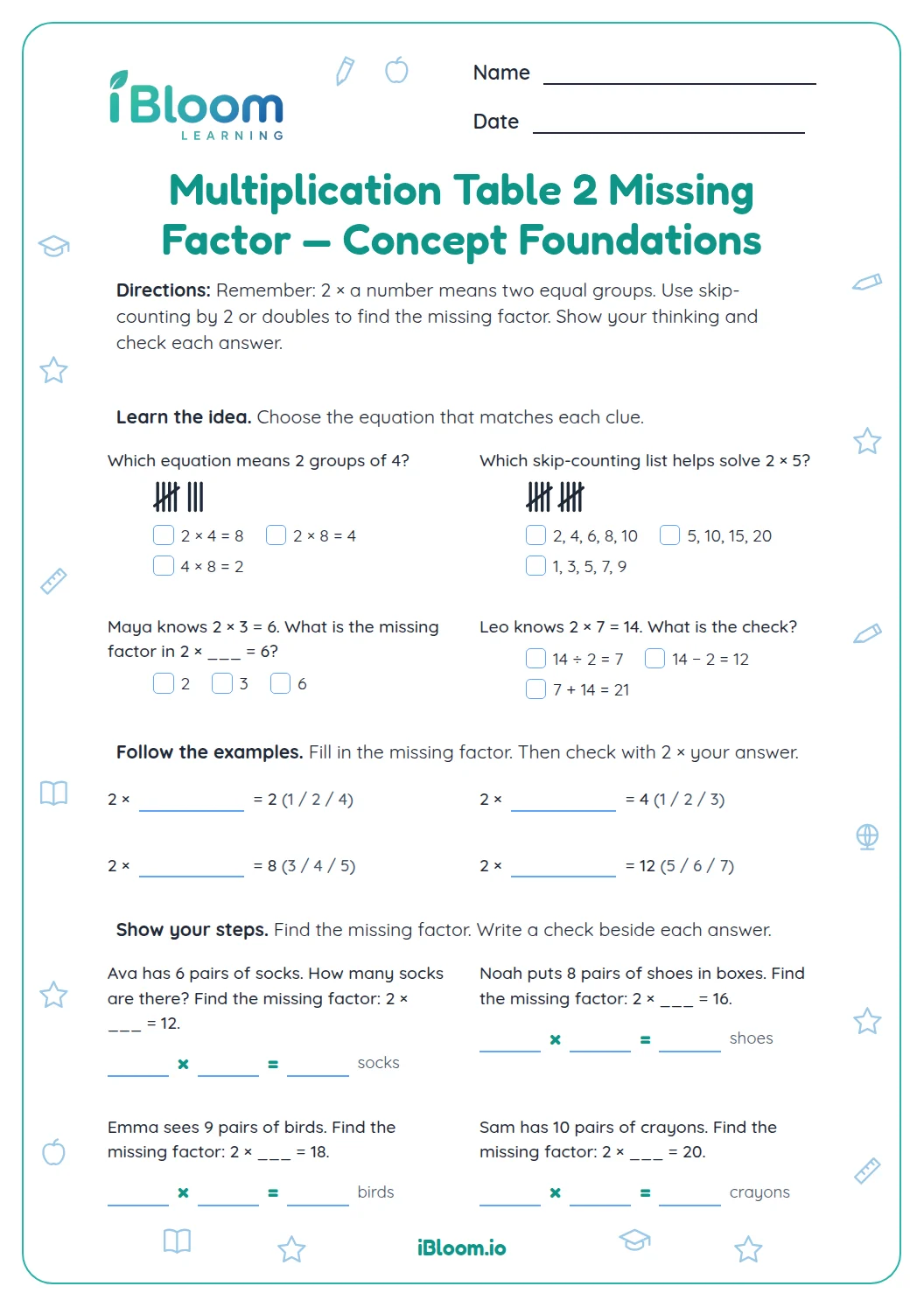
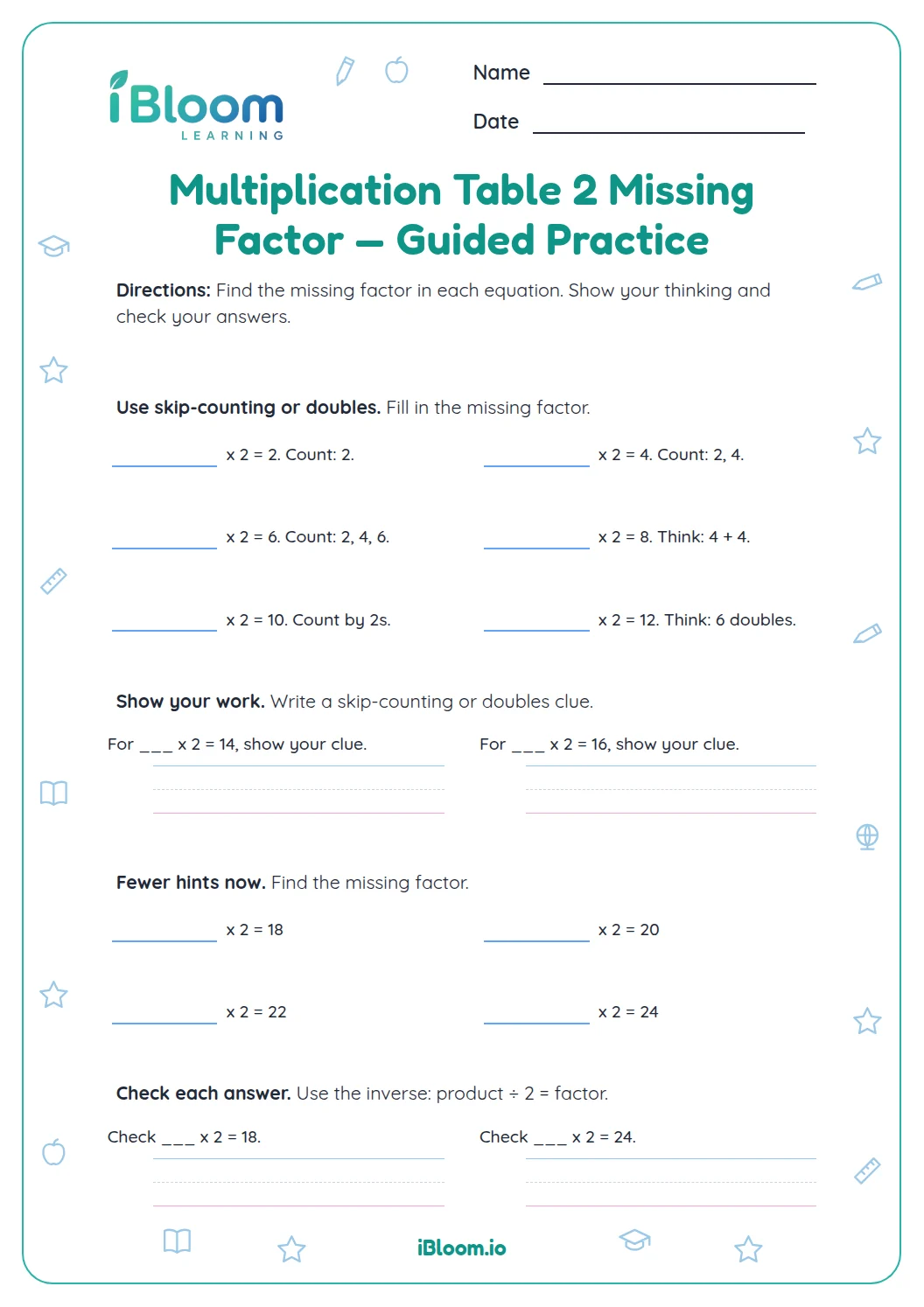
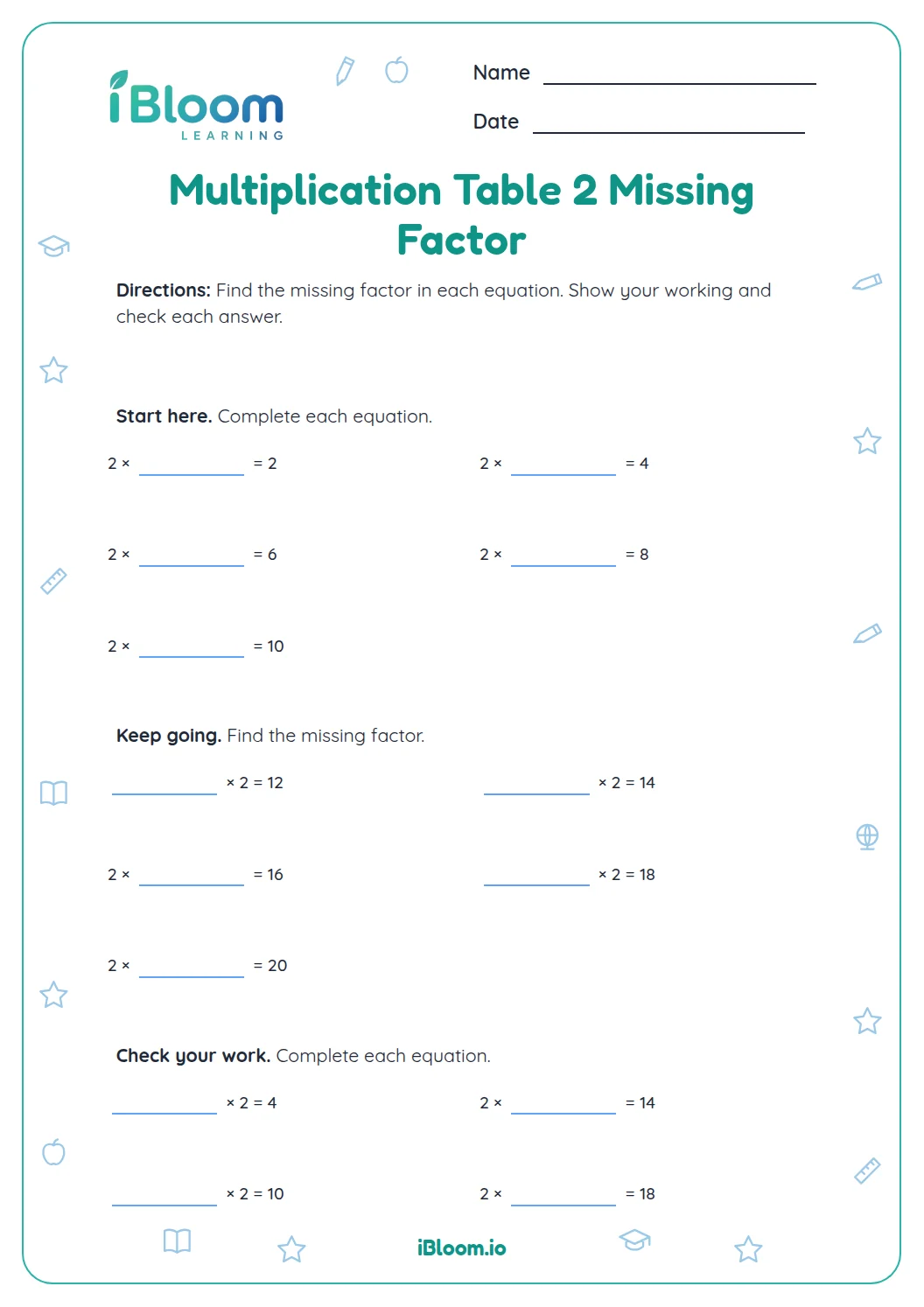
This free printable keeps the original everyday equal-groups setting while giving Grade 2 students 14 fresh problems. Part A asks students to match six stories to multiplication equations. Part B asks them to find totals for eight distinct stories, from oranges and birds to books. The answer key gives each product and unit.
How do you turn an equal-groups story into an equation?
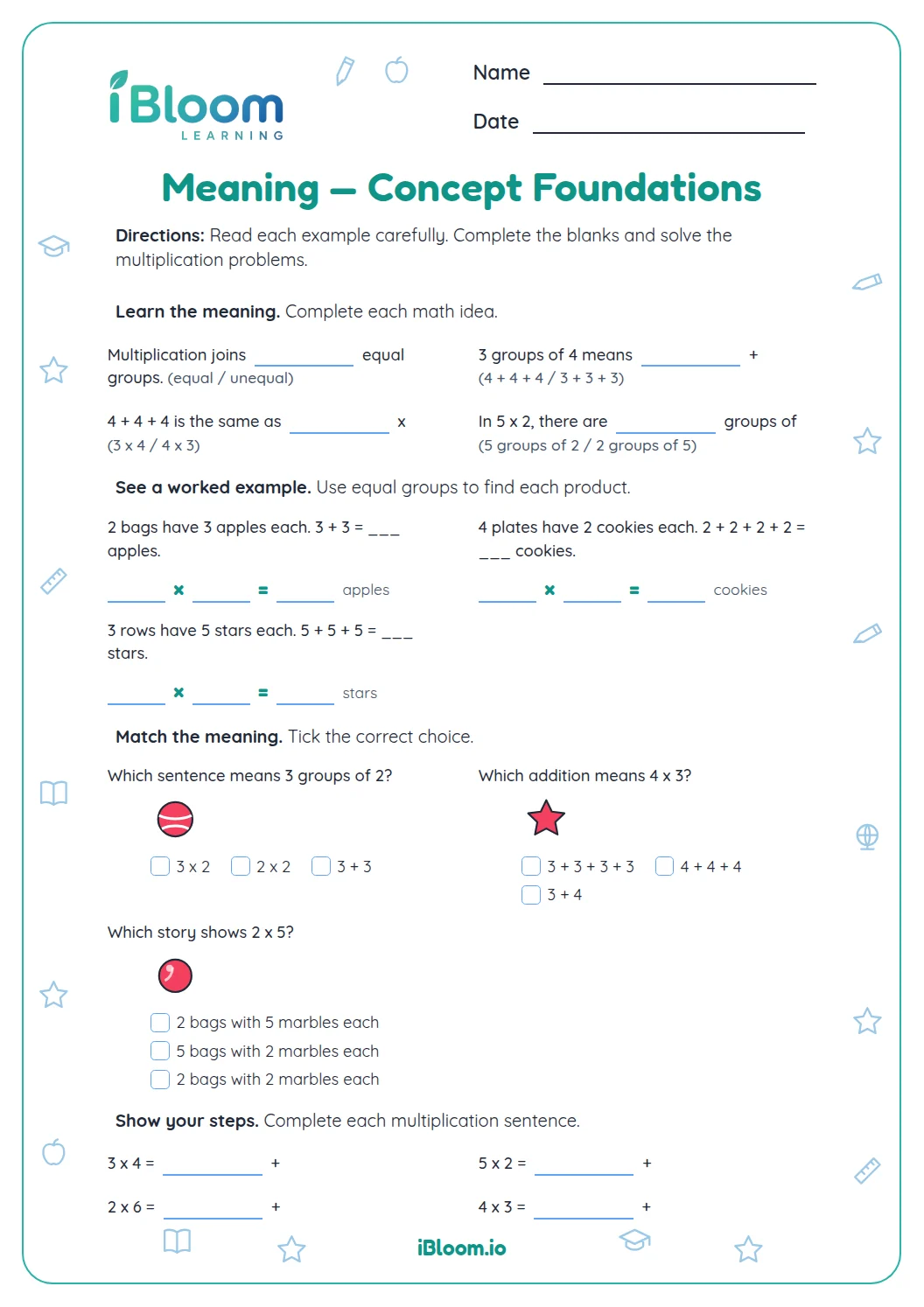
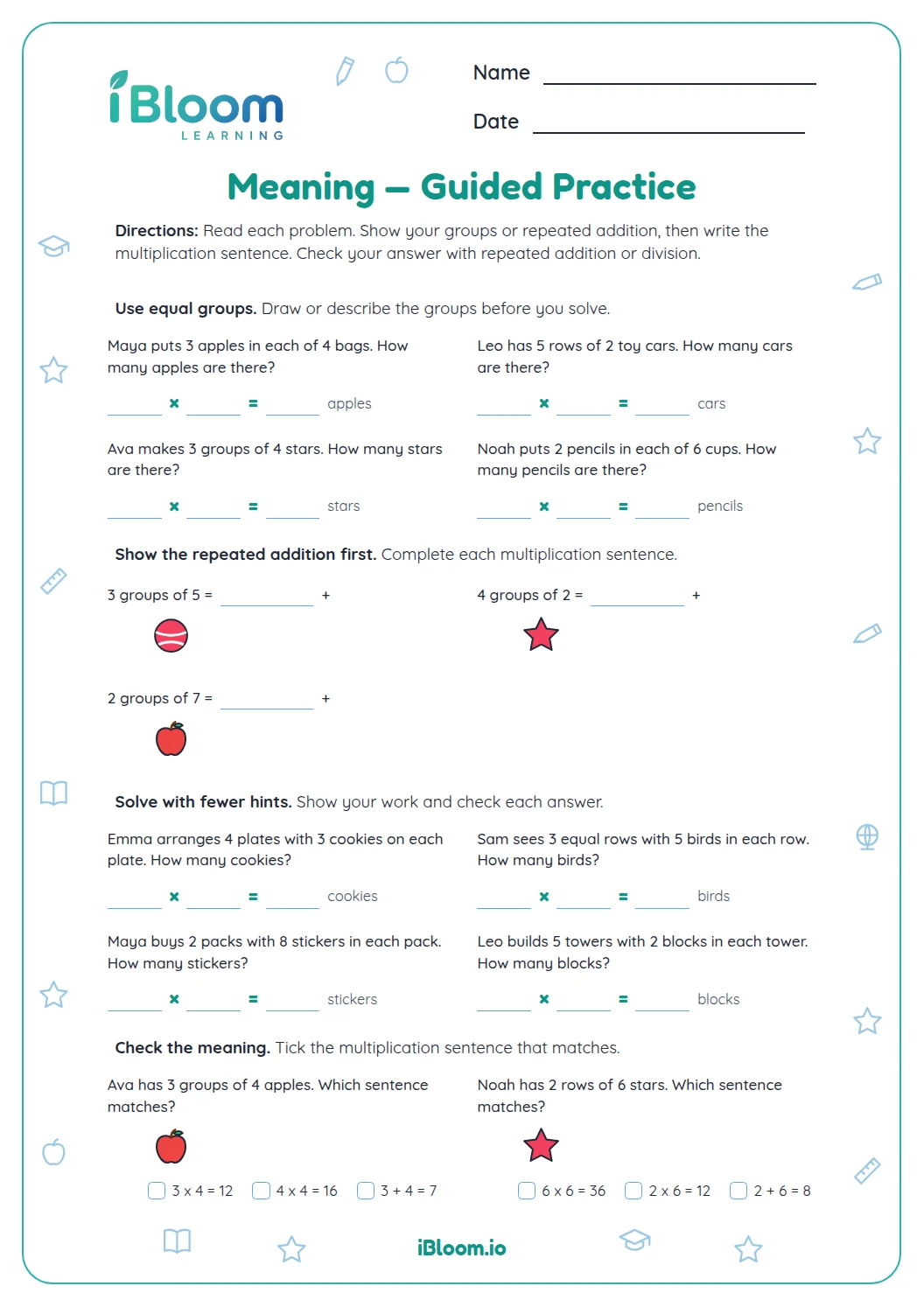
Look for how many groups there are and how many items are in each group. Here, every Part A story has 2 groups, so the matching equation begins with 2 ×.
- 1Maya has 2 bags with 6 apples in each bag.
- 22 groups × 6 apples in each = 2 × 6.
How can you solve a story about two groups?
Multiply the number of groups by the amount in one group. Then include the unit named in the question, such as oranges, beads or dollars.
For question 7, two baskets each hold 7 oranges. Double 7 to get 14, then write “14 oranges.”
How can you check a product?
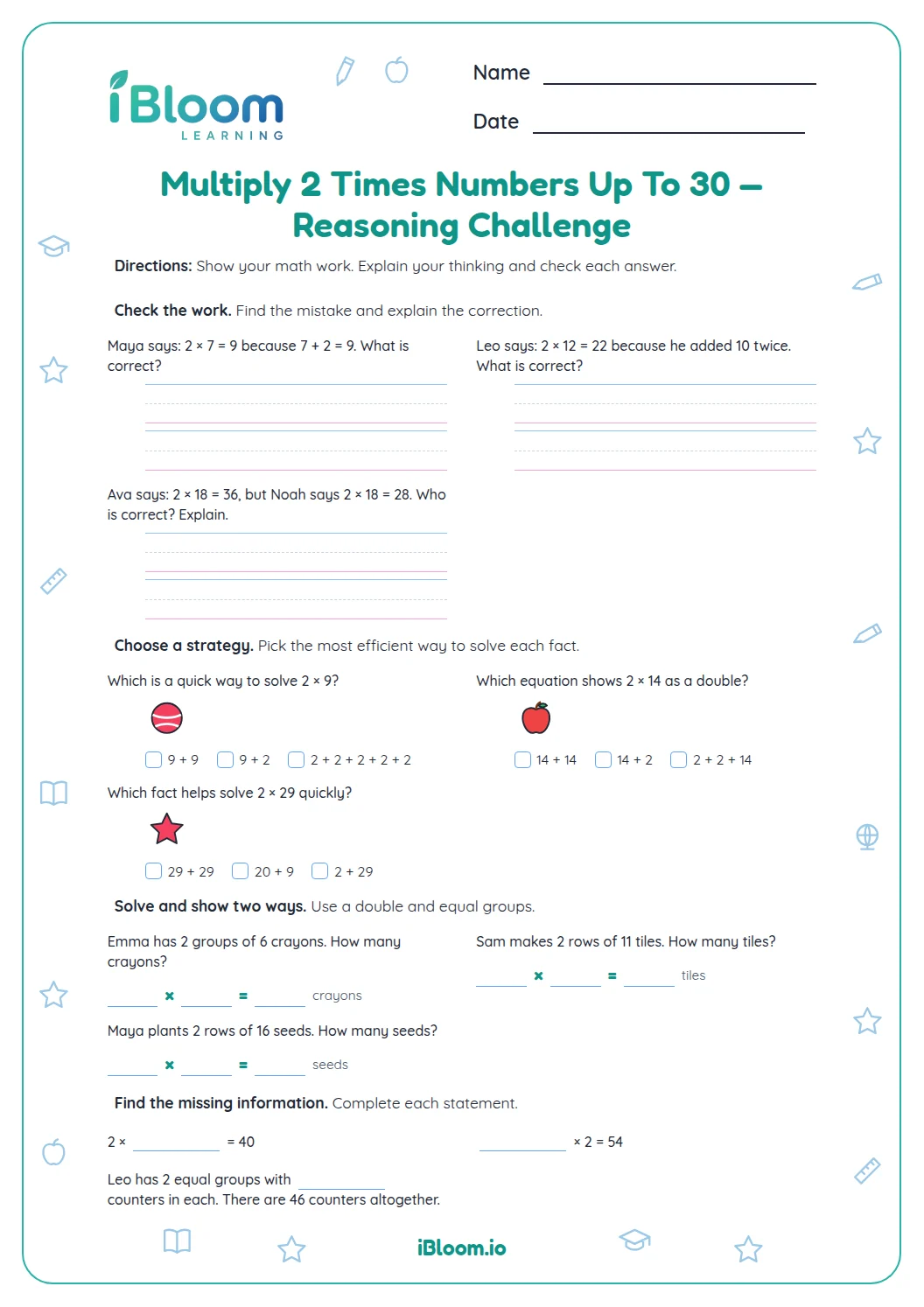
Double the group size or add it twice. For 2 × 23, calculate 23 + 23 = 46. If the product is smaller than 23, check the operation and the number of groups.
How to use this worksheet
- 1Read each story and underline the number of groups and the group size.
- 2In Part A, choose the equation that shows 2 groups of the stated amount.
- 3In Part B, write 2 × the group size in the work area.
- 4Double the group size to calculate the product.
- 5Add the correct unit to the answer.
- 6Use the answer key to check both the equation and total.
Common mistakes and quick fixes
The mistake
Adding 2 to the group size instead of multiplying.
The fix
Ask how many equal groups there are; two groups mean the amount is counted twice.
The mistake
Multiplying by the number of objects in both groups.
The fix
Use the number in one group once as the second factor; 2 × 7 is 14, not 2 × 14.
The mistake
Leaving off the unit.
The fix
Reread the question and label the total as apples, dollars, chairs or the other named item.
What to practice next
Make more practice
Further reading
Questions parents and teachers ask
What does “2 times 14” mean?
It means two equal groups of 14. Add 14 + 14 or double 14 to find the total, 28. In a story, the second factor names the number in each group, and the product names how many items there are altogether.
Should students write a number sentence?
Yes. The Part B work area is for writing a multiplication equation and finding its product. For two rows with 15 chairs in each row, write 2 × 15 = 30, then label the answer “30 chairs.” Ask the student to point to the words in the question or story that support the answer, then explain that clue aloud.
Why does the answer need a unit?
The unit tells what the product counts. A result of 22 could mean 22 dollars, 22 tickets or 22 beads. Match the unit in the answer to the objects or amount named in the story. Ask the student to point to the words in the question or story that support the answer, then explain that clue aloud.
Can students use repeated addition?
Yes. Adding the group size twice is a useful way to check: 2 × 18 equals 18 + 18, or 36. The equation still shows the multiplication structure of the story. Ask the student to point to the words in the question or story that support the answer, then explain that clue aloud.
What is on the answer key?
The key shows the equation choices for Part A and the product with its unit for each Part B story. Check the number sentence and the final total so students can spot whether an error came from the setup or calculation.