




About this worksheet
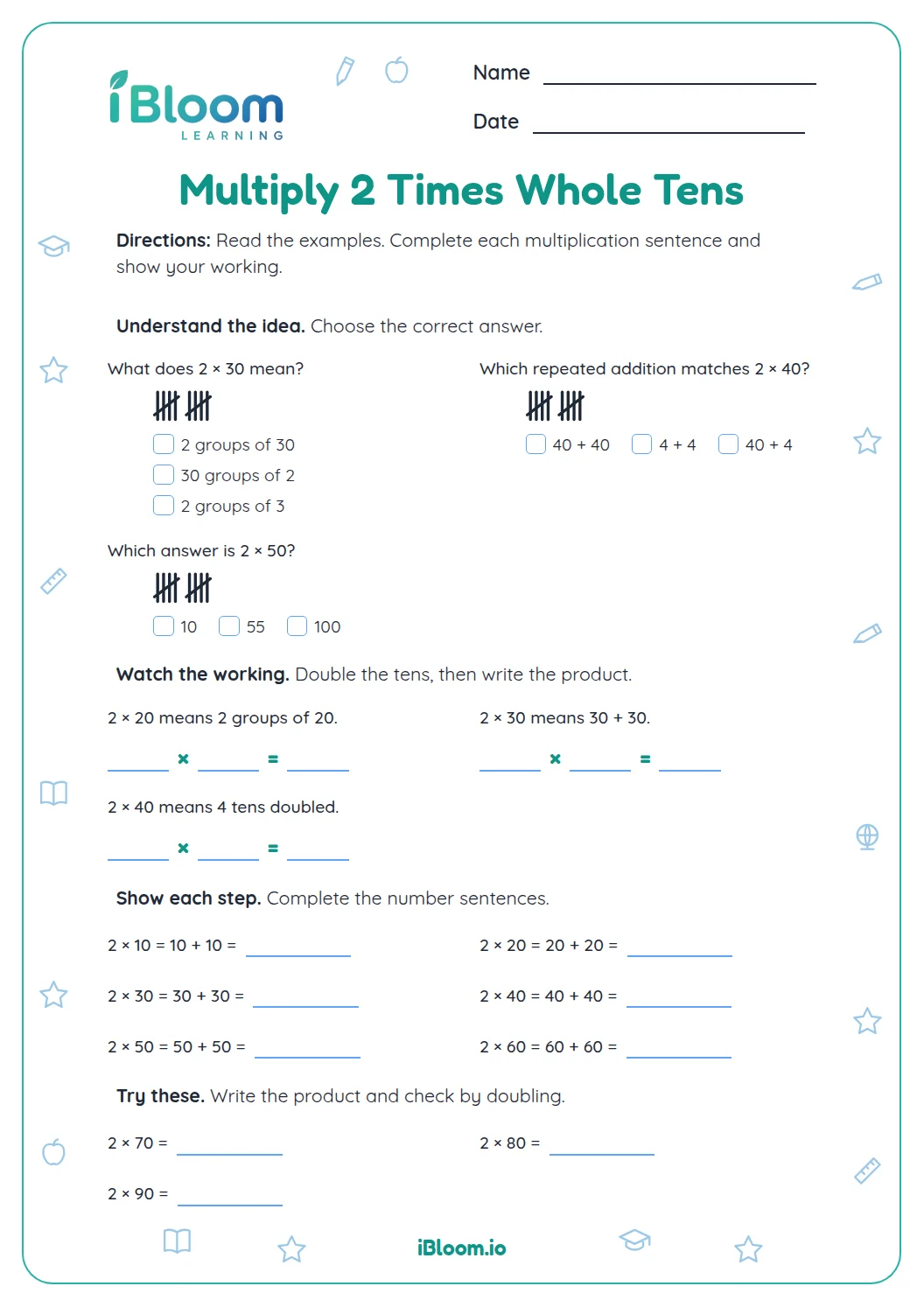
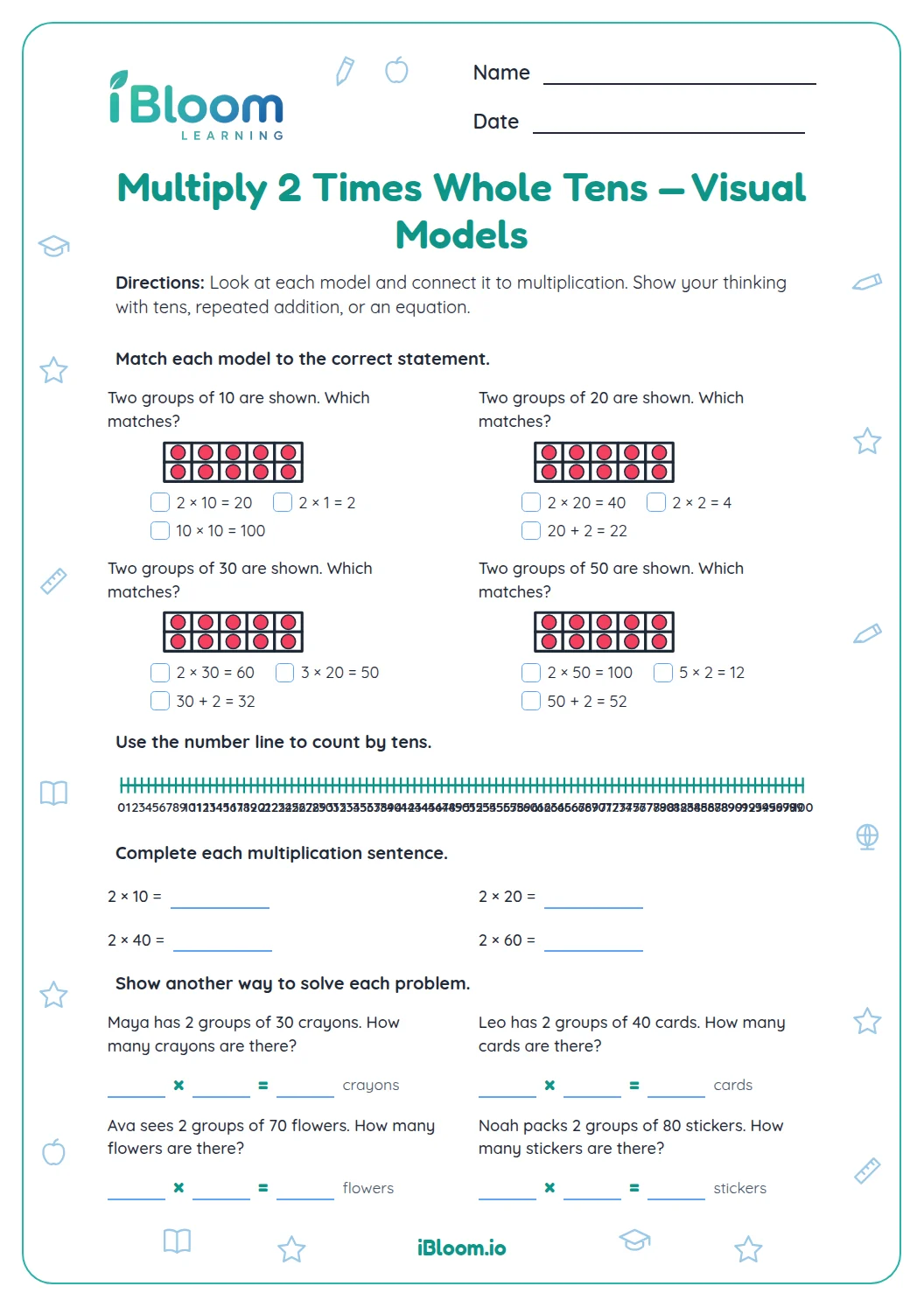
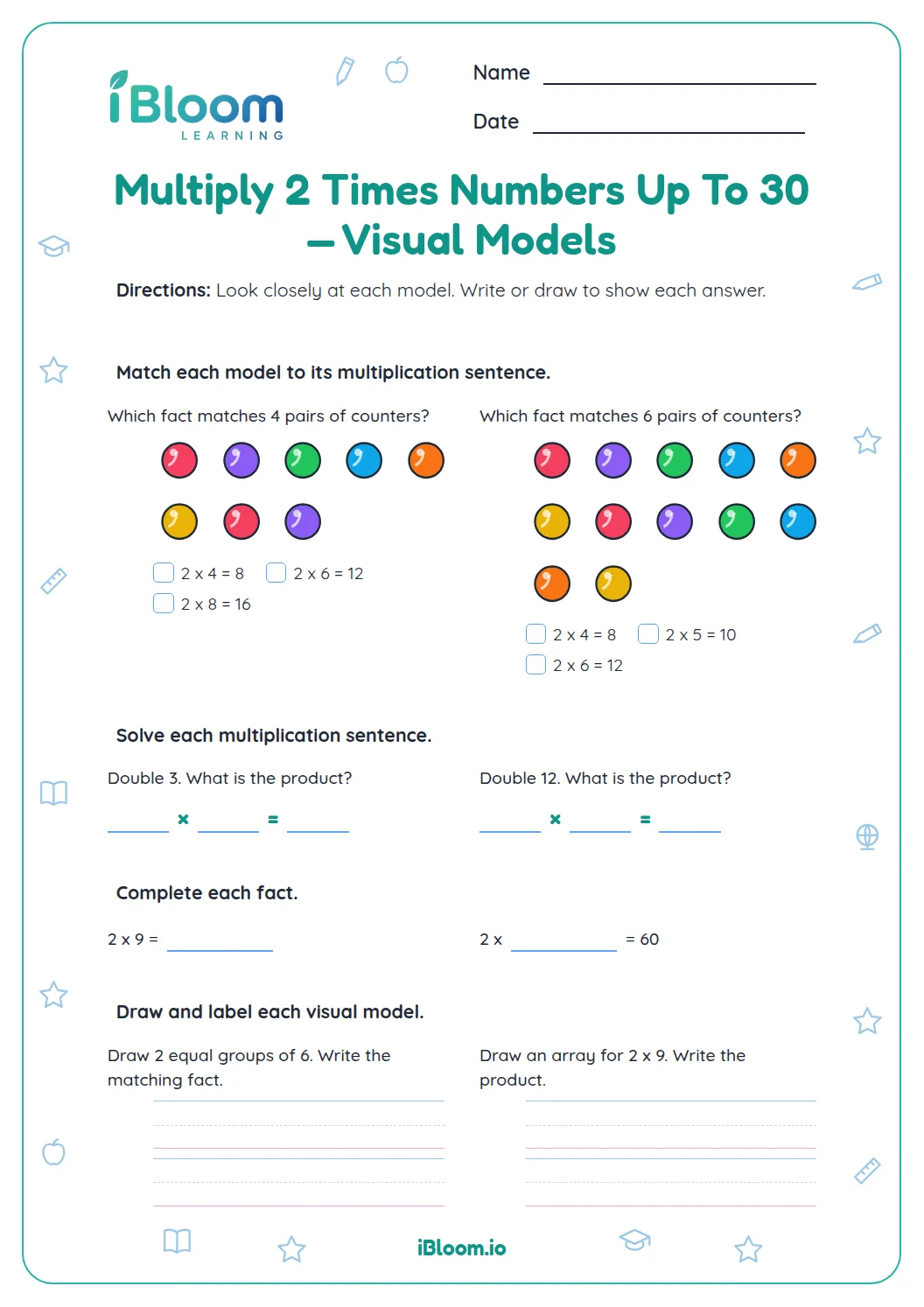
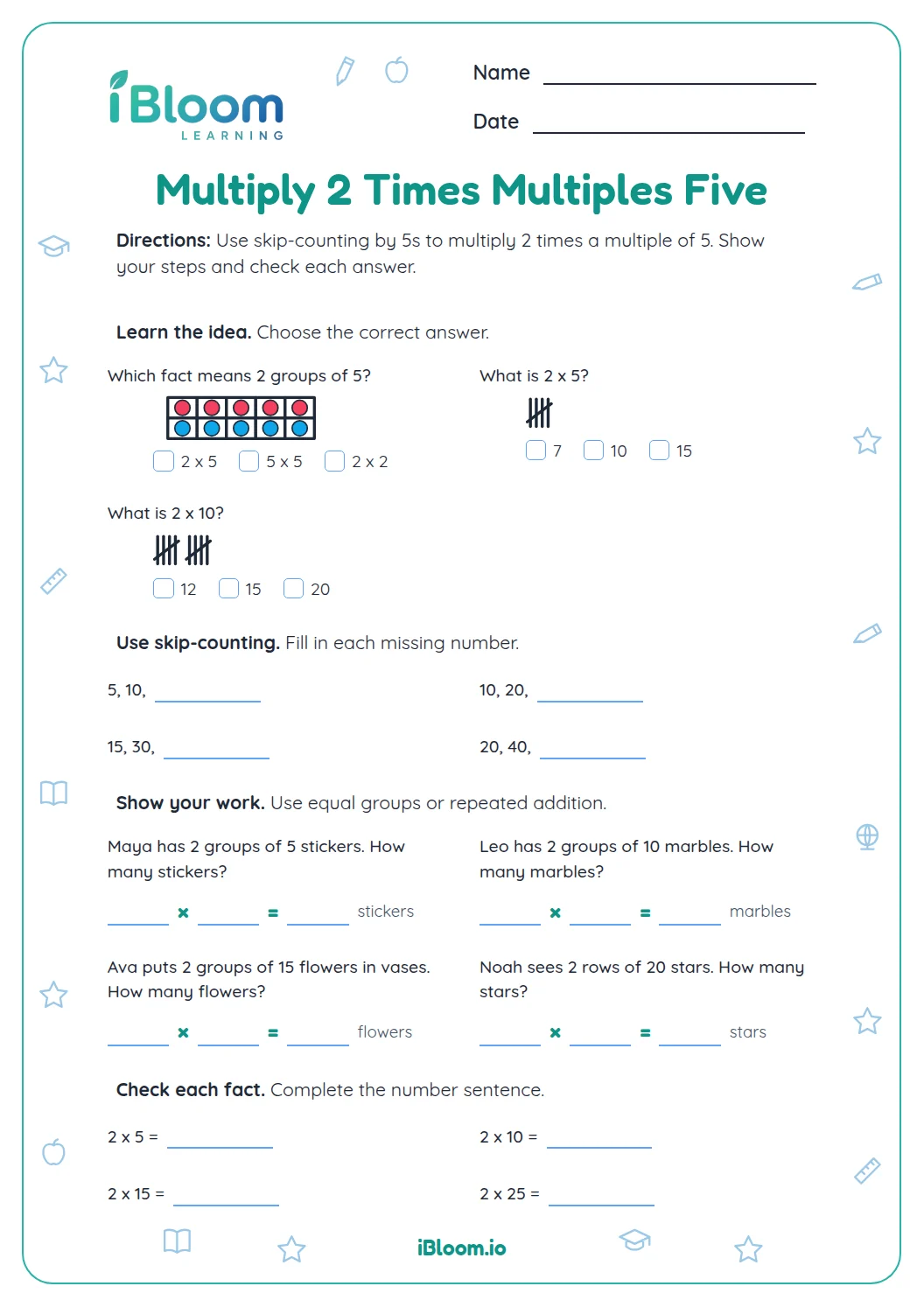
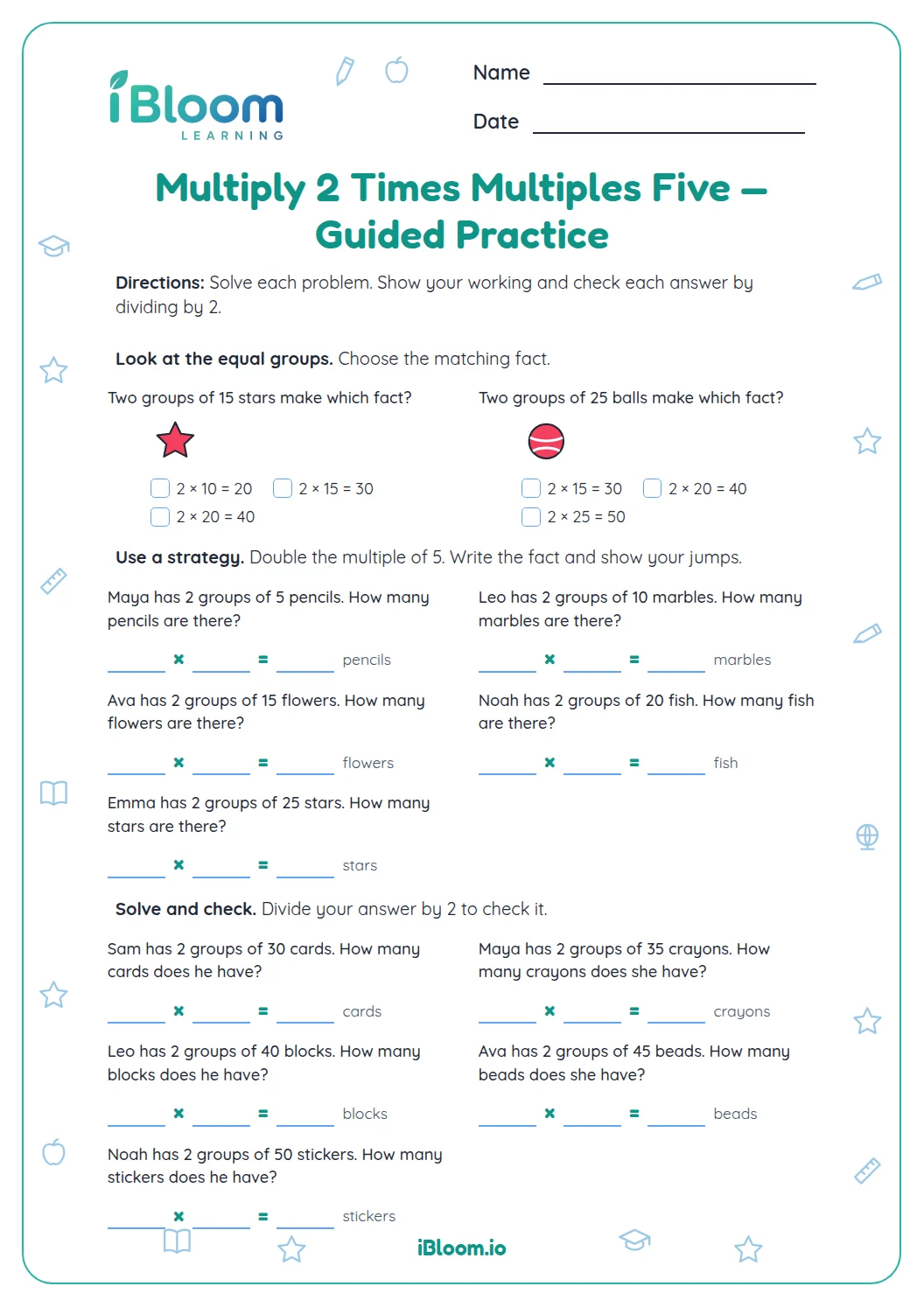
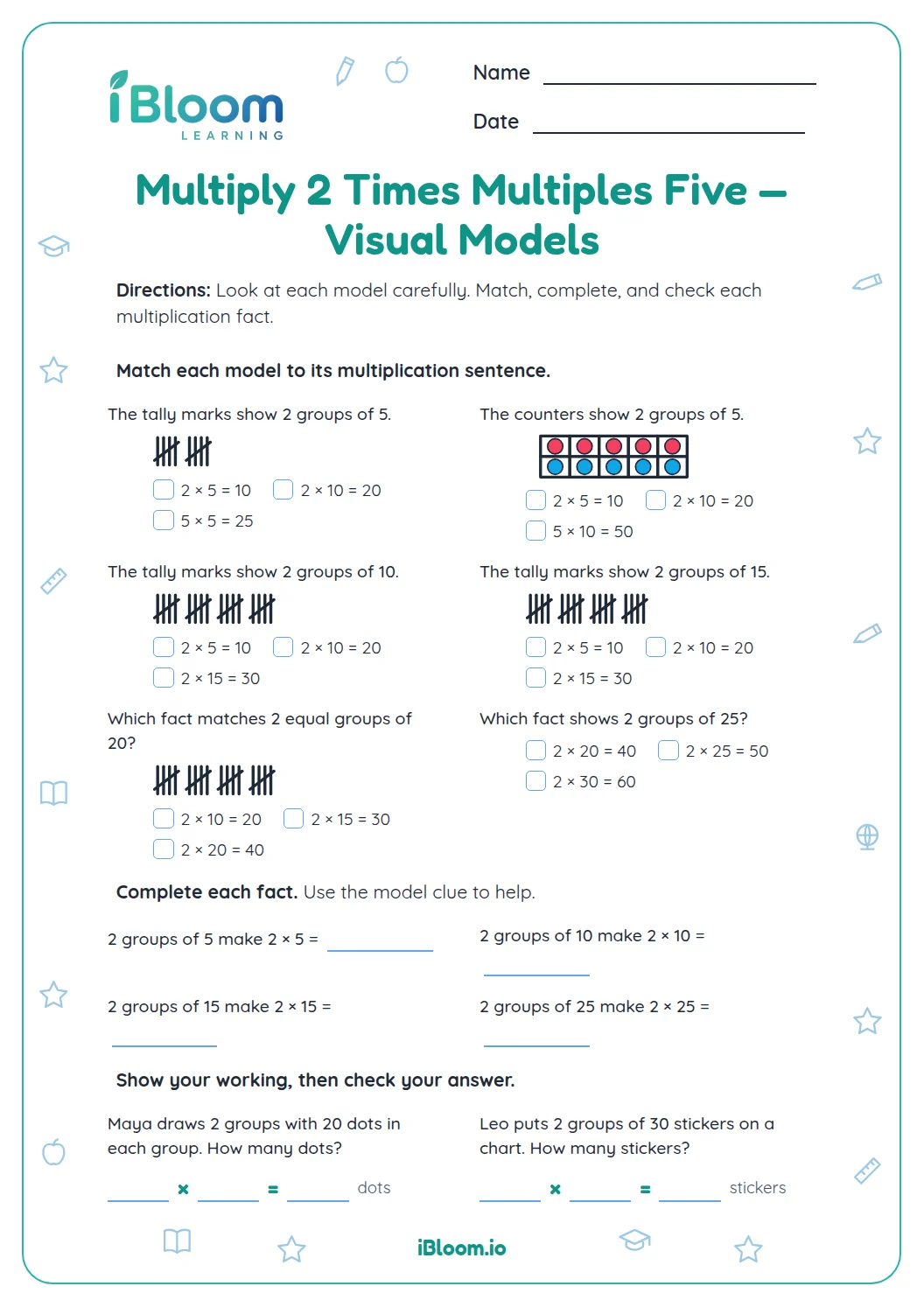
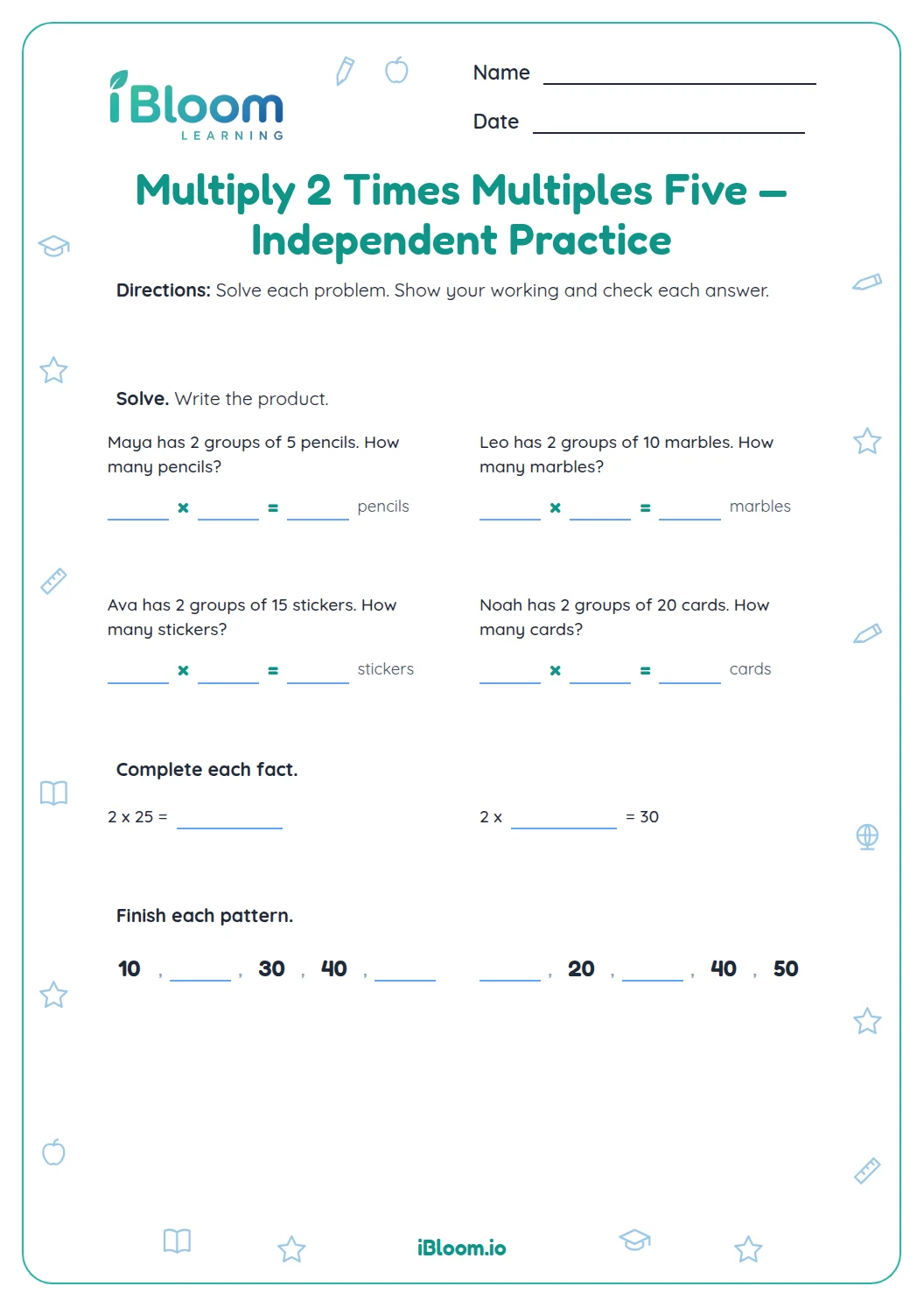
This Grade 2 worksheet practices doubling whole tens in everyday group stories and short number sentences. Students choose matching products, find three products, and identify why 2 × 70 cannot equal 14. Fourteen questions use whole tens from 20 through 90, and the answer key includes units for story totals.
How does doubling tens work?
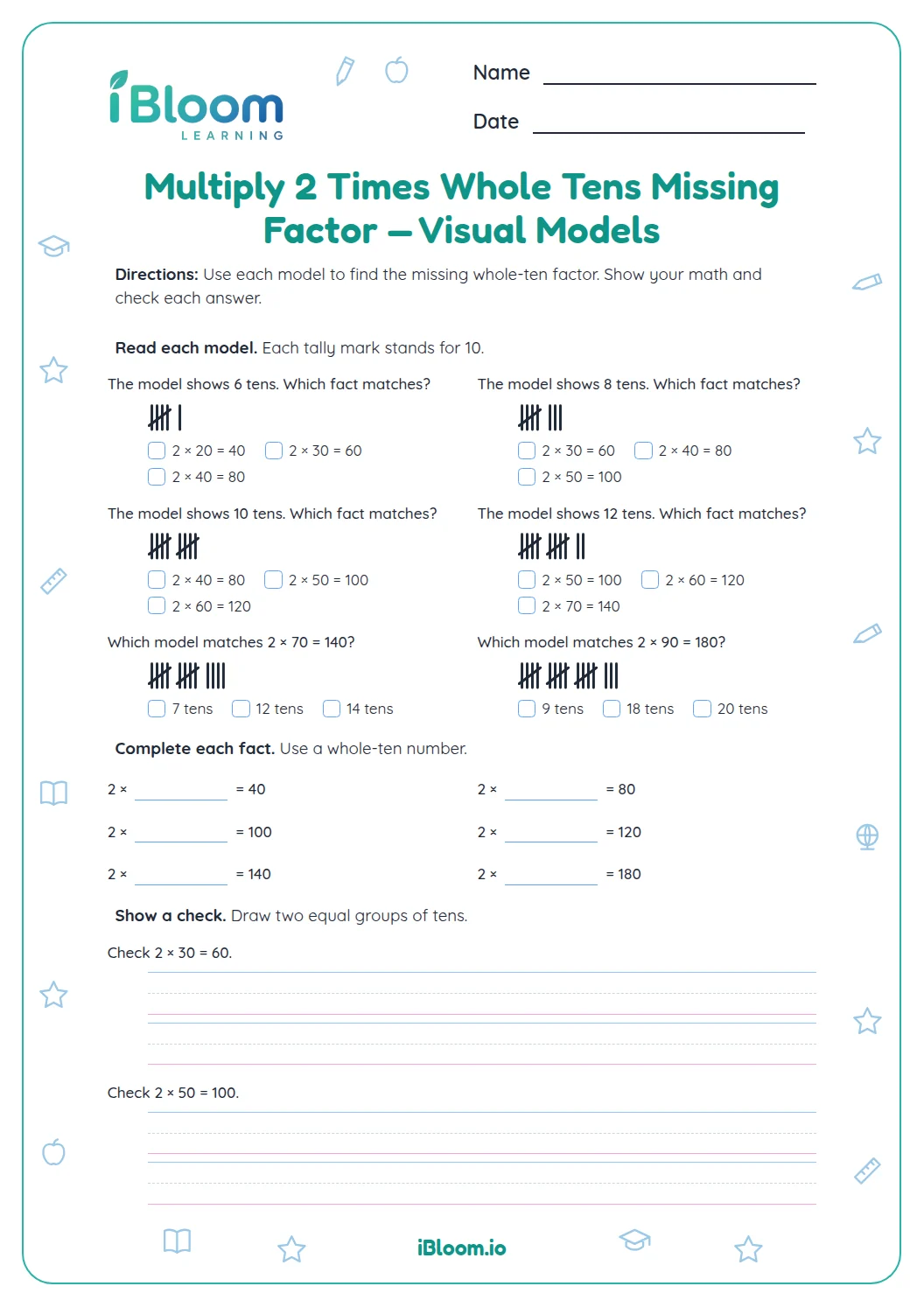
Think of 30 as 3 tens. Two groups of 3 tens make 6 tens, which is 60. The tens unit matters as much as the fact 2 × 3 = 6.
- 12 bags × 30 stickers each
- 22 × 3 tens = 6 tens
- 3Answer: 60 stickers
How do the stories show multiplication?
Look for two groups that have the same number in each. The number in one group is the factor to double; the context tells you what the answer counts.
Why is 2 × 70 not 14?
The basic fact 2 × 7 = 14 counts fourteen groups of one. Here the 7 means seven tens, so the product is fourteen tens: 140.
How to use this worksheet
- 1Circle the two equal groups in the story.
- 2Write 2 × the amount in one group.
- 3Double the nonzero digit.
- 4Keep the tens place in the product.
- 5Add the unit named by the story.
Common mistakes and quick fixes
The mistake
Writing 14 for 2 × 70.
The fix
Read 70 as 7 tens; 14 tens is 140.
The mistake
Adding 2 + 70.
The fix
The story has two equal groups, so multiply 2 × 70.
The mistake
Leaving off what is counted.
The fix
Label the total with the story unit, such as cups.
What to practice next
Make more practice
Further reading
Questions parents and teachers ask
What does 2 times a whole ten mean?
It means making two equal groups of a number such as 30 or 70. Think of 70 as seven tens: two groups make fourteen tens, or 140. The worksheet uses short stories and number sentences to connect that place-value reasoning with the product.
How many questions are on the worksheet?
There are 14 questions across four parts. Students solve equal-group stories, choose matching multiplication equations, fill in products, and explain a place-value error. The two worksheet pages build from direct examples toward applying the same idea in a new context.
Why is 2 × 70 equal to 140 instead of 14?
The 7 in 70 stands for seven tens. Doubling seven tens gives fourteen tens, and fourteen tens equals 140. The answer key names the tens so a child can see why the zero is part of the product rather than an extra mark.
Do students need to draw a model?
The directions invite students to show their working, and the story problems provide room to write an equation and answer. A child can sketch two groups of tens if useful, then check that the product and the story unit agree.
What should we review after this page?
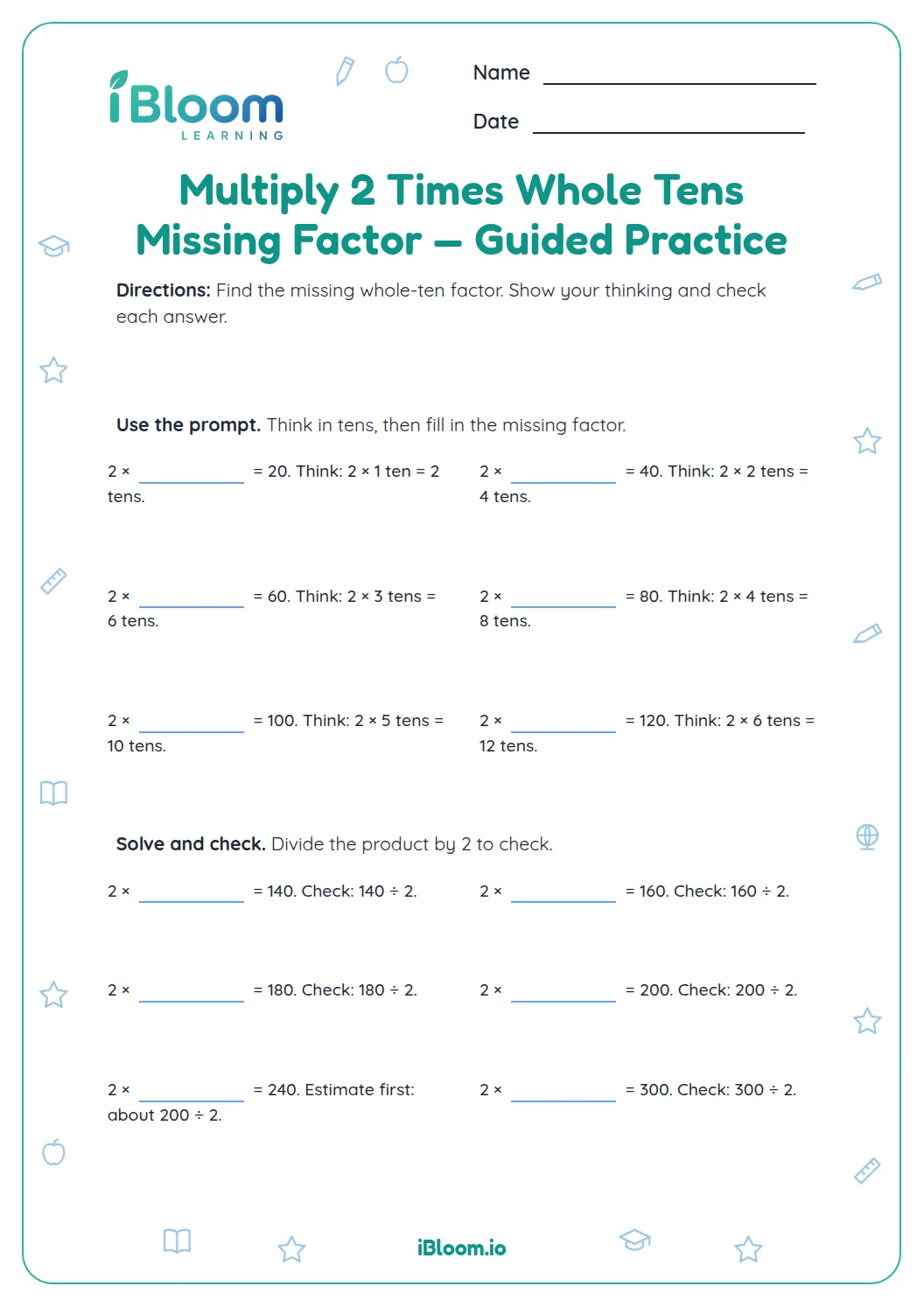
Ask your child to explain one story with the phrase “___ tens doubled is ___ tens.” For more practice, the linked missing-factor sheet reverses the same multiplication relationship, while arrays connect equal groups to rows and columns for another useful visual model.