


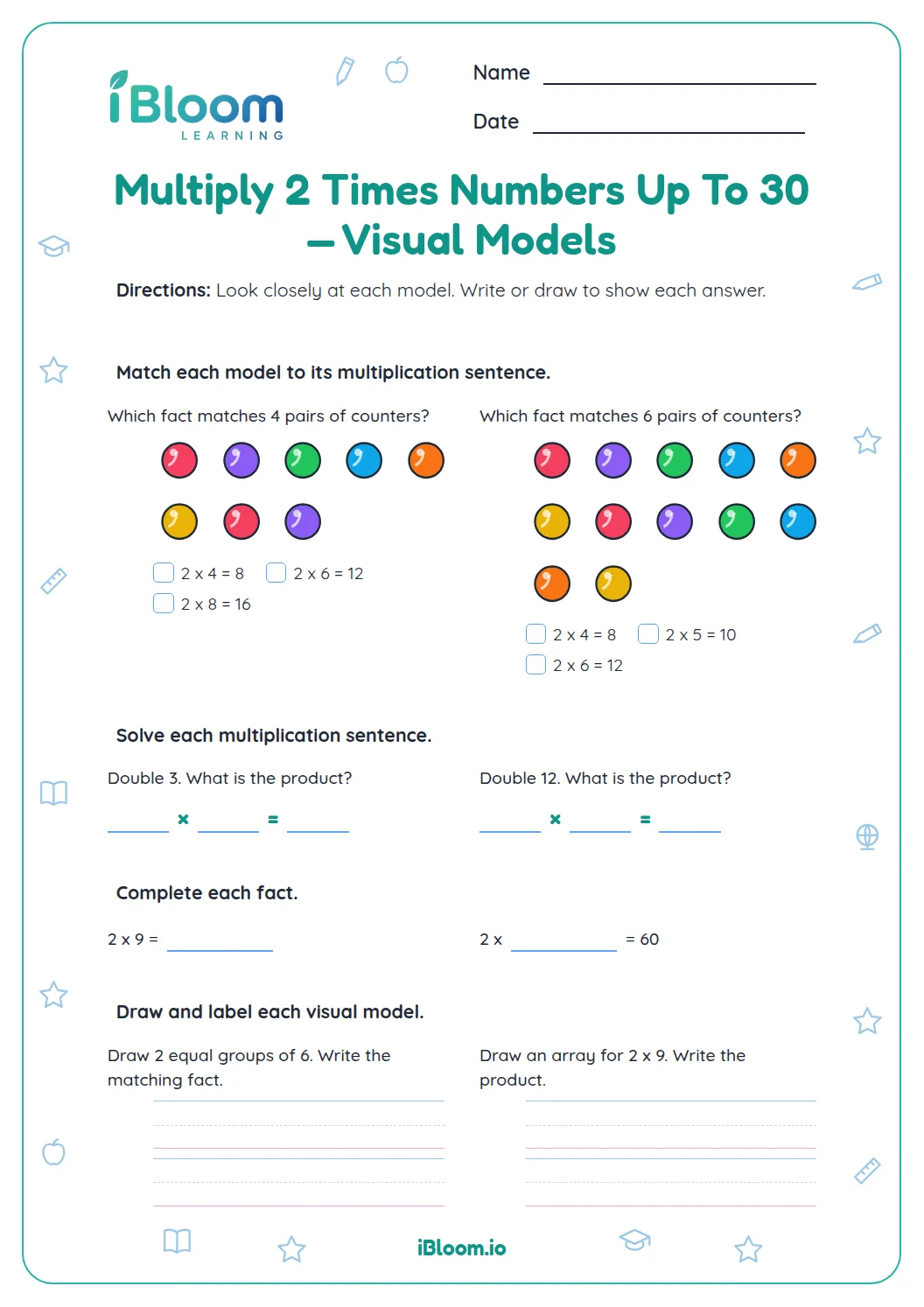

About this worksheet
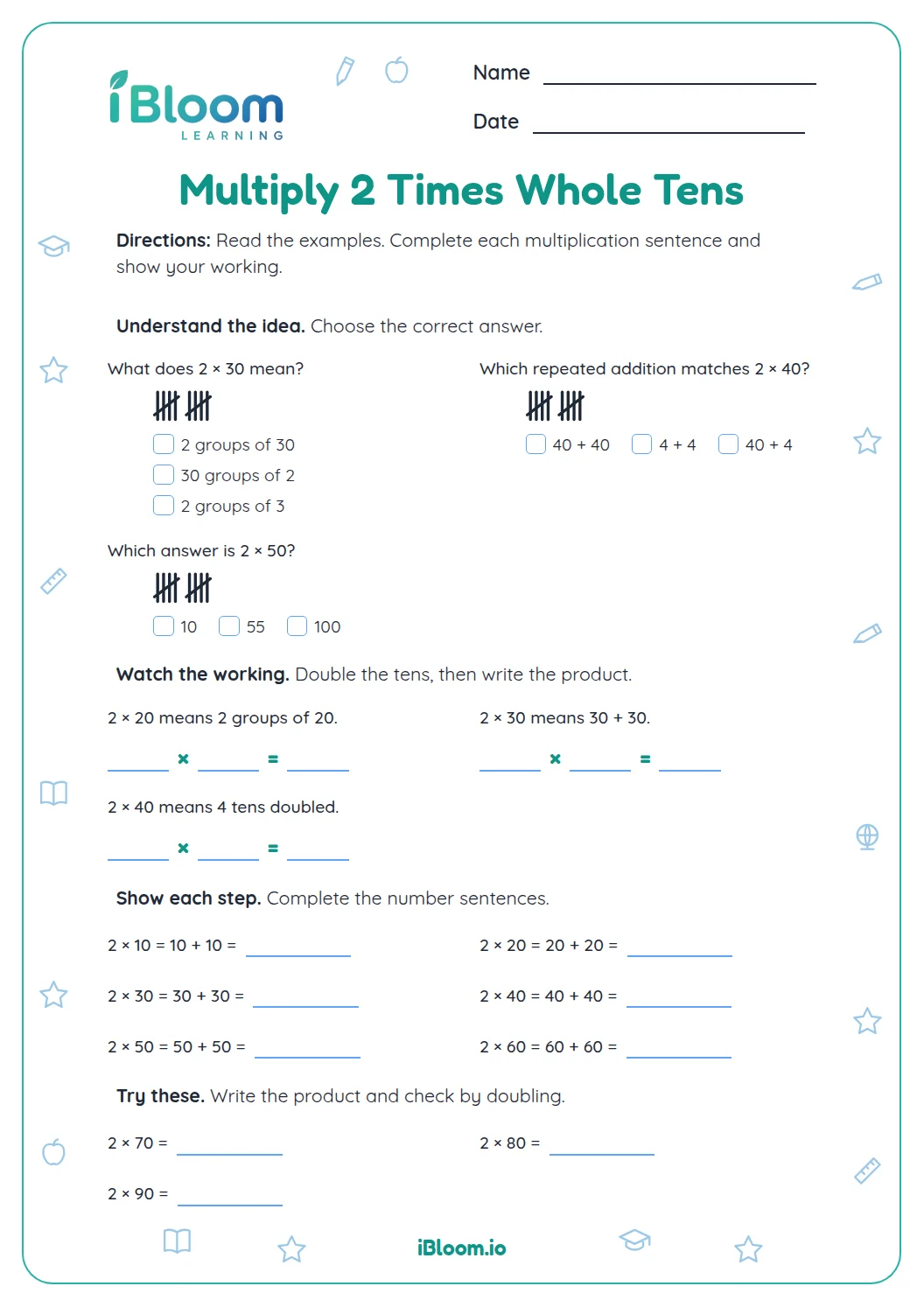
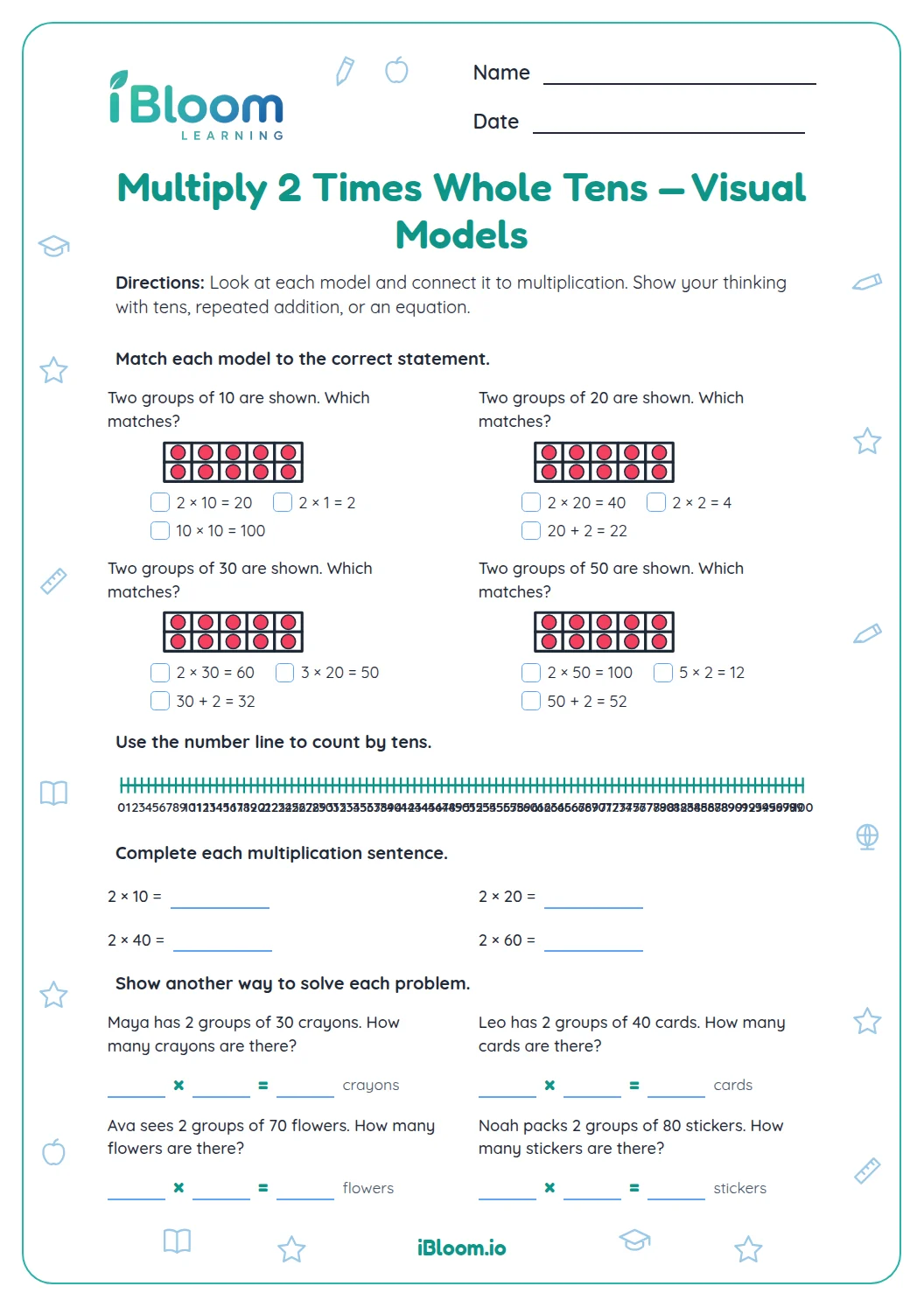
This Grade 2 worksheet gives learners 16 problems multiplying 2 by whole tens. It starts with direct equations, moves to familiar equal-group stories, and finishes with additional products, including 2 × 80 and 2 × 90. Children can use the answer key to check each product and name the result in tens.
Aligned to 3.NBT.A.3
How do you work through multiplying 2 by whole tens?
Find how many tens are in the factor, multiply that count by 2, and express the result in tens.
Write one step at a time and check that the result answers the question asked. The answer key gives a way to check each item.
- 12 × 40
- 22 × 4 tens = 8 tens
- 38 tens = 80
What will the practice ask you to do?
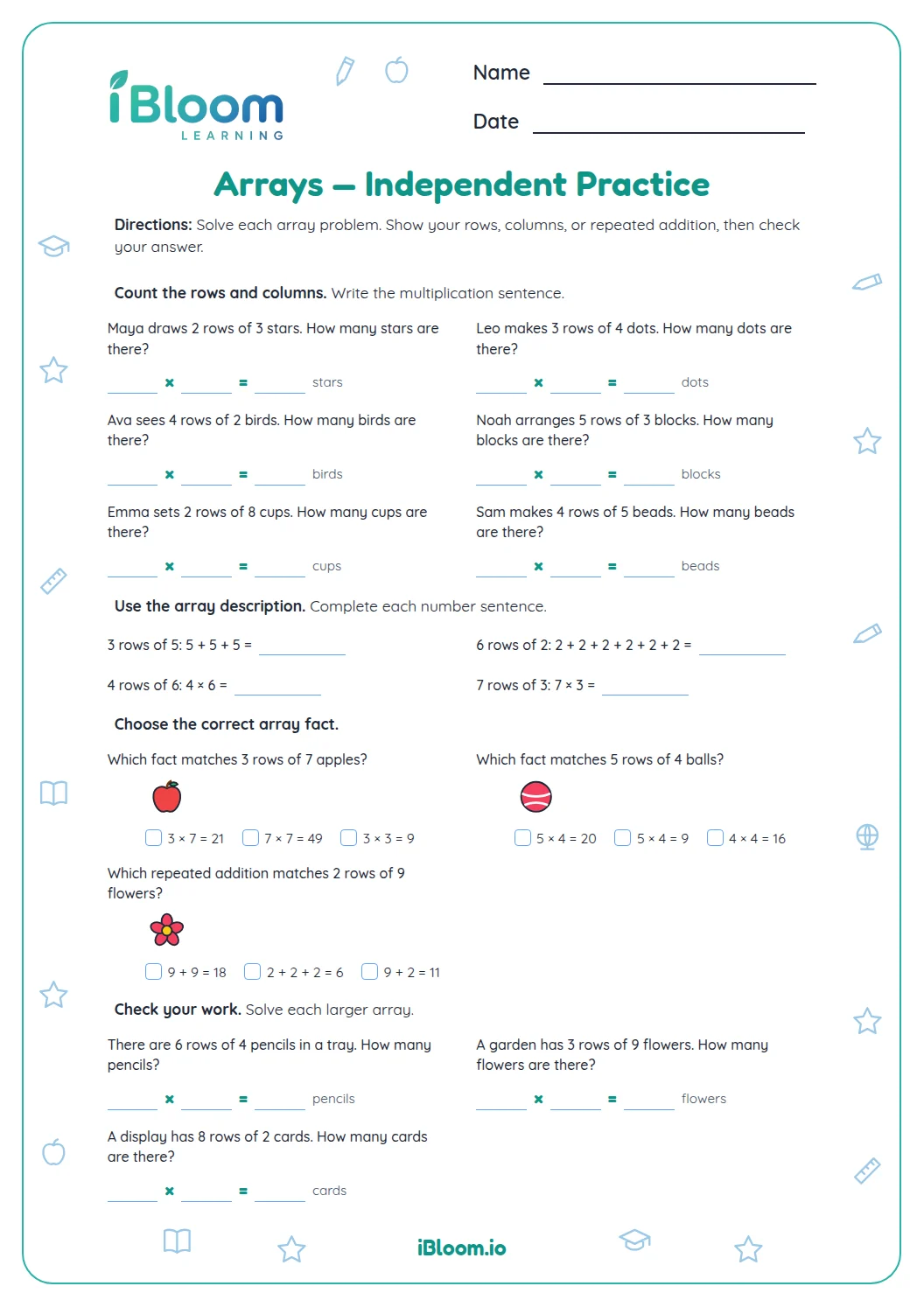
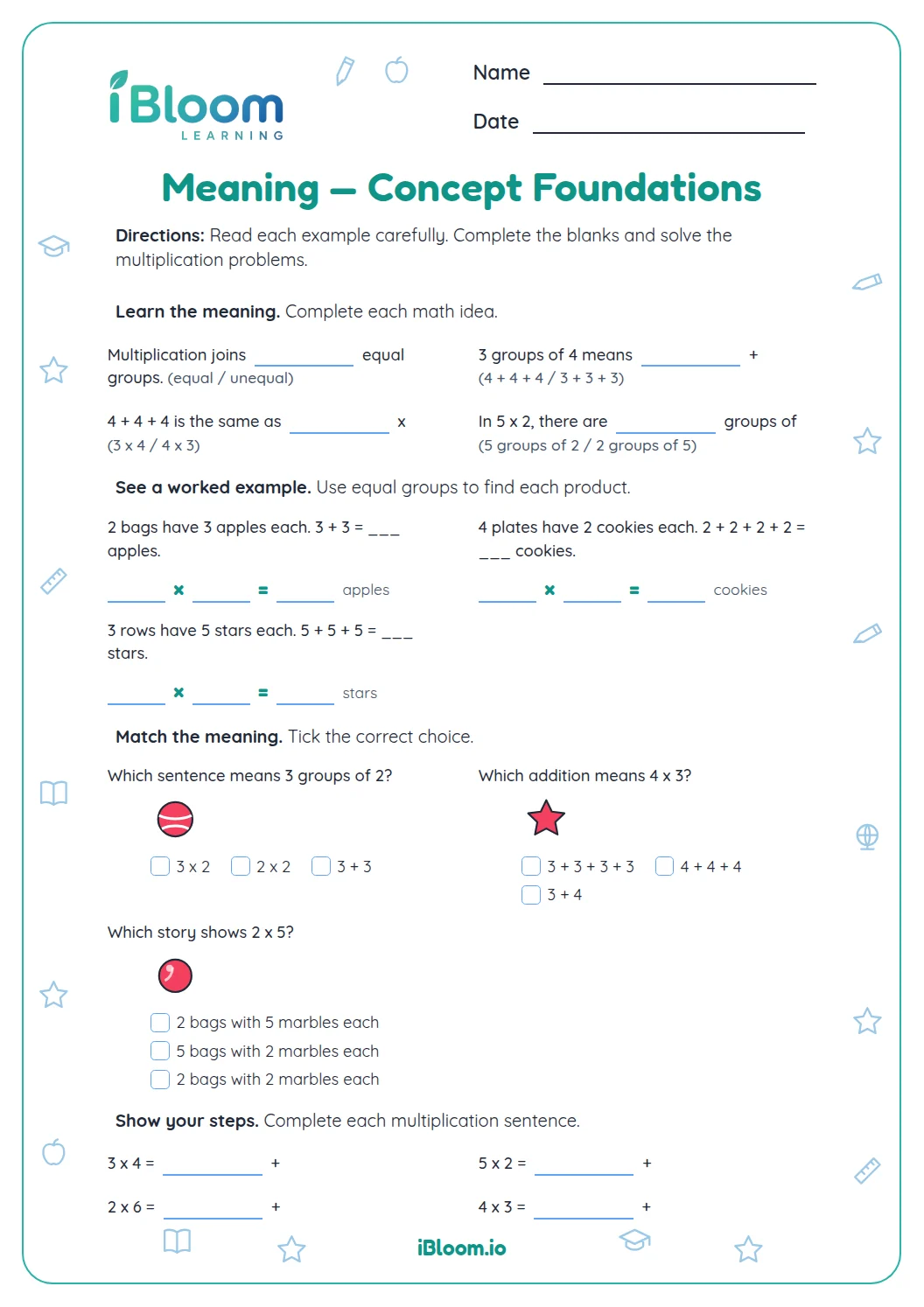
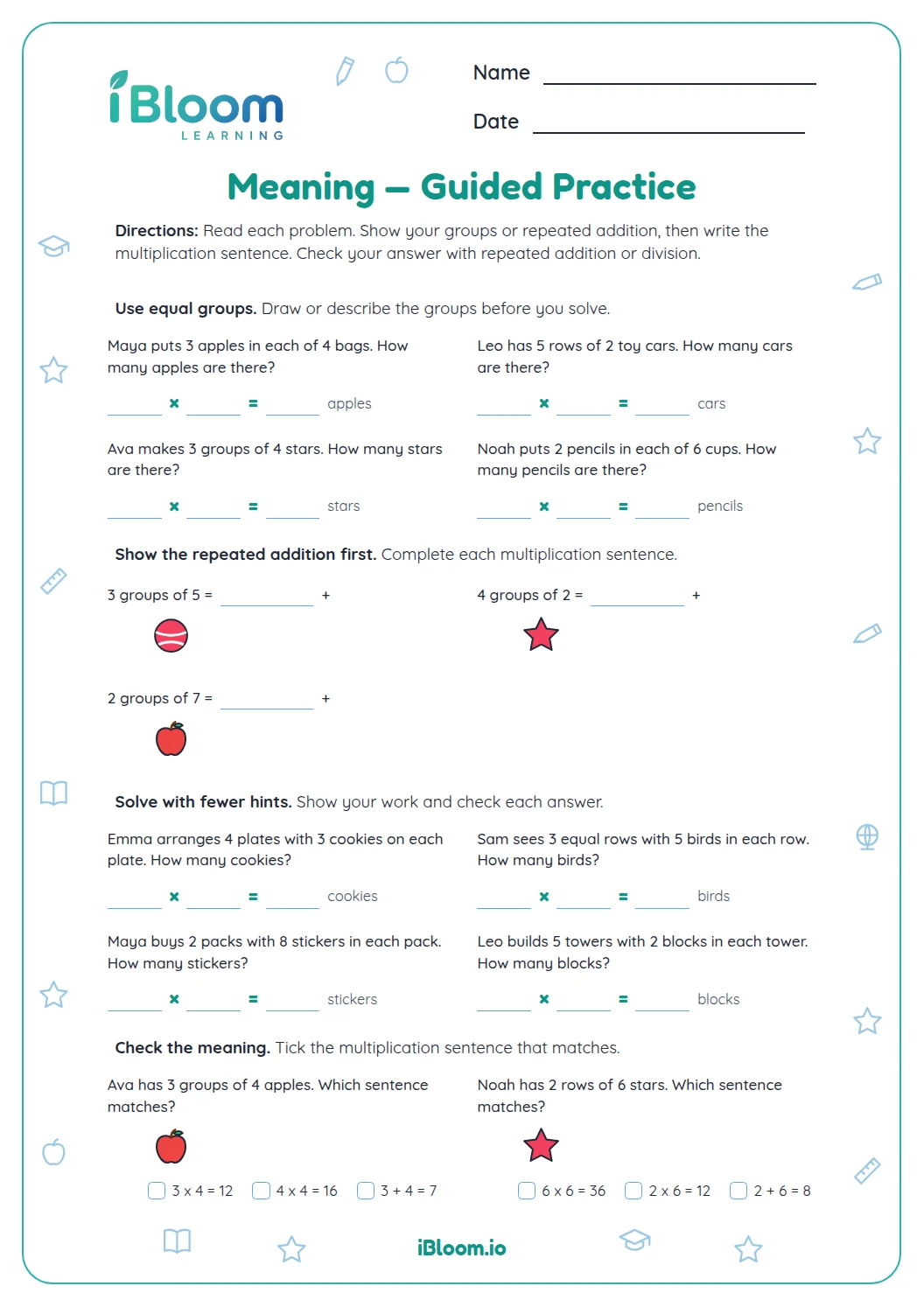
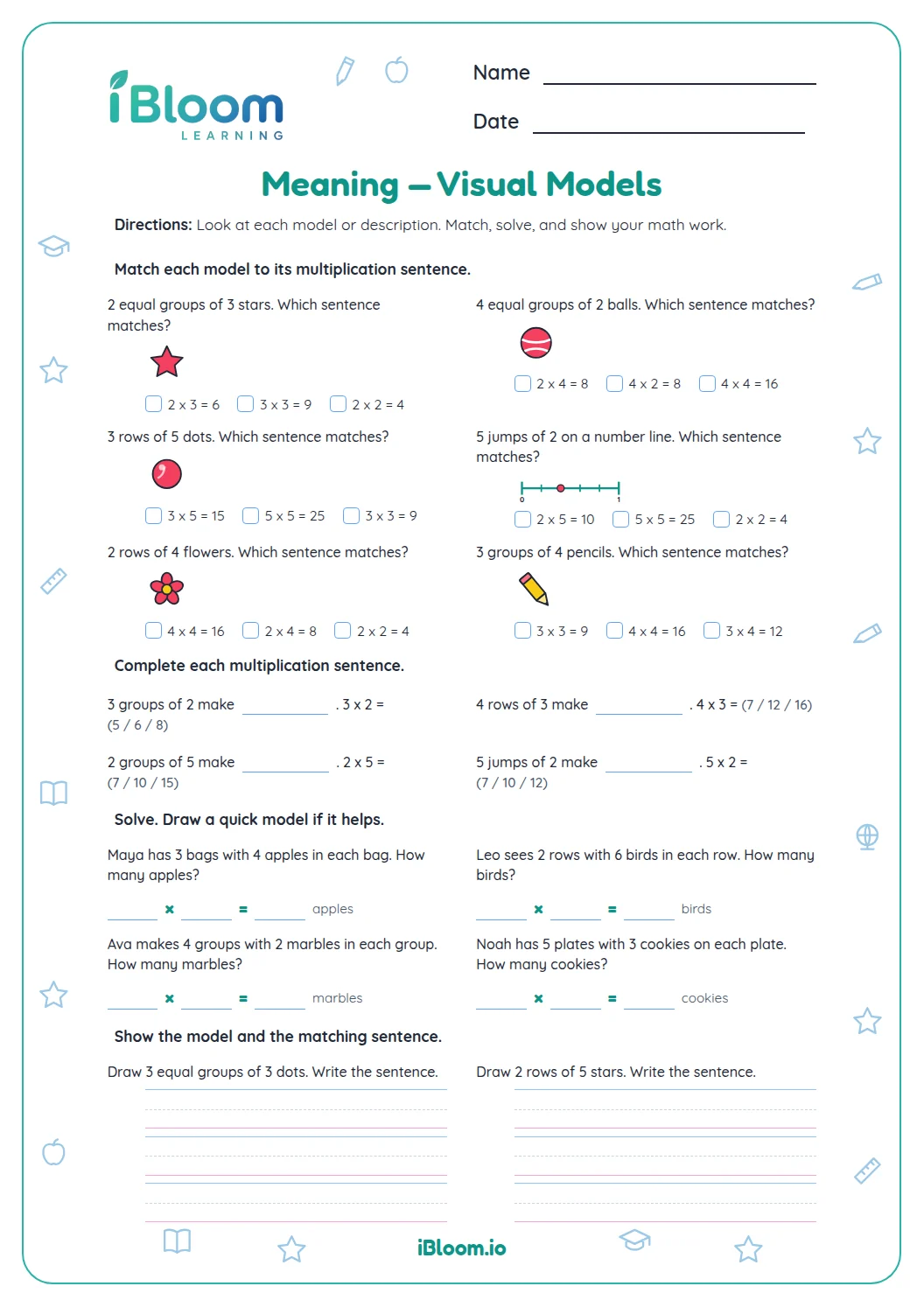
Part A practices direct products. Part B uses equal-group stories with muffins, stickers, buses, boxes, teams, and seeds. Part C mixes a tens question, whole-ten products, and a crayon story.
How can you check an answer?
For a story, multiply the amount in one group by the number of groups, then include what is being counted. For an equation, say the product in tens and check its place value.
How to use this worksheet
- 1Read both factors.
- 2Think of the multiple of ten as tens.
- 3Multiply the tens count by 2.
- 4Write the product with its place value.
- 5Check using addition or an estimate.
Common mistakes and quick fixes
The mistake
Writing 2 × 40 = 8.
The fix
That is 8 tens; write 80.
The mistake
Treating 2 × 40 as 2 + 40.
The fix
Multiplication means two equal groups: 40 + 40 = 80.
The mistake
Writing 2 × 70 = 14.
The fix
Fourteen is the number of tens; write 14 tens as 140.
Common Core alignment
This practice uses place value to multiply a one-digit number by multiples of ten.
Use place value to multiply 2 by multiples of ten.
On this sheet: Use place value to multiply 2 by multiples of ten.
Show the official wordingHide the official wording
Multiply one-digit whole numbers by multiples of 10 in the range 10-90 (e.g., 9 × 80, 5 × 60) using strategies based on place value and properties of operations.
What to practice next
Make more practice
Further reading
Questions parents and teachers ask
What does 2 times 40 mean?
Think of 40 as 4 tens. Two groups of 4 tens make 8 tens, so 2 × 40 = 80. The sheet begins with direct products and then applies the same idea to equal groups such as muffins, stickers, and students. The answer key lists the product for every question.
How can a child solve 2 × 70?
Think of 70 as 7 tens. Doubling 7 tens gives 14 tens, which is 140. Adding 70 + 70 is another way to check the multiplication and confirm the place value. The worksheet includes several whole-ten products and equal-group situations.
Why does a product end in zero?
Each factor in these problems is a multiple of ten, so the product is also a number of tens. For example, 2 × 30 is 6 tens, or 60. Naming the tens before writing the number helps keep the zero and the place value together.
What is in the answer key?
The key lists all 16 products, including the six equal-group stories with the item named in each answer. Children can compare each result with the worksheet and check a story by adding the two equal groups. The key is separate from the two practice pages.
How many problems are on the worksheet?
There are 16 questions in three parts: six direct products, six equal-group stories, and four mixed practice questions. The set includes products with whole tens from 10 through 90. A separate key gives each answer, including the story units.