




About this worksheet
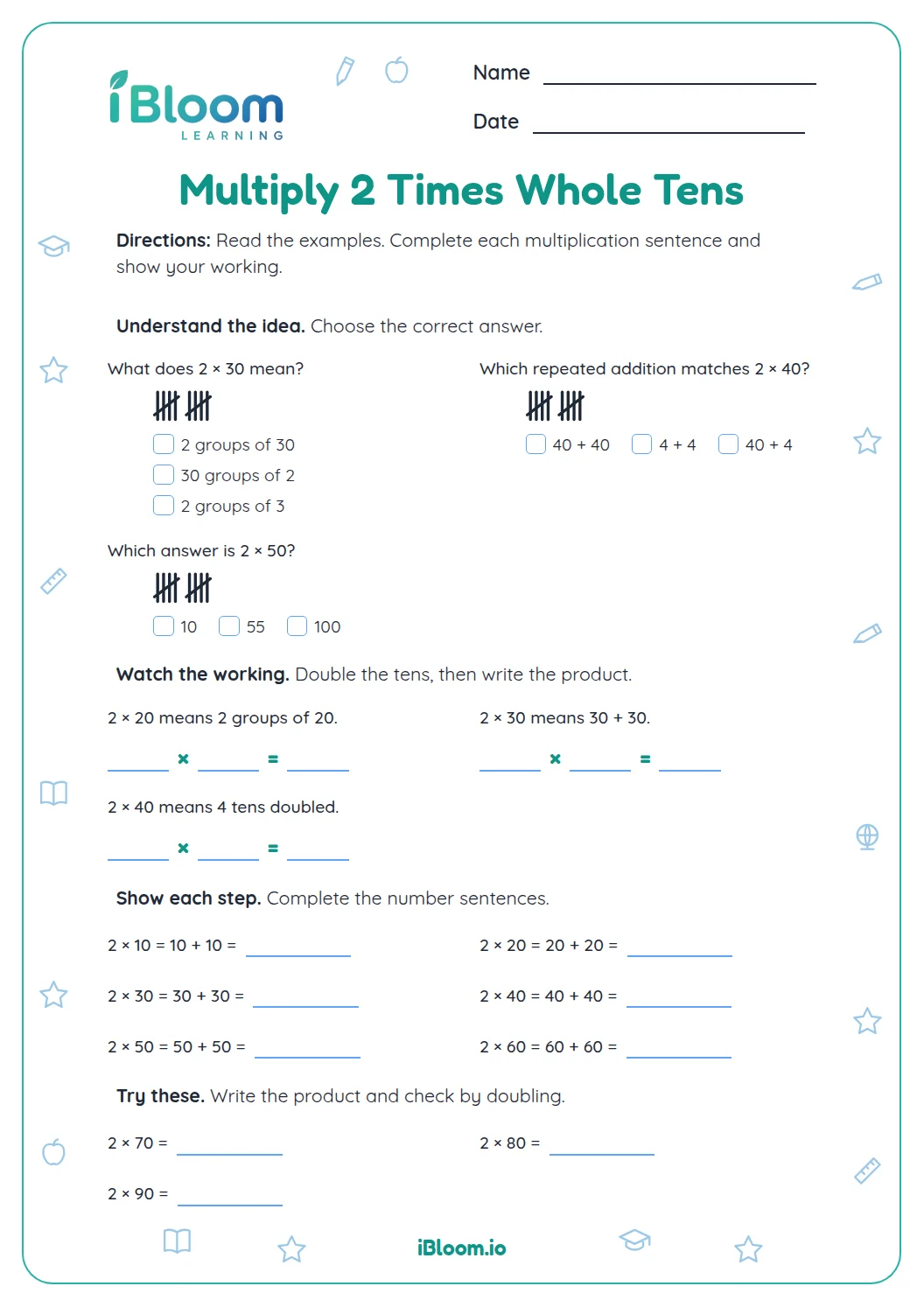
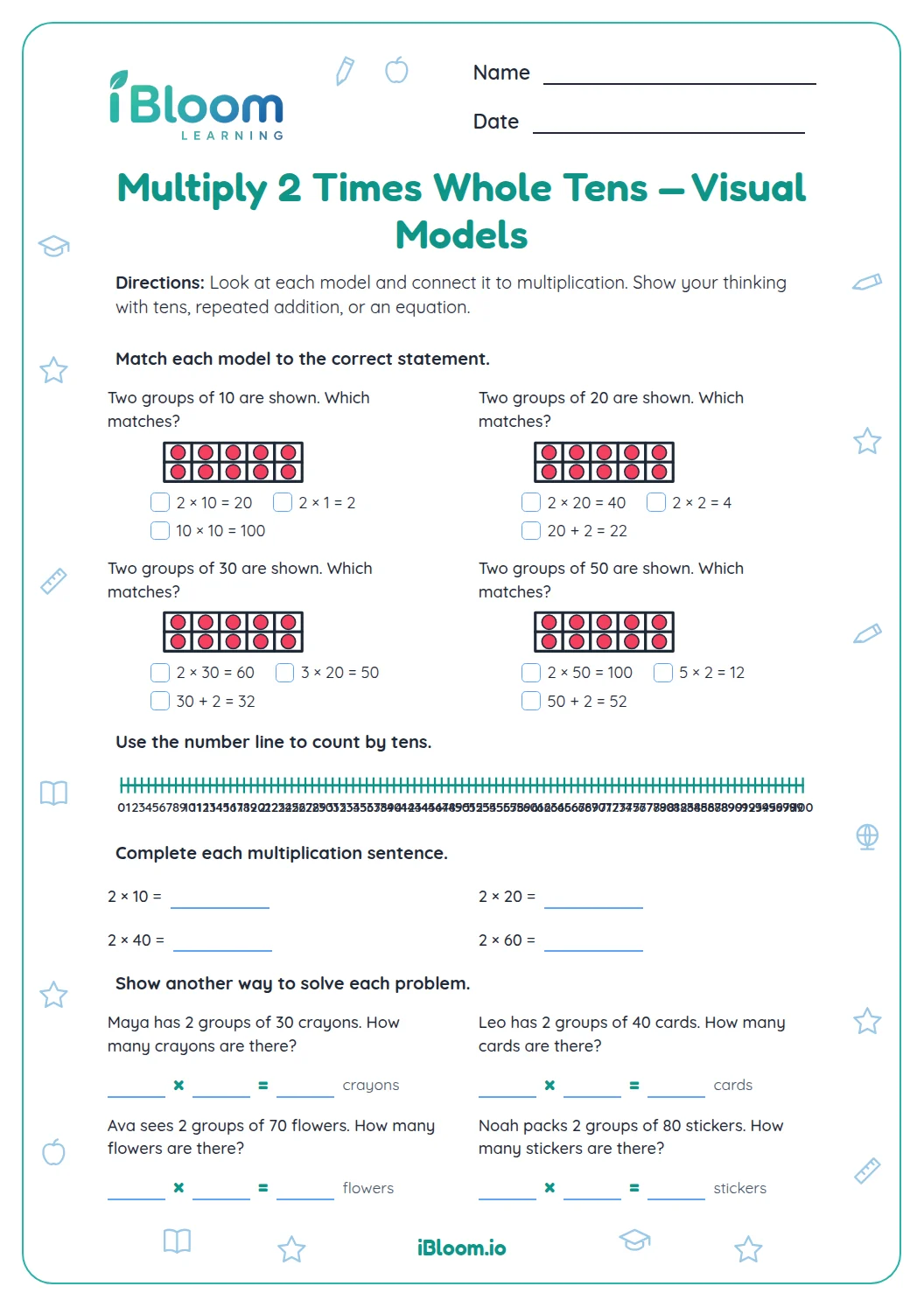
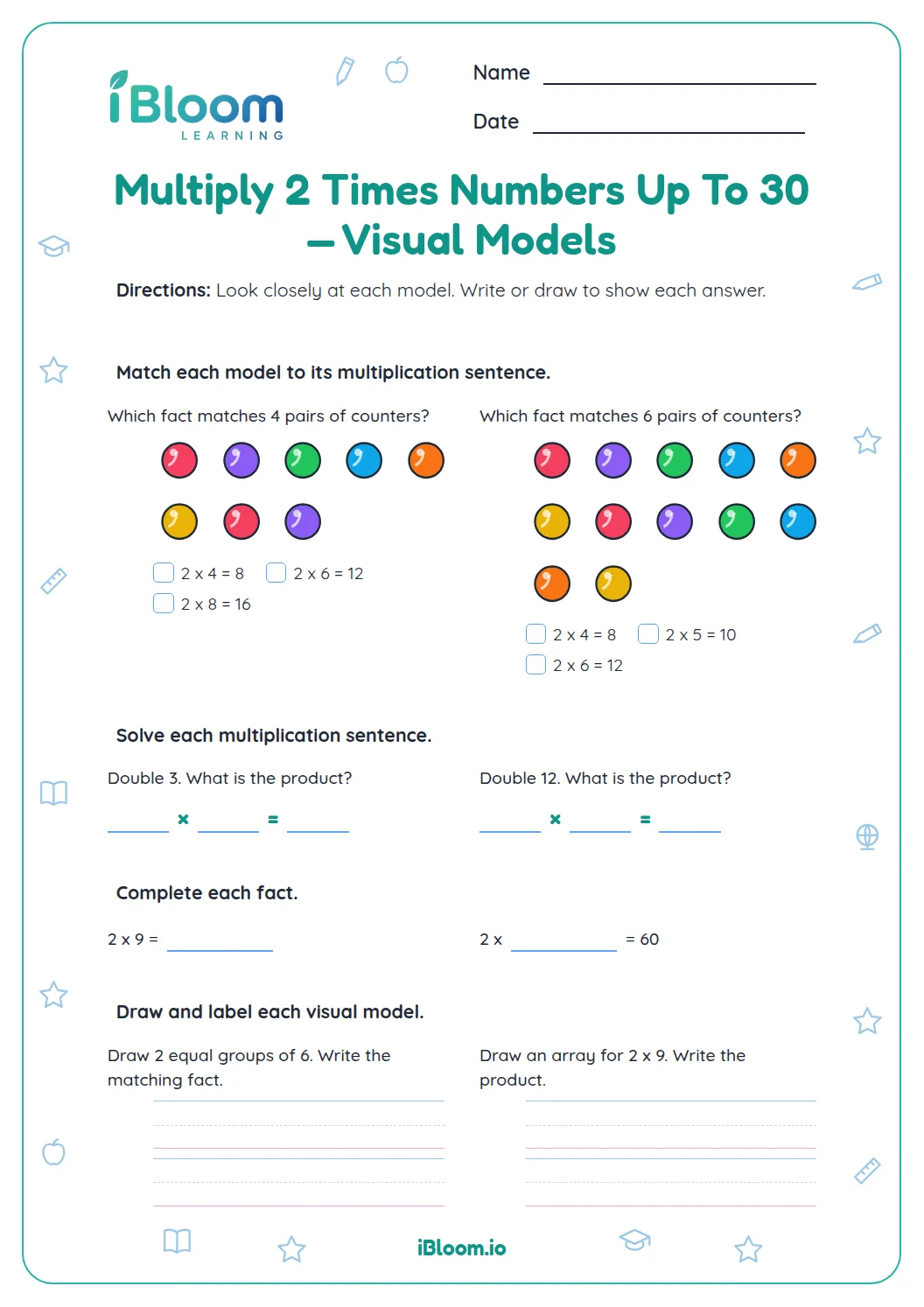
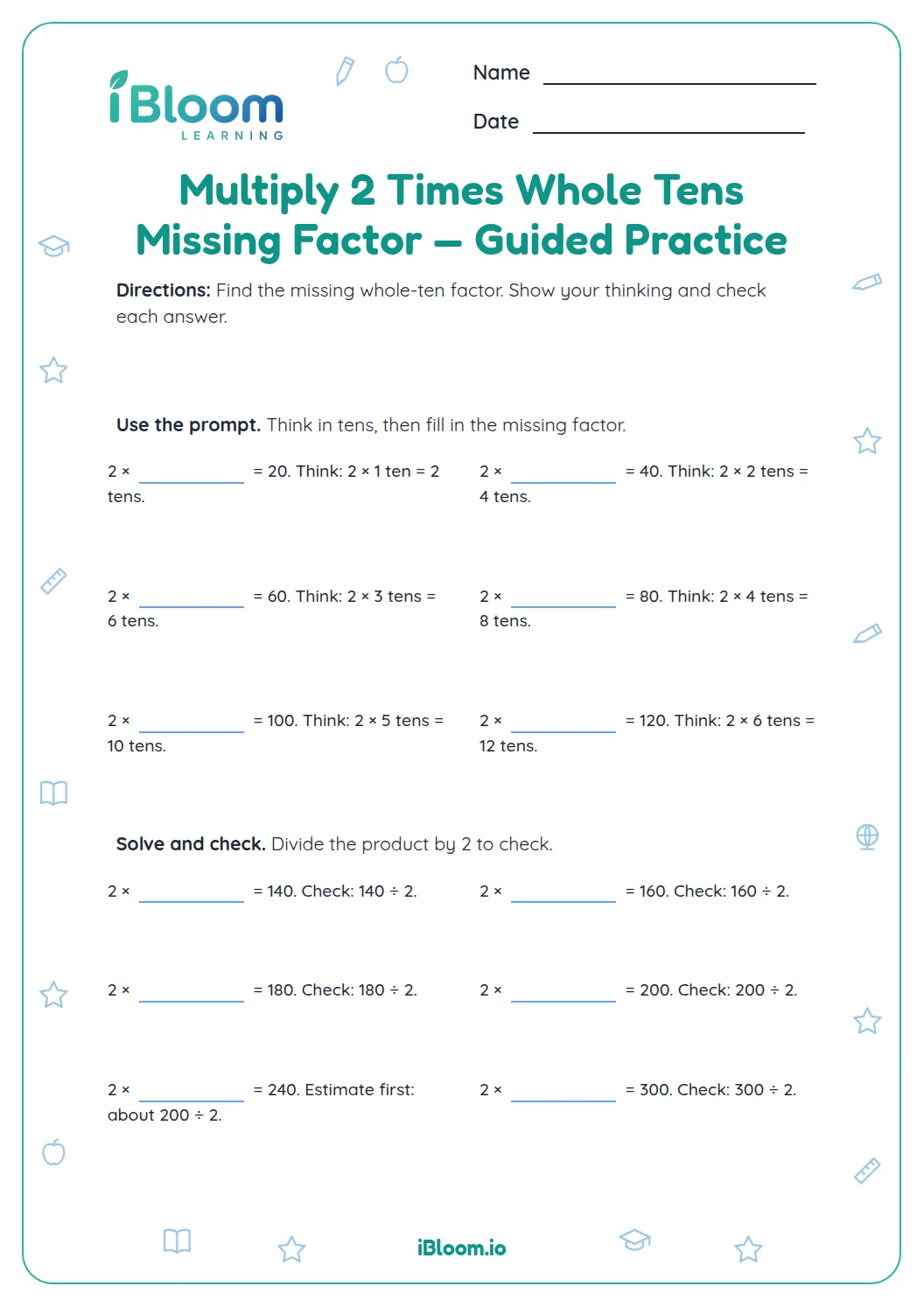
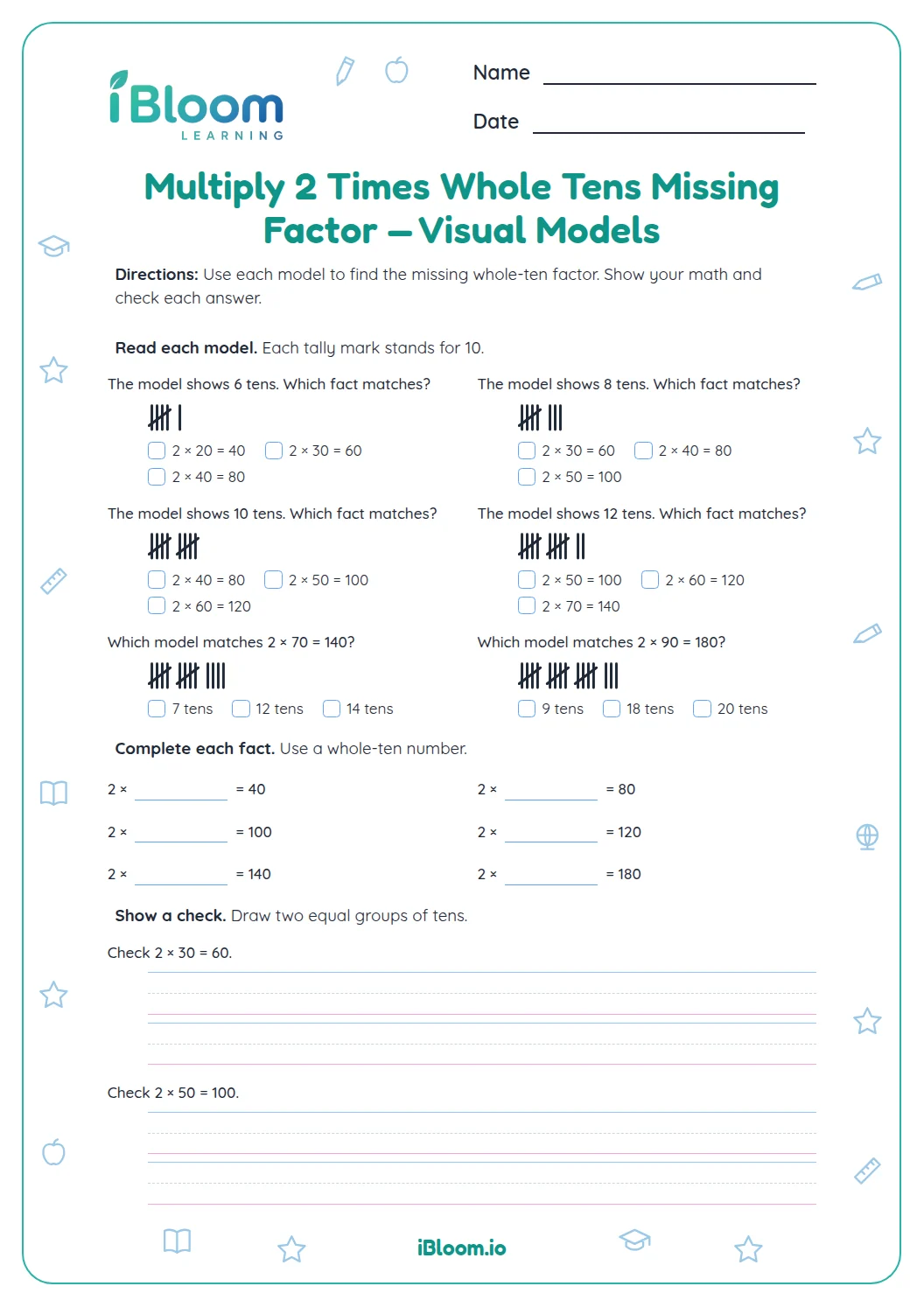
This free Grade 2 multiplication worksheet builds reasoning with two groups of a whole-ten amount. Students first find products such as 2 × 40, then choose equations that show why doubling tens works, and finish with short word problems. The 16 questions move from direct practice to explanation and application. The work aligns with CCSS 3.NBT.A.3, which uses place-value strategies to multiply a one-digit number by a multiple of ten. A separate answer key is included.
Aligned to 3.NBT.A.3
What does 2 times a whole ten mean?
A whole-ten number is made of tens. For 40, there are 4 tens. Two groups of 40 are 8 tens, which is 80. Thinking in tens keeps the place value visible instead of treating 40 like 4 ones.
How can place value check a product?
Rewrite the amount in tens, multiply the number of tens, and then name that many tens. For 2 × 60, double 6 tens to get 12 tens, or 120. Addition gives another check: 60 + 60 has the same total.
- 12 × 30 means 2 groups of 3 tens.
- 2Double 3 tens: 3 tens + 3 tens = 6 tens.
- 3Six tens is 60.
- 4Answer: 60.
What kinds of problems are on the page?
Part A practices products. Part B asks students to select place-value explanations and checking equations. Part C puts two equal groups into three short stories.
- Part A: 6 products
- Part B: 5 reasoning choices
- Part C: 3 word problems with working space
How can students check a multiplication answer?
Use repeated addition or count the tens. For 2 × 80, check that 80 + 80 equals 160. If a product has only one digit when the groups contain dozens of objects, revisit the place value.
How to use this worksheet
- 1Read the whole-ten factor as a number of tens.
- 2Solve Part A by doubling the tens and writing the product.
- 3In Part B, look for an explanation that keeps the tens unit.
- 4For Part C, write 2 × the group size before finding the total.
- 5Check a product with repeated addition or a tens count.
Common multiplication slips and fixes
The mistake
Multiplying 2 by the digit but forgetting the tens, so 2 × 40 becomes 8.
The fix
Say “4 tens” first; 2 groups make 8 tens, which is 80.
The mistake
Adding 2 and 40 instead of finding two groups of 40.
The fix
Rewrite the story as 40 + 40 or 2 × 40.
The mistake
Writing 120 for 2 × 60 after finding 12 tens, then labeling it as 12.
The fix
Keep the unit in the intermediate step: 12 tens equals 120.
Common Core alignment
The problems use place value to multiply one-digit numbers by multiples of ten.
Use tens and doubling to solve products such as 2 × 60.
On this sheet: Every product uses 2 times a whole-ten amount from 10 through 90, with place-value reasoning.
Show the official wordingHide the official wording
Multiply one-digit whole numbers by multiples of 10 in the range 10-90 (e.g., 9 × 80, 5 × 60) using strategies based on place value and properties of operations.
What to practice next
Make more practice
Further reading
Questions parents and teachers ask
What does 2 × 40 mean?
It means two equal groups of 40. Since 40 is 4 tens, the groups contain 8 tens altogether, or 80. Students can also check by adding 40 + 40. That repeated-addition check makes the meaning of the two equal groups visible.
How many problems are included?
There are 14 questions across three parts: six product blanks, five multiple-choice reasoning questions, and three word problems. The separate answer key shows each product and the short answer for each story. Students can work through one part at a time and check the key afterward.
Why does the answer key use 3.NBT.A.3?
That Common Core standard describes multiplying a one-digit whole number by a multiple of ten with place-value strategies. The worksheet uses 2 as the one-digit factor and whole tens from 10 through 90. The examples use 2 as the one-digit factor and whole tens from 10 through 90.
What if a student answers 8 for 2 × 40?
The student may have doubled 4 but lost the tens unit. Ask them to say “4 tens doubled is 8 tens,” then write 80. Adding 40 + 40 is another way to see the same product. The tens unit is the clue that keeps place value in the answer.
Does the page include word problems?
Yes. Part C has three situations with two equal groups, such as two teams receiving 60 cards each. Students can write a multiplication equation and use the working space to calculate the total. Each story includes enough information to write a multiplication equation.