


About this worksheet
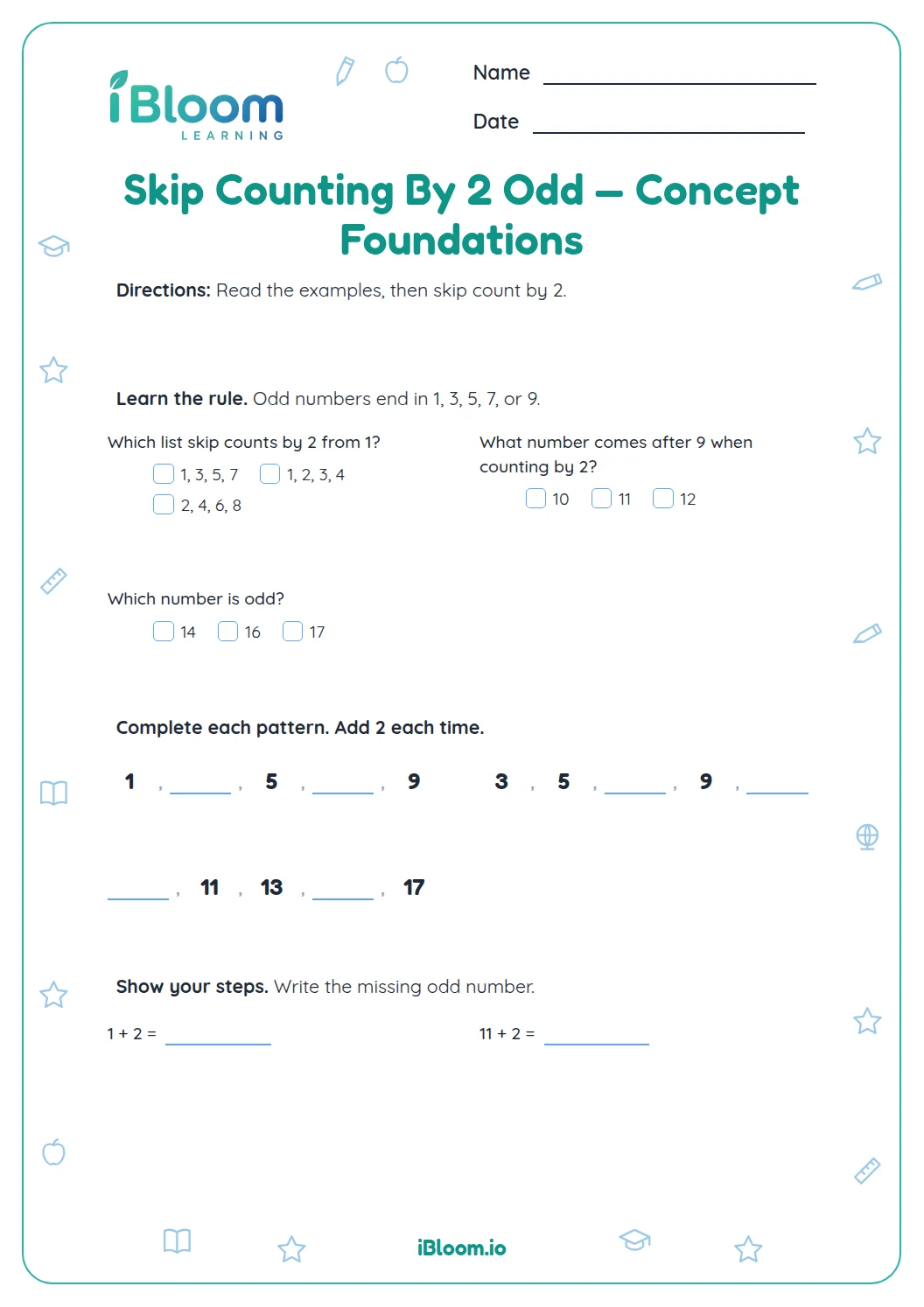
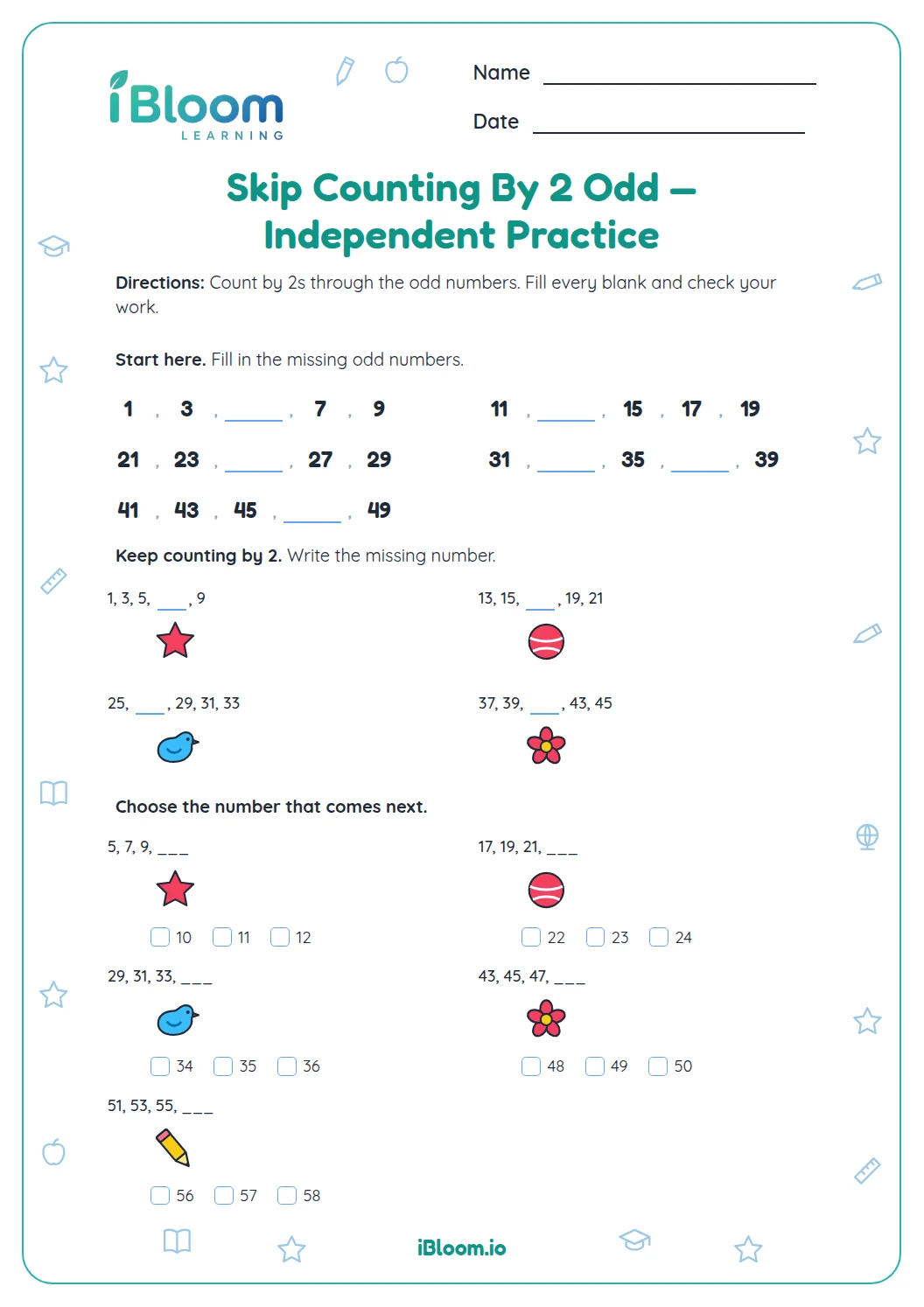
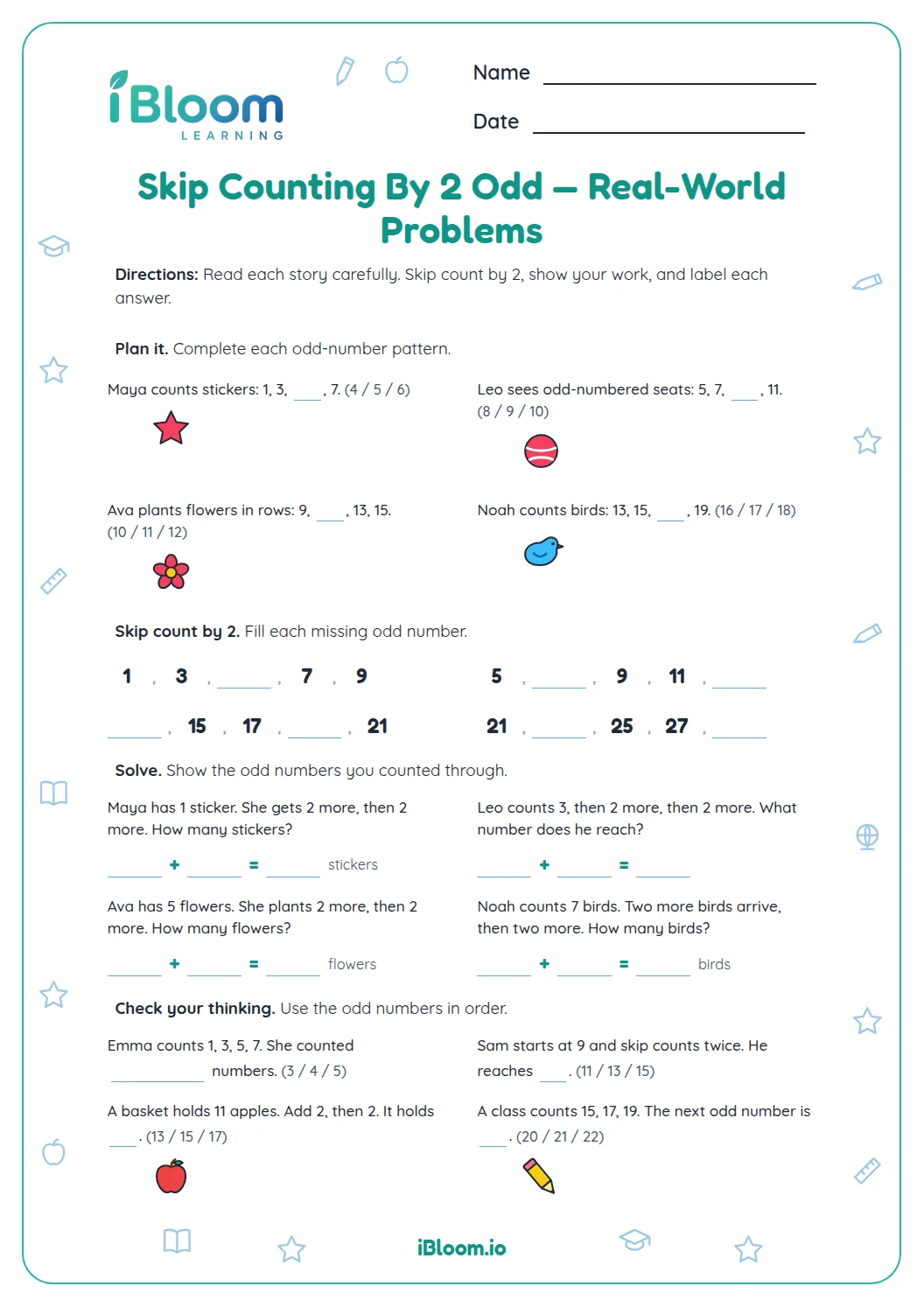
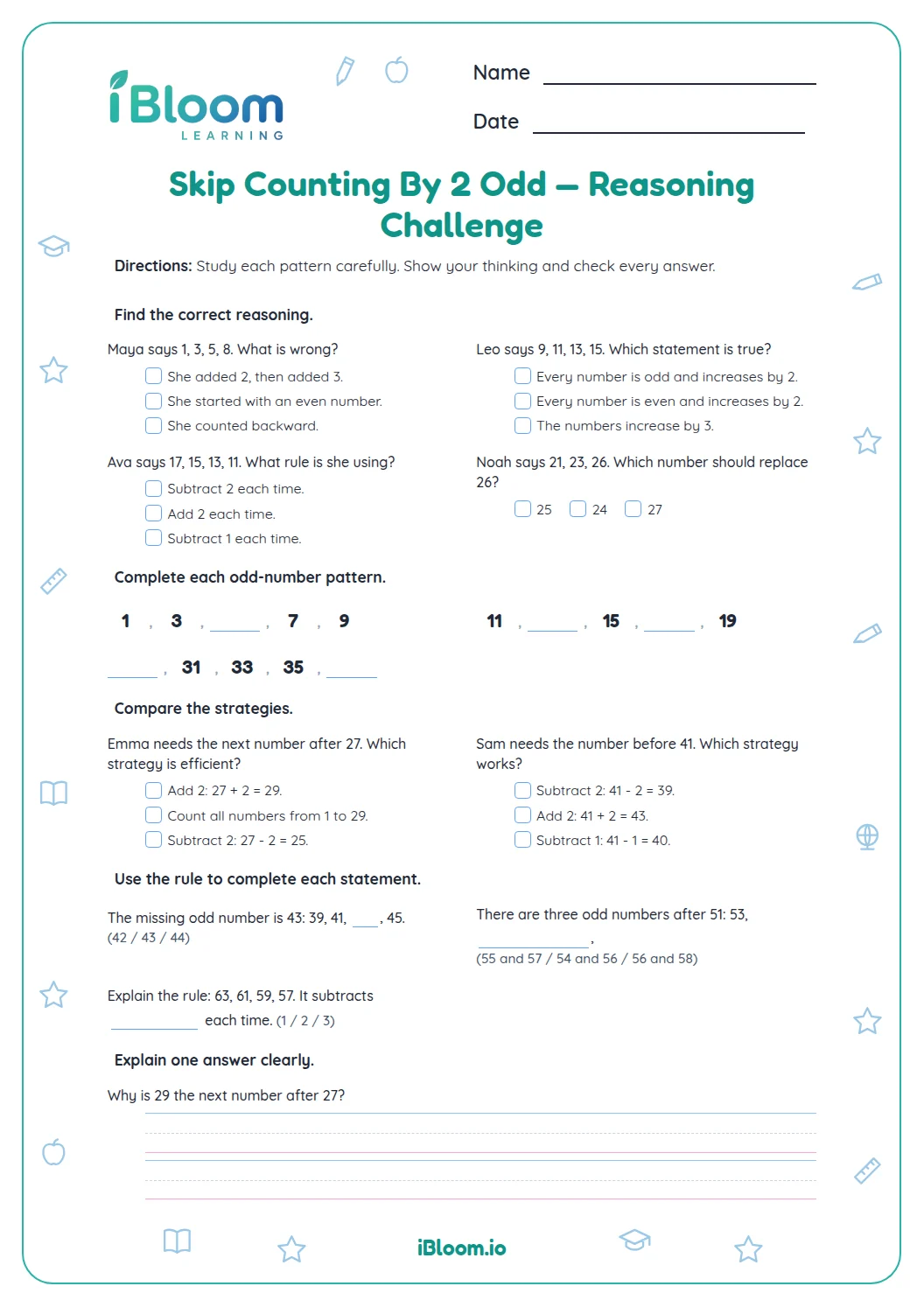
This free printable Grade 2 worksheet connects odd skip counting to pairs of dots and number-line jumps. Four ten-frame questions ask children to make pairs and name the odd total. Four number-line sequences fill in missing odd numbers, and four final choices check the pattern and why adding 2 keeps a number odd. The pairing and counting practice aligns with Common Core 2.OA.C.3. A separate answer key shows each total and choice.
Aligned to 2.OA.C.3
How do pairs explain odd numbers?
Each ten frame shows an odd group. Make pairs of two, then identify the single dot without a partner. Counting the dots gives the total; the extra dot explains why the number is odd.
- 1The ten frame has 5 dots.
- 2Make two pairs. One dot remains.
- 3The total is 5, an odd number.
How do the number lines show steps of two?
Every gap on a Part B line is worth 2. The endpoint labels anchor the counting, and the sequence under the line helps children keep their place. Move from one tick to the next rather than counting each tick as one.
- 1The line runs from 3 to 13 in steps of 2.
- 23, 5, 7, 9, 11, 13
- 3The missing number after 7 is 9.
- 4Check: 7 + 2 = 9 and 9 + 2 = 11.
How can children check a broken pattern?
Check both neighbors of a missing or incorrect number. In question 11, the step from 15 to 18 is 3, and the step from 18 to 19 is 1. Replacing 18 with 17 makes both steps equal to 2.
The last question brings the rule back to the dots. Adding two dots creates one new pair, so the original lone dot still has no partner. This explains why the count continues through odd numbers.
Use the models in order
- 1Point to five counters and make two pairs with one counter left.
- 2In Part A, circle pairs and label each total beside its frame.
- 3Start Part B at the left endpoint and say each step aloud.
- 4For each blank, check the step before it and the step after it.
- 5Use the key, then explain question 12 with two extra counters.
Fix these counting slips
The mistake
Starting at 2 and naming even totals.
The fix
Start with the lone dot as 1, then add each pair.
The mistake
Treating each number-line gap as 1.
The fix
Read the directions: each gap is 2. Say “add two” at each move.
The mistake
Accepting any odd number in a blank.
The fix
Check that it is exactly 2 more than the number before it and 2 less than the next.
Common Core alignment
Pair dots and count by twos to identify odd totals up to 20.
On this sheet: Children pair the dots in four ten-frame models and explain why adding a pair keeps a total odd.
Show the official wordingHide the official wording
Determine whether a group of objects (up to 20) has an odd or even number of members, e.g., by pairing objects or counting them by 2s; write an equation to express an even number as a sum of two equal addends.
What to practice next
Make more practice
Further reading
Questions parents and teachers ask
Why do the frames have one dot left over?
The extra dot makes each total odd. Children circle as many pairs as possible, then begin their count with the single dot as 1. Each pair adds 2 more. The four frames have totals of 5, 9, 13, and 17, all within 20.
Must my child pair dots in a certain direction?
No, any clear set of pairs is correct. Children may pair dots across a row, down a column, or between frames. Check that each dot belongs to at most one pair and that exactly one dot remains unpaired before checking the written total.
Why are most number-line ticks unlabeled?
The unlabeled ticks let children build the count themselves. The endpoints and the printed sequence provide starting information, while the equal spaces show the repeated step. Ask your child to say each value aloud from left to right, then fill the blank and check both neighbors.
What is the answer to the broken pattern?
Replace 18 with 17 in question 11. The corrected pattern is 13, 15, 17, 19. Each number is 2 more than the one before it. Have your child explain both changes around the replaced number, because checking only one side can miss a mistake.
How should I use the answer key?
Check the totals, missing values, and choices after your child has used the models. The key also states how many pairs and leftover dots belong in each frame. A different arrangement of circles is fine when the pair count and the single leftover dot are correct.