

About this worksheet
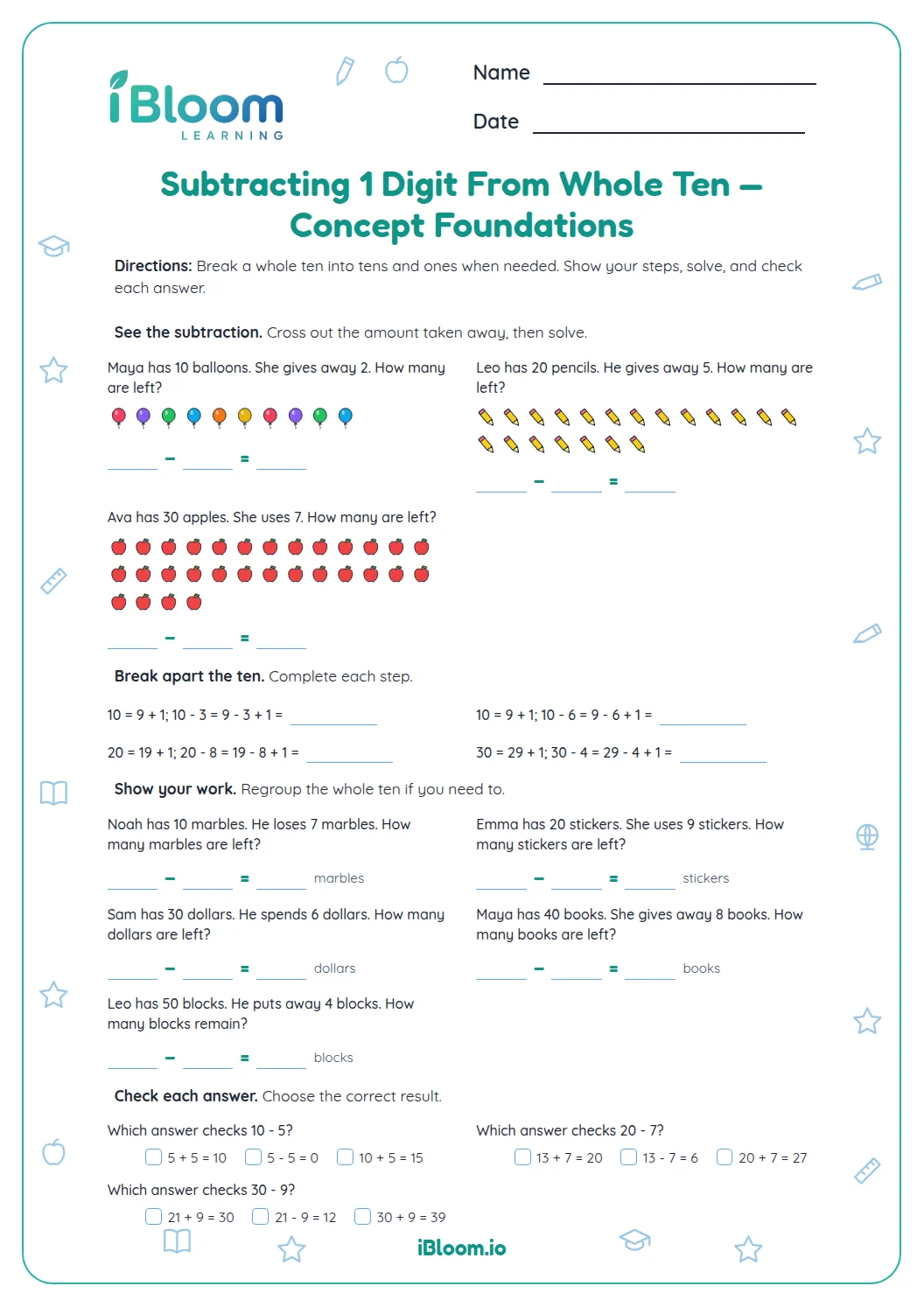
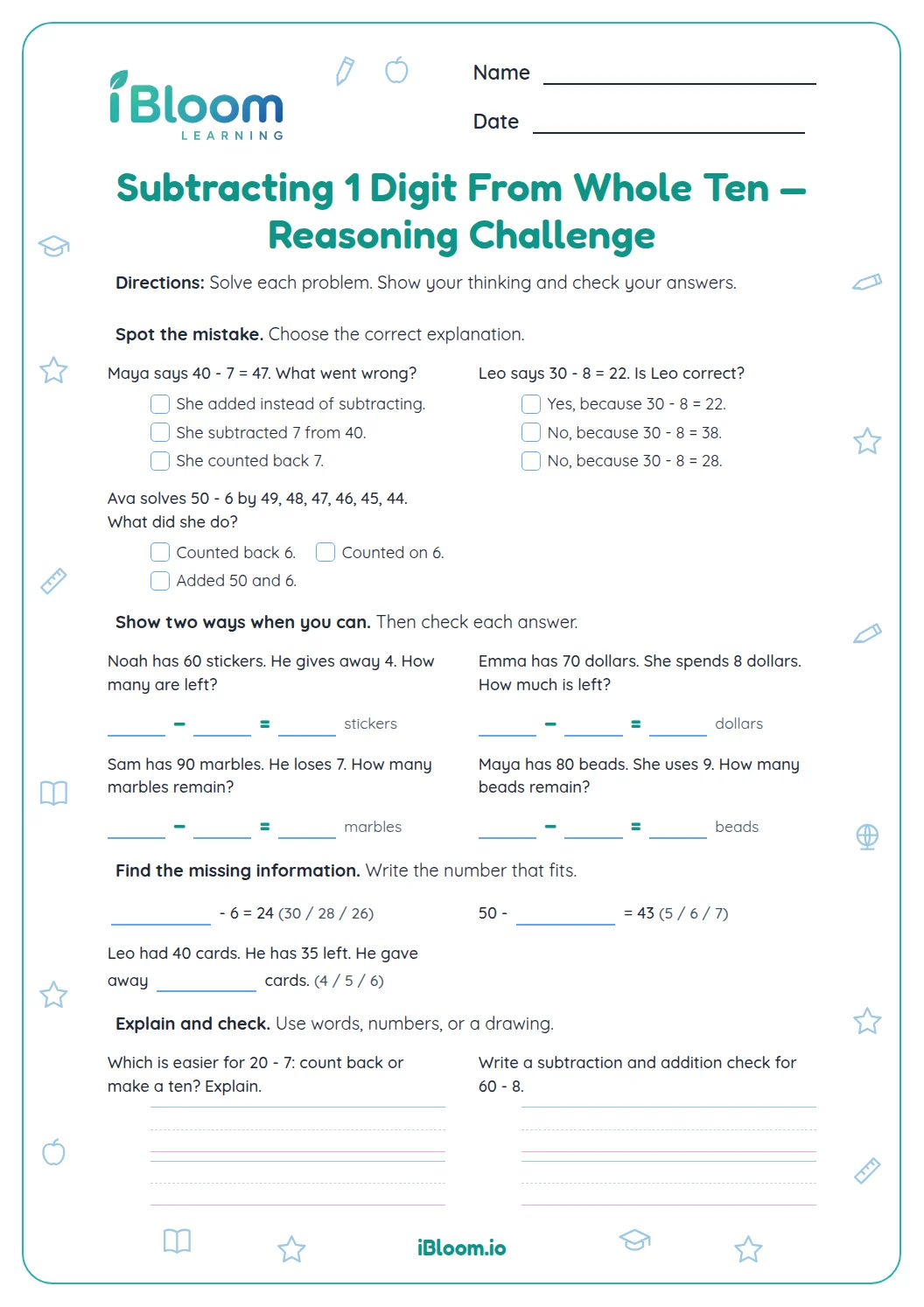
This free printable Grade 2 worksheet practices subtracting a one-digit number from a whole ten. Children begin with ten-frame models they can mark, then solve subtraction facts and short button stories. The 14 questions include examples such as 50 − 9 and 40 buttons with 7 used. A separate answer key supports checking each difference. The practice builds subtraction fluency within 100 and supports CCSS 2.OA.B.2.
Aligned to 2.OA.B.2
How can a ten-frame show what remains?
In Part A, begin with all ten counters. Cross out the number being taken away and count the counters that are still visible. This connects the picture to the subtraction sentence.
- 1Start with 10 counters. Cross out 3.
- 27 counters remain, so 10 − 3 = 7.
What changes when you subtract from a larger whole ten?
In Part C, subtract the one-digit number from the ones in the whole ten and keep track of the tens. For 50 − 9, think of 5 tens and take away 9 ones by regrouping one ten as 10 ones; 50 − 9 = 41.
How do the button stories match subtraction?
The story tells how many buttons there were and how many were used. The question asks for the amount left, so subtract the used buttons from the starting amount.
How to use this worksheet
- 1For the ten-frame, count 10 counters before crossing any out.
- 2Cross out exactly the number being taken away.
- 3For a number sentence, say the starting ten and the number removed.
- 4In a story, underline the starting amount and the amount used.
- 5Check by adding the difference and the amount taken away.
Common mistakes and quick fixes
The mistake
Crossing out the starting amount instead of the amount taken away.
The fix
Mark only the number named after “take away” or “used.”
The mistake
Subtracting the digit from the tens digit.
The fix
Rename one ten as 10 ones when subtracting from a whole ten.
The mistake
Reporting how many were used instead of how many remain.
The fix
Check that the answer describes the amount left in the story.
Curriculum alignment
This worksheet practices subtracting a one-digit number from a whole ten at the stated grade level.
subtracting a one-digit number from a whole ten.
On this sheet: subtracting a one-digit number from a whole ten.
Show the official wordingHide the official wording
Fluently add and subtract within 20 using mental strategies. By end of Grade 2, know from memory all sums of two one-digit numbers.
What to practice next
Make more practice
Further reading
Questions parents and teachers ask
How does the ten-frame help with subtraction?
The ten-frame begins with 10 counters. Cross out the number taken away, then count the counters that remain. In question 1, crossing out 3 leaves 7, which matches 10 − 3 = 7. The answer key lists the remaining amount for both models.
How do you solve 50 minus 9?
Think of 50 as 5 tens. Rename one ten as 10 ones, then take away 9 ones. That leaves 4 tens and 1 one, or 41. Question 9 uses this kind of subtraction from a larger whole ten. Use the key to check each result after the learner finishes the page.
Are there story problems on the worksheet?
Yes. The last part has four button stories. Each gives a starting amount and tells how many buttons are used; subtract the used buttons to find how many remain. For instance, 20 buttons with 6 used leaves 14. Use the key to check each result after the learner finishes the page.
What is the answer key for?
The separate key gives the answer to every model, number sentence, and story. Have the learner try the problem first, then use the key to check. For missed items, return to the ten-frame or rewrite the story as a subtraction sentence.
How many questions and pages are included?
There are 14 questions on two worksheet pages, followed by a two-page answer key. The set includes two ten-frame models, eight subtraction facts, and four short story problems about buttons. Use the key to check each result after the learner finishes the page.