



About this worksheet
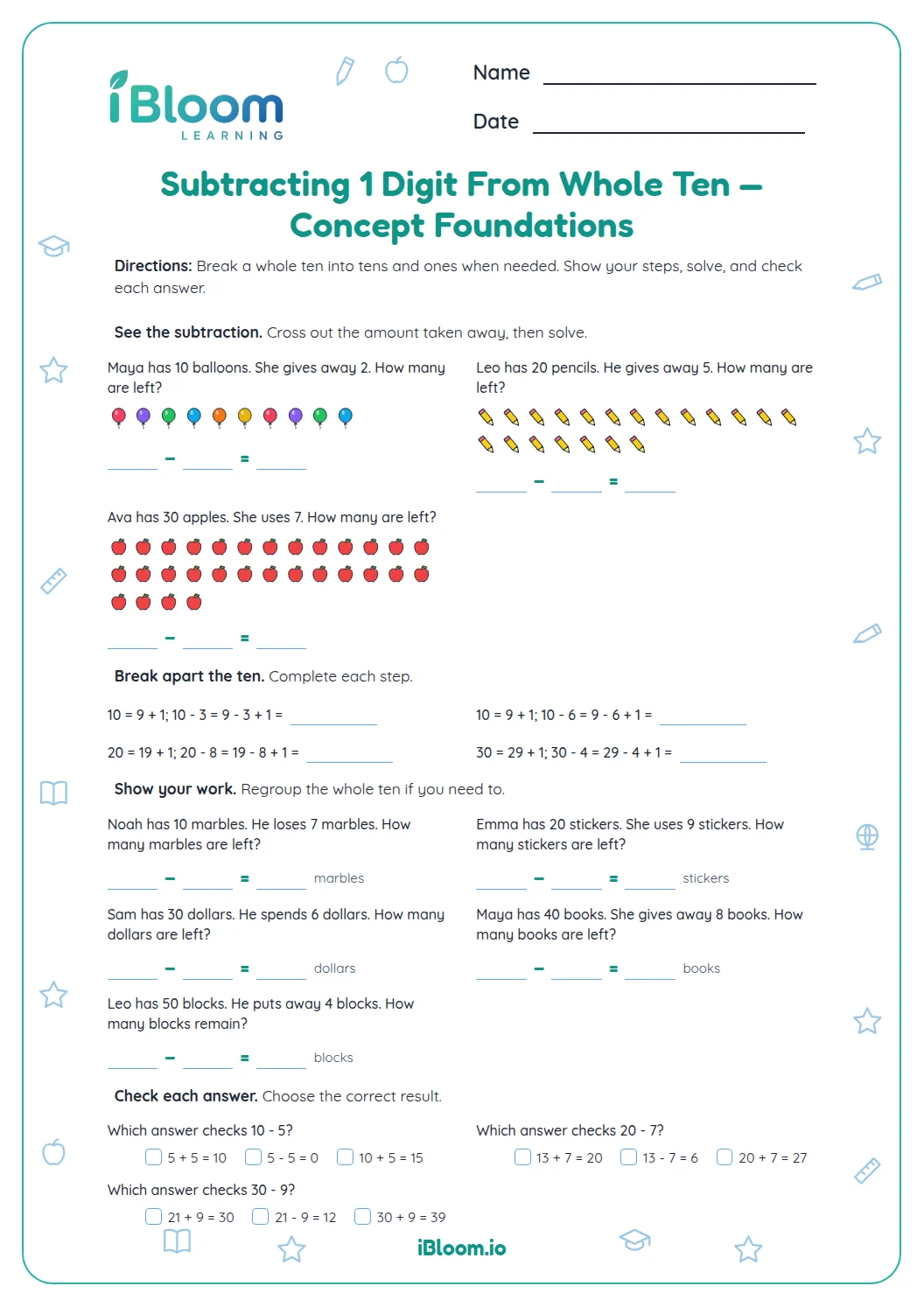
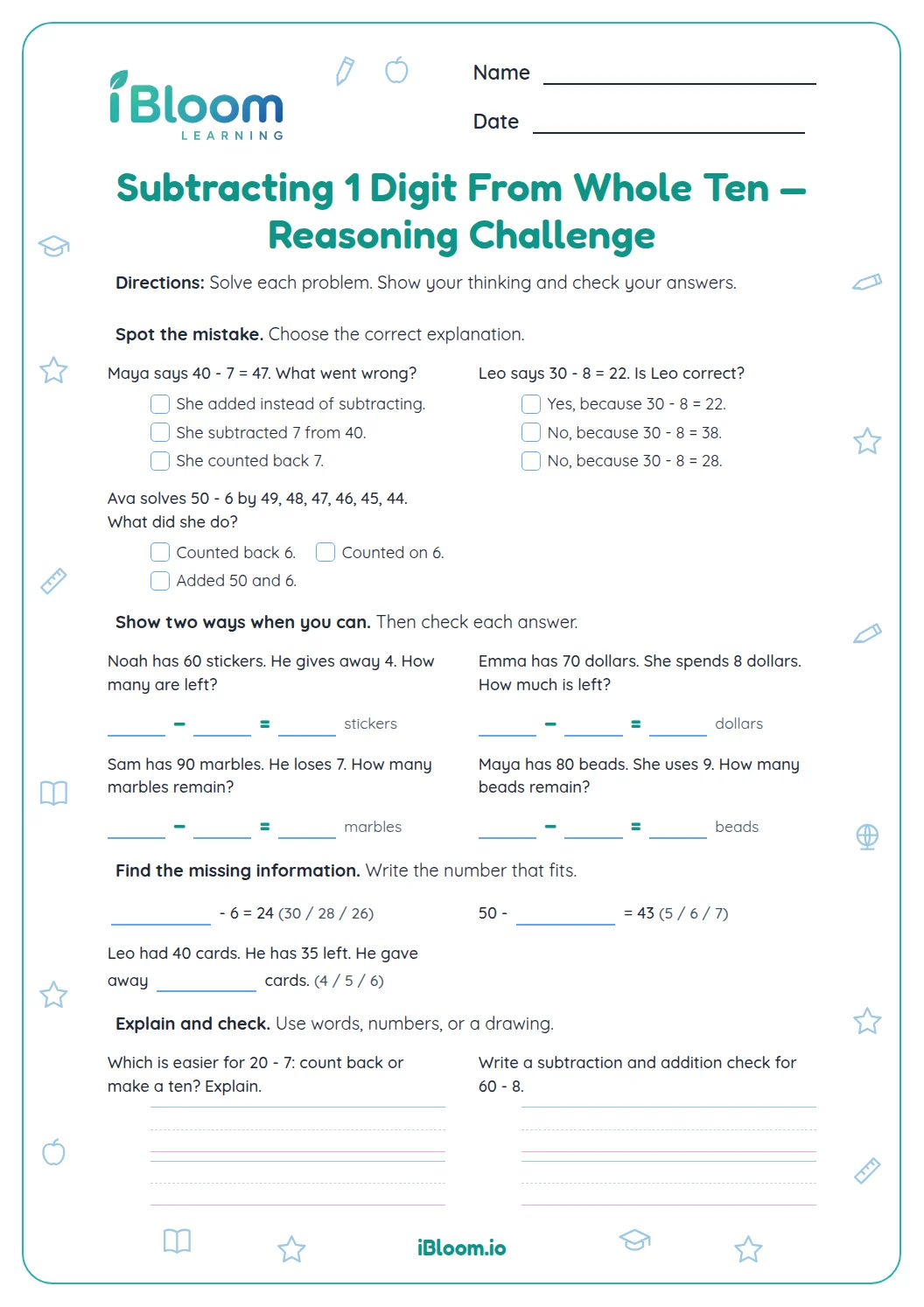
This free printable Grade 2 worksheet helps learners practice subtracting a one-digit number from a whole ten. It contains 14 questions in 5 parts, with two worksheet pages and a separate two-page answer key. Bridge through the next ten, then check by adding the amount taken away. It practices Common Core 2.NBT.B.5 through the questions on this sheet.
Aligned to 2.NBT.B.5
How can a learner work through subtracting a one-digit number from a whole ten?
Start by identifying what each question asks, then use its picture, number sentence, or context as a clue. Bridge through the next ten, then check by adding the amount taken away.
Have the learner show or say one step before checking the answer. That makes the method visible and helps pinpoint where a sign, place value, or word part changed.
- 130 − 4 = 26
- 2Think of 30 as 20 + 10. Take 4 from 10 to leave 6; 20 + 6 = 26.
- 3Check: 26 + 4 = 30.
What appears in each part of the worksheet?
The 14 questions move from direct practice to another way of applying the skill. Each group has its own direction so learners can focus on one task at a time.
- Subtract from ten
- Find the missing part
- Choose and check
- Subtraction stories
- Explain your thinking
How can families check the work?
Use the separate answer key after the learner finishes each group. For a missed item, return to the clue in the prompt and solve it again. Bridge through the next ten, then check by adding the amount taken away.
How to use this worksheet
- 1Read the directions and name the skill: subtracting a one-digit number from a whole ten.
- 2Complete the first group together, saying the reasoning aloud.
- 3Let the learner try the next questions independently and show a step when helpful.
- 4Check answers with the separate key after finishing a group.
- 5For a missed item, find the clue or calculation step that changes the answer, then solve it again.
Common mistakes and quick fixes
The mistake
Writing only the ones digit as the answer
The fix
Subtract from the nearby ten and include the remaining tens; for 20 − 8, the answer is 12.
The mistake
Taking away from the whole ten without bridging
The fix
Break the ten into tens and 10 ones, then remove the ones and recombine.
The mistake
Checking by subtracting again
The fix
Add the number taken away to the difference to see whether it returns to the starting ten.
Common Core alignment
Add and subtract within 100 using place value and the relationship between the operations.
On this sheet: Subtract within 100 and check by adding the amount taken away.
Show the official wordingHide the official wording
Fluently add and subtract within 100 using strategies based on place value, properties of operations, and/or the relationship between addition and subtraction.
What to practice next
Make more practice
Further reading
Questions parents and teachers ask
What does this worksheet practice?
Students subtract a one-digit number from a whole ten, complete missing-part equations, compare subtraction expressions, and solve short stories. It has 14 questions in five parts. Two worksheet pages and a separate two-page answer key support practice and checking. Learners can discuss how the models and equations express the same amount.
How can a child solve 30 − 4?
Break 30 into 20 and 10. Take 4 from the 10 to leave 6, then combine 20 and 6 to get 26. Adding back checks the result: 26 + 4 = 30. This bridge-through-ten idea also works for 50 − 9.
Why are some answers greater than ten?
The starting number is a whole ten, such as 20 or 40, so taking away a small number can leave more than ten. For example, 20 − 8 = 12. The answer is the amount left, not just the ones digit.
What is the ten-frame for?
The ten-frame in the first question shows ten counters before any are taken away. It helps learners connect the picture to 10 − 3 = 7. Later questions use number sentences and short stories to apply the same idea without a picture.
How can I check a subtraction answer?
Add the number taken away to the answer. For the story with 30 crayons and 6 put away, 24 crayons stay out; 24 + 6 = 30 checks it. The answer key lists the expected number and units for the story questions.