



About this worksheet
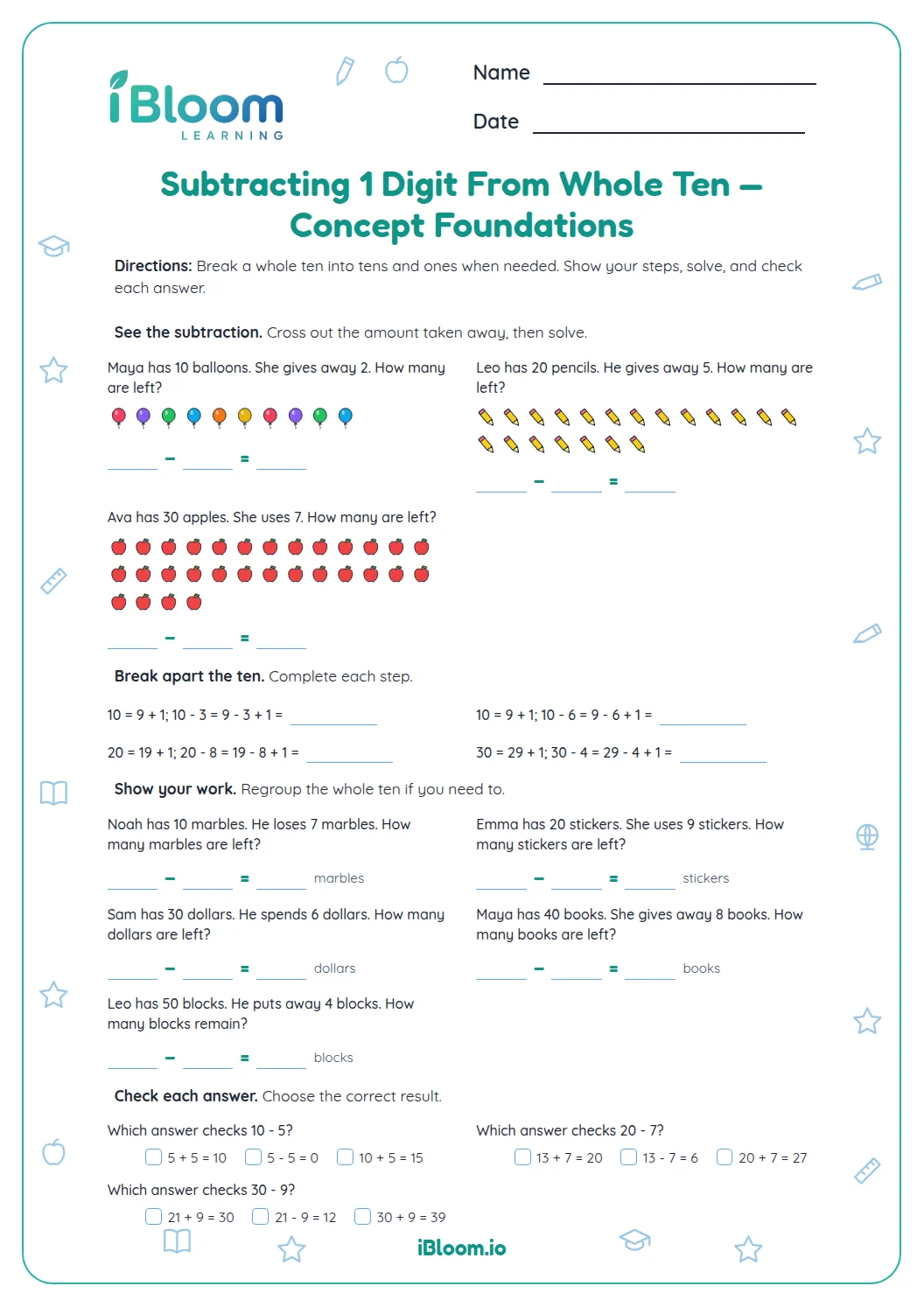
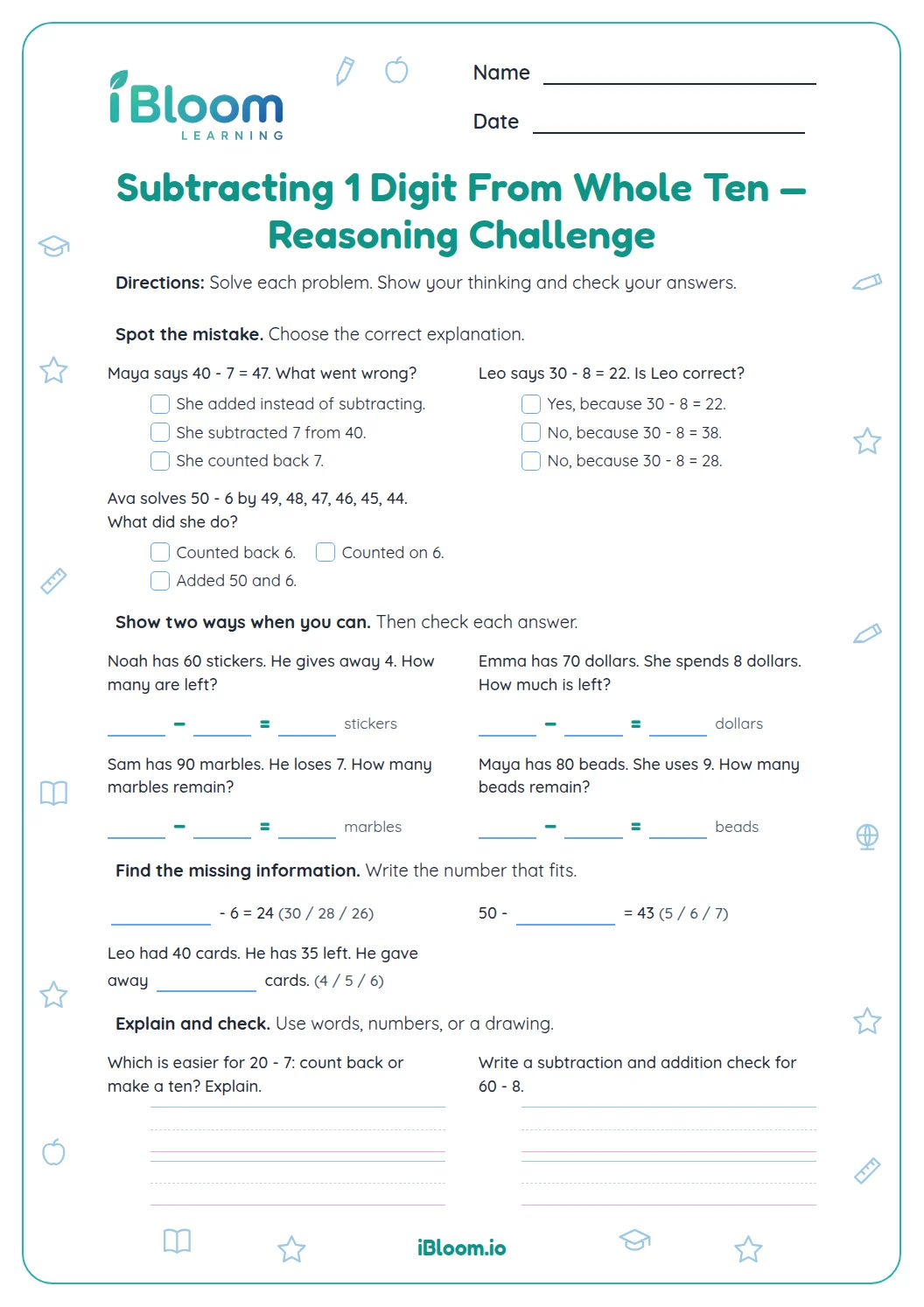
This free Grade 2 printable keeps the original story settings while practicing subtraction of one digit from a whole ten. Maya spends money, Leo gives away stickers, Ava uses apples and Noah’s balloons pop. Fourteen questions mix these familiar stories with quick checks and missing-number sentences. Each answer can be checked by adding the amount taken away; the answer key is included.
Aligned to 2.NBT.B.5
How do the stories show what to subtract?
The stories use the same people and situations as the original sheet. Maya spends money, Leo gives away stickers, Ava uses apples, and Noah loses balloons when three pop. For question 1, 20 − 6 = 14 dollars remain.
- 1Maya has $20 and spends $6.
- 220 − 6 = 14
- 3Check: 14 + 6 = 20
- 4$14 remain.
Why can subtracting from a ten need regrouping?
A whole ten has zero ones. To subtract 8 from 30, rename 3 tens as 2 tens and 10 ones. Then 10 − 8 = 2 ones, with 2 tens left, for 22.
How can addition find the missing number?
When the starting ten is missing, add the difference and the amount taken away. In question 11, 26 + 4 = 30, so the blank in ___ − 4 = 26 is 30.
What is on the two-page worksheet?
There are 14 questions in three parts: four stories with working space, five choices that include story contexts, and five fill-in sentences, including Sam’s pages-read story.
How to use this worksheet
- 1Circle the starting amount in each story.
- 2Write a subtraction sentence for the story.
- 3Subtract the ones; regroup a ten when the ones are not available.
- 4Write the difference with its story unit when needed.
- 5Add back the amount subtracted to check.
Common mistakes and quick fixes
The mistake
Subtracting from the tens digit only
The fix
Rename one ten as 10 ones, then subtract the ones.
The mistake
Writing the number taken away as the answer
The fix
Ask “how many remain?” and subtract from the starting amount.
The mistake
Losing a ten after regrouping
The fix
Keep track of the tens left before finding the ones.
Common Core alignment
This sheet practices the standard below through focused examples and independent practice.
Subtract a one-digit number from a multiple of ten and check with addition.
On this sheet:
Show the official wordingHide the official wording
Fluently add and subtract within 100 using strategies based on place value, properties of operations, and/or the relationship between addition and subtraction.
What to practice next
Make more practice
Further reading
Questions parents and teachers ask
What numbers and stories does this page use?
The problems subtract one-digit numbers from multiples of ten, from 10 through 70. Maya, Leo, Ava and Noah’s stories use money, stickers, apples and balloons; quick checks and missing-number equations practice the same subtraction relationship. Name what the difference counts, then add it to the amount removed to check the original whole ten.
How many questions and pages are included?
The two-page worksheet has 14 questions: four stories with working space, five multiple-choice items, and five fill-in sentences. Emma’s crayon story is a choice question, and Sam’s pages-read story is a fill-in. The two-page answer key follows the same order.
How can a child solve 30 − 8?
Rename 30 as 2 tens and 10 ones. Subtract 8 ones from 10 ones to get 2, then combine those 2 ones with the 2 tens left. The answer is 22. Name what the difference counts, then add it to the amount removed to check the original whole ten.
Can addition check these subtraction answers?
Yes. Add the answer to the amount subtracted. For example, 22 + 8 = 30 confirms that 30 − 8 = 22. This check is especially useful after regrouping. Name what the difference counts, then add it to the amount removed to check the original whole ten.
Are the later questions still real-world practice?
The first four questions are story problems. The remaining questions use the same subtraction skill in short equations and choices so students can get more practice on the two-page worksheet. Name what the difference counts, then add it to the amount removed to check the original whole ten.