


About this worksheet
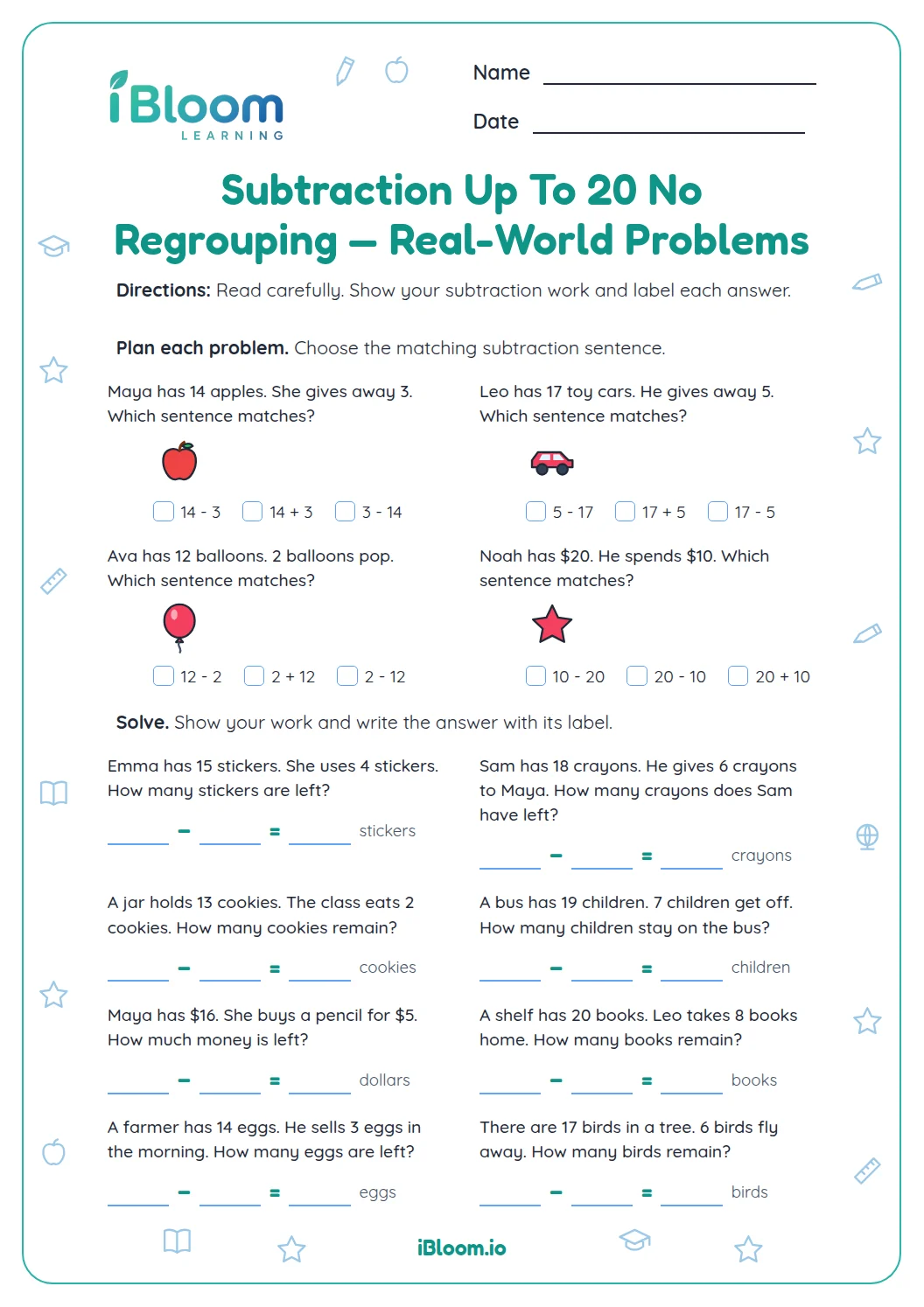
This Grade 2 subtraction worksheet has 14 questions in four parts. Children use one number-bond model and solve take-away stories, find differences within 20, solve missing-number equations, and apply subtraction to short situations. The facts are selected so no regrouping is needed. The separate answer key includes story units for checking.
Aligned to CCSS 2.OA.B.2
How do number bonds show subtraction?
The first story shows the starting whole and the amount taken away in a number bond. The child finds the missing part to learn how many remain. The next three take-away questions use apples, balls, flowers, and pencils as story contexts.
- Read the whole and known part in the number bond.
- Find the missing part to show what remains.
How can you check a subtraction fact?
Find how much remains, then add the amount taken away back to the answer. If the total matches the starting number, the subtraction is correct. This check also connects subtraction to a related addition fact.
- 110 − 4 = ___
- 210 − 4 = 6.
- 3Check: 6 + 4 = 10.
What is a missing number in subtraction?
A missing number is the part or starting amount needed to make an equation true. In 17 − ___ = 12, compare 17 with 12: the difference is 5, so 17 − 5 = 12. In the final part, solve each story and include its unit.
How to use this worksheet
- 1In Part A, read the starting amount and amount taken away in the bond or story.
- 2Solve each number sentence and write one number in the blank.
- 3For a missing number, use addition to check the subtraction equation.
- 4In Part D, underline the starting amount and the amount removed or compared.
- 5Solve each story and include the unit named in its question.
- 6Check that the result is reasonable and does not exceed the starting group.
Common mistakes and quick fixes
The mistake
Subtracting the starting number from the amount taken away.
The fix
Begin with the full starting group, then take away the smaller amount.
The mistake
Reading a missing minuend as a missing difference.
The fix
Use the known difference and subtrahend to find the starting whole.
The mistake
Leaving off the story unit in an answer.
The fix
Reread the question and answer in apples, riders, pages, or kites.
Curriculum alignment
This worksheet practices subtraction fluency within 20 through facts and simple story situations.
Use mental strategies to subtract within 20.
On this sheet: Parts A–D practice subtraction within 20 with a number bond, equations, unknown numbers, and story problems.
Show the official wordingHide the official wording
Fluently add and subtract within 20 using mental strategies. By end of Grade 2, know from memory all sums of two one-digit numbers.
What to practice next
Make more practice
Further reading
Questions parents and teachers ask
What does “no regrouping” mean on this worksheet?
The subtraction examples are chosen so students can subtract the ones directly without exchanging a ten for ten ones. All answers stay within 20. The page moves from one number-bond model to subtraction facts, missing numbers, and short stories, connecting take-away situations with equations.
How should a child use the number-bond model in Part A?
The first Part A story shows the starting whole and how many are taken away. The child finds the missing part to answer how many remain. If the whole is 8 and 3 are taken away, the missing part is 5. The answer key gives the remaining amount with its story unit.
How do you solve a missing-number subtraction problem?
Think about the whole equation and find the number that makes both sides equal. For 17 − ___ = 12, ask how many must be taken from 17 to leave 12; the missing number is 5. A related addition fact, 12 + 5 = 17, can help check the answer.
What does the word problem section practice?
Part D uses three situations: buttons used for a craft, pages already read, and comparing two groups of kites. Students subtract the named amount or compare the groups, then answer with the unit named in the question. The key gives the numerical result and the matching unit.
Does the answer key include units?
Yes. The key gives answers such as 5 apples, 12 buttons, and 8 kites so the unit matches the story. For the number sentences in Parts B and C, the answer is just the missing number or difference. Encourage a child to check a story answer against its starting amount.