
About this worksheet
This free Grade 2 worksheet guides children from counting back to checking subtraction with addition. Part A gives four count-back prompts, including a number line for the first problem. Part B offers four subtraction facts and four short stories within 20. Part C has three missing-number equations, and Part D asks for an addition fact to check a subtraction. Each subtraction keeps the ones in the starting number large enough to take away the required ones, so children can work without regrouping. The 16 questions practice Common Core 2.OA.B.2, subtracting within 20 using mental strategies. The separate answer key gives every missing number and the written check.
Aligned to 2.OA.B.2
How does the count-back guidance work?
The first question shows a number line from 10 to 20. Children start at 16 and move three ticks left. The next three prompts give the first count-back numbers, leaving the landing number blank.
Count the moves rather than the starting tick. The first move from 16 lands on 15.
- 1Question 1: Start at 16. Move 3 steps left. 16 − 3 = ___
- 2One step: 15. Two steps: 14. Three steps: 13.
- 316 − 3 = 13
- 4Check: 13 + 3 = 16.
How can a child keep the ten while subtracting?
For 18 − 6, think of 18 as 10 and 8. Taking 6 from the 8 ones leaves 2 ones, so the answer is 12. Part B includes facts that keep a ten, remove a ten, and subtract zero.
Let children use a mental fact when they know it. Counting back is a support, not a required extra step after an answer is already known.
What do the missing-number questions check?
Part C changes the location of the blank. Children find a missing starting number or a missing amount taken away, then complete a related addition check. Part D asks them to write the addition fact that checks 18 − 6 = 12.
Read the entire equation before choosing a strategy. In 18 − ___ = 13, the missing number is the amount taken away, so 13 + 5 = 18 helps find it.
How to use this worksheet
- 1Point to 16 on the first number line.
- 2Move left three times and say each landing number aloud.
- 3Complete the next three prompts using the given count-back steps.
- 4Solve Part B with mental facts or the same count-back strategy.
- 5For Parts C and D, use addition to check each subtraction and write the final checking fact.
Mistakes to notice and fix
The mistake
Counting 16 as the first backward step in 16 − 3.
The fix
Start counting steps only after moving. The three landing numbers are 15, 14, and 13.
The mistake
Writing 2 for 18 − 6 after subtracting the ones.
The fix
Keep the ten: 8 − 6 leaves 2 ones, and 10 + 2 is 12.
The mistake
Writing 13 in the blank in 18 − ___ = 13.
The fix
The blank asks how much was removed. Count from 13 to 18 or use 13 + 5 = 18.
Common Core alignment
Subtract within 20 and use related addition facts to check answers.
On this sheet: All 16 questions practice subtraction within 20 or its related addition check.
Show the official wordingHide the official wording
Fluently add and subtract within 20 using mental strategies. By end of Grade 2, know from memory all sums of two one-digit numbers.
What to practice next
Make more practice
Further reading
Questions parents and teachers ask
What makes this guided practice?
Part A supplies a number line for the first subtraction and count-back sequences for the next three. Children then use the same strategy on four facts, four stories, three missing-number checks, and one written check. The support decreases across the parts, giving an adult a clear place to model before independent practice.
Does the sheet include the number 20?
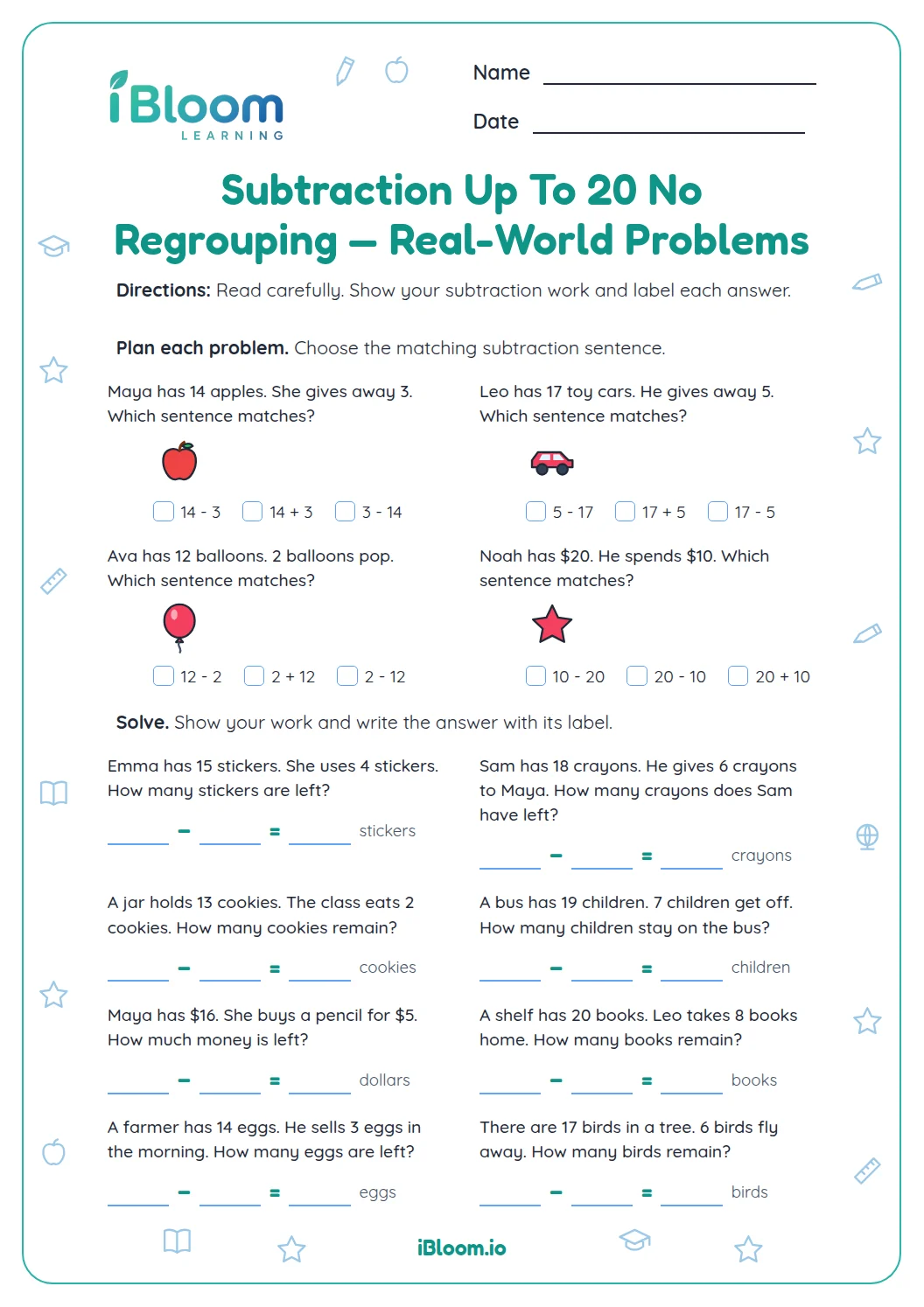
Yes, one Part B story asks children to take 10 pencils from 20. The other starting numbers stay within 20, and the sheet includes subtracting zero and subtracting a number from itself. These examples let children check what subtraction means in several situations while keeping the arithmetic range familiar.
Must my child use the number line for every answer?
No, the number line supports the first guided problem, and children may use mental facts for later questions. If an answer is uncertain, count back again or add the amount taken away to the answer. An addition check should give the starting number in the subtraction.
Why does Part C include addition?
Addition checks whether subtraction has kept track of the whole amount. If 18 − 6 = 12, then 12 + 6 = 18. Part C uses related facts to fill blanks, and Part D asks children to write an addition fact that checks the given subtraction.
How can I check that no regrouping is needed?
Compare the ones digits in each subtraction: the starting ones are enough to take away the second number’s ones. For 18 − 6, eight ones are enough to remove six. For 20 − 10, the task removes one whole ten and leaves one ten, with zero ones throughout.